
The International Trade between ASEAN and Pacific Alliance
Article Sidebar
Main Article Content
Abstract
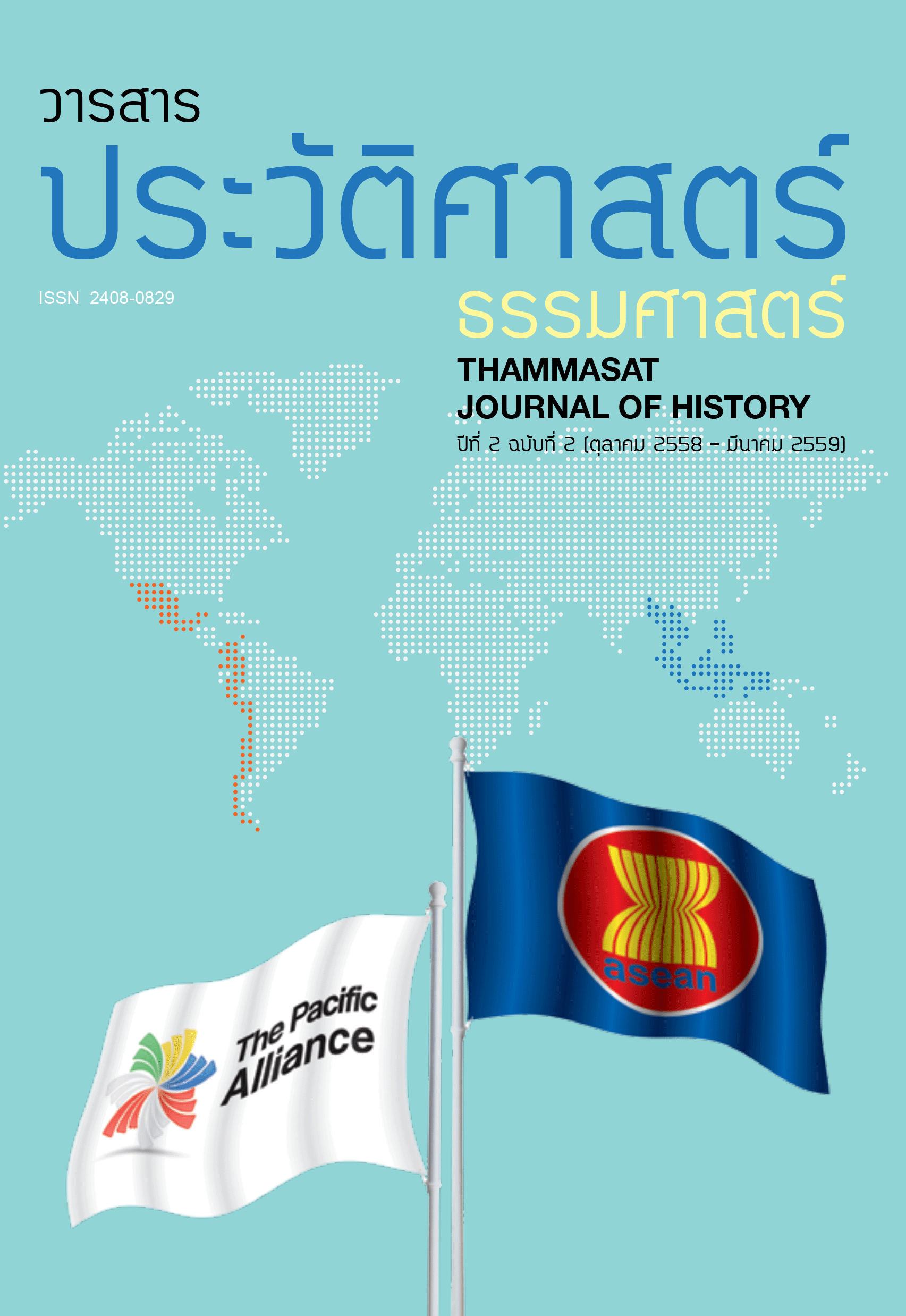
The year 2016 brought much attention to the Pacific Alliance (Alianza del Pacífico), the most recent regional integration initiative in Latin America. Building on the existing free trade agreements, the four members of the Alliance – Chile, Colombia,Mexico and Peru – have set the goal of advancing towards the free movement of goods, services, capitals and people, with the objective of creating an “area of deep integration” to stimulate economic growth and competitiveness. Since its leaders issued the Declaration of Lima on April 28, 2011, the Pacific Alliance has come to be seen as the most promising and dynamic regional group in Latin America. Adopting a free-market approach to regional integration, it is widely perceived as an alternative to the “stagnating” and “increasingly protectionist” Mercosur bloc. In this regard, the Pacific Alliance has led to hopes for a new momentum for regional integration and cooperation in Latin America, as well as to concerns about a possible fracture in the region. The ASEAN, which has long-standing institutionalized links, liberalized trade and good relations with the members of the Pacific Alliance, has welcomed the Alliance as a promising initiative. The evolution of the Alliance could have direct or indirect consequences for the ASEAN’s relations with other regional blocs in Latin America. This article compares trade interactions between six selected ASEAN economies with the Alliance’s members. Interregional engagement between Asia and Latin America has largely taken on a bilateral approach. To deepen interregional trade, it may be best for both regions to transcend bilateral engagements and consider connecting on a wider process, which is on a regional front. In this respect, the ASEAN – Pacific Alliance connection offers an option for linking both regions.
Article Details
Copyright of any paper published in this journal belongs to the Author and All rights reserved.
The opinions expressed in the journal are those of the authors. Department of History, Philosophy and English Literature’s Journal Committee, Editorial Board and Peer Reviewer do not have to agree with those comments.
