
USING ENGOBES FOR THE CERAMIC ART CREATION
-
Keywords:
Engobe, Earthenware, Stonewares, CeramicAbstract
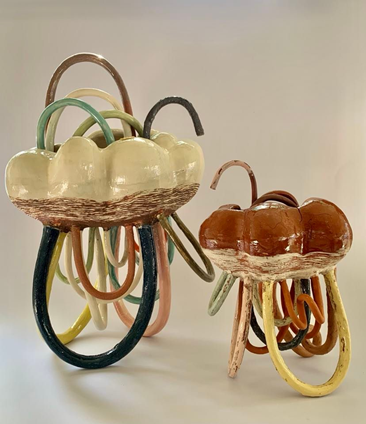
The study titled “Using Engobes for Ceramic Art Creation” aimed 1) to study the proper ratio of the ingredients: engobes and stain colors by testing on earthenwares and stonewares; and 2) to produce ceramic artwork named “Colors of Rainfall” by using the engobe technique to create different patterns and colors.
The experiment was conducted by using raw materials such as kaolin and frit as the ingredients to test for surface adhesion and find the best formula for the right positions, together with the calculation of the equilateral triangle grid and using an electric ceramic kiln to bake the ceramic. It was found that the appropriate ratios are at the 7th point for earthenware and at the 2nd point for stoneware. Then, to create the different color values, color stains were added. The ceramics were experimentally baked at 1,100 and 1,200 degrees Celsius. The final colors obtained from this method were used to create an artistic ceramic sculpture called “Colors of Rainfall.” Inspired by the impression of Mother Nature, the research artist wishes to express uncomplicated beauty through unique symbols on a set of artwork consisting of two pieces.
References
ธาตรี เมืองแก้ว. (2561). การพัฒนาน้ำดินสีเพื่อใช้ในการสร้างสรรค์ผลิตภัณฑ์เครื่องเคลือบดินเผาราชบุรี. Veridian E-Journal,Silpakorn University, 11, 2: 2414 - 2430.
พิพัฒน์ จิตรอารีย์รักษ์. (2555). ประวัติศาสตร์เซรามิกส์. กรุงเทพฯ: มหาวิทยาลัยเทคโนโลยีพระจอมเกล้าพระนครเหนือ.
ไพจิตร อิ่งศิริวัฒน์. (2541). เนื้อดินเซรามิก. กรุงเทพฯ: โอเดียนสโตร์.
_________ (2547). รวมสูตรเคลือบเซรามิกส์ (พิมพ์ครั้งที่ 2). กรุงเทพฯ: โอเดียนสโตร์.
สำนักพิมพ์คติ. (2554). เครื่องปั้นดินเผา. กรุงเทพฯ: พิมพ์ดี.
สุขุมาล สาระเกษตริน. (2564). เครื่องปั้นดินเผาการออกแบบและการปฏิบัติงาน. กรุงเทพฯ: จุฬาลงกรณ์มหาวิทยาลัย.
Downloads
Published
Issue
Section
License
Copyright (c) 2022 Patanasilpa Journal

This work is licensed under a Creative Commons Attribution-NonCommercial-NoDerivatives 4.0 International License.
บทความที่ได้รับการตีพิมพ์เป็นลิขสิทธิ์ของ สบศ.



