DESIRE: THAI CONTEMPORARY PAINTING WITH GENDER NEUTRAL SYMBOL
-
Keywords:
Desire, Thai contemporary painting, Symbol, Gender neutralAbstract
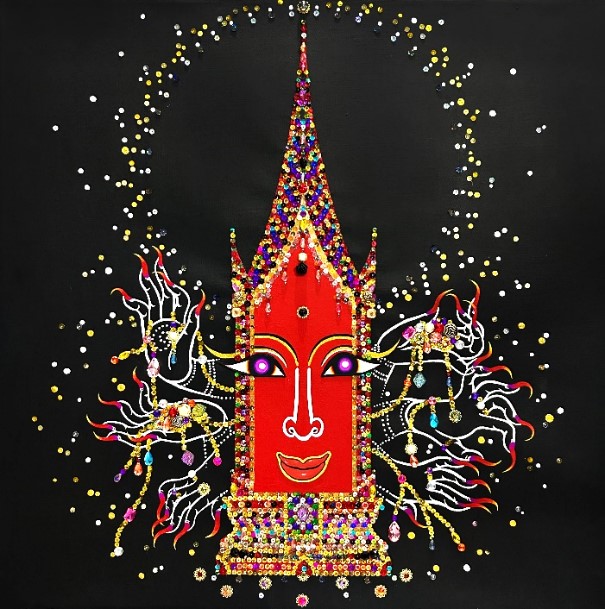
“Tanha” (Passion or Desire) is the principle in Buddhism that deals with human desire and lust. But in the Buddha's biography, an image of desire was created as a voluptuous woman. This caused people in Thai society to misunderstand the meaning of this principle and recognize a picture of desire as a bad woman. So, the creator wanted to create an artwork named “Desire” using the mixed media technique and canvas collage to portray a neutral symbol of desire that was not specific to one gender. In this regard, the information of desire was studied in relation to consuming behavior and gender prejudice in our society. The main aim of this artwork was to enhance people’s understanding of the real principle in Buddhism. The procedure of artwork began with studying the information, creating sketches, and going into the process. The creation resulted in a contemporary painting, presenting a new symbol that is not based on gender. “Realm of Desire” appears in a castle-shaped form with facial features and hands reaching for precious things. This painting shows the realm of desire that invites not just women or men but every human being to indulge, enabling people to understand more religious principles without gender bias as a result of old beliefs and customs.
References
พระพรหมคุณาภรณ์. (2558). พจนานุกรมพุทธศาสตร์ ฉบับประมวลธรรม (พิมพ์ครั้งที่ 30). กรุงเทพฯ: สำนักพิมพ์ผลิธัมม์.
ภิกษุณีรตนธมฺมเจตนา. (2561). “การอธิบายตีความ “ตัณหา” ด้วยหลักเทสนาหาระ”. วารสารปรัชญาปริทรรศน์, 23, 2: 1-9.
ศิรินาถ อุสาพรหม. (2557). วิถีไทยศตวรรษที่ 21 : จากจิตรกรรมไทยสู่ศิลปะเทคนิคผสม. วิทยานิพนธ์ปริญญาศิลปมหาบัณฑิต สาขาทัศนศิลปศึกษา บัณฑิตวิทยาลัย มหาวิทยาลัยศิลปากร.
เสถียรโกเศศ. (2512). เล่าเรื่องในไตรภูมิ. กรุงเทพฯ: โรงพิมพ์อักษรเพชรเกษม.
สำนักข่าว Tnews. (2560). “สมุดภาพไตรภูมิสมัยกรุงธนบุรี” จากพระราชศรัทธาของ พระเจ้าตากสิน อีกหนึ่ง ราชภารกิจบนเส้นทางแห่งการบำเพ็ญเป็นพระโพธิสัตว์. [ออนไลน์]. ค้นเมื่อ 8 มีนาคม 2566. เข้าถึงจาก https://www.tnews.co.th/variety/339810
สำนักข่าว TODAY. (2565). สถิติชี้ “หญิงไทย” เผชิญความรุนแรงสูงติดอันดับโลก สสส.วอนทุกภาคส่วนร่วมมือยุติปัญหา. [ออนไลน์]. ค้นเมื่อ 3 มีนาคม 2566. เข้าถึงจาก https://workpointtoday.com/violence-to-th-women-2022/
สุชาติ บุษย์ชญานนท์. (2563). “การประยุกต์หลักพุทธธรรมในการแก้ปัญหาเศรษฐกิจยุคบริโภคนิยม”. วารสารวนัมฎองแหรกพุทธศาสตรปริทรรศน์, 7, 2: 63-80.
Baramee of Art. (2563). ปัญญา วิจินธนสาร. [ออนไลน์]. ค้นเมื่อ 12 มีนาคม 2566. เข้าถึงจาก https://www.barameeofart.com/artist_detail.php?id=469&lang=
Dhamma for Learner. (2558). พุทธประวัติ ตอน 6 ตรัสรู้. [ออนไลน์]. ค้นเมื่อ 3 มีนาคม 2566 เข้าถึงจาก https://dhammaforlearner.blogspot.com/2015/08/BuhhdaHistoryEp06.html
Jonas Pfeiffer. (2022). Seraph. [online]. Retrieved 20 May 2023. From https://twitter.com/jopfe0815/status/1491171119818506240
Downloads
Published
Issue
Section
License
Copyright (c) 2024 Patanasilpa Journal

This work is licensed under a Creative Commons Attribution-NonCommercial-NoDerivatives 4.0 International License.
บทความที่ได้รับการตีพิมพ์เป็นลิขสิทธิ์ของ สบศ.



