FACTORS CONTRIBUTING TO PROFESSIONAL SUCCESS IN DANCE EDUCATION: A CASE STUDY OF NARUEMAI TRAITHONGYOO
Keywords:
Teacher Characteristics, Performing arts, Naruemai TraithongyooAbstract
This study aimed to analyze the factors contributing to professional success in dance education, focusing on Narumai Traithongyu. The research employed a qualitative research approach and utilized qualitative research methodology. Data were collected through interviews with 23 key informants from six groups, selected through purposive sampling. The research instrument was a semi-structured interview protocol designed to investigate the factors contributing to the professional success of Narumai Traithongyu as a dance educator. The instrument demonstrated content validity indices ranging from 0.80 to 1.00. Data were analyzed using content analysis.
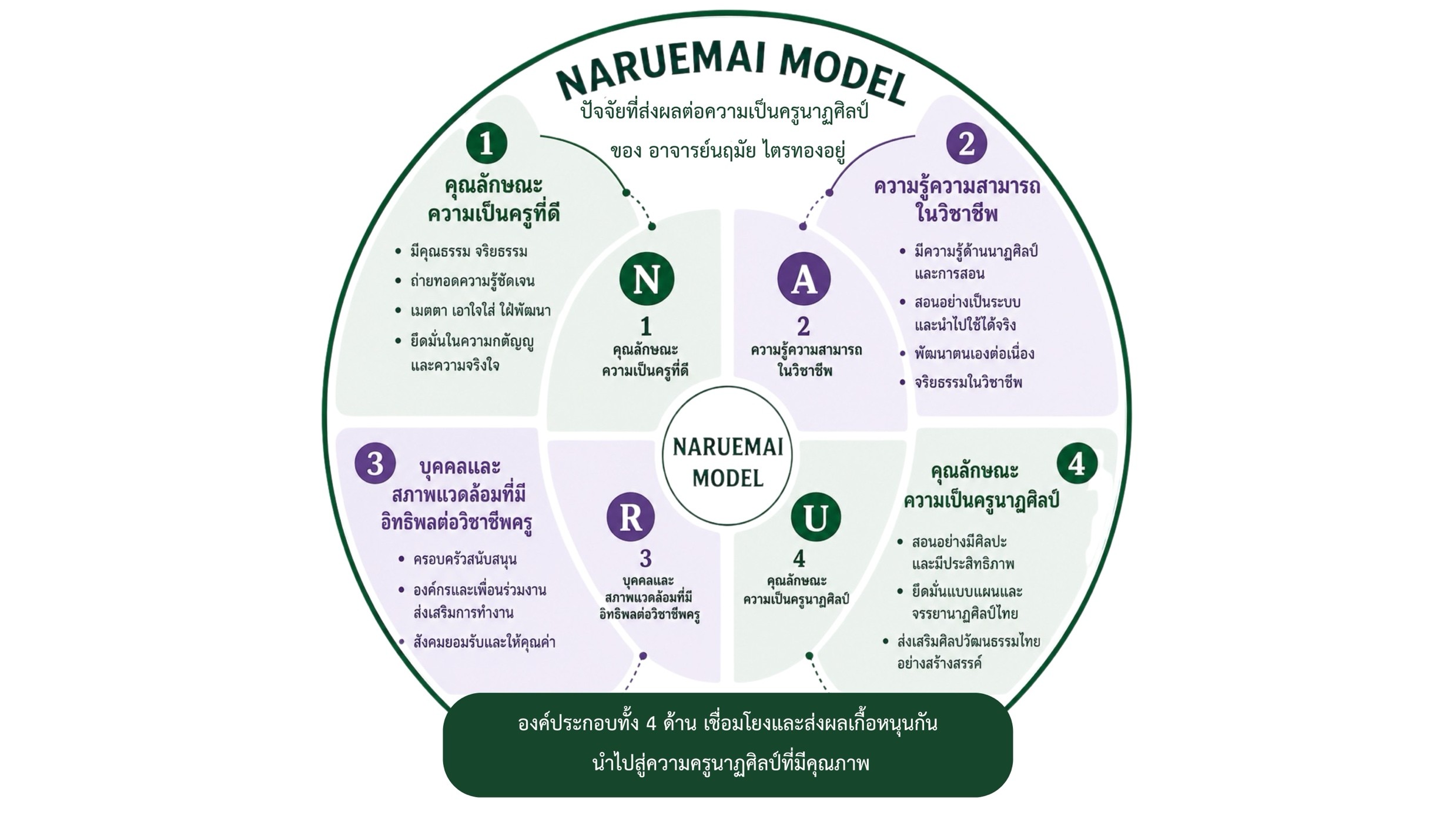
The findings revealed that four key factors contributed to Narumai Traithongyu’s professional success as a dance educator. These factors included: (1) the characteristics of an effective teacher—she possesses a strong teaching spirit, adheres to the principles of compassion and the Four Sublime States of Mind (Brahmavihāra), provides close and equitable care for her students, and instills gratitude and respect for teachers and mentors, particularly renowned masters such as Lamul Yamakupt; (2) professional knowledge and expertise-she demonstrates mastery of both theoretical and practical aspects of dance, possesses extensive tacit knowledge acquired through her experience as a distinguished performing artist, and delivers instruction systematically, emphasizing deep understanding of character interpretation and role analysis while adapting dance movements to suit individual learners’ abilities; (3) personal and environmental factors-she has benefited from support provided by her family, professional networks, and the transmission of knowledge from eminent masters, as well as positive reinforcement derived from her students’ achievements; and (4) the characteristics of a dance educator-she preserves traditional practices while integrating contemporary teaching techniques, employs the teacher–disciple model of instruction, emphasizes demonstration, repetitive practice, and close mentoring with compassion, thereby ensuring the sustainable and graceful transmission of Thai classical dance traditions and their enduring cultural value.
References
กองศิลปวัฒนธรรม กรมศิลปากร. (2563). นาฏศิลป์ไทย: มรดกวัฒนธรรมและการสืบทอด. สำนักพิมพ์กรมศิลปากร.
กิตติศักดิ์ แดงแท้. (2564). ปัจจัยที่ส่งผลต่อความสำเร็จในการจัดการความรู้ของกองบิน 4. [ปริญญานิพนธ์รัฐประศาสนศาสตรมหาบัณฑิต, มหาวิทยาลัยราชภัฏเทพสตรี].
ณัฐธิยา ชื่นสว่าง และอุรารมย์ จันทมาลา. (2565) กลวิธีการรำ บทบาทพระเอกละครรำของอาจารย์เวณิกา บุนนาค ศิลปินแห่งชาติ สาขาศิลปะการแสดง พุทธศักราช 2558. วารสารสังคมศาสตร์เพื่อการพัฒนาท้องถิ่น มหาวิทลัยราชภัฏมหาสารคาม, 6(1), 184-193.
ดนีญา อุทัยสุข. (2561). การวิเคราะห์ปัจจัยที่ส่งผลต่อความสำเร็จในการถ่ายทอดความเป็นคีตศิลปินจากครุคีตศิลปินต้นแบบ: ครูสุรางค์ ดุริยพันธุ์ ศิลปินแห่งชาติ ผู้มีคุณูปการต่อพัฒนาการด้านคีตศิลป์ไทย. วารสารครุศาสตร์, 46(4), 133-152
มนทิรา มะโนรินทร์. (2563). การศึกษาลักษณะความเป็นครูทางด้านนาฏยศิลป์ตะวันตกในระดับอุดมศึกษาของนราพงษ์ จรัสศรี. [ปริญญานิพนธ์ศิลปกรรมศาสตรมหาบัณฑิต, มหาวิทยาลัยศรีนครินทรวิโรฒ].
สุจิตรา พุ่มพึ่ง. (2565). การศึกษาแนวคิดการพัฒนาตนเองสู่การเป็นศิลปินที่ประสบความสำเร็จ: รองศาสตราจารย์ ดร.ศุภชัย จันทร์สุวรรณ์ ศิลปินแห่งชาติ. [ปริญญานิพนธ์ศิลปกรรมศาสตรมหาบัณฑิต, มหาวิทยาลัยศรีนครินทรวิโรฒ].
สุภาวดี โพธิเวชกุล. (2551). การศึกษากลุ่มคำศัพท์ที่ใช้เรียกการปฏิบัติท่ารำที่ไม่ถูกต้อง และวิธีการแก้ไขอวัยวะของร่างกายในการปฏิบัติท่ารำให้ถูกต้องตามมาตรฐานนาฏศิลป์ไทยแบบหลวง. สำนักงานคณะกรรมการวัฒนธรรมแห่งชาติ กระทรวงวัฒนธรรม.
Downloads
Published
Issue
Section
License
Copyright (c) 2026 ฝ่ายผลิตสื่อสิ่งพิมพ์และตำราวิชาการ กองส่งเสริมวิชาการและงานวิจัย สถาบันบัณฑิตพัฒนศิลป์ กระทรวงวัฒนธรรม

This work is licensed under a Creative Commons Attribution-NonCommercial-NoDerivatives 4.0 International License.
บทความที่ได้รับการตีพิมพ์เป็นลิขสิทธิ์ของ สบศ.



