
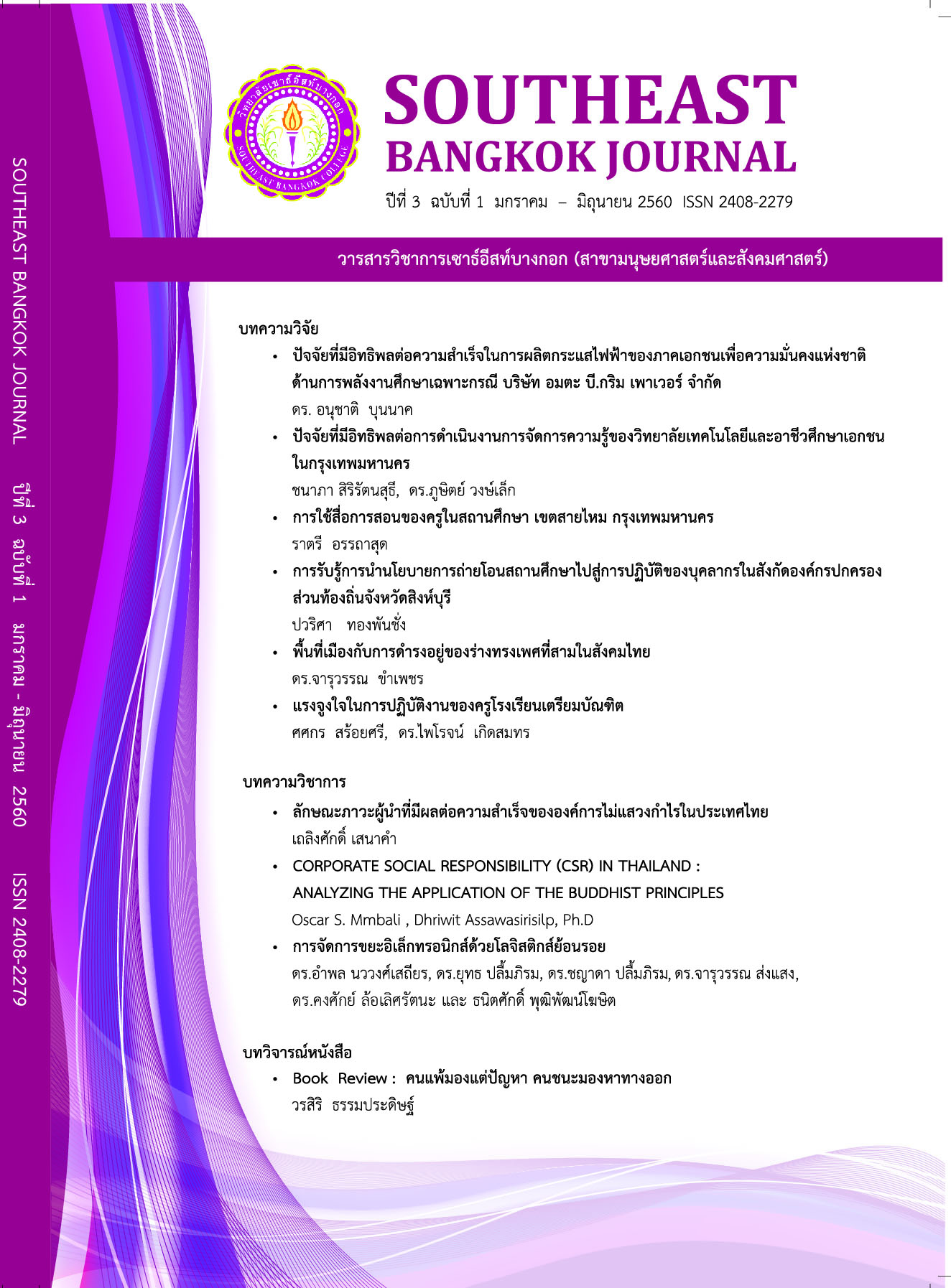
CORPORATE SOCIAL RESPONSIBILITY (CSR) IN THAILAND : ANALYZING THE APPLICATION OF THE BUDDHIST PRINCIPLES
Article Sidebar
Published:
May 30, 2019
Keywords:
Corporate Social Responsibility Buddhist principles Thailand
Main Article Content
Abstract
In realization that regulatory incentives alone cannot achieve corporate social responsibility (CSR), this paper seeks to analyze the application of Buddhist principles to CSR in Thailand. It seeks to find out what major Buddhist principles might, did, or would help shape CSR? To what extent can these principles be applied to CSR in Thailand? The findings of the study show that Buddhist-oriented CSR is embedded in Buddhist socio-religious practices and spirituality. Buddhist values, though less utilized in CSR provide immense resources that are yet to be explored and integrated CSR practices in Thailand.
Article Details
How to Cite
Mmbali, O. S., & Assawasirisilp, D. P. (2019). CORPORATE SOCIAL RESPONSIBILITY (CSR) IN THAILAND : ANALYZING THE APPLICATION OF THE BUDDHIST PRINCIPLES. Southeast Bangkok Journal (Humanities and Social Sciences), 3(1), 98–116. retrieved from https://so05.tci-thaijo.org/index.php/SB_Journal/article/view/191701
Section
Academic Articles
References
Aguilar, M. I. (2006). Sacred rules and secular politics: Religion and rules. International Relations, 20(3), 315-320
Balthip, Q. U., Piriyakoontorn, P.S., & Boddy, J. (2013). Achieving peace and harmony in Life: Thai buddhists living with HIV/AIDS. International Journal of Nursing and Practice, 19(2), 7-14
Bendell, J., & Ng, C. (2009). Characteristics of Asian CSR, Social space. Lien center for social Innovation. Retrieved March 3, 2015, from http://lcsi.smu.edu.sg
Biggsa, D. C., Hall, M., & Stoeckl, N. (2012). The Resilience of formal and Informal tourism enterprises to disasters: Reef tourism in Phuket, Thailand. Journal of Sustainable
Tourism, 20(5), 645-665.
Bodhi, B. (2013). The Noble eightfold path: The Way to end suffering, access to Insight edition. Retrieved August 11, 2015, from http://www.accesstoinsight.org Buracom, P. (2011). The Determinants and distributional effects of public education,health, and welfare spending in Thailand. Asian Affairs: An American Review,38(3), 113-142
Cadge, W., & Sangdhanoo, S. (2005). Thai buddhism in America: an historical and contemporary overview, contemporary buddhism. An Interdisciplinary Joumal, 6(1), 7-35.
Cascaniti, L. (2014). Buddhism and positive psychology. Cross-Cultural Adiancements in Positio Psychology, 9, 101-124
Chalcinthop, N. (2014). Volunteering, dana, and the cultivation of Good People in Thailand. Anthropological Forum: Almal of Social Anthropology and Comparative Sociology,24(4), 596-411.
Chang, O. (2008). Humanistic buoichism and business ethics. Hi Journal of Humanistic Buchem, 4. 181-188
Chancomcaka, S., & Vale, B. (2008). The Buddhist approach to education: An Alternative approach for sustainable education. Asia Pacfic Journal of Education, 25(1).
35-50
Corporate Social Respons bility Asia (CSR ASIA. (2010). Corporate Social Responsibility in Thailand. Retrieved August 11, 2015, from http://www.car-acia.com
Dalton, A M. (2013). Beyond functionality: Religion and international development Canadian Journal of Development Studies, 342), 158-174.
Daniels, P.L. (2010). Climate change, economics and buddhism-part 2: New views and practices for sustainable world economies. Ecological Economics, 69(5), 962-972.
Derezoter, D. (2009) Religious resurgence, human survival, and global religious cocial work Journal of Religion & Spirituality in Social Work: Social Thought, 29(1-2)
63-81.
Elliott, M. (2014). Thai buddhism and well-being: An application of stress process theory.
Mental Health, and Religion & Culture, 17(9), 923-936. Ellor, J. W. (2004). Micro practice and faith-based initiativec: The Role of religious congregations in the social service system. Journal of Religious Gerontology, 16(1-2), 15-55.
Englehart, N. A. (2008). Resource conflict and ethnic peace in Northern Thailand. Asia Paofic Viowpoint, 49(1), 98-110.
Falk, M L (2010). Recovery and buddhist practices in the aftermath of the Teunami in Southern Thailand. Roligion, 40(2), 96-103.
Ferguson, J. M. (2014). Terminally haunted: Aviation shorts, hybrid buddhist practices, and disaster aversion strategies amongst airport workers in Myanmar and Thailand. The Asia Pacific Journal of Anthropology, 15(1), 47-64.
Galbreath, J. (2010). How does corporate social responsibility benefit firms? evidence from Australia. European Business Review, 224) 411-43.
Gellner, D. N. (2001) Buddhism. In Smelzer & P. B. Baltes (Ede international encyclopedia of the social & behavioral sciences (ep.1978-1986) Orford: Pergamon
Ge, N. F. & Petta. (2007). Hebrew and buddhist selves: A constructive postmodern study. Asian philosophy. An International Journal of the Philosophical Traditions of the East. (171). 47-64
Goldewijk. B. K. (2007). Religion and international development policies: An orienting framework In B. K Goldewijk (Eds.) Religion International relations and de clopment
cooperation (pp.523-950). Wegeningen: Wageningen Academic Publishers.
Government Housing Bank (2015). Corporate social responsibility. Retrieved August 11, 2015, from http://www.bankthailand.info/Government Housing-Bank.htm
Hutchison, E., D. (2012). Spirituality, religion, and progressive social movemente: Resources and motivation for social change. Journal of Religion & Spirituality in Social Work: Social Thought, 31(1-2), 105-127.
Kitabunnarat, P. C. Jirapom, P. & Tong, S. (2014). Does religious piety inspire Corporate Social Responsibility (CSR)? evidence from historical religious identification. Applied Economics Letters, 21(16). 1128-1135.
Kornfield, J. (2014). Greater good. Retrieved August 5, 2015, from http://greatergood.berkeley.edu Kovács, G. (2015). Soulful corporations - a velues-based perspective on corporate social responsibility. Journal of Management. Spintuality & Religion, 12(2). 178-181.
MacLeod, M. (2011). Religion and the rise of global corporate social responsibility The Review of Faith & International Affairs, 931. 29-36.
Marcel E. K. Schur, S. & Watke, H . (2012). Life is uncertain death is certain, buddhism and palliative care. Journal of Poin and Symptom Management 442) 307-312.
McCano, D. (2004). Buddhism, democracy and identity in Thaiand Democratkotion 11(4). 155-170
McGhee, M. (2002). Editorial: Greeks. relations and western buddhiste: Christianity, buddhism and social responsibility. Contemporary Buddhism, (32). 99-109.
Mylek, L. & Nel, P. (2010). Religion and relief the role of religion in mobilizing civil society against global poverty. Otitut Now Zealand Journal of Social Sciences Online
5(2, 81-97
Numkanison, S. (2002). Business and buddhist ethics. The Chulalonkhon Journal of Buddhist studies (11 99-57).
Office of the Prime Minister. (2005). King Bhumibol and His Enlightened approach to teaching, Kingdom of Thailand. Retrieved August 5, 2015, from http://thailand.pr.go.th/ebook/king/dhamma.html
Ovrelid, B. (2008). The Cultivation of moral character: A Buddhist challenge to social workers. Ethics and Social Welfare. 28). 243-261.
Parbatesh, P.K. Paik. Y. & Cullen, J.B. (2009). Religious groups and work values a focus on Buddhism, Christianity. Hinduism, and Islam. International Journal of Cross Cultural Management, 9(1), 51-57.
Patrick. C. KL. (2012). Three treasures of Buddhism. Culture & Religion Review Journal (3). 66-72.
Phoenix, B. (2014). Promoting resilience and recovery in a buddhist mental health support group. Issues in Montal Health Nursing, 55(4), 257-264.
Pimpa, N. T., Moore, B., Supachalatai, T. S., Wayakone, S. D., & Gregory, S. (2014). The Thai way of corporate social responsibility: Case of mining industry. Retrieved
August 11, 2015, from http://sydney.edu.au
Plaminte, S. (2011). Buddhism and Thei society. Retrieved August 7, 2015, from http://www.budess.org
Rajanakiom, N. (2012). Bamining corporate social responsibility in Thailand: A view from Thai companies. (Doctoral Dissertation Knoxville, University of Tennessee
Rarick, C.A. (2015). Enlightened management. An analyse of buddhat procopts applied to managerial activity. Retrieved August 11, 2015, from http//www.ibm.org
Rees, d. A. (2011). Religion in international politics and do.clopment The Word Bank and Faith Institutions. Massachusetts: Edward Elger.
Rodloytuk, P. (2007). Buddhist participatory communication for rural development The Journal of International Communication, 13(1), 119-136.
Russell, E., Phillips, Cheng, C. M, Pargement, K L Oemis C. Colvin, S. D. Abart, A N.,Dunn, M. W., & Reed, A S. (2009). Spiritual coping in American buddhists: An exploratory study. The International Journal for the Psychology of Religion,194) 231-245
Schaaf, R. (2010). Financial efficiency or relational harmony Microfinance through community groups in Northeast Thailand. Progress in Development Studies, 2012)
115-29
Schedineck, B. (2007). Buddhist life stories. Contemporary Buddham: An Interdisciplinary Journal 001). 57-63.
Sheravanichiul, A. (2006). Self-Sacrifice of the bodhisatte in the Petru Jätaka. Relgion Compass. (2). 769-787.
Scontornwong, S. (2006). Improving rural livelihood through CBNRM: A Case of self organization in community mangrove management in Thailand. In S. Mahanty and J. F. Michael (Eds.), Hanging in the balance: Equity in community-based natural resource management in Asia (pp.182-199) Honolulu: East-West
Center. Suen, H., Cheung, S-o., & Mondejar, R. (2007). Managing ethical behavior in construction organizations in Asia: How do the teachings of confucianiem. Tasiem and Buddhism and globalization influence ethics management International Journal of Project Management 25(3). 257-265.
Thangthong, K. (2012). A Spiritual dimension and environmental education: Buddhism and environmental crisis. Procedia - Social and Behavioral Sciences (46)
5063-5068
Van Daele, W. (2013) igniting food assemblages in Sri Lanka: Ritual cooking to regenerate the World and interrelations. Contributions to Indian Sociology, 471) 35-60
Vriens and Partners PTE Ltd. (2015). Asia pacji hestment climate index 2014 Retrieved August 11, 2015, from http://www.vienspartners.com/
Walter, P. (2007). Activist forest monks, adult learning and the buddhist environmental movement in Thailand. International Joumol of Lifelong Education, 26(3). 329-345.
Yamnill, S., McLean, G. N., & Singsuriye, P. (2008). The role of a religious institution in HRD: the case of Wat temple) Panyenantaram, Thailand. Human Resource Development International, 13(3). 225-235.
Balthip, Q. U., Piriyakoontorn, P.S., & Boddy, J. (2013). Achieving peace and harmony in Life: Thai buddhists living with HIV/AIDS. International Journal of Nursing and Practice, 19(2), 7-14
Bendell, J., & Ng, C. (2009). Characteristics of Asian CSR, Social space. Lien center for social Innovation. Retrieved March 3, 2015, from http://lcsi.smu.edu.sg
Biggsa, D. C., Hall, M., & Stoeckl, N. (2012). The Resilience of formal and Informal tourism enterprises to disasters: Reef tourism in Phuket, Thailand. Journal of Sustainable
Tourism, 20(5), 645-665.
Bodhi, B. (2013). The Noble eightfold path: The Way to end suffering, access to Insight edition. Retrieved August 11, 2015, from http://www.accesstoinsight.org Buracom, P. (2011). The Determinants and distributional effects of public education,health, and welfare spending in Thailand. Asian Affairs: An American Review,38(3), 113-142
Cadge, W., & Sangdhanoo, S. (2005). Thai buddhism in America: an historical and contemporary overview, contemporary buddhism. An Interdisciplinary Joumal, 6(1), 7-35.
Cascaniti, L. (2014). Buddhism and positive psychology. Cross-Cultural Adiancements in Positio Psychology, 9, 101-124
Chalcinthop, N. (2014). Volunteering, dana, and the cultivation of Good People in Thailand. Anthropological Forum: Almal of Social Anthropology and Comparative Sociology,24(4), 596-411.
Chang, O. (2008). Humanistic buoichism and business ethics. Hi Journal of Humanistic Buchem, 4. 181-188
Chancomcaka, S., & Vale, B. (2008). The Buddhist approach to education: An Alternative approach for sustainable education. Asia Pacfic Journal of Education, 25(1).
35-50
Corporate Social Respons bility Asia (CSR ASIA. (2010). Corporate Social Responsibility in Thailand. Retrieved August 11, 2015, from http://www.car-acia.com
Dalton, A M. (2013). Beyond functionality: Religion and international development Canadian Journal of Development Studies, 342), 158-174.
Daniels, P.L. (2010). Climate change, economics and buddhism-part 2: New views and practices for sustainable world economies. Ecological Economics, 69(5), 962-972.
Derezoter, D. (2009) Religious resurgence, human survival, and global religious cocial work Journal of Religion & Spirituality in Social Work: Social Thought, 29(1-2)
63-81.
Elliott, M. (2014). Thai buddhism and well-being: An application of stress process theory.
Mental Health, and Religion & Culture, 17(9), 923-936. Ellor, J. W. (2004). Micro practice and faith-based initiativec: The Role of religious congregations in the social service system. Journal of Religious Gerontology, 16(1-2), 15-55.
Englehart, N. A. (2008). Resource conflict and ethnic peace in Northern Thailand. Asia Paofic Viowpoint, 49(1), 98-110.
Falk, M L (2010). Recovery and buddhist practices in the aftermath of the Teunami in Southern Thailand. Roligion, 40(2), 96-103.
Ferguson, J. M. (2014). Terminally haunted: Aviation shorts, hybrid buddhist practices, and disaster aversion strategies amongst airport workers in Myanmar and Thailand. The Asia Pacific Journal of Anthropology, 15(1), 47-64.
Galbreath, J. (2010). How does corporate social responsibility benefit firms? evidence from Australia. European Business Review, 224) 411-43.
Gellner, D. N. (2001) Buddhism. In Smelzer & P. B. Baltes (Ede international encyclopedia of the social & behavioral sciences (ep.1978-1986) Orford: Pergamon
Ge, N. F. & Petta. (2007). Hebrew and buddhist selves: A constructive postmodern study. Asian philosophy. An International Journal of the Philosophical Traditions of the East. (171). 47-64
Goldewijk. B. K. (2007). Religion and international development policies: An orienting framework In B. K Goldewijk (Eds.) Religion International relations and de clopment
cooperation (pp.523-950). Wegeningen: Wageningen Academic Publishers.
Government Housing Bank (2015). Corporate social responsibility. Retrieved August 11, 2015, from http://www.bankthailand.info/Government Housing-Bank.htm
Hutchison, E., D. (2012). Spirituality, religion, and progressive social movemente: Resources and motivation for social change. Journal of Religion & Spirituality in Social Work: Social Thought, 31(1-2), 105-127.
Kitabunnarat, P. C. Jirapom, P. & Tong, S. (2014). Does religious piety inspire Corporate Social Responsibility (CSR)? evidence from historical religious identification. Applied Economics Letters, 21(16). 1128-1135.
Kornfield, J. (2014). Greater good. Retrieved August 5, 2015, from http://greatergood.berkeley.edu Kovács, G. (2015). Soulful corporations - a velues-based perspective on corporate social responsibility. Journal of Management. Spintuality & Religion, 12(2). 178-181.
MacLeod, M. (2011). Religion and the rise of global corporate social responsibility The Review of Faith & International Affairs, 931. 29-36.
Marcel E. K. Schur, S. & Watke, H . (2012). Life is uncertain death is certain, buddhism and palliative care. Journal of Poin and Symptom Management 442) 307-312.
McCano, D. (2004). Buddhism, democracy and identity in Thaiand Democratkotion 11(4). 155-170
McGhee, M. (2002). Editorial: Greeks. relations and western buddhiste: Christianity, buddhism and social responsibility. Contemporary Buddhism, (32). 99-109.
Mylek, L. & Nel, P. (2010). Religion and relief the role of religion in mobilizing civil society against global poverty. Otitut Now Zealand Journal of Social Sciences Online
5(2, 81-97
Numkanison, S. (2002). Business and buddhist ethics. The Chulalonkhon Journal of Buddhist studies (11 99-57).
Office of the Prime Minister. (2005). King Bhumibol and His Enlightened approach to teaching, Kingdom of Thailand. Retrieved August 5, 2015, from http://thailand.pr.go.th/ebook/king/dhamma.html
Ovrelid, B. (2008). The Cultivation of moral character: A Buddhist challenge to social workers. Ethics and Social Welfare. 28). 243-261.
Parbatesh, P.K. Paik. Y. & Cullen, J.B. (2009). Religious groups and work values a focus on Buddhism, Christianity. Hinduism, and Islam. International Journal of Cross Cultural Management, 9(1), 51-57.
Patrick. C. KL. (2012). Three treasures of Buddhism. Culture & Religion Review Journal (3). 66-72.
Phoenix, B. (2014). Promoting resilience and recovery in a buddhist mental health support group. Issues in Montal Health Nursing, 55(4), 257-264.
Pimpa, N. T., Moore, B., Supachalatai, T. S., Wayakone, S. D., & Gregory, S. (2014). The Thai way of corporate social responsibility: Case of mining industry. Retrieved
August 11, 2015, from http://sydney.edu.au
Plaminte, S. (2011). Buddhism and Thei society. Retrieved August 7, 2015, from http://www.budess.org
Rajanakiom, N. (2012). Bamining corporate social responsibility in Thailand: A view from Thai companies. (Doctoral Dissertation Knoxville, University of Tennessee
Rarick, C.A. (2015). Enlightened management. An analyse of buddhat procopts applied to managerial activity. Retrieved August 11, 2015, from http//www.ibm.org
Rees, d. A. (2011). Religion in international politics and do.clopment The Word Bank and Faith Institutions. Massachusetts: Edward Elger.
Rodloytuk, P. (2007). Buddhist participatory communication for rural development The Journal of International Communication, 13(1), 119-136.
Russell, E., Phillips, Cheng, C. M, Pargement, K L Oemis C. Colvin, S. D. Abart, A N.,Dunn, M. W., & Reed, A S. (2009). Spiritual coping in American buddhists: An exploratory study. The International Journal for the Psychology of Religion,194) 231-245
Schaaf, R. (2010). Financial efficiency or relational harmony Microfinance through community groups in Northeast Thailand. Progress in Development Studies, 2012)
115-29
Schedineck, B. (2007). Buddhist life stories. Contemporary Buddham: An Interdisciplinary Journal 001). 57-63.
Sheravanichiul, A. (2006). Self-Sacrifice of the bodhisatte in the Petru Jätaka. Relgion Compass. (2). 769-787.
Scontornwong, S. (2006). Improving rural livelihood through CBNRM: A Case of self organization in community mangrove management in Thailand. In S. Mahanty and J. F. Michael (Eds.), Hanging in the balance: Equity in community-based natural resource management in Asia (pp.182-199) Honolulu: East-West
Center. Suen, H., Cheung, S-o., & Mondejar, R. (2007). Managing ethical behavior in construction organizations in Asia: How do the teachings of confucianiem. Tasiem and Buddhism and globalization influence ethics management International Journal of Project Management 25(3). 257-265.
Thangthong, K. (2012). A Spiritual dimension and environmental education: Buddhism and environmental crisis. Procedia - Social and Behavioral Sciences (46)
5063-5068
Van Daele, W. (2013) igniting food assemblages in Sri Lanka: Ritual cooking to regenerate the World and interrelations. Contributions to Indian Sociology, 471) 35-60
Vriens and Partners PTE Ltd. (2015). Asia pacji hestment climate index 2014 Retrieved August 11, 2015, from http://www.vienspartners.com/
Walter, P. (2007). Activist forest monks, adult learning and the buddhist environmental movement in Thailand. International Joumol of Lifelong Education, 26(3). 329-345.
Yamnill, S., McLean, G. N., & Singsuriye, P. (2008). The role of a religious institution in HRD: the case of Wat temple) Panyenantaram, Thailand. Human Resource Development International, 13(3). 225-235.
