
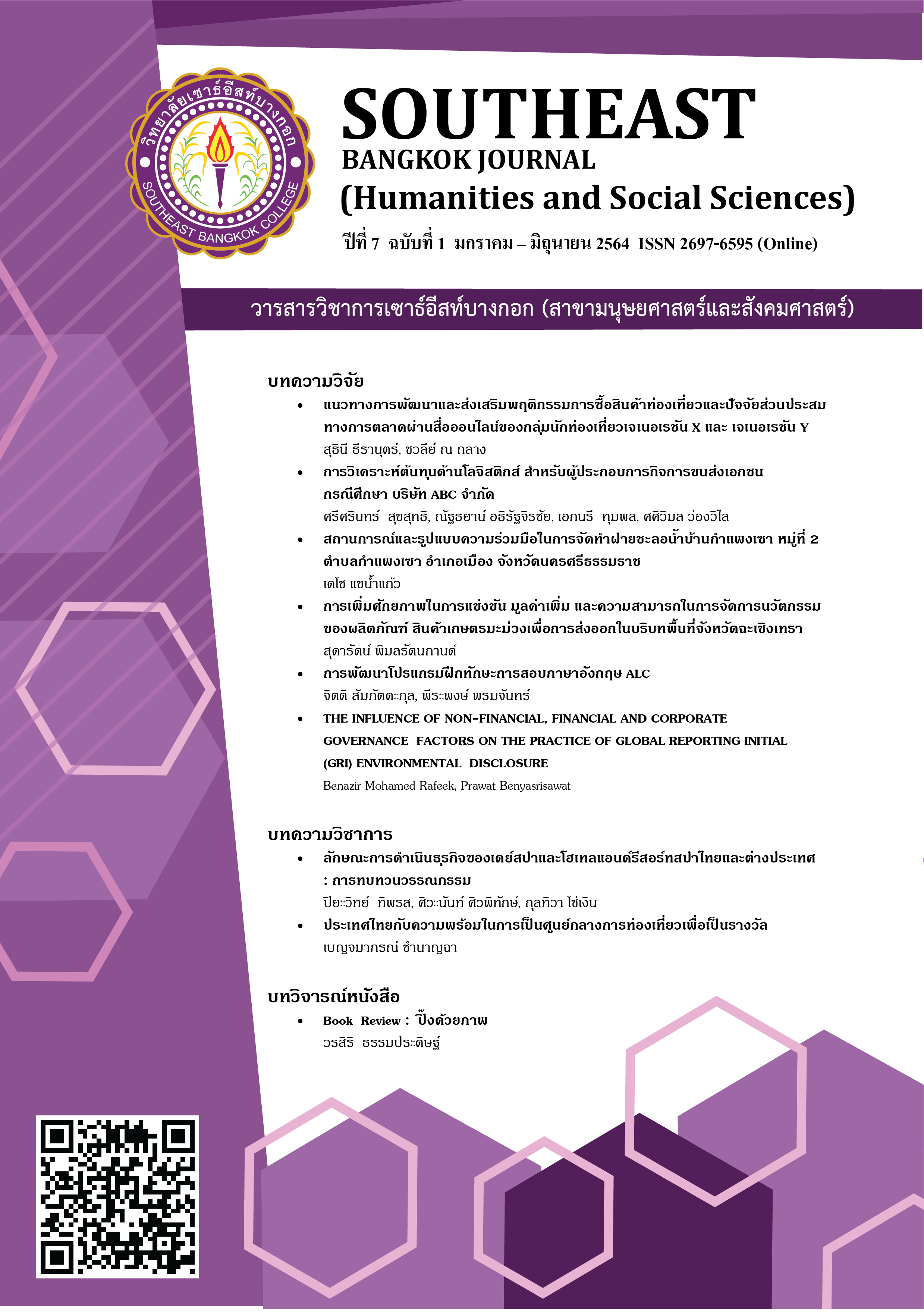
GUIDELINES FOR THE DEVELOPMENT AND PROMOTION OF TOURISM PRODUCT BUYING BEHAVIOR AND MARKETING MIX FACTORS THROUGH ONLINE MEDIA OF GENERATION X AND GENERATION Y TOURISTS.
Article Sidebar
Main Article Content
Abstract
The objectives of this research were to 1) investigate the marketing mixed factors of Thailand’s tourism products through online media used by tourism business operators. 2) Investigate the factors affecting the decision to purchase Thai tourism products through online mediaม and 3) propose guidelines for developing and promoting Thai tourism products through the online media of the generation X and Y tourists. The research design was a mixed methods approach using in-depth interviews with tourism entrepreneurs and questionnaires to collect data from a sample group of 384 Thai and foreign tourists. The data obtained from the questionnaires were analyzed using frequency, percentage, mean, and standard deviation. The results of the research revealed that Generation X and Y travelers bought air tickets through online media the most, followed by hotels and accommodation. Most of them directly bought tourism products through the website of the travel service providers because of its convenience. In addition, the marketing mixed factors influenced on purchasing decision (9P's) through online media was at the highest level, in terms of distribution channels, followed by process, product organization, marketing promotion, perception, partners/alliance, staff, and prices respectively. Finally, the research proposed that entrepreneurs should promote distribution channels to be more efficient because it is a factor affecting the decision to buy tourism products online. Moreover, tourism products and employees should be developed to meet standards superior to competitors to be able to set a selling price to be more competitive and attractive to tourists.
Article Details
References
พิมลพรรณ ณ สมบูรณ์. (2558). คุณลักษณะเว็บไซต์ การสื่อสารแบบปากต่อปากอิเล็กทรอนิกส์ และภาพลักษณ์สถานที่ท่องเที่ยวที่ส่งผลต่อความตั้งใจเลือกซื้อแพ็กเกจท่องเที่ยวออนไลน์ของคนวัยทำงานในกรุงเทพมหานคร. (การค้นคว้าอิสระบริหารธุรกิจมหาบัณฑิต, มหาวิทยาลัยกรุงเทพ).
ละเอียด ศิลาน้อย. (2558). วิธีวิทยาการกำหนดกลุ่มตัวอย่างเพื่อการวิจัยเชิงปริมาณ (พิมพ์ครั้งที่ 2). กรุงเทพฯ: บางกอกบลูพริ้นต์.
วฤตดา วรอาคม. (2557). 5 อินไซต์เจเนอเรชันซี. สืบค้น 7 สิงหาคม 2563, จากhttp://www.bangkokbiznews.com/blog/detail/591770
ศิริวรรณ เสรีรัตน์ และคณะ. (2546). การบริหารการตลาดยุคใหม่. กรุงเทพฯ: บริษัท ธีระฟิล์ม และไซเท็กซ์ จำกัด.
สกุลศรี ศรีสารคาม. (2559). แนวทางการศึกษาและเครื่องมือการมอนิเตอร์สื่อออนไลน์. สืบค้น 13 สิงหาคม 2563, จาก https://www.researchgate.net/publication/314255395
สำนักงานสถิติแห่งชาติ. (2561). สรุปสถานการณ์ท่องเที่ยวภายในประเทศเป็นรายจังหวัด พ.ศ. 2561. สืบค้น 8 สิงหาคม 2563, จากhttp://statbbi.nso.go.th/staticreport/page/sector/th/17.aspx
สุประภา สมนักพงษ์. (2560). แนวโน้มและการตลาดการท่องเที่ยว 4.0 ประเทศไทย. วารสารวิชาการ Veridian E-Journal สาขามนุษยศาสตร์ สังคมศาสตร์ และศิลปะ, 10(3), 2055-2068.
เสรี วงษ์มณฑา. (2554). กลยุทธ์การตลาด วางแผนการตลาด. กรุงเทพฯ: ดวงกมลสมัย.
Blackwell, R., Miniard, P., & Engel, J. (2006). Consumer Behavior (10th ed.). Ohio: Thomson South-Western.
Bleier, A., & Eisenbeiss, M. (2015). The importance of trust for personalized online advertising. Journal of Retailing, 91(3), 390-409.
Kotler, P. (2003). Marketing Management (11th ed.). Upper Saddle River,NJ: Person Prentiec-Hall.
Park, S., Fesenmaier, D. R., & Zach, F. (2016). Online purchase of travel products. Travel and Tourism Research Association: Advancing Tourism Research Globally. In 2015 TTRA international conference. Retrieved June 19, 2019 from https://scholarworks.umass.edu/ttra/2010/Oral/19/
Pereira, H. G., Salgueiro, M., & Rita, P. (2016). Online purchase determinants of loyalty: The mediating effect of satisfaction in tourism. Journal of Retailing consumer Services, 30, 279-291.
