Principals’ Leadership Styles and Teacher Retention in Secondary Schools in Ibadan Metropolis, Nigeria: A Mixed-Methods Study
DOI:
https://doi.org/10.57260/csdj.2026.287346Keywords:
Leadership styles, Teacher retention, Transformational leadership, Secondary schools, NigeriaAbstract
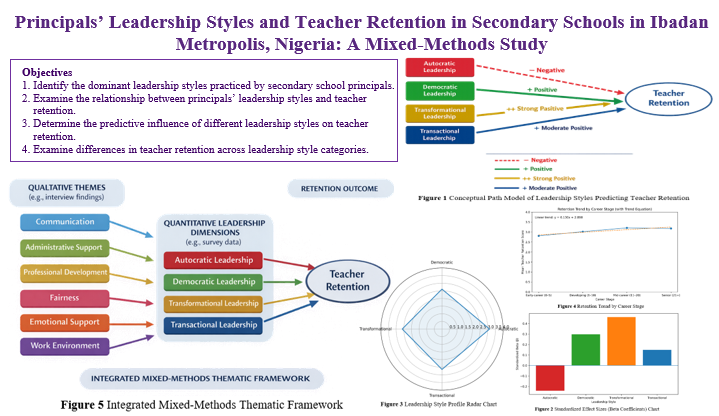
Teacher retention remains a major challenge in secondary schools in Nigeria. This study investigated the influence of principals’ leadership styles on teacher retention in public secondary schools in Ibadan Metropolis, Oyo State. A mixed-methods research design combining descriptive survey and qualitative interviews was adopted. Data were collected from 420 participants (20 principals and 400 teachers) selected from 20 secondary schools across five Local Government Areas using a multi-stage sampling technique involving purposive, stratified, and simple random sampling. Quantitative data were analysed using descriptive statistics, Pearson correlation, multiple regression, and one-way ANOVA with SPSS. Results indicated that transformational leadership (β = 0.462) was the strongest predictor of teacher retention, followed by democratic leadership (β = 0.298) and transactional leadership (β = 0.149), while autocratic leadership negatively predicted retention (β = −0.241). Leadership styles explained 62.7% of the variance in teacher retention (R² = 0.627). Qualitative findings further highlighted communication, administrative support, fairness, and professional development as key factors influencing teacher retention. The study concludes that transformational and democratic leadership practices significantly enhance teacher retention in Nigerian secondary schools.
Downloads
References
Adelodun, A. A., & Ejide, R. E. (2024). Effects of biological responsibilities on the career achievement of female academic staff in oyo metropolis. Journal of Educational Studies Trends and Practice, 5(9), 135-146. http://ssaapublications.com/index.php/sjestp/article/view/263
Agboola, B., & Offong, D. E. (2018). Occupational Incentives and Teacher Retention in Private Secondary Schools in Akwa Ibom State, Nigeria. Journal of Teacher Education and Educators, 7(3), 263-277. https://izlik.org/JA66MG53DH
Ameh, E., Efa, F. A., Omini, E. E., & Inah, R. A. (2024). Work-Related Variables and Teacher Retention in Secondary Schools in Ikom Local Government Area of Cross River State, Nigeria. African Journal of Educational Management, Teaching and Entrepreneurship Studies, 13(3), 1-14. https://ajemates.org/index.php/ajemates/article/view/601
Bahat, I., & Isık, M. (2023). The Relationship Between Teachers’ School Happiness, Organizational Commitment, and Self-Efficacy. Insan ve Sosyal Bilimler Dergisi, 6, 279-308. https://doi.org/10.53048/johass.1354337
Bass, B. M. (1985). Leadership and Performance beyond Expectations. Free Press; Collier Macmillan.
Bennell, P. (2023). How well paid are primary school teachers in Sub-Saharan Africa? A review of recent evidence. International Journal of Educational Development, 98, 102755. https://doi.org/10.1016/j.ijedudev.2023.102755
Cheng, Y. C. (1991). Organizational Environment in Schools: Commitment, Control, Disengagement, and Headless. Educ. Adm. Q, 27(4), 481–505, https://doi.org/10.1177/0013161x91027004003.
Darling-Hammond, L. (1997). School Reform at the Crossroads: Confronting the Central Issues of Teaching. Educational Policy, 11(2), 151-166. https://doi.org/10.1177/0895904897011002002
Darling-Hammond, L., Chung, R., & Frelow, F. (2002). Variation in Teacher Preparation: How Well Do Different Pathways Prepare Teachers to Teach? How Well Do Different Pathways Prepare Teachers to Teach?. Journal of Teacher Education, 53(4), 286-302. https://doi.org/10.1177/0022487102053004002
Demir, H., & Zincirli, M. (2021). The Relationship between Teachers’ Perceptions of Organizational Justice and Authentic Leadership and Their Levels of Organizational Happiness. OPUS International Journal of Society Researches, 17(37), 3976-3998. https://doi.org/10.26466/opus.877220
Dursun, I. E., & Orikun Osman Bilgwar, O. O. (2022). The Effect of Principals’ Leadership Styles on Teacher Performance and Organisational Happiness. International Journal on Educational Administration and Leadership: Theory and Practice, 1(1), 12–25. https://doi.org/10.52380/ijedal.2022.1.1.7
Eyal, O., & Roth, G. (2011). Principals’ Leadership and Teachers’ Motivation: Self-Determination Theory Analysis. Journal of Educational Administration, 49(3), 256-275. http://doi.org/10.1108/09578231111129055
Han, J., & Yin, H. (2016). Teacher motivation: Definition, research development and implications for teachers. Cogent Education, 3(1), 1217819. https://doi.org/10.1080/2331186X.2016.1217819
Ingersoll, R. M. (2001). Teacher Turnover and Teacher Shortages: An Organizational Analysis. American Educational Research Journal, 38(3), 499-534. https://doi.org/10.3102/00028312038003499
Kaufmann, E. (2023). Lens model studies: Revealing teachers’ judgements for teacher education. Journal of Education for Teaching, 49(2), 236–251. https://doi.org/10.1080/02607476.2022.2061336
Manabete, S. S. (2022). Migration, Brain Drain and Attrition: Bane of Nigeria’s Developmental Strides. BW Academic Journal, 1(1), 10. https://www.bwjournal.org/index.php/bsjournal/article/view/798
Meyer, J. and Allen, N. (1997). Commitment in the Workplace: Theory, Research, and Application. Sage Publications, Thousand Oaks.
McInerney, D., & Putwain, D. (2017). Developmental and educational psychology for teachers: An applied approach. (2nd ed.). UK: Taylor & Francis.
Mendes, F., Delgado, C., & Brocardo, J. (2022). Challenges faced by Preservice Teachers in Planning and Exploring Tasks that Promote Mathematical Reasoning. Capa, 24(4), 147-182. https://doi.org/10.17648/acta.scientiae.7123
Olabode, O. (2024). Democracy, Good Governance And Leadership Challenges: A Perspective For National Cohesion And Development In Nigeria. International Journal of Management Studies and Social Science Research, 6(6), 250-262. https://doi.org/10.56293/IJMSSSR.2024.5332
See, B. H., Morris, R., Gorard, S., & El Soufi, N. (2020). What works in attracting and retaining teachers in challenging schools and areas?. Oxford Review of Education, 46(6), 678–697. https://doi.org/10.1080/03054985.2020.1775566
Victor, A. K., Kolade, O. B., Abiodun, A. E., & Oluwasola, I. T. (2025). Leader Characteristics and Teacher Productivity in Public Secondary Schools in Southwest, Nigeria. International Journal of Academic Research in Business, Arts & Science (IJARBAS), 7(12), 291–303. https://doi.org/10.5281/zenodo.18119901
Downloads
Additional Files
Published
How to Cite
Issue
Section
Categories
License
Copyright (c) 2026 Community and Social Development Journal

This work is licensed under a Creative Commons Attribution-NonCommercial-NoDerivatives 4.0 International License.