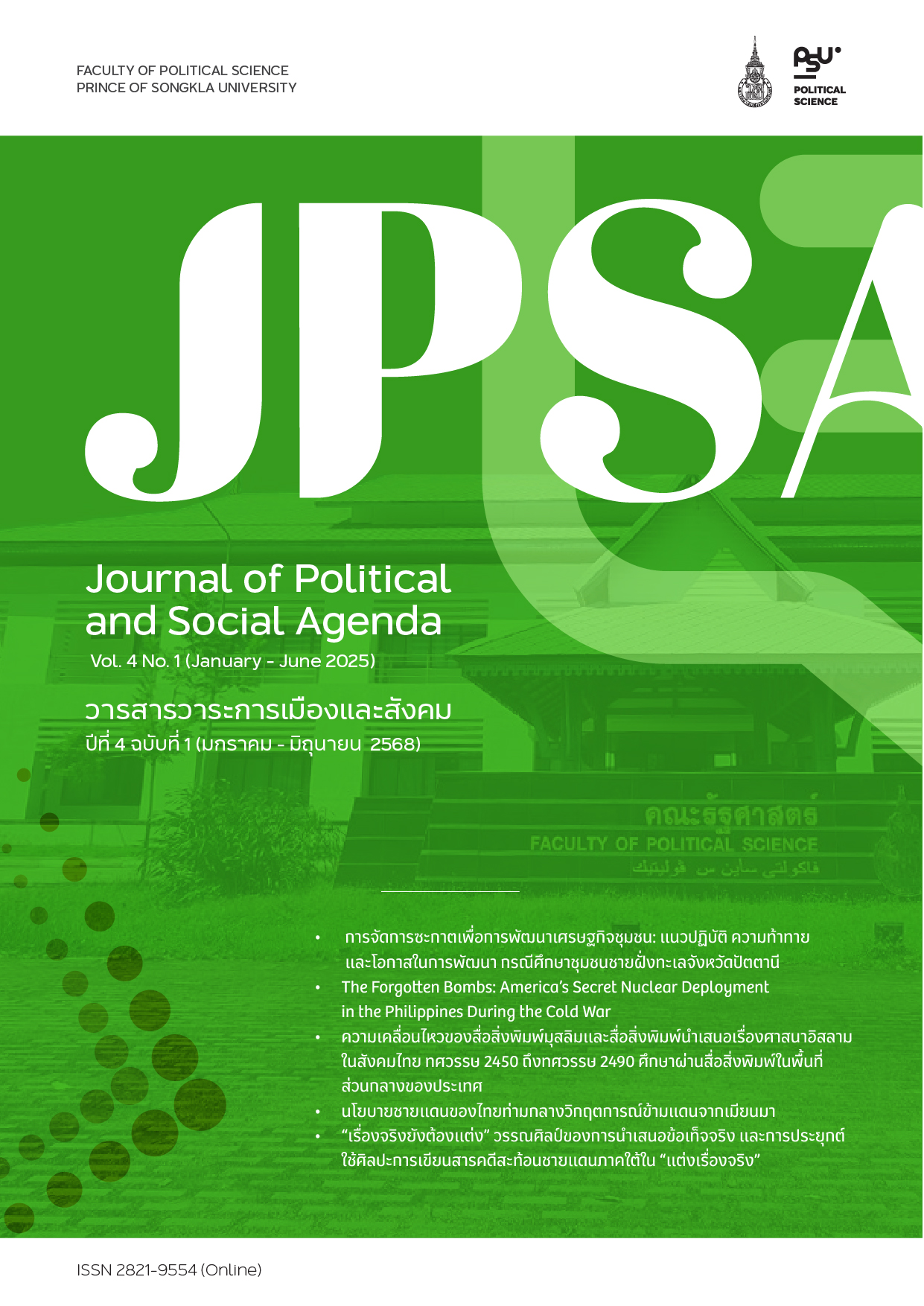
นโยบายชายแดนของไทยท่ามกลางวิกฤตการณ์ข้ามแดนจากเมียนมา
Article Sidebar
Main Article Content
บทคัดย่อ
บทความนี้มีวัตถุประสงค์หลักเพื่อวิเคราะห์นโยบายชายแดนของประเทศไทยในบริบทที่เผชิญผลกระทบจากวิกฤตการณ์ในประเทศเมียนมา ภายหลังการรัฐประหารเมื่อ พ.ศ. 2564 ซึ่งก่อให้เกิดปัญหาข้ามพรมแดนในหลายมิติ ทั้งด้านมนุษยธรรม ความมั่นคง และภัยคุกคามข้ามชาติ โดยใช้ระเบียบวิธีการศึกษาเชิงคุณภาพผ่านการวิเคราะห์ข้อมูลทุติยภูมิจากเอกสารทางวิชาการ รายงานของหน่วยงานที่เกี่ยวข้อง องค์กรพัฒนาเอกชน และสื่อมวลชน ครอบคลุมช่วงเวลาระหว่าง พ.ศ. 2564–2567 โดยเน้นพื้นที่ชายแดนไทย–เมียนมา ผลการศึกษาพบว่า การบริหารจัดการชายแดนของไทยยังคงให้น้ำหนักกับมิติด้านความมั่นคงของรัฐมากกว่าหลักสิทธิมนุษยชน นำไปสู่ข้อจำกัดในการคุ้มครองผู้พลัดถิ่นและผู้ลี้ภัย อีกทั้งยังตอบสนองต่อสถานการณ์ในลักษณะเฉพาะกิจ (ad hoc) โดยขาดกรอบกฎหมายหรือกลไกที่เป็นระบบ ซึ่งก่อให้เกิดปัญหาในด้านความไม่แน่นอนของมาตรการ การขาดมาตรฐานร่วมในการปฏิบัติ และความไม่ต่อเนื่องของการจัดการในระยะยาว ขณะเดียวกัน บทความยังชี้ให้เห็นถึงข้อจำกัดเชิงนโยบายในการรับมือกับภัยคุกคามข้ามชาติ โดยเฉพาะอาชญากรรมในพื้นที่ชายแดน บทความนำเสนอการวิเคราะห์ทั้งในระดับโครงสร้างนโยบายและกลไกการปฏิบัติ พร้อมเปรียบเทียบนโยบายชายแดนของประเทศเพื่อนบ้าน เช่น อินเดีย ลาว และบังกลาเทศ เพื่อเสนอแนวทางปรับปรุงระบบนโยบายของไทยในระยะยาว โดยเน้นความสมดุลระหว่างอธิปไตยของรัฐกับหลักสิทธิมนุษยชน นอกจากนี้ยังชี้ให้เห็นว่าบทบาทของภาคประชาสังคมมีความสำคัญต่อการเติมเต็มช่องว่างของรัฐในทางปฏิบัติ และควรได้รับการยกระดับให้เป็นหุ้นส่วนเชิงนโยบายอย่างเป็นทางการ
Article Details

อนุญาตภายใต้เงื่อนไข Creative Commons Attribution-NonCommercial-NoDerivatives 4.0 International License.
บทความที่ได้รับการตีพิมพ์ในวารสารออนไลน์เล่มนี้เป็นลิขสิทธิ์ของวารสารวาระการเมืองและสังคม ความคิดเห็นและข้อถกเถียงที่ปรากฏในบทความเป็นความรับผิดชอบของผู้เขียน บรรณาธิการวารสารฯ ไม่มีความเกี่ยวข้องใด ๆ กับความคิดเห็นของผู้เขียนและไม่จำเป็นต้องเห็นด้วยกับความคิดเห็นของผู้เขียน
เอกสารอ้างอิง
Agnew, J. (2005). Sovereignty regimes: Territoriality and state authority in contemporary world politics. Annals of the Association of American Geographers, 95(2), 437–461. https://doi.org/10.1111/j.1467-8306.2005.00468.x
AHA Centre. (n.d.). About AHA Centre. ASEAN Coordinating Centre for Humanitarian Assistance. Retrieved June 26, 2025, from https://ahacentre.org/about-us/
Amnesty International. (2023). Caught between borders: Refugees fleeing Myanmar and the Thai response. Retrieved from https://www.amnesty.org/en/documents/asa39/6580/2023/en/
AP News. (2023, November 20). From scams to slavery: How a Thai border town became ground zero for transnational crime. Retrieved from https://apnews.com/article/1133cd767e4015229f4b43fc675bcfa6
Asia Pacific Refugee Rights Network, Asylum Access Thailand, People Empowerment Foundation, & Refugee Rights Litigation Project. (2021). Refugee Rights Network in Thailand: Joint Submission for the Universal Periodic Review of Thailand. Retrieved from https://asylumaccess.org/wp-content/uploads/2021/06/Refugee- Rights-Network-in-Thailand_en.pdf
Asian Development Bank. (2023). Greater Mekong Subregion economic cooperation program strategic framework 2030. Retrieved from https://www.adb.org
Baldwin, D. A. (1997). The concept of security. Review of International Studies, 23(1), 5– 26.
Bangkok Post. (2025, March 15). Refugees in limbo, Thailand in denial. Retrieved from https://www.bangkokpost.com/opinion/opinion/2982101/refugees-in-limbo-thailand-in-denial
Buzan, B., Wæver, O., & de Wilde, J. (1998). Security: A New Framework for Analysis. Boulder, CO: Lynne Rienner Publishers.
Chachavalpongpun, P. (2013). Thai-Cambodian conflict: The failure of ASEAN’s dispute settlement mechanisms. Asian Journal of Peacebuilding, 1(1), 65–86. https://doi.org/10.18588/201305.000005
Chongkittavorn, K. (2023). Transnational threats in mainland Southeast Asia. ASEAN Security Outlook, 11(2), 24–35.
Décobert, A. (2016). The politics of aid to Burma: A humanitarian struggle on the Thai–Burmese border. Routledge.
Décobert, A. (2023). Aid, displacement and authoritarianism: Myanmar's borderlands in crisis. Journal of Refugee Studies, 36(2), 245–264.
Fortify Rights. (2023). Thailand: Protect Myanmar refugees, allow humanitarian aid. Retrieved from https://www.fortifyrights.org/tha-inv-2023-06-21/
Fortify Rights. (2024, May 17). Thailand: Prevent Forced Returns of Myanmar Refugees, Provide Humanitarian Aid. Retrieved from https://www.fortifyrights.org/tha-inv-2024-05-17/
Grindle, M. S. (1980). Politics and policy implementation in the Third World. Princeton University Press.
Hou, T. (2024). Humanitarian aid practices on the Thai–Myanmar border after the coup: Beyond depoliticization and inequality. Journal of International Humanitarian Action, 9(16). https://doi.org/10.1186/s41018-024-00157-0
Human Rights Watch. (2022). Thailand: Stop forced returns of Myanmar refugees. Retrieved from https://www.hrw.org/news/2022/12/16/thailand-stop-forced- returns-myanmar-refugees
Human Rights Watch. (2023, November 29). Thailand: Recent refugees pushed back to Myanmar. Retrieved from https://www.hrw.org/news/2023/11/29/thailand-recent- refugees-pushed-back-myanmar
Interpol. (2023). Cyber-enabled crimes and transnational threats in Southeast Asia. Retrieved from https://www.interpol.int/en/Crimes/Cybercrime
International Crisis Group. (2023). Managing Myanmar’s border crisis: The regional implications. Retrieved from https://www.crisisgroup.org
Jesuit Refugee Service. (2023). Annual Report 2023: Finding Hope in the Reality and Responding with Love. Retrieved from https://jrs.net/wp-content/uploads/2024/07/JRS_annual-report-2023_Eng_compressed.pdf
Jesuit Refugee Service. (n.d.). Thailand. Retrieved from https://jrs.net/en/country/thailand/
Jones, R., & Johnson, C. (2016). Border militarisation and the re-articulation of sovereignty. Transactions of the Institute of British Geographers, 41(2), 187–200. https://doi.org/10.1111/tran.12115
Krause, K., & Williams, M. C. (1997). Critical security studies: Concepts and cases. Minneapolis: University of Minnesota Press.
Lipsky, M. (1980). Street-level bureaucracy: Dilemmas of the individual in public services. Russell Sage Foundation.
Mae Tao Clinic. (n.d.). Our Services. Retrieved from https://maetaoclinic.org/our-services/
Mountz, A. (2010). Seeking asylum: Human smuggling and bureaucracy at the border. University of Minnesota Press.
Newman, E. (2010). Critical human security studies. Review of International Studies, 36(1), 77–94.
Saisin, A., Somboonboorana, S., Laishram, R. S., & Chaisingkananont, S. (2023). Securitization in Moreh town of Manipur State, India and the impact of the Myanmar political conflict. Research in Globalization, 7, 100150. https://doi.org/10.1016/j.resglo.2023.100150
Scott, J. C. (2009). The art of not being governed: An anarchist history of upland Southeast Asia. Yale University Press.
The Border Consortium. (n.d.). TBC | The Border Consortium. Retrieved from https://www.theborderconsortium.org/
UNHCR. (2022). Myanmar Emergency Update (as of 5 December 2022). Retrieved from https://reliefweb.int
UNHCR. (2023). Thailand country factsheet. Retrieved from https://www.unhcr.org/th/thailand-factsheet
UNHCR. (2024a). Thailand Multi-Country Office – Strategy 2022–2026. Retrieved from https://reporting.unhcr.org/sites/default/files/2025-01/Thailand%20Multi-Country%20Office%20%20%20Strategy%202022%20%E2%80%93%202026_0.pdf
UNHCR. (2024b). Myanmar emergency overview map: Number of people displaced (as of 29 April 2024). Retrieved from https://data.unhcr.org/en/situations/myanmar
UNHCR Thailand. (2023). Thailand and UNHCR. https://www.unhcr.org/th/thailand-and-unhcr
UNOCHA. (2024). Humanitarian Needs Overview – Myanmar. Retrieved from https://reliefweb.int/report/myanmar/myanmar-humanitarian-needs-overview-2024
United Nations Development Programme (UNDP). (1994). Human Development Report 1994: New Dimensions of Human Security. New York: Oxford University Press.
United Nations High Commissioner for Refugees. (2010). Convention and protocol relating to the status of refugees. https://www.unhcr.org/3b66c2aa10333
กระทรวงกลาโหม. (2565). กรอบความร่วมมือด้านความมั่นคงชายแดนระหว่างไทยกับประเทศเพื่อนบ้าน. กรุงเทพฯ: สำนักงานนโยบายและแผน.
กรุณา ใจใส. (2567). สงครามยึดเมียวดีกับชีวิตคนชายแดน. ศูนย์วิจัยและพัฒนานโยบายสาธารณะ มหาวิทยาลัยธรรมศาสตร์ (TU-RAC).
จุฑามณี สามัคคีนิชย์. (2566). นโยบายต่างประเทศไทยต่อเมียนมาหลังรัฐประหารในเมียนมาปี 2021. วิทยานิพนธ์รัฐศาสตร์มหาบัณฑิต, มหาวิทยาลัยธรรมศาสตร์.
ชนะศึก โรจนพิทยากร. (2564). การรัฐประหารในเมียนมา ปี พ.ศ. 2564 กับการเพิ่มขึ้นของปัญหายาเสพติดในไทย. จุฬาลงกรณ์มหาวิทยาลัย.
ไทย พีบีเอส. (2568, 19 กุมภาพันธ์). ปิดฉาก "คอลเซนเตอร์" เมียวดี ไทยเตรียมรับ "ศึกใหม่ชายแดน". สืบค้นจาก https://www.thaipbs.or.th/news/content/349457
ไทยรัฐ. (2568, 11 มีนาคม). เปิดเส้นทางจ่ายค่าไถ่ แก๊งคอลเซนเตอร์ “เมียวดี”. สืบค้นจาก https://www.thairath.co.th/scoop/theissue/2846537
มติชนออนไลน์. (2568, 21 พฤษภาคม). มาริษ เผยเร่งแก้ปัญหาชายแดนไทย-เมียนมา เน้นไม่กระทบคนไทยในพื้นที่. สืบค้นจาก https://www.matichon.co.th/politics/news_5193485
วรเชษฐ์ รัตนพันธ์. (2565). การบริหารจัดการผู้ลี้ภัยการสู้รบจากเมียนมา: กรณีศึกษาการลักลอบออกนอกพื้นที่พักพิงชั่วคราว. วารสารมุมมองความมั่นคง, 9, 57–74.
อัจฉรียา สายศิลป์. (2566). ผลกระทบจากการเคลื่อนย้ายฐานการทำงานขององค์กรพัฒนาเอกชนจากชายแดนไทย-เมียนมา. วารสารสังคมศาสตร์ มหาวิทยาลัยวลัยลักษณ์, 10(2), 19–38.
The101.world. (2568). ซีลชายแดน: หยุดวิถีชีวิต แต่มิจฯ ไปต่อ. สืบค้นจาก https://www.the101.world/thai-seal-border-scammers/
