
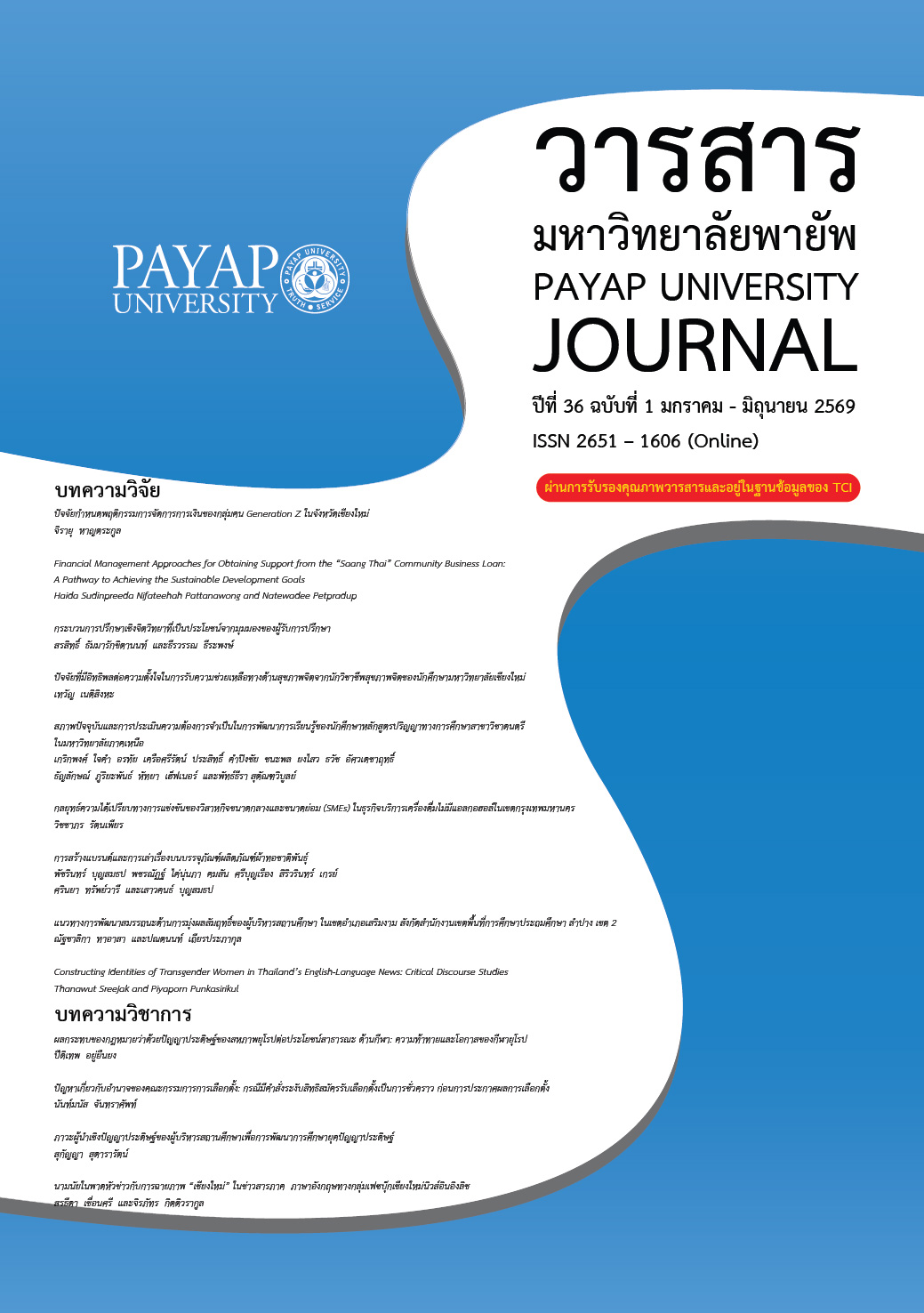
ภาวะผู้นำเชิงปัญญาประดิษฐ์ของผู้บริหารสถานศึกษา เพื่อการพัฒนาการศึกษายุคปัญญาประดิษฐ์
Article Sidebar
Main Article Content
บทคัดย่อ
บทความนี้มีวัตถุประสงค์เพื่อวิเคราะห์และนำเสนอแนวคิดภาวะผู้นำเชิงปัญญาประดิษฐ์ (AI Leadership) ของผู้บริหารสถานศึกษาเพื่อใช้เป็นกรอบแนวทางในการพัฒนาการศึกษาในยุคปัญญาประดิษฐ์ โดยอาศัยการสังเคราะห์วรรณกรรมด้านภาวะผู้นำร่วมสมัย การประยุกต์ใช้ปัญญาประดิษฐ์ในการศึกษาและจริยธรรมดิจิทัลเพื่อส่งเสริมการตัดสินใจเชิงกลยุทธ์ที่อิงข้อมูลและยึดมนุษย์เป็นศูนย์กลาง ผลการวิเคราะห์ชี้ให้เห็นว่า ภาวะผู้นำเชิงปัญญาประดิษฐ์มิได้มุ่งให้เทคโนโลยีแทนที่มนุษย์ แต่เน้นการทำงานร่วมกันระหว่างผู้นำกับระบบปัญญาประดิษฐ์ในลักษณะ “ผู้ช่วยคิดร่วม” เพื่อยกระดับคุณภาพการบริหารและการเรียนรู้ บทความสังเคราะห์องค์ประกอบสำคัญของภาวะผู้นำเชิงปัญญาประดิษฐ์ในสถานศึกษา 4 ด้าน ได้แก่ (1) ความรอบรู้ด้านปัญญาประดิษฐ์และสมรรถนะดิจิทัล (2) การใช้ปัญญาประดิษฐ์อย่างมีจริยธรรมและความรับผิดชอบ (3) การจัดการนวัตกรรมและการเปลี่ยนแปลง และ (4) ความร่วมมือระหว่างมนุษย์กับปัญญาประดิษฐ์ ซึ่งเป็นฐานของการบริหารแบบการตัดสินใจอิงข้อมูลและธรรมาภิบาลดิจิทัล นอกจากนี้ยังเสนอแนวทางการประยุกต์ใช้ในระดับสถานศึกษา เช่น การกำหนดวิสัยทัศน์และนโยบายปัญญาประดิษฐ์ที่ชัดเจน การพัฒนาศักยภาพบุคลากรตามกรอบสมรรถนะดิจิทัลสำหรับครูและบุคลากรทางการศึกษา (DigCompEdu) และการออกแบบกลไกความร่วมมือมนุษย์กับปัญญาประดิษฐ์อย่างสมดุลเพื่อขับเคลื่อนการศึกษาไทยสู่ระบบการเรียนรู้ ที่มีคุณภาพเท่าเทียมและสอดคล้องกับพลวัตของโลกยุคปัญญาประดิษฐ์
Downloads
Article Details
เอกสารอ้างอิง
พระราชบัญญัติคุ้มครองข้อมูลส่วนบุคคล พ.ศ. 2562. (2562). ราชกิจจานุเบกษา. เล่มที่ 136 ตอนที่ 37ก, หน้า 52-95.
Bass, B. M. (1985). Leadership and performance beyond expectations. Free Press.
Burns, J. M. (1978). Leadership. Harper & Row.
By, R. T., Burnes, B., & Hughes, M. (2023). Organizational change, leadership and ethics. Routledge. https://doi.org/10.4324/9781003036395
Chen, L., Chen, P., & Lin, Z. (2020). Artificial intelligence in education: A review. IEEE Access, 8, 75264–75278. https://doi.org/10.1109/ACCESS.2020.2988510
Ching, V., & Mothi, D. (2025). AI for creatives. Auerbach Publications. https://doi.org/10.1201/9781003533016
Farri, E., & Rosani, G. (2024). HBR guide to generative ai for managers. Harvard Business Review Press.
Hassani, H., & Silva, E. S. (2023). The role of chatgpt in data science: How ai-assisted conversational interfaces are revolutionizing the field. Big Data and Cognitive Computing, 7(2), 62. https://doi.org/10.3390/bdcc7020062
Heifetz, R. A., Grashow, A., & Linsky, M. (2009). The practice of adaptive leadership: Tools and tactics for changing your organization and the world. Harvard Business Press.
Heisterberg, R., & Verma, A. (2014). Creating business agility: How convergence of cloud, social, mobile, video, and big data enables competitive advantage. John Wiley & Sons.
Holmes, W., Porayska-Pomsta, K., Holstein, K., Sutherland, E., Baker, T., Shum, S. B., & Koedinger, K. R. (2022). Ethics of ai in education: Towards a community-wide framework. International Journal of Artificial Intelligence in Education, 32(3), 504–526. https://doi.org/10.1007/s40593-021-00239-1
Kuenkel, P., Kuhn, E., Stucker, D., & Williamson, D. (2020). Leading transformative change collectively: A practitioner guide to realizing the SDGs. Routledge. https://doi.org/10.4324/9781003033561
Northouse, P. G. (2019). Leadership: Theory and practice (8th ed.). Sage Publications.
Redecker, C., & Punie, Y. (2017). European framework for the digital competence of educators: DigCompEdu. Publications Office of the European Union. https://doi.org/10.2760/178382
Senge, P. M. (2006). The fifth discipline: The art and practice of the learning organization. Doubleday.
United Nations Educational, Scientific and Cultural Organization. (2020). Education for sustainable development: A roadmap. UNESCO. https://unesdoc.unesco.org/ark:/48223/pf0000373718.
United Nations Educational, Scientific and Cultural Organization. (2024). AI competency framework for teachers. UNESCO. https://unesco-asp.dk/wp-content/uploads/2025/02/AI-Competency-framework-for-teachers_UNESCO_2024.pdf
Wood, A. (2024). The philosophy of artificial intelligence. Author. https://www.barnesandnoble.com/w/the-philosophy-of-ai-alex-wood/1146737756
Woods, G. (2024). The AI-driven leader: Harnessing AI to make faster, smarter decisions. AI Thought Leadership.
