
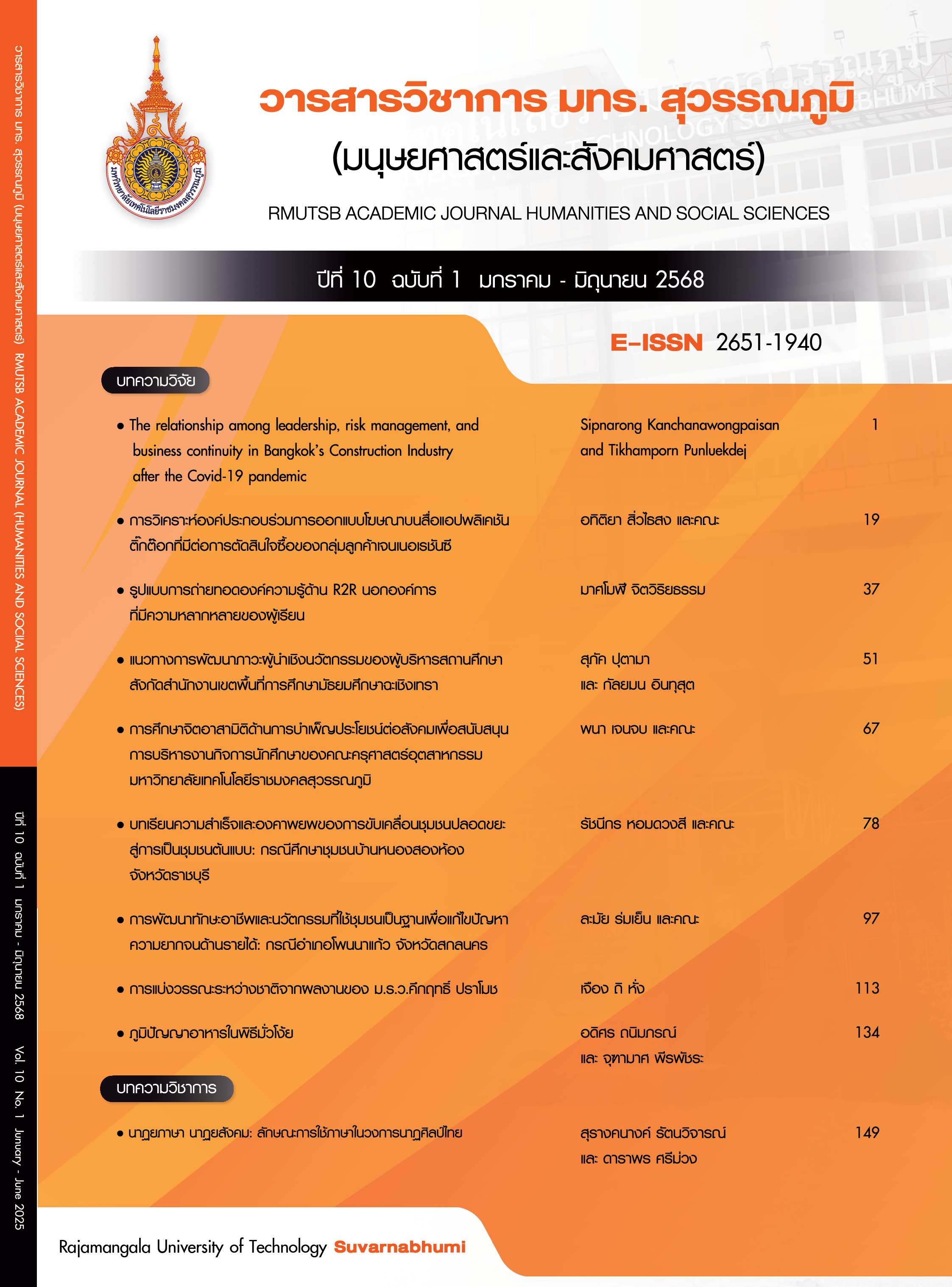
Routine to research (R2R) knowledge transfer model for other organizations with the diversity of learners
Article Sidebar
Main Article Content
Abstract
The objective of this research is to find a suitable Routine to Research (R2R) knowledge transfer model of the department and use it as a guideline for proper R2R process management. The research method is Survey Research with Cross-Sectional Survey. The populations are 180 people who attended the R2R workshop of Samut Sakhon Hospital, National Institute of Child Health, and Samut Sakhon Provincial Public Health Office in the financial year 2018 - 2019, A number of respondents is 170 (94.44%). The research tool used is google form assessment, with data analysis using frequency and percentage. For qualitative aspect, the tool used is BAR/AAR process, with content analysis method.
The research results found that the suitable R2R knowledge transfer model must be able to develop people to create ideas for job development. Therefore, there must be an important component such as clear content of R2R concept, emphasizing clear problem issues. Knowledge is created to practice complete skills, both the background and the importance of the problem, research methodology, tool creation, statistics, data analysis, and writing of research results clearly. It is important to have a success story of R2R practitioners, and to present research results, it must focus on the use of statistics. The key is a team of knowledgeable speakers with good communication techniques, putting effort and dedication to training, including fun activities, relieving stress, and getting everyone involved. Therefore, this will be a model of R2R knowledge transfer that is suitable for the department.
Article Details

This work is licensed under a Creative Commons Attribution-NonCommercial-NoDerivatives 4.0 International License.
References
Boonkhum, P., & Sukustit, P. (2016). Needs, motivations, barriers, promoting and supporting the routine to research (R2R): A case study of Staff personnel in Institute for Population and Social Research, Mahidol University. Journal of Council of University Administrative Staff of Thailand, 12(2), 67-80. (in Thai)
Chaikongkiat, P., & Kumkong, M. (2017). Routine to research: Driving to utilization. The Southern Collage Network Journal of Nursing and Public Health, 4(3), 259-270. (in Thai)
Chandavimol, P. (2013). Development of a blended training model with knowledge management and action learning principles to develop training program design competencies of personnel development staff (Doctoral dissertation). Chulalongkorn University, Bangkok. (in Thai)
Nopmaneejumruslers, C., & Nimmannit, A. (2010). Facilitator not secret: Driven R2R. Bangkok: Union Creation. (in Thai)
Nopmaneejumruslers, C., & Nimmannit, A. (2015). Fill heart, fill fire, fill dreams important skills of facilitator. Bangkok: Union Creation. (in Thai)
Pisanbut, S. (2012). Classroom research: Learn in 5 hours. Bangkok: Witthayaphat. (in Thai)
Poompeng, K. (2022). A study of needs and motivation for routine to research (R2R) developing of academic supporting staff in Faculty of Science Burapha University. CUAST Journal, 11(2), 52-61. (in Thai)
Srisasalux, J., & Jamniandamrongkarn, S. (2009). R2R not secret central; General; community hospital context. Bangkok: Union Creation. (in Thai)
Srisasalux, J., & Tantawevong, A. (2008). R2R: Routine to Research, overcome monotonous work with research entering a new world of routine work. Nonthaburi: Health Systems Research Institute (HSRI). (in Thai)
Thianthong, S. (2019). National health R2R forum 2019. Bangkok: Project to Support the Routine to Research to National Research. (in Thai)
