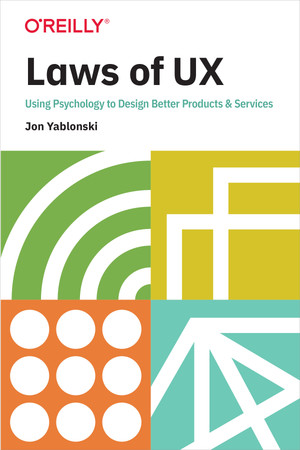
Laws of UX: Using Psychology to Design Better Products & Services (By Jon Yablonski)
Article Sidebar
Main Article Content
Abstract
-
Article Details

This work is licensed under a Creative Commons Attribution-NonCommercial-NoDerivatives 4.0 International License.
References
Angskun, T., Sritha, K. N., Srithong, A., Khopolklang, N., Kamollimsakul, S., Phithak, T., & Angskun, J. (2024). Using big data to assess an affective domain for distance education. Future Generation Computer Systems, 160, 131-139. https://doi.org/10.1016/j.future.2024.05.057
Brooke, J. (1996). SUS-A quick and dirty usability scale. Usability Evaluation in Industry, 189(194), 4-7.
Harrati, N., Bouchrika, I., Tari, A., & Ladjailia, A. (2016). Exploring user satisfaction for e-learning systems via usage-based metrics and system usability scale analysis. Computers in Human Behavior, 61, 463-471. https://doi.org/10.1016/j.chb.2016.03.051
Kamollimsakul, S., Petrie, H., & Power, C. (2014). The effect of text color and background color on skim reading webpages in Thai. In International Conference on Human-Computer Interaction (pp. 615-620). Cham: Springer International Publishing. https://doi.org/10.1007/978-3-319-07854-0_106
Kirakowski, J., & Corbett, M. (1993). SUMI: the Software Usability Measurement Inventory. British Journal of Educational Technology, 24(3), 210-212 https://doi.org/10.1111/j.1467-8535.1993.tb00076.x
Mortazavi, E., Doyon-Poulin, P., Imbeau, D., Taraghi, M., & Robert, J. M. (2024). Exploring the landscape of UX subjective evaluation tools and UX dimensions: A Systematic Literature Review (2010–2021). Interacting with Computers, 36(4), 255-278. https://doi.org/10.1093/iwc/iwae017
