
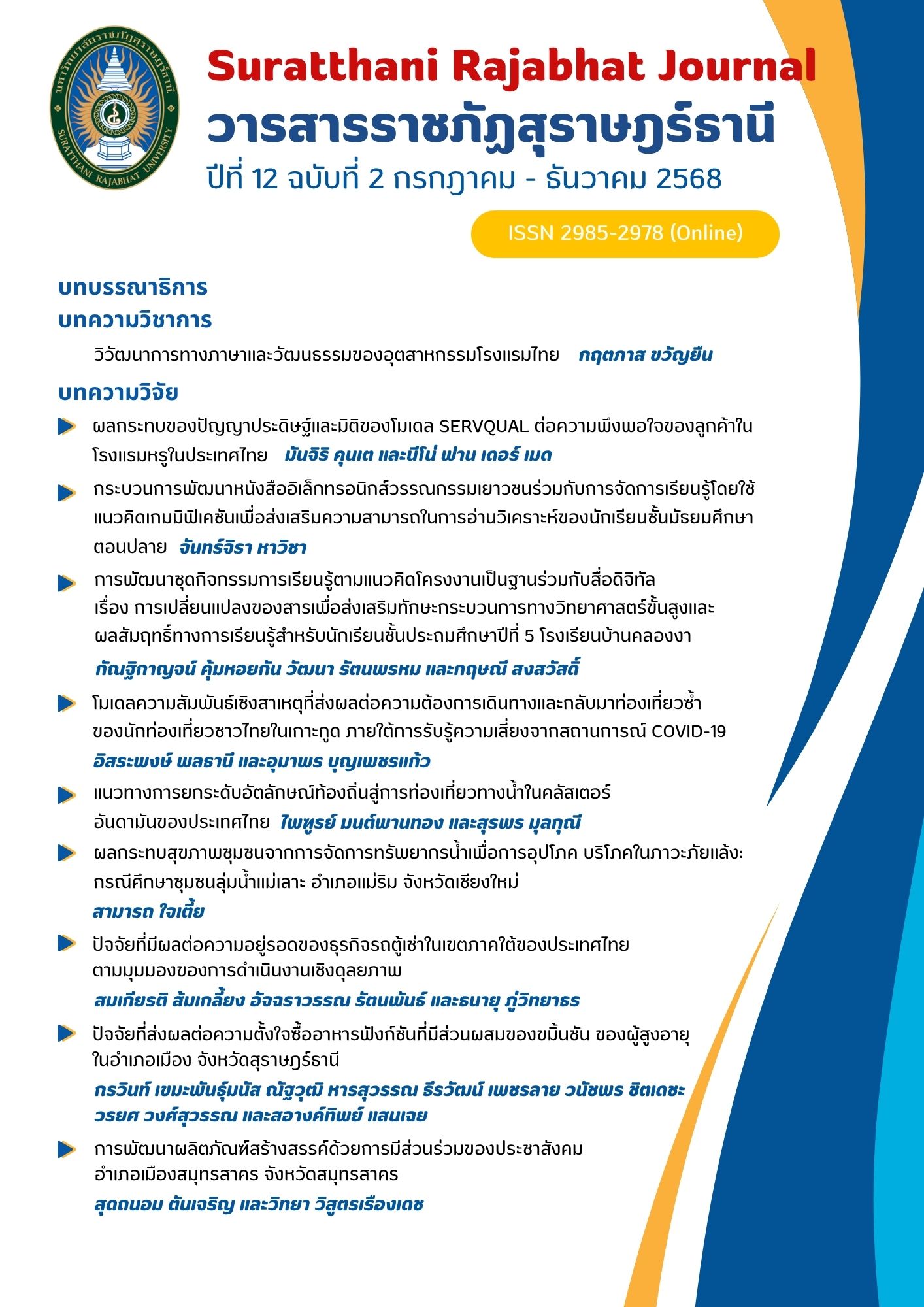
The Process of Developing Children's Literature E-books in Collaboration with the Gamification Concept for Learning Management to Enhance Analytical Reading Skills of High School Students
Article Sidebar
Main Article Content
Abstract
This research aimed to 1) investigate the needs and 2) develop an electronic youth literature book integrated with gamification-based learning management. The study employed a mixed-methods research design. The qualitative research component collected data through interviews with three upper secondary school Thai language teachers. The quantitative research component utilized questionnaires administered to 75 tenth-grade students at the Demonstration School of Phranakhon Si Ayutthaya Rajabhat University. Data were analyzed using descriptive statistics, including percentage, mean (x̄), and standard deviation (S.D.).
The research findings revealed that teachers should utilize modern learning media that attract attention through age-appropriate literature, combined with learning management that applies gamification concepts to stimulate motivation and engagement in learning. Regarding content preferences, the top three genres ranked by students were informative stories (60.53%), fantasy tales (52.64%), and short stories about friendship (52.64%), respectively. The preferred assessment format was exercises, accounting for 43.43%.
The expert evaluation of the electronic youth literature book yielded an overall mean score at the highest level (x̄ = 4.52). The aspects of content accessibility and content quality received the highest mean scores of 4.74 and 4.72, respectively. The analytical reading lesson plan incorporating gamification concepts with the electronic book was also evaluated at the highest level, with an overall mean score of 4.64. Specifically, the learning process management, media and time allocation, and learning activities and assignments received mean scores of 4.80, 4.80, and 4.73, respectively. These results reflect the efficiency and appropriateness of the developed innovation for enhancing Thai language instruction at the secondary level.
Article Details

This work is licensed under a Creative Commons Attribution-NonCommercial-NoDerivatives 4.0 International License.
References
Baker. (1992). Electronic Book and Libraries of the Future. The Electronic Library, 10(10), 139-149.
Buason, R. (2022). Research and development, education innovation. Chulalongkorn University Press. Thailand.
Buranasingh, W. (2004). Analytical reading, course review and instruction (3rd Edition). Ramkhamhaeng University. Thailand.
Champasak, W. (2017). The Development of electronic book Entitled “Noun Classifiers” in Thai language for Prathomsuksa 3 student. Naresuan University.
Charoenwongsak, K. (2005). Analytical thinking (5th edition). Success Media. Thailand.
Chesamae, A., Nakaram, N., & Phondee, S. (2017). Development of Tourist Attraction Simulation Game Prototype by Using Gamification Format : Case Study Puranawas Tong Tew Pa Ploen Game. Journal of Thonburi University (Science and Technology), 1(1), 14-23. https://www.thonburi-u.ac.th/Journal_SIT/Vol1_No1_2.pdf (in Thai).
Fakkhao, S. (2003). Analytical thinking. Thai Wattana Panich. Thailand.
Jamkrajang, N. (2020). Developing Analytical Thinking Skills from Youth Literature. Wonder by R.J. Palacio by Using Marzano’s Theory together with CAI for Tenth Grade Students. Naresuan University.
Hsin-Yuan Huang W, & Soman D. A. (2013). Practitioner's Guide to Gamification of education. Rotman school of management.
Kapp, K. M. (2012).The gamification of learning and instruction: game – based methods and strategie for training and education. John Wiley and Sons.
Khaleel, Ashaari, & Wook. (2020). The impact of gamification on students learning engagement. International Journal of Electrical and Computer Engineering, 10(5), 49-65. http://doi.org/10.11591/ijece.v10i5.pp4965-4972
Klaisang, J. (2012). Desktop publishing is an e-book to promote awareness Digital age students. Chulalongkorn University Book Center. Thailand.
Kulkong, K. (2012). A design system for electronic tale book with creative activities to enhance creative thinking of elementary school students. Chulalongkorn University.
LaorienDee, W. (2006). Techniques and tactics for developing student-focused management thinking skills are crucial. Faculty of Education, Silpakorn University.
Mingsiritham, K. (2016). Creative media design. Chulalongkorn University Press. Thailand.
Munkham, S. (2007). Analysis Teaching Strategy (4th edition). Phaphphim.
Office of the Basic Education Commission. (2009). Performance indicators and Core Learning Areas for Thai Language Curriculum According to the Fundamental Education Core Curriculum, 2551. The Cooperative Agricultural Cooperative Limited of Thailand Press. Thailand.
Office of the Secretariat of the Education Council. (2017). National Education Plan 2017-2036. Phrikwan Graphic Company Limited. Thailand.
Phonsen, K., Teemuangsai, S., & Chandrasena, U. (2023). Promoting Achievement Motivation in Mathematics through Blended Learning with Gamification Techniques for Pratomsuksa 5 Students At Ban Phaeng Nong Nuea School. Rajabhat Mahasarakham University Journal, 17(3), 103-113. http://so05.tci-thaijo.org/index.php/rmuj/article/view/269749/180529
Phothirat, N. (2019). Action Research Report for Solving Reading Problems of Students in Prathomsuksa 1. Rajabhat MahaSarakham University.
Pinthong, T. (1998). Literature for Adolescents TH459. Faculty of Humanities, Ramkhamhaeng University. Thailand.
Phinyoyang, W. (2013). Marketing idea: The idea of turning the world. Krungthep Thurakit. Thailand.
Poondet, C., & Lertphonkulrat, T. (2015). Learning Management with the Gamification Concept. Journal of Education Naresuan University, 18(3), 332. https://so06.tci-thaijo.org/index.php/edujournal_nu/article/view/66651 (in Thai).
Pradit, C. (2007). E-book creation manual with Flip Album 5 Pro. Wat Boran Luang School. Thailand.
Reynolds, K. (2011). Children’s Literature:A Very Short Introduction. Oxford.
Richey, R. C., Klein, J. D., & Tracey, M. W. (2011). The instructional design knowledge base. New York: Taylor & Francis.
Ruangrong P., Jiravarapong, B., Manyum, W., Somyaron, W., Muendet, S., & Srisurat, C. (2014). Education Technology vs Thai Teachers in 21st Century. Panyapiwat Journal, 5(5), 195-207. https://so05.tci-thaijo.org/index.php/pimjournal/article/view/20162 (in Thai).
Saengthip, W. (2021). The Development of Learning by Using Gamification with Task-based Learning to Enhance English Reading Comprehension and Learning Motivation of Matthayom 3 Students. Silpakorn University.
Sirisingha, W. (2008). Literary creation for children and young people. Sureeviriyasan. Thailand.
Songyang, P. (2018). Thinking, writing, creating stories and children's books. Chulalongkorn University Press. Thailand.
Srifa, P. (2008). E-book, talk book. Than Book. Thailand.
Srisa-at, B. (2011). Preliminary research (9th edition). Suviriyasan Company Limited. Thailand.
Sunthon, T. (2006). Creating an E-Book on Internet for the University of Mahidol Employee System. Kasetsart University. Thailand.
Thongrak, S. (2015). Gamification for education. https://prezi.com/egljtudugd8e/gamification-for-education
Waithayawongsakul, S. (2007). The meaning of electronic books. http://www.gotoknow.org/posts/446337
Wanichawattanaworachai, S. (2019). General teaching. Faculty of Education, Silpakorn University. Thailand.
Wannakit, N. (2019). Children's literature. Inthanin. Thailand.
