Adaptive Leadership of Administrators of Private Vocational Schools in The New Normal Era
Keywords:
Adaptive leadership, New Normal Era, Vocational education, Bangkok areaAbstract
This research aims to: 1) study the components related to the adaptive leadership of administrators of private vocational schools in the new normal era in the Bangkok area, 2) analyze the components and indicators of adaptive leadership of private vocational school administrators in the new normal era in province Bangkok. The sample group used were teachers in private vocational education in the Bangkok area, A total of 322 participants were obtained using simple random sampling. The tool used is a questionnaire. The statistics used are exploratory component analysis (EFA) by factor extraction (PCA), orthogonal rotation method using the varimax method, Eigan value, percentage variance, and factor loading.
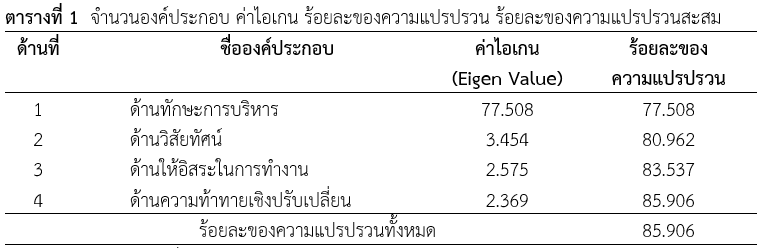
The research results found that there are four components and indicators of adaptive leadership of administrators of private vocational schools in the new normal era in the Bangkok area: 1) Management skills with 15 indicators with an Eigen value of 77.508, a percentage of variance equal to 77.508, and a component weight ranging from .666 - .925, 2) visionary side of 9 indicators with an eigen value of 3.454, a percentage of variance equal to 80.962, and a component weight value ranging from .731-.903, 3) Job autonomy has 12 indicators with an eigen value of 2.575, a percentage of variance equal to 83.537, and a component weight value ranging from .816 – .926, and 4) Adaptive Challenge has 14 indicators with an eigenvalue of 2.369, a percentage of variance equal to 85.906, and a component weight value ranging from .783 – .965.
References
Fernandez, A. A., & Shaw, G. P. (2020). Academic Leadership in a Time of Crisis: The Coronavirus and COVID-19. Journal of Leadership Studies, 14(1), 39-45. Retrieved from https://onlinelibrary.wiley.com/doi/abs/10.1002/jls.21684
Hair, J. F., Black, W. C., & Babin, B. J. (2010). Multivariate Data Analysis: A Global Perspective. Pearson Education.
Hawley, S. R. (2021). Using Adaptive Leadership Principles to Support Public Health 3.0 in Multidisciplinary Undergraduate Education. Leadership in Health Services, 34(3), 248-262. doi:10.1108/LHS-07-2020-0051
Heifetz, R., Linsky, M., & Grasshow, Z. (2009). The Practice of Adaptive Leadership: Tools and Tactics for Changing Your Organization and the World. Boston: Harvard Business Press.
Kotakarn, P. (2016). Leaders and leadership and organizational success. Retrieved September 9, 2020, from http://phinit0112.blogspot.com/2016/02/ (In Thai)
Krejcie, R. V., & Morgan, D. W. (1970). Determining Sample Size for Research Activities. Educational and Psychological Measurement, 30(3), 607–610. doi:10.1177/001316447003000308
Parween, S., & Deepak, S. (2019). Positioning the future of Human Resource Management. Retrieved from https://www.researchgate.net/publication/333673492_Positioning_The_Future_Of_Human_Resource_In_A_VUCA_World
Downloads
Published
How to Cite
Issue
Section
License
Copyright (c) 2024 Institute of Research and Development, Suan Sunandha Rajabhat University

This work is licensed under a Creative Commons Attribution-NonCommercial-NoDerivatives 4.0 International License.
บทความที่ได้รับการตีพิมพ์เป็นลิขสิทธิ์ของ สถาบันวิจัยและพัฒนา มหาวิทยาลัยราชภัฎสวนสุนันทา
ข้อความที่ปรากฏในบทความแต่ละเรื่องในวารสารวิชาการเล่มนี้เป็นความคิดเห็นส่วนตัวของผู้เขียนแต่ละท่านไม่เกี่ยวข้องกับมหาวิทยาลัยราชภัฎสวนสุนันทา และคณาจารย์ท่านอื่นๆในมหาวิทยาลัยฯ แต่อย่างใด ความรับผิดชอบองค์ประกอบทั้งหมดของบทความแต่ละเรื่องเป็นของผู้เขียนแต่ละท่าน หากมีความผิดพลาดใดๆ ผู้เขียนแต่ละท่านจะรับผิดชอบบทความของตนเองแต่ผู้เดียว
 ISSN
ISSN