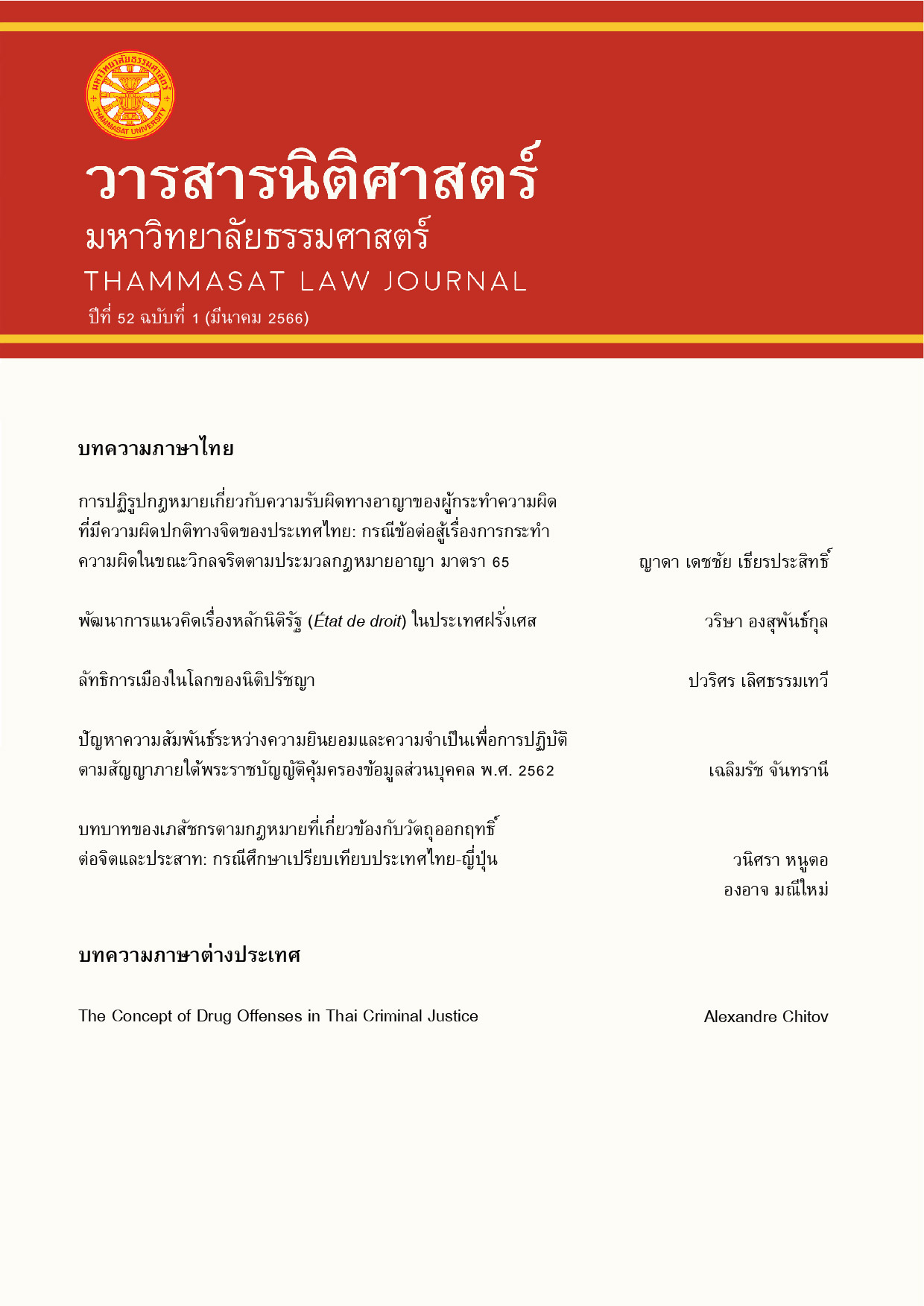
การปฏิรูปกฎหมายเกี่ยวกับความรับผิดทางอาญาของผู้กระทำความผิดที่มีความผิดปกติทางจิตของประเทศไทย: กรณีข้อต่อสู้เรื่องการกระทำความผิดในขณะวิกลจริตตามประมวลกฎหมายอาญา มาตรา 65
คำสำคัญ:
ผู้กระทำความผิดที่มีความผิดปกติทางจิต, ข้อต่อสู้เรื่องการกระทำความผิดในขณะวิกลจริต, ประมวลกฎหมายอาญา มาตรา 65บทคัดย่อ
บทความวิจัยฉบับนี้มีวัตถุประสงค์เพื่อเสนอการปรับปรุงแก้ไขข้อต่อสู้เรื่องการกระทำความผิดในขณะวิกลจริตในประเทศไทย โดยการศึกษาเปรียบเทียบกับสหราชอาณาจักร (อังกฤษและเวลส์ และสกอตแลนด์)
ปัจจุบัน ประเทศไทยมีปัญหาในการจัดการผู้กระทำความผิดที่มีความผิดปกติทางจิต เนื่องจากกฎหมายและระบบปฏิบัติในปัจจุบันของประเทศไทยมีช่องโหว่ซึ่งทำให้ผู้กระทำความผิดเหล่านี้ต้องเข้าสู่กระบวนการยุติธรรมทางอาญาทั่วไป ส่งผลให้พวกเขาอาจต้องรับโทษ ซึ่งโดยปกติแล้วคือจำคุก และในทางปฏิบัติผู้กระทำความผิดมักจะไม่ได้รับการรักษาพยาบาลในเรือนจำและมักถูกคุมขังน้อยกว่าโทษตามคำพิพากษาเนื่องจากนโยบายของกรมราชทัณฑ์ เช่นนี้ โอกาสที่ผู้กระทำความผิดที่มีความผิดปกติทางจิตจะได้รับการบำบัดฟื้นฟูจึงมีค่อนข้างน้อย ดังนั้นจึงมีโอกาสที่พวกเขาจะทำกระทำผิดซ้ำ ในแง่นี้ จึงมีความเสี่ยงต่อความปลอดภัยของสาธารณะ ยิ่งกว่านั้นหากบุคคลนั้นวิกลจริตถึงขนาดที่ไม่รู้ผิดชอบ เขาก็ไม่ควรได้รับโทษทางอาญาตั้งแต่ต้น การลงโทษบุคคลวิกลจริตจึงขัดต่อเจตนารมณ์ของกฎหมายอาญาและวัตถุประสงค์การลงโทษ
บทความวิจัยฉบับนี้จึงเสนอให้มีการแก้ไขบทบัญญัติเกี่ยวกับข้อต่อสู้เรื่องการกระทำความผิดในขณะวิกลจริตตามประมวลกฎหมายอาญา โดยเสนอให้มีการบัญญัติ ‘ข้อต่อสู้เรื่องการไม่มีความสามารถทางอาญา’ แทน เพื่อผู้กระทำความผิดที่มีความผิดปกติทางจิตจะได้รับการปฏิบัติอย่างยุติธรรมมากขึ้น และความเสี่ยงในการกระทำผิดซ้ำจะลดลง ซึ่งจะส่งผลให้สังคมไทยปลอดภัยขึ้นพร้อมกับการแก้ไขปัญหาที่เกี่ยวข้องกับอาชญากรรมที่กระทำโดยผู้กระทำความผิดที่ความผิดปกติทางจิตได้
เอกสารอ้างอิง
เกียรติขจร วัจนะสวัสดิ์, คำอธิบายกฎหมายอาญา ภาค 1 เล่ม 1 (พิมพ์ครั้งที่ 11, กรุงสยาม พับลิชชิ่ง 2562).
โสภณ รัตนากร, คำอธิบายกฎหมายลักษณะพยาน (พิมพ์ครั้งที่ 11, นิติบรรณาการ 2557).
Gerald Gordon QC, The Criminal Law of Scotland, Vol I (3rd edn, Edinburgh 2000).
John Stanton-Ife, ‘Total Incapacity’ in Ben Livings, Alan Reed and Nicola Wake (eds), Mental Condition Defences and the Criminal Justice System (Cambridge Scholar Publishing 2015).
Judicial Studies Board, Crown Court Bench Book (March 2010).
Law Commission, Criminal Liability: Insanity and Automatism Discussion Paper (London 2013).
M Corrado, ‘The Case for a Purely Volitional Insanity Defence’ (2009) 2 Tex. Tech L. Rev. 481.
N.E. Anderson and K.A. Kiehl, ‘Psychopathy: developmental perspectives and their implications for treatment’ (2014) Restorative neurology and neuroscience 32 (1).
Paul Litton, ‘Psychopathy and responsibility theory’ (2010) 5(8) Philosophy Compass, 676.
Report on the Review of the Mental Health (Scotland) Act 1984 (Edinburgh 2001).
Scottish Law Commission, Report on Insanity and Diminished Responsibility (Edinburgh 2004).
Simon Barnes, ‘Re-evaluating the exclusion of psychopathy from the mental disorder defence in Scots law’ (2018) 1 Juridical Review 1.
Yada Dejchai, ‘Reforming the Insanity Defence in Thailand: A Comparative Study in the Light of Legal Developments in Scotland and England and Wales’ (PhD Thesis University of Aberdeen 2020).
ดาวน์โหลด
เผยแพร่แล้ว
ฉบับ
ประเภทบทความ
สัญญาอนุญาต
ลิขสิทธิ์ (c) 2023 วารสารนิติศาสตร์ มหาวิทยาลัยธรรมศาสตร์

อนุญาตภายใต้เงื่อนไข Creative Commons Attribution-NonCommercial-NoDerivatives 4.0 International License.
ผลงานที่ตีพิมพ์ในวารสารนิติศาสตร์เป็นลิขสิทธิ์ของวารสารนิติศาสตร์ มหาวิทยาลัยธรรมศาสตร์ และวารสารนิติศาสตร์ มหาวิทยาลัยธรรมศาสตร์ สงวนสิทธิในการเผยแพร่ผลงานที่ตีพิมพ์ในแบบรูปเล่มและทางสื่ออิเล็กทรอนิกส์อื่นใด
บทความหรือข้อความคิดเห็นใด ๆ ที่ปรากฏในวารสารนิติศาสตร์เป็นความรับผิดชอบของผู้เขียนโดยเฉพาะ คณะนิติศาสตร์ มหาวิทยาลัยธรรมศาสตร์ และบรรณาธิการไม่จําเป็นต้องเห็นด้วยหรือร่วมรับผิดชอบใด ๆ

