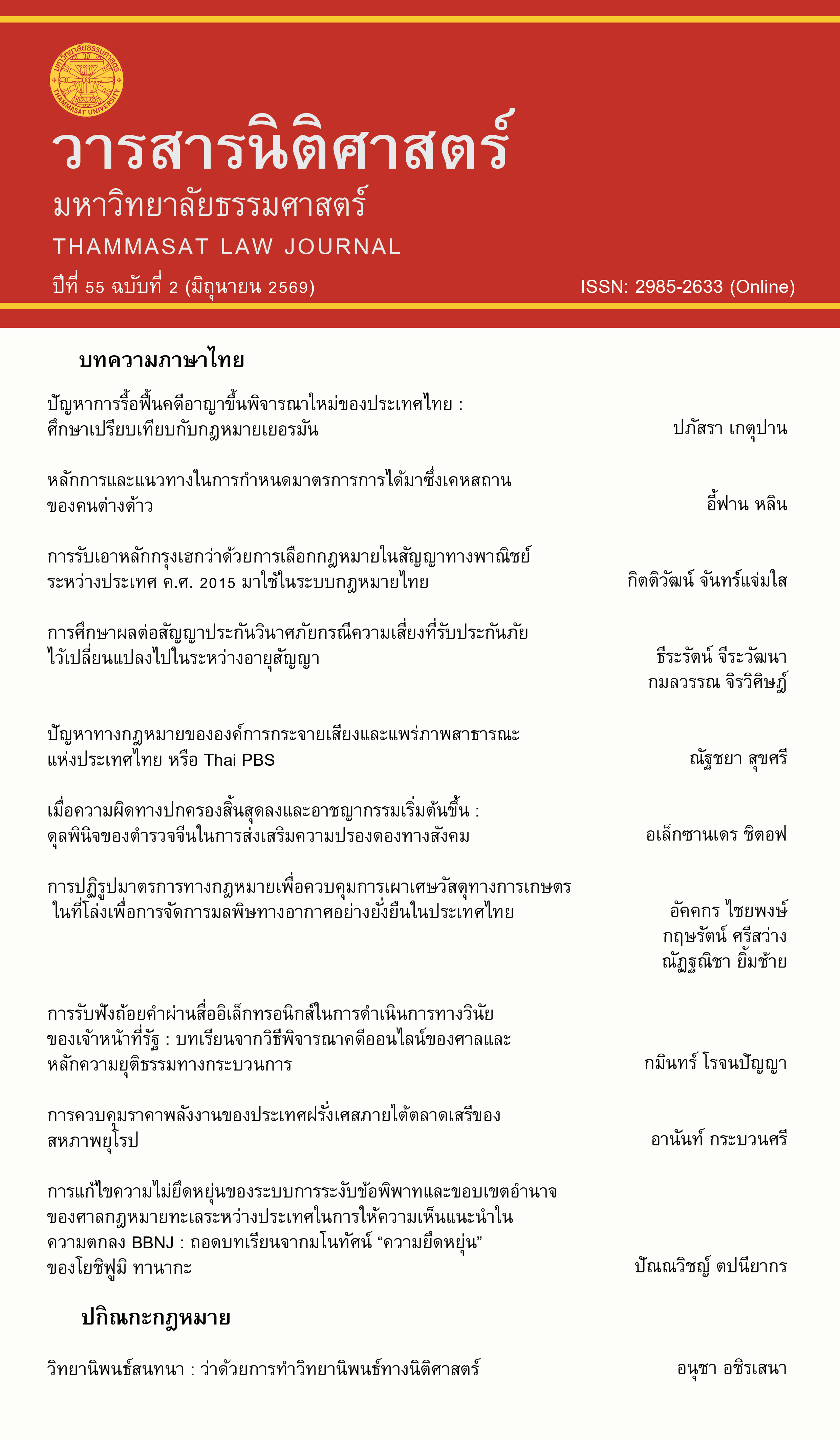
เมื่อความผิดทางปกครองสิ้นสุดลงและอาชญากรรมเริ่มต้นขึ้น : ดุลพินิจของตำรวจจีนในการส่งเสริมความปรองดองทางสังคม
คำสำคัญ:
ประเทศสาธารณรัฐประชาชนจีน, ความผิดอาญา, ความผิดทางปกครอง, ตำรวจบทคัดย่อ
ประเทศจีนมีระบบความรับผิดสำหรับการกระทำผิดต่อสาธารณะที่แยกออกจากกันเป็นสองระบบ ได้แก่ ความรับผิดทางอาญา และความรับผิดทางปกครอง การมีอยู่ของระบบความรับผิด ทั้งสองนี้ก่อให้เกิดปัญหาในการแบ่งแยกขอบเขตความรับผิด แม้ว่าจะมีความพยายามในการกำหนดเส้นแบ่งที่ชัดเจนระหว่างความรับผิดทางปกครองกับความรับผิดทางอาญา แต่ยังคงมีความคลุมเครืออย่างมากในการแยกแยะความแตกต่างระหว่างความรับผิดทั้งสองประเภท ซึ่งหลีกเลี่ยงไม่ได้ที่เจ้าหน้าที่ตารวจจะต้องใช้ดุลพินิจในการตัดสินใจว่าจะใช้ความรับผิดประเภทใด อย่างไรก็ตาม ดุลพินิจดังกล่าวมิได้เป็นไปโดยปราศจากข้อจำกัด
ในประเทศจีน ความร้ายแรงของการกระทาผิดต่อสาธารณะได้รับการยอมรับว่าเป็นหลักการพื้นฐานในการจาแนกความผิดทางอาญาออกจากความผิดทางปกครอง เพื่อให้ระบบความรับผิดทั้งสองสามารถบังคับใช้ได้อย่างมีประสิทธิภาพ จึงจำเป็นต้องมีมาตรฐานที่ชัดเจนในการกาหนดและวัดระดับความร้ายแรงของความผิด
ประเทศจีนมีความผันผวนระหว่างแนวนโยบายทางเลือกสองประการในการกำหนดมาตรฐานดังกล่าว ประการแรก คือ การประเมินความร้ายแรงของความผิดจากมุมมองของผลกระทบต่อ ความสงบสุขและความปรองดองทางสังคม ซึ่งแนวนโยบายนี้ต้องอาศัยดุลพินิจในระดับสูงจากเจ้าหน้าที่ตำรวจที่ต้องปฏิบัติหน้าที่เชิงรุกในการระบุและแก้ไขความขัดแย้งทางสังคม ประการที่สอง คือ การกำหนดคาอธิบายที่เฉพาะเจาะจงเกี่ยวกับระดับความร้ายแรงสาหรับความผิดแต่ละประเภท ที่สมควรได้รับการบังคับใช้กฎหมายอาญา ภายใต้แนวนโยบายนี้ เจ้าหน้าที่ตำรวจต้องปฏิบัติตามหลักเกณฑ์ดังกล่าวอย่างเคร่งครัด
บทความนี้เสนอข้อโต้แย้งว่า การส่งเสริมความปรองดองทางสังคมเป็นแนวนโยบายที่เหมาะสมกว่าการบังคับใช้กฎเกณฑ์อย่างเคร่งครัด
เอกสารอ้างอิง
Bibliography to WHEN AN ADMINISTRATIVE DELICT ENDS
Allan Y Jiao, ‘Police and culture: A comparison between China and the United States’ (2001) Police quarterly 2: pp 156-185;
Aristotle, Nicomachean Ethics V, 1137 a 31 - 1138 a 3.
John Tasioulas, ‘The paradox of equity’, (1996) 55 The Cambridge Law Journal 3: pp 456-469.
Børge Bakken, Crime and control in China: The myth of harmony (Polity Press, 2023).
Chen Qi, Governance, Social Control and Legal Reform in China (Palgrave Macmillan, 2018), pp 123.
Cheng Li & Eve Cary ‘The Last Year of Hu's Leadership: Hu's to Blame?’ (2011) 11 China Brief 23.
Constitution of the PRC. 1982, 2018. Article 134. https://english.www.gov.cn/archive/lawregulations/201911/20/content_WS5ed8856ec6d0b3f0e9499913.html (last visited 23 October 2025).
Criminal law of the People’s Republic of China (1979, 2024) http://www.chnlawyer.net/law/subs/xingfa.html (last visited 21 October 2025)
Criminal law of the People’s Republic of China (1979, 2024) http://www.chnlawyer.net/law/subs/xingfa.html (last visited 21 October 2025)
Criminal Procedure Law of the PRC (CPR). 1979, (2018). https://www.spp.gov.cn/zdgz/201810/t20181027_396818.shtml (last visited 21 October 2025).
David M. Engel, and Frank E. Reynolds, Code and Custom in a Thai Provincial Court: The Interaction of Formal and Informal Systems of Justice (Association for Asian Studies, 1978).
Deborah Cao, Chinese law: A language perspective. (Routledge, 2016).
E. Li, ‘China's new counterterrorism legal framework in the post-2001 era: Legal development, penal change, and political legitimacy’ (2016) 19 New Criminal Law Review, 3: pp 344-381;
Elisa Nesossi, ‘The Politics of Torture and Miscarriages of Justice in Contemporary China,’ (2016) 11 Journal of Comparative Law 2: pp 166-185.
Ewan Smith, ‘The Conception of Legality under Xi Jinping’ in: Rogier J. E. H. Creemers and Susan Trevaskes Eds.), Law and the Party in China: Ideology and Organisation (Cambridge University Press, 2020), pp. 97-120. At p. 114.
Guodong Du & Meng Yu, ‘Mediation in China: Past and Present’ (2019, August 11). Retrieved from https://www.chinajusticeobserver.com/a/mediation-in-china-past-and-present (last visited 10 February 2020).
Guoxiang Sun, ‘Research on the subordinate and independent character of the judgement on unlawfulness of administrative offences.’ In Jichun Shi (ed) Renmin Chinese Law Review: Selected Papers of the Jurist (法学家) Volume 7, (Edward Elgar Publishing, 2019), pp 110-137.
Guy Olivier Faure, ‘Practice note: Informal mediation in China,’ (2011) 29 Conflict Resolution Quarterly 1: pp 85-99;
H. E. Jie, ‘Taking the Victims′ Interests into Consideration, Promoting Social Harmony - Also on the System of Criminal Reconciliation’ (2006) Journal of Kunming Teachers College 2.
Hans-Georg Gadamer, Truth and Method (Continuum, 1989), XI.
Ilse Nina Bulhof, Wilhelm Dilthey: A hermeneutic approach to the study of history and culture (Martinus Nijhoff, 1980).
Ivan Y. Sun et al. ‘Trust in the Police in Rural China: a Comparison Between Villagers and Local Officials’ (2019) 14 Asian Journal of Criminology 3: pp 241-258;
James Fitzjames Stephen, A Digest of the Law of Evidence (Georg Chase’, 1898), p. 896; Christopher Allen, Practical guide to evidence (Routledge-Cavendish, 2008), Chapter 12.
Jiang, F., & Xie, C. ‘Roles of Chinese police amidst the COVID-19 pandemic’ (2020) Policing: A Journal of Policy and Practice, 14(4), 1127-1137.
Jue Jiang, ‘The Family as a Stronghold of State Stability: Two Contradictions in China’s Anti-Domestic Violence Efforts’ (2019) 33 International Journal of Law, Policy and the Family, 2: 228-251;
Julius Paul, The Legal Realism of Jerome N. Frank: A Study of Fact-Skepticism and the Judicial Process (Martinus Nijhoff, 1959), p 78.
Kam C Wong, Police reform in China (CRC Press, 2011), p 6.
Kam C. Wong, Police Reform in China (CRC Press, 2011), pp 300-303.
Ke Li, Marriage Unbound State Law, Power, and Inequality in Contemporary China (Stanford University Press, 2022), p. 162.
Law of the People's Republic of China on Administrative Penalty 1996, 2021. Article 5.
Legal Daily, ‘Obstacles to law enforcement cases: heavy punishment for violent attacks on police makes sense’ (31 January 2018) (Chinese) http://www.xinhuanet.com/2018-01/31/c_1122343513.htm (last visited 10 February 2020).
Lijuan Xing, ‘The Rhyme of History: A Transition of Legal Culture in China Crowned by the Criminal Procedure Law 2012’, (2015) 23 Asia Pacific Law Review 1, pp 31-65. At 38.
Lin Li, The Chinese Road of the Rule of Law (Springer, 2018), pp 178.
Luo Haocai & Song Gongde ‘The Public Law Construction of a Harmony Society [J]’ (2004) 4 Chinese Legal Science 6;
Michael Hooper, China Rule of Law and the West (Springer, 2014), p. 14
Mireille Delmas-Marty, ‘Conclusion: The Chinese Laboratory’ in Stephen F. Teiser, Martin Kern & Timothy Brook (Eds), China, Democracy, and Law (Brill, 2012), pp. 839-876. At p. 869.
O. Hansen, ‘Legality and Lawlessness in China: An Analysis of Chinese Criminal Law and Procedure’, (1980) 6 Poly L. Rev., p. 46.
Organic Law of the People's Procuratorates of the People's Republic of China 1979, 2018. https://www.spp.gov.cn/zdgz/201810/t20181026_396791.shtml (last visited 23 October 2025).
People's Police Law of the People's Republic of China (1995, 2012). https://jtgl.beijing.gov.cn/jgj/jgxx/flfg/fl/203770/index.html (last visited 23 October 2025).
Prateeppornnarong, Dhiyathad & Richard Young. ‘A critique of the internal complaints system of the Thai police’ (2019) Policing and Society 29.1 18-35.
Public Security Administrative Penalties Law of the People’s Republic of China 2005, 2025. https://www.spp.gov.cn/spp/fl/202506/t20250627_699863.shtml (last visited 21 October 2025).
Randall Peerenboom, ‘Out of the Pan and into the Fire: Well-Intentioned but Misguided Recommendations to Eliminate All Forms of Administrative Detentions in China,’ (2004) 93 Northwestern University Law Review 3: 991-1104;
Samuel March Phillipps, A Treatise on the Law of Evidence: 9th Ed., (Saunders and Bennings, 1843), Vol. 2, p. 435;
Samuli Seppänen, Ideological conflict and the rule of law in contemporary China: useful paradoxes. (Cambridge University Press, 2016), p 31.
Sarah Biddulph, Elisa Nesossi & Susan Trevaskes, ’Criminal justice reform in the Xi Jinping era’, (2017) 2 China Law and Society Review 1, pp 63-128.
Shi Li, Hiroshi Sato, & Terry Sicular, eds. Rising inequality in China: Challenges to a harmonious society. (Cambridge University Press, 2013);
Shi Yan’an, ‘Criminalization and the Improvement of the Punishment System.’ (2020) 41 Social Sciences in China 4: pp. 63-84.
Shi-lin Zhao, ‘Police Mediation in the Context of Rule of Law,’ (2007) Journal of Political Science and Law: 6;
State Council of the PRC, ‘Socialist Legal System with Chinese Characteristics’, (2011), Available at http://www.gov.cn/zwgk/2011-10/27/content_1979526.htm (last visited 23 October 2025).
Supreme People's Court. The Interpretation of the Supreme People's Court and the Supreme People's Procuratorate on Several Issues concerning the Application of Laws in Handling Criminal Cases of Provocative Trouble. 1579th meeting on May 27, 2013. Chinese text is available at: http://gongbao.court.gov.cn/Details/2a498c88b9d4f06ed7ff24387ce6e6.html (last visited 22 October 2025).
Supreme People's Court. The Interpretation of the Supreme People's Court of the Supreme People's Procuratorate on Several Issues Concerning the Application of Laws in Handling Criminal Cases of Theft. 1571st meeting of the Supreme People's Court Judiciary Committee on March 8, 2013. https://www.spp.gov.cn/zdgz/201304/t20130403_57894.shtml (last visited 22 October 2025).
Supreme People's Procuratorate. 52nd Collection of Guiding Cases. 2025, August 15. Inspection Case No. 209. http://www.scdzjcy.gov.cn/Article/ShowArticle.asp?ArticleID=2466 (last visited 22 October 2025).
Susan Trevaskes, ‘The shifting sands of punishment in China in the era of “Harmonious Society”.’ (2010) 32 Law & Policy 3: pp 332-361.
Suzanne E. Scoggins, ‘Policing Modern China’ (2018) 3 China Law and Society Review 2: pp 79-117.
Takeyoshi Kawashima, ‘Some Reflections on Law and Morality in Contemporary Societies’, (Oct, 1971), 21 Philosophy East and West, No. 4, Symposium on Law and Morality: East and West, pp 493-504.
The Chinese Government. ‘China's judicial system’ 2017-11-08 http://www.gov.cn/guoqing/2017-11/08/content_5238058.htm (last visited 23 October 2025).
Thomas W. Simon, Chuan Feng, & Leyton P. Nelson, China's Changing Legal System: Lawyers & Judges on Civil & Criminal Law (Palgrave Macmillan, 2016).
Vai I. Lo, Law and Society in China (Edward Elgar, 2020), p. 34.
Wilhelm Dilthey, Selected Works, Hermeneutics and the Study of History. Vol. 4 (Princeton University Press, 2010).
X. I. A. Gong-yi, ‘Research upon Related Problems of Public Security Mediation,’ (2005) Journal of Henan Public Security Higher Academy: 3;
Xiaoyu Yuan, Restorative justice in China: Comparing theory and practice (Springer, 2017), pp 101.
Xinhua “Inner Mongolia: a newly diagnosed patient with new coronary pneumonia was investigated for concealment.” (8 February 2020). Retrieved from http://news.cctv.com/2020/02/08/ARTICahQyy1gYMJnkc3BRgsW200208.shtml?spm=C73544894212.P99766666351.EogkW3VdRtw6.2 (last visited 10 February 2020).
Yan Xiang, ‘Criminal mediation in mainland China: a leap from judicial endeavor to legal norm’ (2013) 8 Asian Journal of Criminology 4: pp 247-256.
Yong Zhang, ‘The Development of the Chinese Administrative Penalty System: A Comparative Perspective with Japanese and Taiwanese Law’, In: Paul van der Velde & Alex McKay (eds) New Developments in Asian Studies (Routledge, 1998), pp 158-188.
Yongnian Zheng & Sow Keat Tok. ‘Harmonious society and harmonious world: China’s policy discourse under Hu Jintao’ (2007) 26 Briefing Series, pp 1-12.;
Yu Jie, ‘Centralisation is hobbling China’s response to the coronavirus’ Financial Times (5 February 2020) https://www.ft.com/content/1a76cf0a-4695-11ea-aee2-9ddbdc86190d (last visited 10 February 2020).
Yu Rui, ‘The Practice and Improvement Path of China's Reverse Coordination System between Administrative Enforcement and Criminal Justice,’ (2025), 13. China Legal Science, pp. 60-94. 62.
Yuhua Wang, ‘Empowering the police: how the Chinese Communist Party manages its coercive leaders’, (2014) The China Quarterly 219: pp 625-648.
Yuning Wu et al. ‘Group position, consciousness and perception of police fairness among urban residents in China.’ (2019) 42 Policing: An International Journal 4: pp 640-653. Guangzhen Wu & Francis D. Boateng, ‘Police perception of citizens and its impact on police effectiveness and behavior’, (2019) 42 Policing: An International Journal 5: pp 785-797.
劉紹武, ‘创新执法质量监督机制科学评估依法行政水平’ (2009)《行政法學研究》1, pp. 111.
ดาวน์โหลด
เผยแพร่แล้ว
ฉบับ
ประเภทบทความ
สัญญาอนุญาต
ลิขสิทธิ์ (c) 2026 วารสารนิติศาสตร์ มหาวิทยาลัยธรรมศาสตร์

อนุญาตภายใต้เงื่อนไข Creative Commons Attribution-NonCommercial-NoDerivatives 4.0 International License.
ผลงานที่ตีพิมพ์ในวารสารนิติศาสตร์เป็นลิขสิทธิ์ของวารสารนิติศาสตร์ มหาวิทยาลัยธรรมศาสตร์ และวารสารนิติศาสตร์ มหาวิทยาลัยธรรมศาสตร์ สงวนสิทธิในการเผยแพร่ผลงานที่ตีพิมพ์ในแบบรูปเล่มและทางสื่ออิเล็กทรอนิกส์อื่นใด
บทความหรือข้อความคิดเห็นใด ๆ ที่ปรากฏในวารสารนิติศาสตร์เป็นความรับผิดชอบของผู้เขียนโดยเฉพาะ คณะนิติศาสตร์ มหาวิทยาลัยธรรมศาสตร์ และบรรณาธิการไม่จําเป็นต้องเห็นด้วยหรือร่วมรับผิดชอบใด ๆ

