
Strengthening Hotel Management Model Based on Buddhist Integration
Article Sidebar
Main Article Content
Abstract
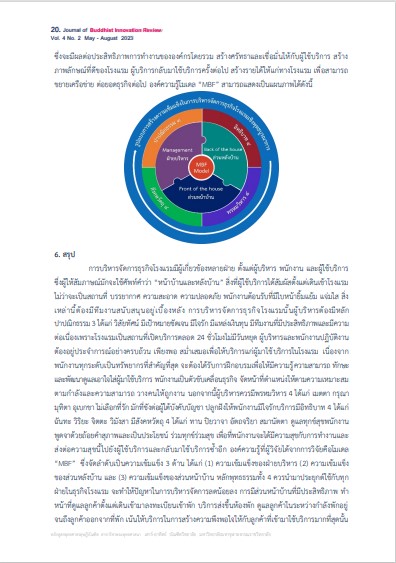
This research article has three objectives: 1) to study concepts and theories of hotel management in Thai society 2) to study the integration of dharmic principles in strengthening hotel management in Thai society and 3) to propose strengthening hotel management model based on Buddhist integration. This is qualitative research using in-depth interview with 15 key informants and studying relevant documents for appropriates principles in strengthening hotel management by adopting content analysis as well as descriptive analysis presentation. The research findings revealed that current problems and obstacles in hotel management are personnel issues, staff turnover and digital marketing competition. The applied dharma principles are Papanikadhamma 3, Iddhipada 4, Brahmavihara 4 and Sangkahavattu 4. The strengthening hotel management model based on Buddhist integration is “MBF” which consists of three strengths: (1) Management strength/M (2) Back of the house strength/B and (3) Front of the house strength/F. This model “MBF” can be applied to strengthen hotel management by building guest trust and confidence. Guest can utilize the service, be impressed, and repeat the services. If the hotel manages these three strengths, it will result in the hotel being reputable, profitable, able to build network and expand business sustainably.
Article Details

This work is licensed under a Creative Commons Attribution-NonCommercial-NoDerivatives 4.0 International License.
เรื่องลิขสิทธิ์/เป็นความคิดเห็นของผู้เขียน
References
เอกสารอ้างอิง :
หนังสือ :
สำนักงานคณะกรรมการพัฒนาการเศรษฐกิจและสังคมแห่งชาติ. (2559). แผนพัฒนาเศรษฐกิจและสังคมแห่งชาติฉบับที่สิบสอง พ.ศ. 2560 - 2564. กรุงเทพมหานคร: สำนักนายกรัฐมนตรี.
สำนักงานคณะกรรมการพัฒนาระบบราชการ. (2552). คู่มือการจัดระดับการกำกับดูแลองค์การภาครัฐตามหลักธรรมาภิบาลของการบริหารกิจการบ้านเมืองที่ดี (Good governance rating). กรุงเทพมหานคร: พรีเมียร์ โปร.
วารสาร :
ขจรศักดิ์ ว่องไว. (2562). การบริหารงานตามหลักธรรมาภิบาลที่ส่งผลต่อประสิทธิผลการบริหารงานโรงเรียนสังกัดสำนักงานเขตพื้นที่การศึกษาประถมศึกษามุกดาหาร. วารสารครุศาสตร์ มหาวิทยาลัยราชภัฏสกลนคร. 1(1);140-147.
ยุทธนา อิศรางกูร ณ อยุธยา. (2557). การบริหารงานบุคคลตามหลักธรรมาภิบาลในสถานศึกษา สังกัด สำนักงานเขตพื้นที่การศึกษาประถมศึกษาปทุมธานี เขต 1. วารสารวิจัยราชภัฏกรุงเก่า. 1(1); 55-57.
วิทยานิพนธ์ :
จุฑามาส นาคปฐม. (2559). การบริหารการศึกษาตามหลักธรรมาภิบาลของผู้บริหารโรงเรียนเทศบาลอินทปัญญาวัดใหญ่อินทาราม เทศบาลเมืองชลบุรี. ศึกษามหาบัณฑิต สาขาวิชาการบริหารการศึกษา คณะศึกษาศาสตร์ มหาวิทยาลัยบูรพา.
วิไลรัตน์ ฝ่ายดี. (2559). การบริหารงานตามหลักธรรมาภิบาลของผู้บริหารโรงเรียนขนาดกลางในอำเภอตาพระยาสังกัดสำนักงานเขตพื้นที่การศึกษาประถมศึกษาสระแก้ว. วิทยานิพนธ์การศึกษามหาบัณฑิตสาขาการบริหารการศึกษา. คณะศึกษาศาสตร์ มหาวิทยาลัยบูรพา.
Reference :
Books :
Blumel, C. M. Foreign Aid. (2000. Donor Coordination and the Pursuit of Good Governance (Kenya). Maryland : University of Maryland.
Clarke, V. B. (2001). Unit Search of Good Governance:Decentralization and Democracyin Ghana. Illinois : Northern Illinois University.
Hendrick, J.T. (2005). Donors and Good Governance : Analysis of a policy discourse in the Netherlands and Germany. Ph.D. Dissertation. Netherlands : Universities Twente.
Krejcie. R.V. and Morgan. D.W. (1970). Educational and Psychological Measurement. New York : Stag.
Marcella, C.C.(2005). Educational governance of the Morongo unified school district. Doctoral dissertation, Capella University.
Millan, M.C. and Leah, K. (2007). A misguided curriculum : Decentralized education policy in Ghana’s primary school system. Canada : Saint Mary’s University.
Phillip, K. (2005). The Politics of Good Governance in the Asian 4. Master Thesis, Australia Griffith University.
