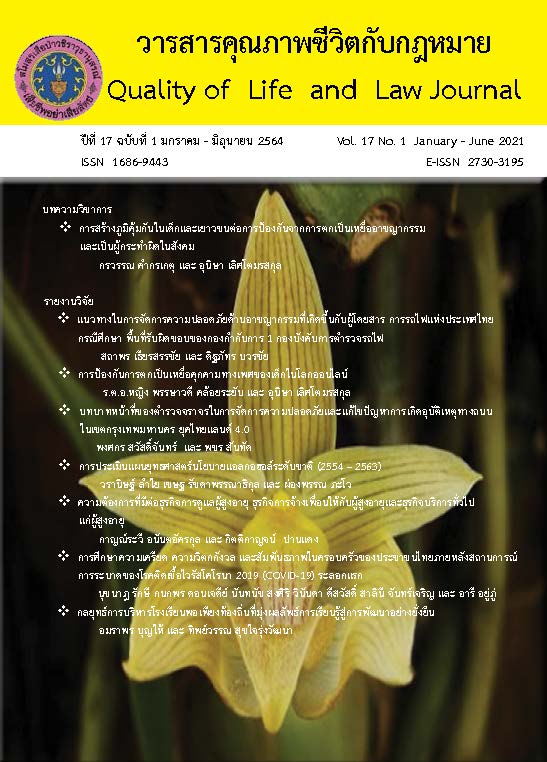
การศึกษาความเครียด ความวิตกกังวล และสัมพันธภาพในครอบครัวของประชาชนไทยภายหลังสถานการณ์การระบาดของโรคติดเชื้อไวรัสโคโรนา 2019 (COVID-19) ระลอกแรก
Article Sidebar
Main Article Content
บทคัดย่อ
มาตรการล็อกดาวน์ของไทยเพื่อลดการระบาดของโรค COVID-19 ระลอกแรกมีผลกระทบต่อการดำเนินชีวิตประจำวัน นำไปสู่ความเครียด ความวิตกกังวล และปัญหาสัมพันธภาพในครอบครัว การวิจัยภาคตัดขวางครั้งนี้มีวัตถุประสงค์เพื่อศึกษาระดับ ความเครียด ความวิตกกังวล และสัมพันธภาพในครอบครัว ภายหลังสถานการณ์การระบาดของโรค COVID-19 ระลอกแรก และศึกษาปัจจัยที่สัมพันธ์กับระดับความเครียดของประชาชนช่วงหลังการระบาดของโรค COVID-19 ระลอกแรก เก็บรวบรวมข้อมูลจากประชาชนที่อาศัยอยู่ในประเทศไทยช่วงหลังการแพร่ระบาดของโรค COVID-19 ระลอกแรก เดือนพฤษภาคม จำนวน 361 คน เครื่องมือที่ใช้ในการเก็บรวบรวมข้อมูล ได้แก่ แบบสอบถามข้อมูลทั่วไป แบบประเมินความเครียด (ST5) แบบประเมินความวิตกกังวล ฉบับภาษาไทย (Thai HADS) แบบสอบถามสัมพันธภาพในครอบครัว วิเคราะห์ข้อมูลด้วย จำนวน ร้อยละ ค่าเฉลี่ย ส่วนเบี่ยงเบนมาตรฐาน สถิติทดสอบไคสแควร์ และการทดสอบของฟิชเชอร์
ผลการวิจัย พบว่า กลุ่มตัวอย่างส่วนใหญ่มีความเครียดระดับน้อย 56.2% , ปานกลาง 29.9% และมากถึงมากที่สุด 13.9% ไม่มีความวิตกกังวล 97.8% สัมพันธภาพในครอบครัวที่เปลี่ยนแปลงในเชิงบวก พบว่า ครอบครัวเอาใจใส่ดูแล มากขึ้น 58.4% ส่วนสัมพันธภาพในเชิงลบ พบว่า การทะเลาะ เบาะแว้ง โต้เถียงกันในครอบครัว ยังมีเหมือนเดิม 25.2%, ลดลง 21.1% ปัจจัยที่มีความสัมพันธ์กับระดับความเครียดของประชาชนภายใต้การระบาดของโรค COVID-19 ระลอกแรก ได้แก่ ช่วงอายุ กลุ่มอาชีพ จำนวนบุตร และความวิตกกังวล (p-value< 0.05)
จากผลการวิจัยมีข้อเสนอแนะ คือ สุขภาพจิต และสัมพันธภาพในครอบครัวเป็นปัญหาสำคัญที่ส่งผลกระทบระยะยาว หน่วยงานที่เกี่ยวข้องจำเป็นต้องเพิ่มแนวทางการฟื้นฟูจิตใจให้มีพลังบวก พลังยืดหยุ่น และพลังร่วมมือ ในสถานการณ์การระบาดของโรค COVID-19 ซึ่งน่าจะยังคงมีอยู่ในระยะยาว
Article Details
- บทความหรือข้อคิดเห็นใดๆ ในวารสารคุณภาพชีวิตกับกฎหมายเป็
- กองบรรณาธิการไม่สงวนสิทธิ์
เอกสารอ้างอิง
ธนาสิทธิ์ วิจิตราพันธ์. (2564). วามชุกและปัจจัยที่เกี่ยวข้องกับความเครียดและภาวะซึมเศร้าใน สถานการณ์แพร่ระบาดโรคโควิด-19 ของประชาชนเขตคลินิกหมอครอบครัวบ้านทุ่งเสี้ยว อำเภอสันป่าตอง จังหวัดเชียงใหม่. วารสารสุขภาพจิตแห่งประเทศไทย,29(1), 12-21.
สำนักข่าวไทย PBS . (2563). 48 องค์กรจี้รัฐบาลประกาศระยะ 3 ปิดประเทศป้อง COVID-19.ค้นจาก https://news.thaipbs.or.th/content/289980.
สำนักงานปลัดกระทรวงสาธารณสุข.(2563). สธ. พบช่วงวิกฤติโควิด 19 ผู้สูงอายุ และครอบครัว เป็นพลังใจสำคัญสำหรับคนไทย. ค้นจาก https://pr.moph.go.th/?url=pr/detail/2/04/156844/
เอกลักษณ์ แสงศิริรักษ์ และคณะ. (2563). ความเครียดและอารมณ์เศร้าของบุคลากรทางการแพทย์ ในช่วงการระบาดของโรคติดเชื้อไวรัสโคโรนา 2019.วารสารสมาคมจิตแพทย์แห่งประเทศไทย, 65(4), 400-408.
Aldwin, C. M., Sutton, K. J., Chiara, G., & Spiro, A. (1996). Age differences in stress, coping, and appraisal: Findings from the Normative Aging Study. The Journals of Gerontology: Series B, 51(4), 179-188.
Bitan, D. T., Grossman-Giron, A., Bloch, Y., Mayer, Y., Shiffman, N., & Mendlovic, S. (2020). Fear of COVID-19 scale: Psychometric characteristics, reliability and validity in the Israeli population. Psychiatry Research, 289, 113100.
Campbell, A. M. (2020). An increasing risk of family violence during the Covid-19 pandemic: Strengthening community collaborations to save lives. Forensic Science International: Reports, 2, 100089.
Cochran, W.G. (1953). Sampling Techiques. New York : John Wiley & Sons. Inc.
Huang, C., Wang, Y., Li, X., Ren, L., Zhao, J., Hu, Y., ... & Cao, B. (2020). Clinical features of patients infected with 2019 novel coronavirus in Wuhan, China. The lancet, 395(10223), 497-506.
Lachman, M. E., Teshale, S., & Agrigoroaei, S. (2015). Midlife as a pivotal period in the life course: Balancing growth and decline at the crossroads of youth and old age. International journal of behavioral development, 39(1), 20-31.
Lee, J., Chin, M., & Sung, M. (2020). How Has COVID-19 Changed Family Life and Well-Being in Korea?. Journal of Comparative Family Studies, 51(3-4), 301-313.
Liu, N., Zhang, F., Wei, C., Jia, Y., Shang, Z., Sun, L., ... & Liu, W. (2020). Prevalence and predictors of PTSS during COVID-19 outbreak in China hardest-hit areas: Gender differences matter. Psychiatry research, 287, 112921.
Marzo, R. R., Singh, A., & Mukti, R. F. (2021). A survey of psychological distress among Bangladeshi people during the COVID-19 pandemic. Clinical Epidemiology and Global Health, 10, 100693.
Mertens, G., Gerritsen, L., Duijndam, S., Salemink, E., & Engelhard, I. M. (2020). Fear of the coronavirus (COVID-19): Predictors in an online study conducted in March 2020. Journal of Anxiety Disorders, 74, 102258.
OECD Policy Responses to Coronavirus (COVID-19) . (2020). Combatting COVID-19's effect on children. Retrieved from: http://www.oecd.org/coronavirus/policy-responses/combatting-covid-19-s-effect-on-children-2e1f3b2f/.
Qiu, J., Shen, B., Zhao, M., Wang, Z., Xie, B., & Xu, Y. (2020). A nationwide survey of psychological distress among Chinese people in the COVID-19 epidemic: implications and policy recommendations. General psychiatry, 33(2).
Relationship org . (2020). COVID-19 and its Effects on Relationships (May Survey: Have the COVID-19 restrictions affected people’s relationships?). Retrieved from https://www.relationships.org.au/what-we-do/research/online-survey/MaySurveyResults.pdf.
Scott, S. B., Whitehead, B. R., Bergeman, C. S., & Pitzer, L. (2013). Combinations of stressors in midlife: Examining role and domain stressors using regression trees and random forests. Journals of Gerontology Series B: Psychological Sciences and Social Sciences, 68(3), 464-475.
Taylor, S., Landry, C. A., Paluszek, M. M., Fergus, T. A., McKay, D., & Asmundson, G. J. (2020). Development and initial validation of the COVID Stress Scales. Journal of Anxiety Disorders, 72, 102232.
Wang, G., Zhang, Y., Zhao, J., Zhang, J., & Jiang, F. (2020). Mitigate the effects of home confinement on children during the COVID-19 outbreak. The Lancet, 395(10228), 945-947.
Williamson, H. C. (2020). Early Effects of the COVID-19 Pandemic on Relationship Satisfaction and Attributions. Psychological Science, 31(12), 1479-1487.
World Health Organization. (2020). Coronavirus Disease (COVID-19) Situation Report – 136. Retrieved from: https://www.who.int/docs/default-source/coronaviruse/situation-reports/20200604-covid-19-sitre136.pdf?sfvrsn=fd36550b_2
