
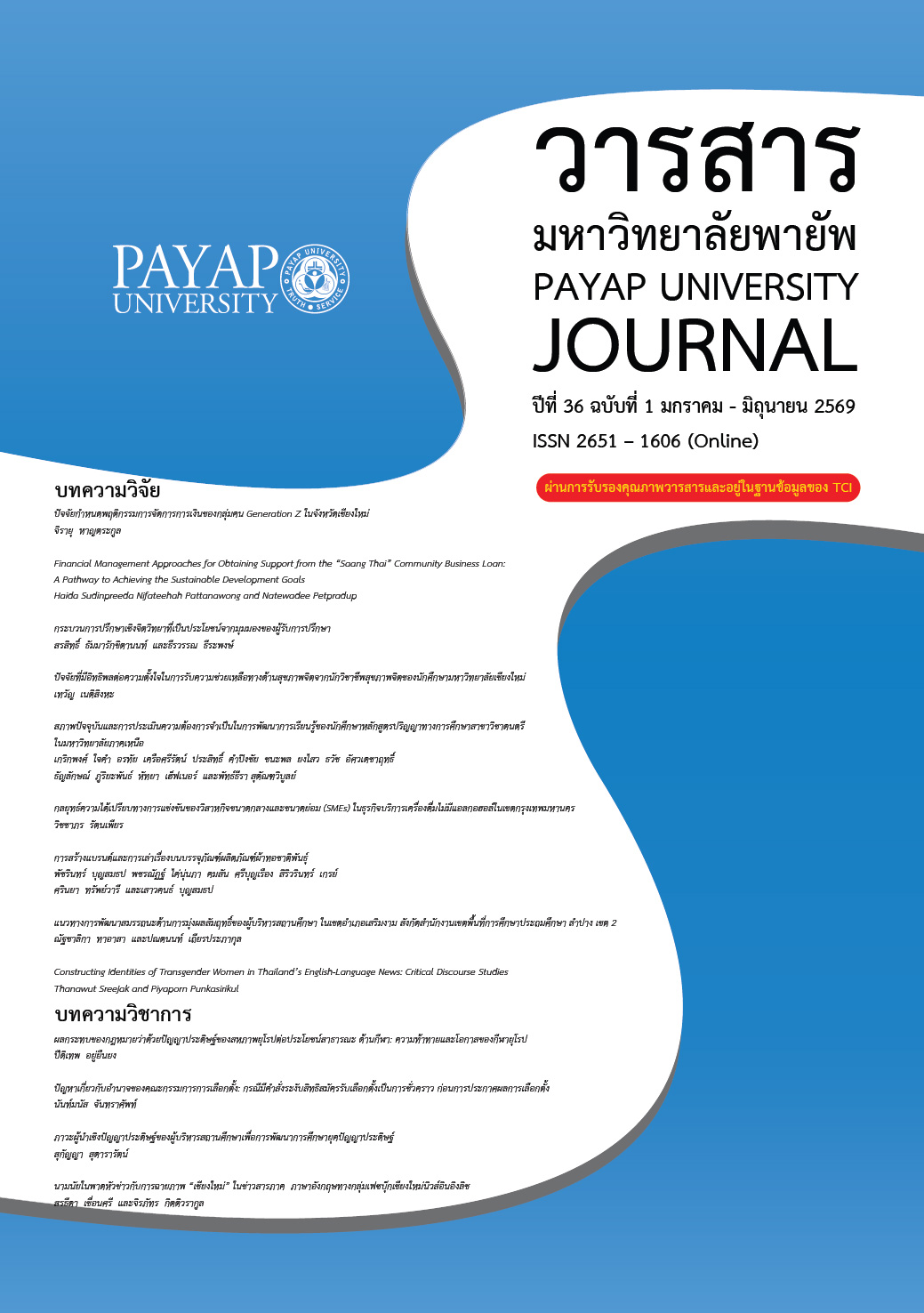
ผลกระทบของกฎหมายว่าด้วยปัญญาประดิษฐ์ของสหภาพยุโรป ต่อประโยชน์สาธารณะด้านกีฬา: ความท้าทายและโอกาสของกีฬายุโรป
Article Sidebar
Main Article Content
บทคัดย่อ
กฎหมายว่าด้วยปัญญาประดิษฐ์ของสหภาพยุโรป (EU AI Act) ได้กำหนดกฎระเบียบที่ครอบคลุมเพื่อสร้างเกณฑ์การจำแนก AI ตามความเสี่ยง และนำไปสู่การสกัดกั้นความเสี่ยงจาก AI ที่ยอมรับไม่ได้หรือความเสี่ยงที่ไม่เหมาะสม กฎหมายฉบับนี้มีผลบังคับใช้กับอุตสาหกรรมกีฬาในสหภาพยุโรป ซึ่งหมายความว่า ผู้กำหนดนโยบายด้านกีฬา หน่วยงานกำกับดูแลกีฬา และผู้เกี่ยวข้องสัมพันธ์กับกีฬาในสหภาพยุโรปต้องปฏิบัติตามทุกประเด็นที่เกี่ยวข้องของกฎหมายฉบับนี้ อย่างไรก็ตาม กฎหมายฉบับนี้เผชิญความท้าทายในบางประเด็น อันประกอบด้วยประเด็นการกำหนดให้องค์กรกีฬาต้องเปิดเผยข้อมูลตามระดับความเสี่ยงที่เกี่ยวข้อง และประเด็นการให้ข้อมูลเท็จหรือทำให้เข้าใจผิดเกี่ยวกับความสามารถของ AI บทความนี้อภิปรายและนำเสนอความท้าทายและโอกาสในการนำ AI มาใช้ภายใต้กฎระเบียบ ที่กำหนดโดยสโมสรกีฬาหรือนิติบุคคลที่ดำเนินธุรกิจกีฬาเพื่อให้มั่นใจว่าการแข่งขันกีฬาจะเป็นไป อย่างบริสุทธิ์ยุติธรรมและน่าเชื่อถือ ตั้งแต่ข้อได้เปรียบไปจนถึงข้อกังวลเกี่ยวกับการใช้ AI ในวงการกีฬา โดยอาศัยบทเรียนจากสหภาพยุโรป ข้อกังวลด้านประโยชน์สาธารณะของกฎหมายว่าด้วย AI ของสหภาพยุโรปครอบคลุมการใช้ AI ในลักษณะที่เป็นการต้องห้ามภายใต้หลักเกณฑ์เกี่ยวกับความปลอดภัยและความมั่นคง รวมถึงวัตถุประสงค์ต่าง ๆ อาทิ การสร้างสมดุลระหว่างนวัตกรรม AI กับเศรษฐกิจ ความซื่อสัตย์สุจริต และสังคม แม้ว่าการกำกับดูแล AI ภายใต้กฎหมายว่าด้วย AI ของสหภาพยุโรป เปิดแง่มุมทั้งความท้าทายและโอกาสสำหรับกีฬาที่ได้รับผลกระทบจากพฤติกรรมการใช้ AI ที่ไม่เหมาะสม แต่การวิเคราะห์ของบทความนี้ยังนำไปใช้กับสโมสรกีฬา นิติบุคคลที่ดำเนินธุรกิจกีฬา และผู้มีส่วนได้ส่วนเสียที่เกี่ยวข้องทั้งหมดในกีฬายุโรป โดยเฉพาะอย่างยิ่งผู้ที่ปฏิบัติตามกฎหมายว่าด้วย AI ของสหภาพยุโรปในแวดวงกีฬา
Downloads
Article Details
เอกสารอ้างอิง
Capgemini Research Institute. (2025). Beyond the game: The new era of AI-powered sports engagement (Research brief). https://www.capgemini.com/insights/research-library/tech-in-sports-2025/
Carrio Sampedro, A. (2024). Artificial intelligence in sports: A revolutionary technology that must be handled with care. Movimento, 30, 1-18. https://doi.org/10.22456/1982-8918.143278
Chidambaram, S., Maheswaran, Y., Patel, K., Sounderajah, V., Hashimoto, D. A., Seastedt, K. P., McGregor, A. H., Markar, S. R., & Darzi, A. (2022). Using Artificial Intelligence-Enhanced Sensing and Wearable Technology in Sports Medicine and Performance Optimisation. Sensors (Basel, Switzerland), 22(18), 1-11. https://doi.org/10.3390/s22186920
Consumer protection in age of artificial intelligence. (2025, 27 October). https://unctad.org/meeting/consumer-protection-age-artificial-intelligence-launch-unctads-technical-note-and-checklist
European Commission. (2025a). Artificial intelligence in the sport sector: A paper from the SHARE 2.0 initiative. Publications Office of the European Union. https://op.europa.eu/en/publication-detail/-/publication/3f44deb6-8937-11f0-9af8-01aa75ed71a1/language-en
European Commission. (2025b, October 23). AI Act. https://digital-strategy.ec.europa.eu/en/policies/regulatory-framework-ai
European Parliament. (2023, June 8). EU AI Act: first regulation on artificial intelligence. https://www.europarl.europa.eu/topics/en/article/20230601STO93804/eu-ai-act-first-regulation-on-artificial-intelligence
Gasser, U. (2023). An EU landmark for ai governance. Science, 380(6651), 1203. https://doi.org/10.1126/science.adj1627
Glebova, E., Madsen, D. Ø., Mihaľová, P., Géczi, G., Mittelman, A., & Jorgič, B. (2024). Artificial intelligence development and dissemination impact on the sports industry labor market. Frontiers in Sports and Active Living, 6, 1-11. https://doi.org/10.3389/fspor.2024.1363892
Karimi, J., Pashaie, S., & Golmohammadi, H. (2025). Artificial intelligence (AI) and the future of sports marketing: Exploring new challenges and opportunities. Journal of Advanced Sport Technology, 8(4), 65–79. https://doi.org/10.22098/jast.2025.15830.1374
Kesarwani, Y. (2025). The intersection of data privacy and abuse of dominance in digital markets: The role of AI. International Journal of Law, 11(2), 53–58. https://www.lawjournals.org/archives/2025/vol11issue2/PartA/11-2-10
Kim, J.-H., Kim, J., Kang, H., & Youn, B.-Y. (2025). Ethical implications of artificial intelligence in sport: A systematic scoping review. Journal of Sport and Health Science, 14, 1-11. https://doi.org/10.1016/j.jshs.2025.101047
Li, Q., Philipsen, N., & Cauffman, C. (2023). AI-enabled price discrimination as an abuse of dominance: A law and economics analysis. China-EU Law Journal, 9, 51–72. https://doi.org/10.1007/s12689-023-00099-z
Li, W., Liu, M., Liu, J., Zhang, B., Yu, T., Guo, Y., & Dai, Q. (2025). A review of artificial intelligence for sports: Technologies and applications. Intelligent Sports and Health, 1(3), 113–126. https://doi.org/10.1016/j.ish.2025.05.001
Lu, L., Yang, S., & Li, Q. (2024). The interaction of digital economy, artificial intelligence and sports industry development --based on China PVAR analysis of provincial panel data. Heliyon, 10(4), 1-15. https://doi.org/10.1016/j.heliyon.2024.e25688
Mateus, N., Abade, E., Coutinho, D., Gómez, M. Á., Peñas, C. L., & Sampaio, J. (2024). Empowering the Sports Scientist with Artificial Intelligence in Training, Performance, and Health Management. Sensors, 25(1), 1-12. https://doi.org/10.3390/s25010139
Musat, C. L., Mereuta, C., Nechita, A., Tutunaru, D., Voipan, A. E., Voipan, D., Mereuta, E., Gurau, T. V., Gurău, G., & Nechita, L. C. (2024). Diagnostic applications of AI in sports: A comprehensive review of injury risk prediction methods. Diagnostics, 14(22), 1-23. https://doi.org/10.3390/diagnostics14222516
Mushtaq, S. A., & Hafeez, M. M. (2024). An analysis of the abuse of dominance using artificial intelligence (AI) enabled price discrimination from a law and economics perspective. Pakistan Social Sciences Review, 8(3), 1-18. https://ojs.pssr.org.pk/journal/article/view/776
Nemitz, P. (2018). Constitutional democracy and technology in the age of artificial intelligence. Philosophical Transactions of the Royal Society A, 376(2133), 20180089. https://doi.org/10.1098/RSTA.2018.0089
Orlando, A. (2022). AI for sport in the EU legal framework. In P. Bouquet. A. Molinari & D. Petri (Eds.). 2022 IEEE International Workshop on Sport, Technology and Research (STAR) (pp. 100–105). IEEE. https://doi.org/10.1109/STAR53492.2022.9860029
Popa, M. G., Costin, D. E., Sandu, V. A., Pasarin, L. D., Diaconescu, D. L., & Popescu, M. C. (2024). Artificial intelligence in the sports sector. Annals – Economy Series, Constantin Brancusi University, Faculty of Economics, 3, 109–116. https://www.utgjiu.ro/revista/ec/pdf/2024-03/11_Popa.pdf
Regulation (EU) 2024/1689 of the European Parliament and of the Council of 13 June 2024 laying down harmonised rules on artificial intelligence (Artificial Intelligence Act). (2024). Official Journal of the European Union, 1–144. https://eurlex.europa.eu/legal-content/EN/TXT/PDF/?uri=OJ:L_202401689
Reis, F. J. J., Alaiti, R. K., Vallio, C. S., & Hespanhol, L. (2024). Artificial intelligence and Machine Learning approaches in sports: Concepts, applications, challenges, and future perspectives. Brazilian Journal of Physical Therapy, 28(3), Article 101083. https://doi.org/10.1016/j.bjpt.2024.101083
Rodrigues, A. C. N., Pereira, A. S., Mendes, R. M. S., Araújo, A. G., Couceiro, M. S., & Figueiredo, A. J. (2020). Using artificial intelligence for pattern recognition in a sports context. Sensors, 20(11), 1-18. https://doi.org/10.3390/s20113040
Westerbeek, H. (2025). Algorithmic fandom: How generative AI is reshaping sports marketing, fan engagement, and the integrity of sport. Frontiers in Sports and Active Living, 7, 1-7. https://doi.org/10.3389/fspor.2025.1597444
World Economic Forum. (2025). Artificial intelligence in media, entertainment and sport. Author. https://reports.weforum.org/docs/WEF_Artificial_Intelligence_in_Media_Entertainment_and_Sport_2025.pdf
Zhou, D., Keogh, J. W. L., Ma, Y., Tong, R. K. Y., Khan, A. R., & Jennings, N. R. (2025). Artificial intelligence in sport: A narrative review of applications, challenges and future trends. Journal of Sports Sciences, 1–16. https://doi.org/10.1080/02640414.2025.2518694
