
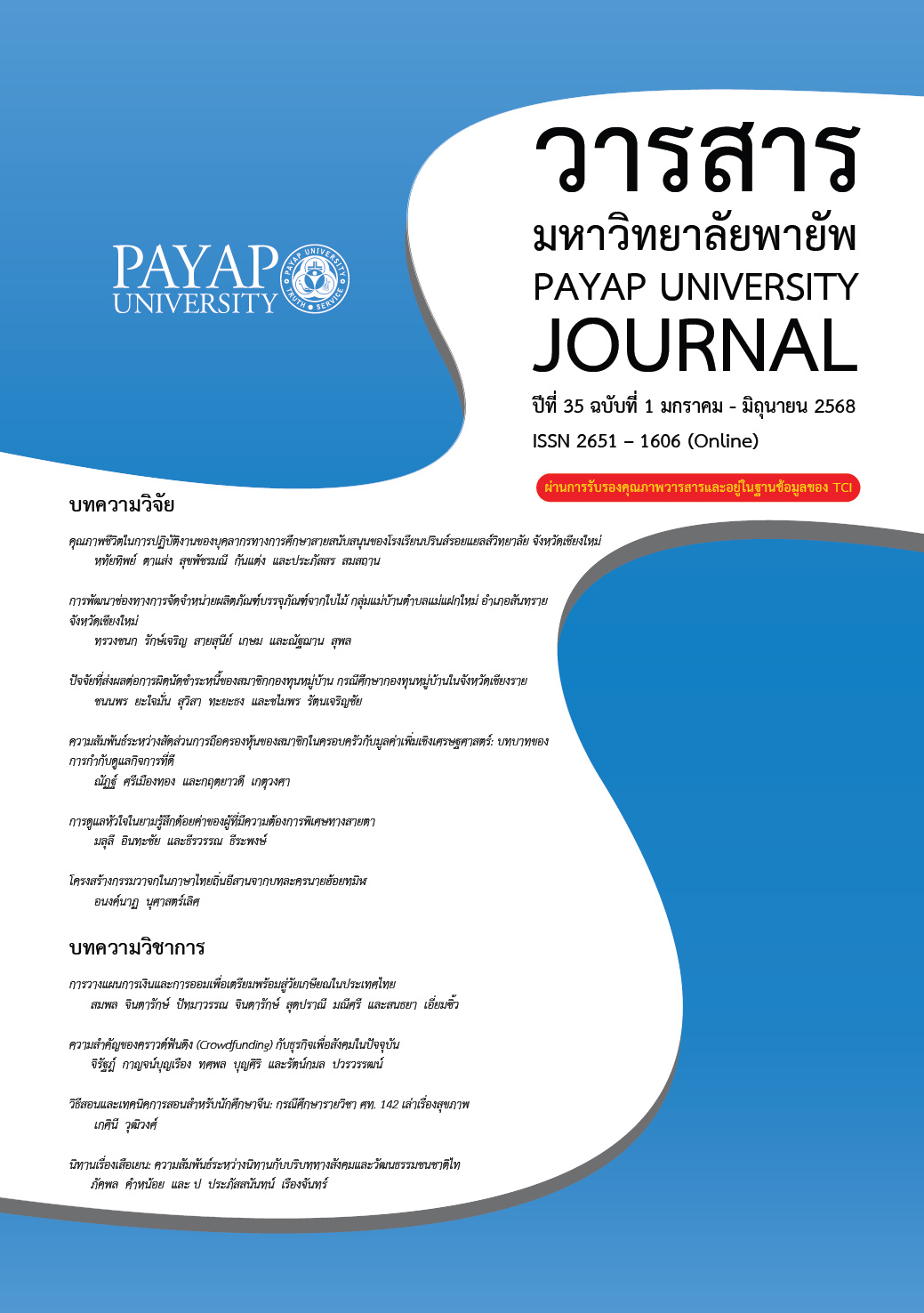
การดูแลหัวใจในยามรู้สึกด้อยค่าของผู้ที่มีความต้องการพิเศษทางสายตา
Article Sidebar
Main Article Content
บทคัดย่อ
การวิจัยครั้งนี้มีวัตถุประสงค์เพื่อศึกษาการดูแลจิตใจตนเองเมื่อเผชิญกับความรู้สึกด้อยค่า ของผู้มีความต้องการพิเศษทางสายตา ผู้ให้ข้อมูลในการศึกษานี้ คือ ผู้ที่มีความต้องการพิเศษทางสายตา (พิการทางสายตา) อายุ 18 ปีขึ้นไปที่เคยมีประสบการณ์รู้สึกด้อยค่า แต่ปัจจุบันไม่ได้รู้สึกเช่นนั้นแล้ว จำนวน 7 คน เก็บรวบรวมข้อมูลโดยการสัมภาษณ์เชิงลึก แล้วนำข้อมูลมาวิเคราะห์เนื้อหา (Content Analysis) ผลการศึกษาพบว่า ผู้ให้ข้อมูลมีกระบวนการดูแลจิตใจเมื่อเผชิญกับความรู้สึกด้อยค่า ดังนี้ 1) การระบายความรู้สึกที่เกิดจากประสบการณ์ที่เผชิญมาให้คนรอบข้างรับฟัง ทำให้ได้แลกเปลี่ยนมุมมอง ได้รับกำลังใจ และรู้สึกเบาใจจากความอัดอั้นที่เผชิญมา 2) การรับรู้และเข้าใจความแตกต่าง ของมนุษย์ ทำให้เกิดการยอมรับในตนเอง ไม่เปรียบเทียบตนเองกับผู้อื่น นำมาสู่การมีอิสระในการใช้ชีวิต และ 3) การทำกิจกรรมที่ชื่นชอบ งานอดิเรก และการกินช่วยให้รู้สึกเพลิดเพลินใจ มีความสุข และ ผ่อนคลายจากความเหนื่อยล้า รวมไปถึงการนอนทำให้ร่างกายและจิตใจได้หยุดพักจากความทุกข์ ที่เผชิญมา สามารถกลับมารับมือกับปัญหาในชีวิตประจำวันได้
Downloads
Article Details
เอกสารอ้างอิง
กัญญาวีณ์ โมกขาว, วัชรินทร์ ช่างประดับ, และวลัยนารี พรมลา. (2563). อิทธิพลของจิตวิทยาเชิงบวก ความรอบรู้ด้านสุขภาพจิตต่อความสามารถในการดูแลตนเองด้านจิตใจของประชาชนในตำบลท่าข้าม อำเภอบางประกง จังหวัดฉะเชิงเทรา. วารสารกองการพยาบาล, 47(3), 57-70. https://he01.tci-thaijo.org/index.php/JND/article/view/249931/169061
กิตติทัต แสงส่ง และภัทรกร มุขศรีนาค. (2567). แนวทางการดูแลตนเองของนักจิตวิทยาการปรึกษา. วารสารสุขภาพกับการจัดการสุขภาพ, 10(2), 12-25.
https://he01.tci-thaijo.org/index.php/slc/article/view/272960/185375
จิตติมา เจือไทย. (2551). การสร้างอัตลักษณ์ตัวตนของคนพิการ [ปริญญานิพนธ์ดุษฎีบัณฑิต, มหาวิทยาลัยศรีนครินทรวิโรฒ]. http://thesis.swu.ac.th/swudis/Dev_Ed/Jittima_J.pdf
ชวัลรัตน์ ทวาโรจน์. (2560). การวิเคราะห์บุคลิกภาพของอังเดร ทาร์คอฟสกี้ ผ่านภาพยนตร์เรื่อง The mirror [ภาคนิพนธ์ศิลปะศาสตร์บัณฑิต, มหาวิทยาลัยธรรมศาสตร์]. TU digital collection. https://digital.library.tu.ac.th/tu_dc/frontend/Info/item/dc:183763
ถิรวรินทร์ บุญญาพิพรรธน์, ชมพูนุท ศรีจันทร์นิล, และดลดาว วงศ์ธีระธรณ์. (2566). สิ่งที่ช่วยให้ก้าวผ่านการฆ่าตัวตาย: มุมมองจากผู้หญิงที่ก้าวผ่านการฆ่าตัวตาย. วารสารพุทธจิตวิทยา, 8(2), 243-256. https://so03.tci-thaijo.org/index.php/jbp/article/view/268977
ทิพาภรณ์ เยสุวรรณ์, ปรีชา อุปโยคิน, และเทิดชัย ชีวะเกตุ. (2555). คนพิการขาขาดไทย: กระบวนการตีตราและการปรับตัว. วารสารเวชศาสตร์ฟื้นฟู, 22(2), 51-57. https://www.rehabmed.or.th/main/wp-content/uploads/2015/01/L-340.pdf
ประกาศกระทรวงศึกษาธิการ เรื่อง กำหนดประเภทและหลักเกณฑ์ของคนพิการทางการศึกษา พ.ศ. 2552. (2552). ราชกิจจานุเบกษา. เล่มที่ 12 ตอนพิเศษ 80 ง. หน้า 45-47.
พระราชบัญญัติส่งเสริมและพัฒนาคุณภาพชีวิตคนพิการ พ.ศ. 2550. (2550). ราชกิจจานุเบกษา. เล่มที่ 124 ตอนที่ 61 ก. หน้า 8-24.
พัชรี ศุภดิษฐ์. (2551). อิทธิพลของการเปรียบเทียบทางสังคมและรายได้ต่อความสุขเชิงอัตวิสัย [วิทยานิพนธ์ปริญญามหาบัณฑิต, จุฬาลงกรณ์มหาวิทยาลัย]. Chulalongkorn University Intellectual Repository. https://cuir.car.chula.ac.th/handle/123456789/21590
พารุณี วงษ์ศรี และทีปทัศน์ ชินตาปัญญากุล. (2561). การประยุกต์ใช้ทฤษฎีของโอเร็มกับการดูแลและการให้คำแนะนำผู้ป่วยที่มีภาวะหัวใจล้มเหลว. พยาบาลตำรวจ, 10(1), 209-219. https://he01.tci-thaijo.org/index.php/policenurse/article/view/132208/99590
มันทนาวดี ตันสกุล. (2552). ความหมายของชีวิตในทัศนะผู้พิการทางสายตา [วิทยานิพนธ์ปริญญามหาบัณฑิต, มหาวิทยาลัยเชียงใหม่]. Digital Research Information Center. https://dric.nrct.go.th/index.php?/Search/SearchDetail/223862
ยุรดา สินสวัสดิ์. (2566). ประสบการณ์การจัดการความเครียดจากการทำงานของนักเขียน [วิทยานิพนธ์ปริญญามหาบัณฑิต, จุฬาลงกรณ์มหาวิทยาลัย]. Chula Digital Collection. https://digital.car.chula.ac.th/chulaetd/10392/
ศรัณยา ยอดสุด. (2553). ความสามารถในการดูแลตนเองด้านจิตใจและพฤติกรรมการป้องกันโรคของผู้สูงอายุ [วิทยานิพนธ์ปริญญามหาบัณฑิต, มหาวิทยาลัยศรีนครินทรวิโรฒ]. Srinakharinwirot University Institutional Repository. https://ir.swu.ac.th/jspui/handle/123456789/972
สรัญญา เตรัตน์. (2559). ผัสสะกับการใช้ชีวิตของคนตาบอด [วิทยานิพนธ์ปริญญามหาบัณฑิต, มหาวิทยาลัยธรรมศาสตร์]. TU Digital Collections. https://digital.library.tu.ac.th/tu_dc/frontend/Info/item/dc:91433
แอน มหาคีตะ. (2560). การเห็นคุณค่าในตนเองและแรงจูงใจใฝ่สัมฤทธิ์ของนักกีฬาพิการที่เข้าร่วมการแข่งขันกีฬาอาเซียนพาราเกมส์ ครั้งที่ 8 ที่ประเทศสิงค์โปร์. วารสารวิชาการสถาบันพละศึกษา, 9(3), 213-228. http://digital.nlt.go.th/dlib/items/show/8753?
Jessup, G. M., Bundy, A. C., & Cornel, E. (2012). To be or to refuse to be? Exploring the concept of leisure as resistance for young people who are visually impaired, Leisure Studies, 32(2), 191-205. https://doi.org/10.1080/02614367.2012.695388
Kef, S., & Dekovic, M. (2004). The role of parental and peer support in adolescents well-being: A comparison of adolescents with and without a visual impairment. Journal of Adolescence, 27(4), 453-466. https://doi.org/10.1016/j.adolescence.2003.12.005
Lestari, R., & Fajar, M. (2020). Gratitude, self-esteem and optimism in people with physical disabilities. Prizren Social Science Journal, 4(2), 14-21. https://prizrenjournal.com/index.php/PSSJ/article/view/150
Lourens, H., & Swartz, L. (2016). Experiences of visually impaired students in higher education: Bodily perspectives on inclusive education. Disability and Society, 31(2), 240-251. https://doi.org/10.1080/09687599.2016.1158092
Nelson, M. (2021, October 15). You should talk about your problems more here are some instructions for self-disclosure. Psychology Today. https://www.psychologytoday.com/us/blog/how-to-be-a-burden/202110/you-should-talk-about-your-problems-more?fbclid=IwZXh0bgNhZW0CMTAAAR1j8QAC4XsVkAjXgmuuP-uBugI5MMdti8qSf376j4U474hbI6lyQl0KnEI_aem_nFfhSuTXGyqCjLYKZxE-QA
Salloum, A., Kondrat, D. C., Johnco, C., & Olson, K. R. (2015). The role of self-care on compassion satisfaction, burnout and secondary trauma among child welfare workers. Children and Youth Services Review, 49, 54-61. https://doi.org/10.1016/j.childyouth.2014.12.023
Thahane, L. N. (2002). The life-world of visually impaired adolescents: An educational guidance perspective [Thesis Master of Education, University of Johannesburg]. UJContent. https://hdl.handle.net/10210/6992
Tjahyani, A. P. (2024). Feelings of inferiority in adolescents and implications for guidance and counseling services: A literature review. Consilium: Berkala Kajian Konseling dan Ilmu Keagamaan, 11(1), 1-9. https://jurnal.uinsu.ac.id/index.php/consilium/article/view/13969
Tran, V., Szabo, A., Ward, C., & Jose, P. E. (2023). To vent or not to vent? The impact of venting on psychological symptoms varies by levels of social support. International Journal of Intercultural Relations, 92(2023), 1-9. https://doi.org/10.1016/j.ijintrel.2022.101750
Yang, J., & Milliren, A. (2009). The psychology of courage. Routledge. https://doi.org/10.4324/9780203893517
Zur, H. B., & Debi, Z. (2005). Optimism, social comparisons, and coping with vision loss in Israel. Journal of Visual Impairment & Blindness, 99(3), 151-164. https://doi.org/10.1177/0145482X0509900304
