Product development of dining table decorations from weaving fabrics of local weaving community enterprises in Ban Kha District, Ratchaburi Province
Keywords:
Decorative dining table products, Local weaving community, Woven fabrics, Karen motifsAbstract
The research objectives were 1) to explore the problems and needs of developing decorative dining table products from woven fabrics of the local weaving community enterprise group, Ban Kha District, Ratchaburi Province, 2) to develop decorative products on the dining table from woven fabrics of the local weaving community enterprise group, and 3) to investigate satisfaction levels towards the decorative dining table products made by the local weaving community enterprise group. Combined research methods, both qualitative and quantitative, were employed in this research. The research tool was interviews with stakeholders in the local weaving community enterprise and questionnaires with the experts and the target group to explore their satisfaction levels. Analyzed using frequency, percentage, average and standard deviation.
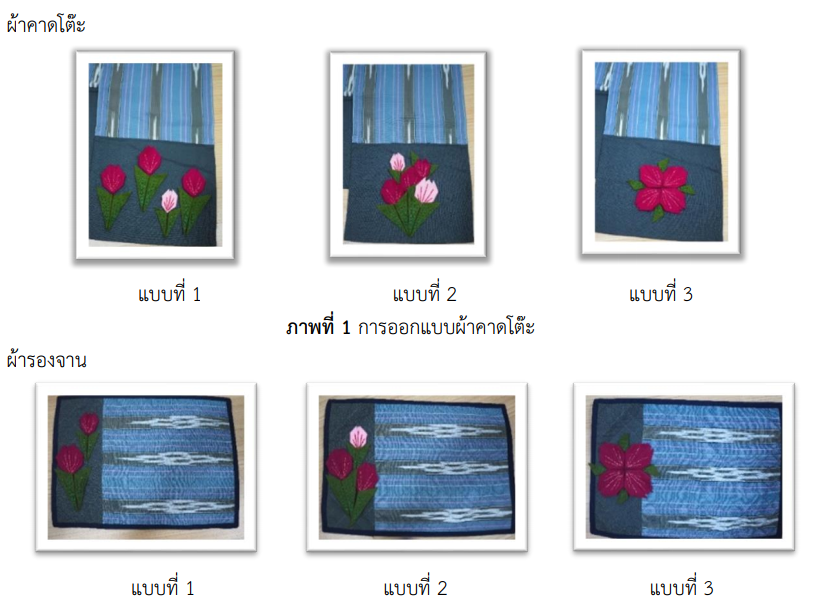
The results of the analysis showed that the community enterprise group had weaving, sewing Karen shirt products, accessories as home decorations, and products embroidered with motifs related to the Karen faith. The group members expressed their desire to add value to their decorative dining table products by incorporating the weaving of Karen fabric to create new products and using embroidery to add artistic elements. The product line of the local weaving community enterprise includes tablecloths, plate mats, glass coasters, and tissue boxes, each available in three different designs. Five experts were consulted to assess the suitability of these designs. The majority of experts preferred the third design for tablecloths, the second design for plate mats, the third design for glass coasters, and the third design for tissue boxes. Prototypes were then developed, and product satisfaction was evaluated through a questionnaire. The respondents exhibited a high level of satisfaction with the overall product, with an average of 4.25.
References
Burapajatana, J. (2016). Applying patterns from Identity of Jok woven textiles of Mae Jam todesign of cultural textile products for home decoration. Veridian E-Journal, Silpakorn University, 9(3), 1720-1738. Retrieved from https://he02.tci-thaijo.org/index.php/Veridian-E-Journal/article/view/90823 (In Thai)
Chomchuen, T., & Jaiban, S. (2018). Enhancing of Productive Potentiality of Community Products “Karen Weaving” with Sufficiency Economy and Creative Economy: Case of Mae Yao Sub-district Community,Muang District. Chiang Rai Province. Journal of Community Development and Life Quality, 3(2), 203-214. Retrieved from https://so02.tci-thaijo.org/index.php/JCDLQ/article/view/132500 (In Thai)
Dawdeaen, S. (2010). The Study on the Development of Woven Cloth with Antique Pattern into Table-cloth Set Handicraft as Commercial Products at Pa Tang Village in Uthai Thani Province. Art and Architecture Journal Naresuan University, 1(1), 40-50. Retrieved from https://so01.tci-thaijo.org/index.php/ajnu/article/view/26374 (In Thai)
Hongrattanavorakit, S., & Chantakul, S. (2022). Development of home decoration products from woven origami technique community products sewing enterprise and artificial fabric Khao Kaew Srisomboon Thung Saliam Sukhothai. Art and Architecture Journal Naresuan University, 13(1), 113-122. Retrieved from https://so01.tci-thaijo.org/index.php/ajnu/article/view/246574 (In Thai)
Janpla, J., Songsuwong, W., Kijkar, P., & Wongsaming, S. (2016). Development of Thai Song Dam Woven Fabric Products Add Value Following the Creative Economy Concept. Veridian E-Journal, Silpakorn University, 9(2), 82-98. Retrieved from https://he02.tci-thaijo.org/index.php/Veridian-E-Journal/article/view/61543 (In Thai)
Kanchanasuphan, J., Boonkoum, W., & Kheovichai, K. (2020). Participatory Action Research for the Conservation of Sustainable Karen Culture: a Case Study of the Karen Ethnic Group in Ratchaburi Province. Dhonburi Rajabhat University Journal, 14(2), 84-97. Retrieved from http://ithesis-ir.su.ac.th/dspace/handle/123456789/2750 (In Thai)
Keawpan, T., Itsaranuwat, S., & Plangnok, J. (2020). Principles and concepts in product design. Journal of Humanities and Social Sciences Surin Rajabhat University, 22(2), 161-182. Retrieved from https://so03.tci-thaijo.org/index.php/jhssrru/article/view/248733 (In Thai)
Kongjok, A. (2022). Head of the Karen weaving group Ratchaburi Province. Ratchaburi.
Phiwongkun, K., Bunlikhitsir, B., & Panthupkorn, P. (2019). A Study on Ethnic Tribal Patterns in Karen Ruam Mitr Souvenir Designs. MangraiSaan Journal, 7(2), 123-140. Retrieved from https://so04.tci-thaijo.org/index.php/mrsj/article/view/192149 (In Thai)
Pichayakul, P., Mahachaiwong, N., & Srisawat, J. (2020). Marketing Mix Strategy Development of Ban Lai Kaew Karen Weaving Textile Group, Chiang Mai Province. Area Based Development Research Journal, 12(5), 356-372. Retrieved from https://so01.tci-thaijo.org/index.php/abcjournal/article/view/241210 (In Thai)
Sahasomchoke, W., Porncharoen, R., & Somthai, S. (2013). Prototype Design and Development of Home Use Souvenirs and Home Decorative Items, Produced from Natural Material and Production Wastage from Pathum-thani Province. Phranakhon Rajabhat Research Journal, 8(1), 1-16. Retrieved from https://so05.tci-thaijo.org/index.php/PNRU_JHSS/article/view/41758 (In Thai)
Thama, R., & Kason, K. (2020). The Development of Karen Scarf Pattern, Scarf Weaving Group, Ruammit Village, Mae Yao Sub-District, Mueang District, Chiang Rai Province. The Journal of Accounting Review Phiang Rai Rajabhat University, 5(1), 13-23. Retrieved from https://so02.tci-thaijo.org/index.php/JAR_CRRU/article/view/259678 (In Thai)
Downloads
Published
How to Cite
Issue
Section
License
Copyright (c) 2024 Institute of Research and Development, Suan Sunandha Rajabhat University

This work is licensed under a Creative Commons Attribution-NonCommercial-NoDerivatives 4.0 International License.
บทความที่ได้รับการตีพิมพ์เป็นลิขสิทธิ์ของ สถาบันวิจัยและพัฒนา มหาวิทยาลัยราชภัฎสวนสุนันทา
ข้อความที่ปรากฏในบทความแต่ละเรื่องในวารสารวิชาการเล่มนี้เป็นความคิดเห็นส่วนตัวของผู้เขียนแต่ละท่านไม่เกี่ยวข้องกับมหาวิทยาลัยราชภัฎสวนสุนันทา และคณาจารย์ท่านอื่นๆในมหาวิทยาลัยฯ แต่อย่างใด ความรับผิดชอบองค์ประกอบทั้งหมดของบทความแต่ละเรื่องเป็นของผู้เขียนแต่ละท่าน หากมีความผิดพลาดใดๆ ผู้เขียนแต่ละท่านจะรับผิดชอบบทความของตนเองแต่ผู้เดียว
 ISSN
ISSN