The Influence of Basic Concepts in Educational Management on CIPPA Model Teaching Method to Seminar in Police Administration
Keywords:
CIPPA model, Police cadets, Teaching method, Educational managementAbstract
The purposes of this research were to study 1) opinions of police cadets on the basic concepts of education management in 5 areas (1) knowledge creation, (2) group process and cooperative learning, (3) learning readiness, (4) learning process, and (5) learning transfer; and 2) the influence of the basic concepts of educational management on the teaching method of the Zipp a Model. This study was conducted by applying the quantitative method, Data were collected from 125 police cadets using a questionnaire that was verified. The research analyzed the data using descriptive statistics and route analysis techniques.
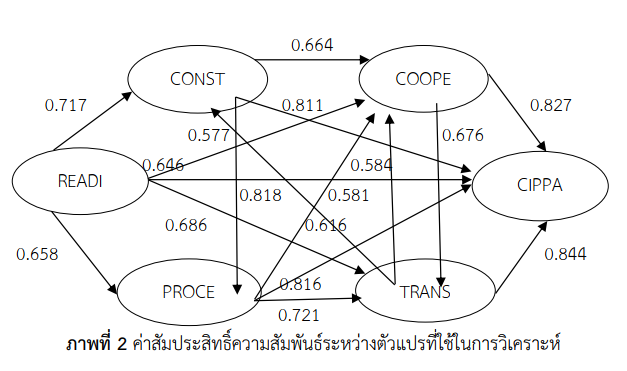
The research results found that 1) police cadets have moderate opinions on the basic concept of education management in all 5 areas, in descending order: learning transfer (𝑥̅=2.74, S.D.= 0.66) group process and cooperative learning (𝑥̅= 2.72, S.D.= 0.59), learning readiness (𝑥̅= 2.63, S.D.= 0.78), process learning (𝑥̅= 2.61, S.D.= 0.94), and knowledge creation (𝑥̅= 2.59, S.D.= 0.66) and 2. Learning transfer had the most direct influence (0.844) on the Zippa model teaching method, and learning readiness had the greatest influence on both indirect (1.907) and total (2.725) influence on the Zippa model teaching method.
References
Andersson, S., Granat, L., Brännström, M., & Sandgren, A. (2022). Translation, cultural adaptation, and content validation of the palliative care self-efficacy scale for use in the Swedish context. International Journal of Environmental Research and Public Health, 19(3), 1143. doi:10.3390/ijerph19031143
Bloom, B. S., Engelhart, M., Furst, E. J., Hill, W. H., & Krathwohl, D. R. (1956). Taxonomy of Educational Objectives, Handbook: The Cognitive Domain. New York: David McKay Co Inc.
Chen, C. (2024). Assessment of test validity in the context of the Duolingo English test. Journal of Modern Linguistics, 14(1), 1-7. doi:10.4236/ojml.2024.141001
Chen, C., Chen, K. Z., & Tsai, H. F. (2022). Did self-directed learning curriculum guidelines change Taiwanese high-school students’ self-directed learning readiness? The Asia-Pacific Education Researcher, 31, 409-426. doi:10.1007/s40299-021-0058w
Cheung, G. W., Thomas, H. C., Lau, R. S., & Wang, L. C. (2023). Reporting reliability, convergent and discriminant validity with structural equation modeling: A review and best-practice recommendations. The Asia-Pacific Education Researche, 31(4), 409–426. doi:10.1007/s40299-021-00582-w
Couper, M. P. (2017). New Developments in Survey Data Collection. Annual Review of Sociology, 43(1), 121-145. doi:10.1146/annurev-soc-060116-053613
Do, H. N., Do, B. N., & Nguyen, M. H. (2023). 3 How do constructivism learning environments generate better motivation and learning strategies? The design science approach. Heliyon, 9(12), e22862. doi:10.1016/j.heliyon.2023.e22862
Institutional Review Board Health Sciences and Minimal Risk Research IRBs. (2023). Belmont Report. Wisconsin: University of Wisconsin-Madison Press.
Jeawkok, J. (2023). Development of Academic Achievement toward Community Health Management on Health System in CIPPA Model Learning Management for Students of Social Development Program, Faculty of Humanities and Social Sciences, Prince of Songkla University, Pattani Campus. Humanities and Social Sciences Journal of Pibulsongkram Rajabhat University, 17(1), 254-265. Retrieved from https://so01.tci-thaijo.org/index.php/GraduatePSRU/article/view/244457 (In Thai)
Johnson, D. W., & Johnson, R. T. (2018). Cooperative learning: The foundation for active learning. London: IntechOpen.
Khammanee, T. (1999 A). Organizing teaching and learning with the student at the center: CIPPA model. Journal of Education Studies, 27(3), 1-17. doi:10.58837/CHULA.EDUCU.27.3.1
Khammanee, T. (1999 B). Organizing teaching and learning by using the learner as the center. Bangkok: Odeon store press (In Thai).
Khammanee, T. (2002). Teaching science: knowledge for organizing an effective learning process. Bangkok: Chulalongkorn University (In Thai).
Knowles, J. G., & Cole, A. L. (2008). Handbook of the Arts in Qualitative Research: Perspectives, Methodologies, Examples, and Issues. Los Angeles: CA: Sage Publications.
León, B., Rio, J., Pérez, S., & Iglesia, D. (2023). Cooperative learning, emotions, and academic performance in physical education: A serial multiple mediation model. Psicología Educativa, 29(1), 75-82. doi:10.5093/psed2023a2
Liu, Y., Meng, Q., Chen, R., & Wang, J. (2024). A New Method to Evaluate the Similarity of Chromatographic Fingerprints: Weighted Pearson Product-Moment Correlation Coefficient. Journal of Chromatographic Science, 42(10), 545-550. doi:10.1093/chromsci/42.10.545
Millan, M. R., Rodríguez, M. V., Flores, M. E., Cornejo, L. B., Villegas, P. V., & Hernández, J. M. (2023). Evaluation of online learning readiness in the new distance learning normality. Heliyon, 9(11), e22070. doi:10.1016/j.heliyon.2023.e22070
Ngamnin, S. (2022). The effect of learning management based on CIPPA model with graphic organizer to promote analytical thinking ability of teacher students. Social Sciences Research and Academic Journal, 17(2), 137-151. Retrieved from https://so05.tci-thaijo.org/index.php/JSSRA/article/view/254485 (In Thai)
Regmi, K. (2020). A systematic review of the factors– enablers and barriers– affecting e-learning in health sciences education. BMC Medical Education, 20, 91. doi:10.1186/s12909-020-02007-6
Roebianto, A., Savitri, S. i., Aulia, I., Auciyana, A., & Mubarokah, l. (2023). Content validity: Definition and procedure of content validation in psychological research. TPM – Testing, 30(1), 5-18. doi:10.4473/TPM30.1.1
Ronkko, M., & Cho, E. (2020). An updated guideline for assessing discriminant validity. Organizational Research Methods, 25(1), 6-14. doi:10.1177/1094428120968614
Royal Police Cadet Academy. (2023). Course Report 2023: Seminar in Police Administration. Retrieved October 20, 2024, from https://qa.rpca.ac.th/files/1/pdf (In Thai)
Royal Thai Police. (2024). List of 4th year police cadets choosing to register for elective courses Semester 1, academic year 2024. Nakhon Pathom. : RPCA Prints (In Thai).
Sabangban, H. (2024). The Development of geographical abilities and learning achievement geography subject using the CIPPA model with gamilab computer game of the forth grade student at ban navee school, Khao Wong district, Kalasin province. Journal of MCU Ubon Review, 9(1), 775-791. Retrieved from https://so06.tci-thaijo.org/index.php/mcjou/article/view/273538 (In Thai)
Santosa, L., Iskandar, L., & Munawaroh, L. A. (2024). Assessing students’ learning readiness toward student-centered learning. Journal of English Education and Teaching, 8(1), 254-269. doi:10.33369/jeet.8.1.254-268
Saqr, M., Matcha, W., Ayu, N., & Uzir, N. A. (2023). Transferring effective learning strategies across learning contexts matters: A study in problem-based learning. Australasian Journal of Educational Technology, 39(3), 39-57. doi:10.14742/ajet .8303
Schuler, J., Anderson, B., Murnieks, C. Y., Baum, M., & Kusshauer, A. (2023). Test-retest reliability in metric conjoint experiments: A new workflow to evaluate confidence in model results. Entrepreneurship Theory and Practice, 48(2), 42-57. doi:10.1177/1042258723118407
Sriubon, P. (2022). The achievement of the hotel business learning using CIPPA model for the first-year vocational certificate students in hotel major, Loengnoktha vocational college. KKU International Journal of Humanities and Social Sciences, 12(1), 21-40. Retrieved from https://so04.tci-thaijo.org/index.php/KKUIJ/article/view/249747 (In Thai)
Sumantri, A., Paulpi, M., & Ping, L. C. (2023). Student readiness in the transfer of online learning to face-to-face learning after the Covid-19 Pandemic. Harmoni Sosial Jurnal Pendidikan IPS, 10(2), 122-131. doi:10.21831/hsjpi.v10i2.64507
Thorndike, E. L. (1898). Animal intelligence: An experimental study of the associative processes of animals. Psychological Review Monograph Supplement, 2, 1–107. doi:10.1037/10780-000
Tsai, C. A., .Song, M. Y., Lo, Y., & Lo, C. C. (2023). Design thinking with constructivist learning increases the learning motivation and wicked problem-solving capability—An empirical research in Taiwan. Thinking Skills and Creativity, 50, 101385. doi:10.1016/j.tsc.2023.101385
Watrat, S. (2023). The development of learning achievement on Buddhist proverbs of students in grade 1 Wat Ban Wat Student's Office by using the teaching technique of the Cippa Model. Chaiyaphruekphirom Journal, 5(2), 47-56. Retrieved from https://so16.tci-thaijo.org/index.php/JPPJ/article/view/86/ (In Thai)
Yamane, T. (1973). Statistics: An Introductory Analysis (3rd ed.). New York: Harper and Row Publications.
Zhao, Z., Alzubaidi, L., Zhang, J., Duan, Y., & Gu, Y. (2023). A comparison review of transfer learning and self-supervised learning: Definitions, applications, advantages and limitations. Expert Systems with Applications, 242, 122807. doi:10.1016/j.eswa.2023.122807
Downloads
Published
How to Cite
Issue
Section
License
Copyright (c) 2024 Institute of Research and Development, Suan Sunandha Rajabhat University

This work is licensed under a Creative Commons Attribution-NonCommercial-NoDerivatives 4.0 International License.
บทความที่ได้รับการตีพิมพ์เป็นลิขสิทธิ์ของ สถาบันวิจัยและพัฒนา มหาวิทยาลัยราชภัฎสวนสุนันทา
ข้อความที่ปรากฏในบทความแต่ละเรื่องในวารสารวิชาการเล่มนี้เป็นความคิดเห็นส่วนตัวของผู้เขียนแต่ละท่านไม่เกี่ยวข้องกับมหาวิทยาลัยราชภัฎสวนสุนันทา และคณาจารย์ท่านอื่นๆในมหาวิทยาลัยฯ แต่อย่างใด ความรับผิดชอบองค์ประกอบทั้งหมดของบทความแต่ละเรื่องเป็นของผู้เขียนแต่ละท่าน หากมีความผิดพลาดใดๆ ผู้เขียนแต่ละท่านจะรับผิดชอบบทความของตนเองแต่ผู้เดียว
 ISSN
ISSN