
วิถีแห่งทรัพยากรเตยของช่างจักสานเตยปาหนันชุมชนบ้านดุหุน จังหวัดตรัง (The way of Pandanus resources among Panan Pandanus weaving artisans of the Baan Duhun community, Trang province)
Article Sidebar
Main Article Content
Abstract
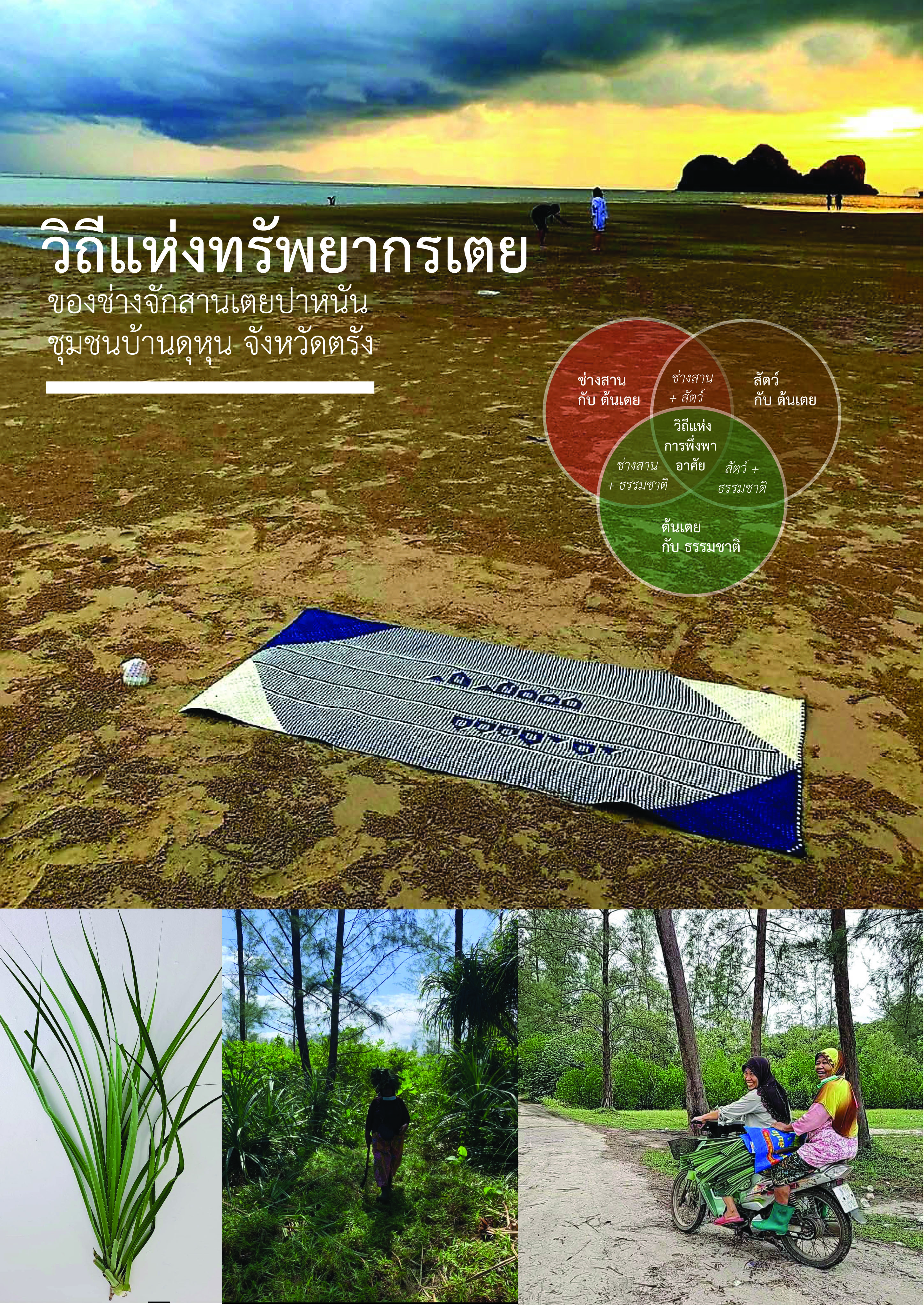
งานวิจัยนี้ให้ความสำคัญต่อต้นเตยปาหนัน ซึ่งถือเป็นต้นทุนทางทรัพยากรของผู้คนในชุมชนสู่การสร้างภูมิปัญญาอันนำไปสู่วิถีชีวิตที่เชื่อมโยงของวัฒนธรรมเตยปาหนัน มีวัตถุประสงค์เพื่อศึกษาและวิเคราะห์วิถีแห่งทรัพยากรเตยของช่างจักสานเตยปาหนัน ชุมชนบ้านดุหุน ซึ่งมีพื้นที่ตั้งอยู่ในอำเภอสิเกา จังหวัดตรัง โดยทบทวนเอกสารที่เกี่ยวข้อง ใช้ระเบียบการวิจัยเชิงคุณภาพ ประเภทกรณีศึกษา ใช้เครื่องมือวิจัย คือ แบบสัมภาษณ์ ซึ่งมีกลุ่มประชากรเป้าหมาย คือ ช่างจักสาน จำนวน 12 ราย ผลการวิจัยสรุปเป็น 4 ประเด็น ดังนี้ 1) ต้นเตย - ต้นทางแห่งหัตถกรรม : ในชุมชนมีแหล่งพื้นที่เตยปาหนัน 2 แหล่ง ได้แก่ บริเวณป่าชุมชนติดชายหาด และป่าชุมชนที่ไม่ติดชายหาด ช่างจักสานใช้เตยทั้งสองแหล่ง แต่ไม่เคยมีการบันทึกหรือจัดทำข้อมูลการใช้ทรัพยากร 2) ภูมิปัญญาในการตัดเตย : มีการเลือกใบที่ไม่อ่อนและไม่แก่จนเกินไป โดยใช้มีดพร้าตัดบริเวณโคนกอ 3) วิถีชีวิตที่เกี่ยวข้องกับการตัดเตย : ช่างจักสานเลือกเวลาเช้าหรือช่วงเย็นในการเดินทางไปตัดเตยปาหนัน ซึ่งจะไปด้วยกันอย่างน้อย 2 คน เพื่อช่วยเหลือกัน และ 4) การรักษาทรัพยากรเตย : ถึงแม้จะไม่มีการปลูกทดแทนอย่างเป็นรูปธรรม แต่ด้วยการตัดต้นเตยที่มีเทคนิคไม่ให้ลึกถึงโคนต้นทำให้ต้นเตยแตกหน่ออีกครั้งและใช้งานได้แบบหมุนเวียน การศึกษาในครั้งนี้ทำให้เห็นถึงคุณค่าของทรัพยากรเตยที่สัมพันธ์กับวิถีชีวิตสู่การสร้างนิเวศวัฒนธรรมซึ่งยังประโยชน์แก่ผู้คน สัตว์ และภูมิประเทศในชุมชน ซึ่งล้วนก่อให้เกิดระบบการพึ่งพาอาศัยซึ่งกันและกัน โดยสามารถนำความรู้ไปต่อยอดสู่การสร้างมูลค่าเพิ่มแก่สินค้าเชิงวัฒนธรรมซึ่งยังประโยชน์ในมิติทางเศรษฐกิจของชุมชนต่อไป
This research focuses on the Panan Pandanus as a key natural resource that underpins local wisdom and sustains a way of life closely connected to pandanus-based cultural practices in southern Thailand. The study aims to investigate and analyze the ways in which pandanus resources are utilized by pandanus weaving artisans in the Baan Duhun community, located in Sikao District, Trang Province. A qualitative research approach employing a case study design was adopted. Data were collected through in-depth interviews with twelve local artisans, supported by a review of relevant documents. The findings are synthesized into four key aspects. First, pandanus as the source of handicrafts: the community accesses pandanus resources from two main areas—the coastal community forest and the inland community forest—yet no formal documentation or systematic records of resource use have been established. Second, local wisdom in harvesting pandanus: artisans select leaves that are neither too young nor overly mature and harvest them using a machete, cutting at the base of the clump. Third, ways of life associated with harvesting: pandanus is typically harvested in the morning or late afternoon, with artisans working in groups of at least two for mutual assistance. Fourth, resource conservation practices: although no formal replanting system exists, the technique of cutting leaves without damaging the root system enables pandanus plants to regenerate, allowing resources to be used sustainably in a cyclical manner. This study reveals the value of the pandanus resources as an integral part of community life and demonstrates how their use contributes to the formation of a cultural ecology that benefits people, animals, and the local landscape. These interdependent relationships provide knowledge that can be further developed to add value to cultural products and support the long-term economic sustainability of the community.
Downloads
Article Details

This work is licensed under a Creative Commons Attribution-NonCommercial-NoDerivatives 4.0 International License.
References
Amitha Bachan, K. H., & Nasser, K. M. M. (2015). Conservation of screw pine “Pandanus” in Kerala, need for reestablishment of community – resource link. Meridian, 4(2), 106–111.
Bansard, J., & Schröder, M. (2021, April). The sustainable use of natural resources: The governance challenge. https://www.iisd.org/system/files/2021-04/still-one-earth-natural-resources.pdf
Britannica Editors. (2021). Pandanus. In Britannica. Retrieved June 18, 2022, from https://www.britannica.com/plant/pandanus
College of Tropical Agriculture and Human Resources, University of Hawaii at Manoa. (2002). Pandanus tectorius. http://www2.hawaii.edu/~eherring/hawnprop/pan-tect.htm
Department of Agricultural Extension. (2017). Community enterprise, Panan Pandanus products, Baan Duhun (วิสาหกิจชุมชนผลิตภัณฑ์เตยปาหนันบ้านดุหุน). https://smce.doae.go.th/ProductCategory/managecontent.php?smce_id=59205011000
Hyndman, D. C. (1984). Ethnobotany of Wopkaimin Pandanus significant Papua New Guinea plant resource. Economic Botany, 38(3), 287–303.
Nartsupha, C. (1997). History, community culture and Thai people (ประวัติศาสตร์ วัฒนธรรมชุมชนและชนชาติไท). Chulalongkorn University Press.
Ounjit, S. (2019, June 21). Duhun Samaki: Panan Pandanus handicraft village, the chic basketry products of the group of teenage women to grand generation of Trang province (ดุหุนสามัคคี หมู่บ้านหัตถกรรมเตยปาหนัน สินค้าจักสานสุดเก๋ของกลุ่มหญิงวัยรุ่นถึงวัยคุณย่าแห่งจังหวัดตรัง). The Cloud. https://readthecloud.co/toeypanhan-trang/
Purvis, B., Mao, Y., & Robinson, D. (2019). Three pillars of sustainability: In search of conceptual origins. Sustainability Science, 14(3), 681–695. https://doi.org/10.1007/s11625-018-0627-5
Royal Forest Department. (2020). Panan Pandanus: A study of local wisdom (เตยปาหนัน : การศึกษาภูมิปัญญาท้องถิ่น). N.P.G. Enterprise.
United Nations Development Programme. (2015). What are the sustainable development goals? https://www.undp.org/sustainable-development-goals
