
การวิเคราะห์ผลิตภัณฑ์รองเท้าวิ่งด้วยหลักการกลยุทธ์มหาสมุทรสีคราม (Analysis of running shoes using Blue Ocean Strategy)
Article Sidebar
Main Article Content
Abstract
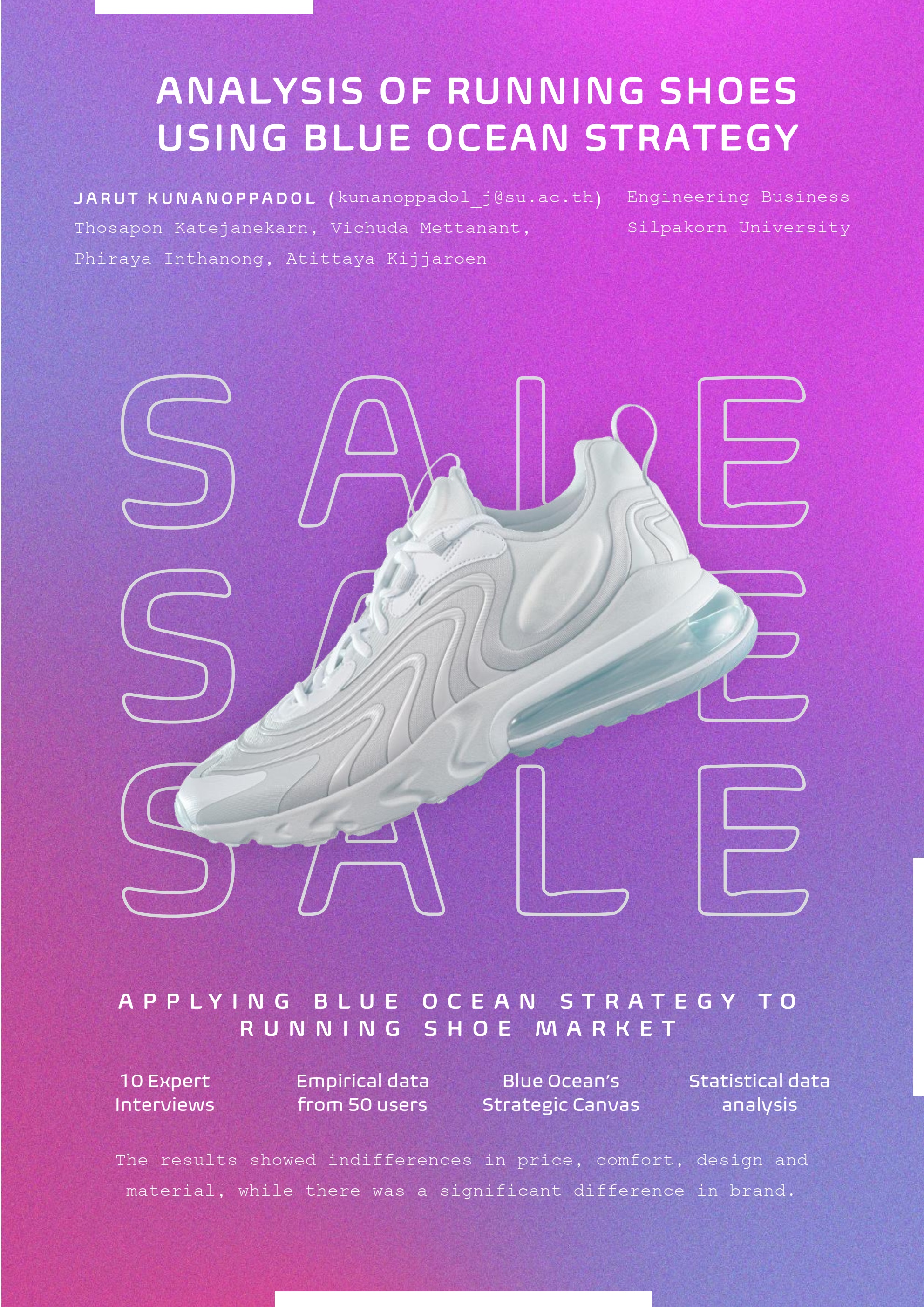
ท่ามกลางตลาดที่มีข้อจำกัดในการสร้างความโดดเด่น ผลการวิเคราะห์เชิงปริมาณสามารถระบุปัจจัยที่มีผลต่อการรับรู้ความแตกต่างของผลิตภัณฑ์จากมุมมองผู้บริโภคได้ งานวิจัยนี้จึงมีวัตถุประสงค์เพื่อแสดงการเก็บข้อมูลและการวิเคราะห์ข้อมูลเพื่อสร้างผืนผ้าใบเชิงกลยุทธ์สำหรับการวิเคราะห์ความแตกต่างของผลิตภัณฑ์ งานวิจัยใช้ผลิตภัณฑ์รองเท้าวิ่งเป็นผลิตภัณฑ์ตัวอย่างเนื่องจากเป็นผลิตภัณฑ์ที่มีการแข่งขันสูง มีการพัฒนาต่อเนื่องยาวนาน และเป็นตลาดที่มีความยากในการสร้างความแตกต่างใหม่ตามแนวคิดกลยุทธ์มหาสมุทรสีคราม ผู้วิจัยได้ทำการสัมภาษณ์ผู้เชี่ยวชาญ จำนวน 10 คน เพื่อกำหนดปัจจัยประเมิน แล้วสร้างแบบสอบถามเพื่อเก็บข้อมูลจากกลุ่มผู้ใช้ จำนวน 50 คน จากนั้นวิเคราะห์ข้อมูลเพื่อสร้างผืนผ้าใบเชิงกลยุทธ์ และวิเคราะห์ข้อมูลด้วยวิธีโมเดลสมการโครงสร้างเพื่อประเมินความเชื่อมั่นของตัวแปรเชิงปริมาณ ผลการวิจัย พบว่า ปัจจัยด้านราคา ความนุ่มสบาย การออกแบบ และวัสดุที่ใช้ยังไม่มีความแตกต่าง ในขณะที่ปัจจัยด้านชื่อเสียงของยี่ห้อมีความแตกต่างอย่างมีนัยสำคัญ ในงานวิจัยนี้นำเสนอวิธีการเก็บและวิเคราะห์ข้อมูลเชิงปริมาณซึ่งจะเป็นประโยชน์กับนักออกแบบ นักพัฒนา และธุรกิจ เพื่อนำไปปรับใช้ในกระบวนการวิเคราะห์และพัฒนาผลิตภัณฑ์ใหม่ต่อไป
In a market increasingly constrained in its ability to create product distinctiveness, quantitative analysis plays a crucial role in identifying the key factors that shape consumers’ perceptions of differentiation. This study aims to demonstrate a systematic approach to data collection and analysis for constructing a strategic canvas to evaluate product differentiation. Running shoes were selected as the sample product due to their highly competitive market, extensive technological development, and the growing difficulty of generating new differentiation within the Blue Ocean Strategy (BOS) framework. Ten experts were interviewed to determine the assessment factors, after which a questionnaire was developed and distributed to 50 users. The collected data were analyzed to construct the strategic canvas, and structural equation modeling was applied to assess the reliability of the quantitative measures. The results revealed no significant differentiation in price, comfort, design, or materials, whereas brand reputation shows a statistically significant difference. This research presents a quantitative data collection and analysis method that can support designers, developers, and businesses in product analysis and in the development of new products.
Downloads
Article Details

This work is licensed under a Creative Commons Attribution-NonCommercial-NoDerivatives 4.0 International License.
References
Brown, T. A. (2015). Confirmatory factor analysis for applied research (2nd ed.). The Guilford Press.
Chang, B. P., Kashcheev, A., Veksha, A., Lisak, G., Goei, R., Leong, K. F., Tok, A. L. Y., & Lipik, V. (2024). Enhancing dynamic energy return and performance of running shoes: Replacing talc with multi-walled carbon nanotubes derived from plastic wastes in midsole foam. Applied Materials Today, 36, Article 102016.
Christodoulou, I., & Langley, P. A. (2020). A gaming simulation approach to understanding blue ocean strategy development as a transition from traditional competitive strategy. Journal of Strategic Marketing, 28(8), 727–752.
Fornell, C., & Larcker, D. F. (1981). Evaluating structural equation models with unobservable variables and measurement error. Journal of Marketing Research, 18(1), 39–50.
Grover, V., & Lyytinen, K. (2023). The Pursuit of innovative theory in the digital age. Journal of Information Technology, 38(1), 45–59.
Hair, J. F., Jr., Black, W. C., Babin, B. J., & Anderson, R. E. (2009). Multivariate data analysis (7th ed.). Pearson Prentice Hall.
Hébert-Losier, K., & Pamment, M. (2023). Advancements in running shoe technology and their effects on running economy and performance – a current concepts overview. Sports Biomechanics, 22(3), 335–350.
Kim, W. C. (2005). Blue ocean strategy: From theory to practice. California Management Review, 47(3), 105–121.
Kim, W. C., & Mauborgne, R. (2004, October). Blue ocean strategy. Harvard Business Review. https://hbr.org/2004/10/blue-ocean-strategy
Kim, W. C., & Mauborgne, R. (2005). Value innovation: A leap into the blue ocean. Journal of Business Strategy, 26(4), 22–28.
Kim, W. C., & Mauborgne, R. (2017). Blue ocean shift: Beyond competing. Macmillan.
Loh, K. L., & Yusof, S. M. (2019). Blue ocean leadership activities improve firm performance. International Journal of Lean Six Sigma, 11(2), 359–375.
Mina, F., & Mohseni, R. (2015). Blue ocean strategy (evaluating profit of businesses in the industrial town of bu ali in hamadan). International Journal of Applied Business and Economic Research, 13, 1941–1952.
Nagy, H., & Nene, S. (2021). Blue gold: Advancing blue economy governance in Africa. Sustainability, 13(13), Article 7153.
Nezam, M. H. K. (2019). How to identify and prioritise factors affecting the designing of innovative strategies in insurance industry based on the blue ocean approach by FDAHP and SEM. International Journal of Business Innovation and Research, 20(4), 431–464.
Nunnally, J. C. (1975). Psychometric theory—25 years ago and now. Educational Researcher, 4(10), 7–21.
Podsakoff, P. M., & Organ, D. W. (1986). Self-reports in organizational research: Problems and prospects. Journal of Management, 12(4), 531–544.
Ruiz-Alias, S. A., Molina-Molina, A., Soto-Hermoso, V. M., & García-Pinillos, F. (2023). A systematic review of the effect of running shoes on running economy, performance and biomechanics: Analysis by brand and model. Sports Biomechanics, 22(3), 388–409.
Shafiq, M., Tasmin, R., Qureshi, M. I., & Takala, J. (2019). A new framework of blue ocean strategy for innovation performance in manufacturing sector. International Journal of Engineering and Advanced Technology, 8(5C), 1382–1389.
Sirathatnararojana, T., Onkasame, P., Jankoson, P., & Lueayklang, P. (2021). The blue ocean strategy to prevent pregnancies students in Chachoengsao province, Thailand [Special issue]. Journal of Legal, Ethical and Regulatory Issues, 24(1).
Wilcox, R. R. (2001). Fundamentals of modern statistical methods: Substantially improving power and accuracy. Springer.
Woo, H., Lim, S. W., & Sohn, S. Y. (2021). Recommending blue ocean technologies for subcontractors: A framework based on business reports of prime contractors and patents. PLoS ONE, 16(8), Article e0256157.
Xavier, J. A., Siddiquee, N. A., & Mohamed, M. Z. (2021). Public management reform in the post-NPM era: Lessons from Malaysia’s National Blue Ocean Strategy (NBOS). Public Money & Management, 41(2), 152–160.
Xiao, X., Lian, A., Li, Z., & Fan, Y. (2025). Trends and hotspots in running shoe research: A bibliometric study from 2005 to 2024. Frontiers in Sports and Active Living, 7, Article 1609141.
