
งานตกแต่งเครื่องเรือนในพระที่นั่งอัมพรสถาน พระราชวังดุสิต (Furniture decoration in the Amphorn Sathan Throne Hall, Dusit Palace)
Article Sidebar
Main Article Content
Abstract
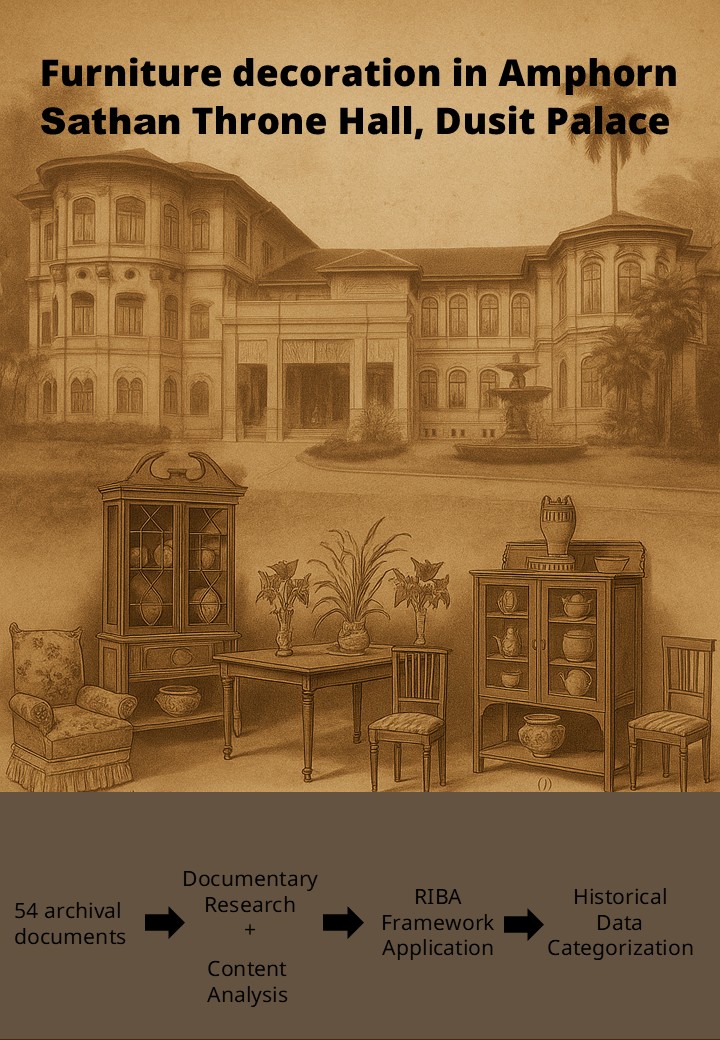
พระที่นั่งอัมพรสถาน พระราชวังดุสิต เป็นที่ประทับสำคัญในรัชสมัยพระบาทสมเด็จพระจุลจอมเกล้าเจ้าอยู่หัว ซึ่งพระองค์ทรงมีส่วนในกระบวนการตกแต่งเครื่องเรือน งานวิจัยนี้มีวัตถุประสงค์เพื่อศึกษาและวิเคราะห์กระบวนการตกแต่งเครื่องเรือนในพระที่นั่งอัมพรสถาน โดยใช้ RIBA Plan of Work ซึ่งเป็นกรอบการดำเนินงานด้านสถาปัตยกรรมสากลที่แบ่งออกเป็น 8 ขั้นตอน ได้แก่ ขั้นกำหนดกลยุทธ์ ขั้นเตรียมการและสรุปรายละเอียดโครงการ ขั้นการออกแบบแนวคิด ขั้นการประสานงานเชิงพื้นที่ ขั้นการออกแบบทางเทคนิค ขั้นการผลิตและการก่อสร้าง ขั้นส่งมอบ และขั้นการใช้งาน เป็นเครื่องมือในการจำแนกและจัดเรียงข้อมูลจากเอกสารประวัติศาสตร์ที่เกี่ยวข้อง การวิจัยใช้วิธีวิจัยเอกสาร (documentary research) โดยอ้างอิงเอกสาร จำนวน 54 ฉบับ จากเอกสารประวัติศาสตร์งานตกแต่งเครื่องเรือนในพระที่นั่งอัมพรสถาน และผ่านการคัดกรองและวิเคราะห์ด้วยวิธีวิเคราะห์เนื้อหา (content analysis) เพื่อนำไปจำแนกตามเกณฑ์ของ RIBA Plan of Work 2020 ผลการวิจัยพบว่า กระบวนการตกแต่งพระที่นั่งอัมพรสถาน พระราชวังดุสิต สอดคล้องกับ 7 ขั้นตอนตามเกณฑ์ โดยขาดขั้นตอนการออกแบบทางเทคนิคที่ไม่ปรากฏหลักฐาน ซึ่งสะท้อนถึงการใช้เครื่องเรือนสำเร็จรูปนำเข้าจากต่างประเทศโดยตรง การประยุกต์ใช้กรอบ RIBA Plan of Work 2020 ช่วยให้สามารถจัดระเบียบเอกสารที่กระจัดกระจายให้มีความเป็นระบบ และสร้างความเข้าใจและสามารถเปรียบเทียบระหว่างกระบวนการในอดีตกับมาตรฐานสากลในปัจจุบันได้อย่างมีประสิทธิภาพ ประโยชน์ของการวิจัยครั้งนี้อยู่ที่การนำเสนอวิธีการใช้กรอบดำเนินงานสมัยใหม่มาประยุกต์ใช้กับการวิเคราะห์ข้อมูลจากเอกสารประวัติศาสตร์ ซึ่งสามารถประยุกต์ใช้เป็นกรณีศึกษาในสาขาสถาปัตยกรรมภายใน งานอนุรักษ์ และงานวิจัยที่อาศัยข้อมูลจากเอกสารจดหมายเหตุในอนาคต
The Amphorn Sathan Throne Hall in Dusit Palace was a significant royal residence during the reign of King Chulalongkorn (Rama V), in which the King personally participated in the furnishing and decoration process. This study aims to examine and analyze the furniture decoration process of the Amphorn Sathan Throne Hall by employing the RIBA Plan of Work 2020 as an analytical framework. The RIBA framework is a globally recognized architectural management system comprising eight stages: strategic definition, preparation and briefing, concept design, spatial coordination, technical design, manufacturing and construction, handover, and use. These stages were applied to classify and organize historical documents related to the throne hall’s furnishing. The research employs a documentary research method, referencing 54 archival documents concerning the furnishing of the Amphorn Sathan Throne Hall. The data were systematically screened and analyzed through content analysis to categorize information according to the RIBA Plan of Work 2020. The findings reveal that the furnishing process of the Amphorn Sathan Throne Hall corresponds to seven of the eight RIBA stages, with the technical design stage notably absent. This absence reflects the use of prefabricated imported furniture that required no local technical design process. The application of the RIBA framework provided an effective means to structure and categorize dispersed historical data systematically, thereby enabling a comparative understanding between past furnishing practices and contemporary professional standards. This study contributes a methodological approach that integrates a modern architectural framework with the analysis of historical documents. Such an approach can serve as a case study for future research in interior architecture, conservation, and other design-related disciplines that rely on archival documentation as a primary source of evidence.
Downloads
Article Details

This work is licensed under a Creative Commons Attribution-NonCommercial-NoDerivatives 4.0 International License.
References
Barty-King, H. (1992). Maples fine furnishers: A household name for 150 years. Quiller Press.
British and Irish Furniture Makers Online (BIFMO). (2022). Maple & Co.; Cook & Maple; J. Maple (1841-1988). The Furniture History Society. https://bifmo.history.ac.uk/entry/maple-co-cook-maple-j-maple-1841-1988
Chulasai, B., & Povatong, P. (2006). The study of historic documents on the architectural history of Dusit Palace (การศึกษาข้อมูลในเอกสารประวัติศาสตร์สถาปัตยกรรม : พระราชวังดุสิต). Academic Journal of Architecture, 1(1), 1–15. https://www.arch.chula.ac.th/journal/files/article/LnVcmsEXucSun93013.pdf
Chulasai, B., & Povatong, P. (2007). The study of historic documents on the architectural history of Dusit Palace (Research report) (การศึกษาข้อมูลในเอกสารประวัติศาสตร์สถาปัตยกรรม พระราชวังดุสิต) (รายงานการวิจัย). Faculty of Architecture, Chulalongkorn University. https://cuir.car.chula.ac.th/handle/123456789/56653
Chulasai, B., Povatong, P., & Chotipanich, R. (2014). Dusit Palace (วังสวนดุสิต). Matichon Book.
Krippendorff, K. (2004). Content analysis: An introduction to its methodology (2nd ed.). Sage.
Nengnoi Suksri, M.R., Krittikakul, N., & Kaewmuang, D. (1982). Palaces and royal residences in Bangkok (1782 A.D. - 1982 A.D.) (Research report) (พระราชวังและวังในกรุงเทพฯ (พ.ศ. 2325 - 2525)) (รายงานการวิจัย). Chulalongkorn University.
Royal Institute of British Architects (RIBA). (2020). RIBA Plan of Work 2020 Overview. https://www.architecture.com/knowledge-and-resources/resources-landing-page/riba-plan-of-work
Scott, J., & Marshall, G. (2015). A supplementary dictionary of social research methods. Oxford University Press.
