
“ตัวตน” และ “พื้นที่” ของแฟนดอมไอดอลในภูมิทัศน์ดิจิทัล (“Being” and “Space” of idol fandoms in the digital landscape)
Article Sidebar
Main Article Content
Abstract
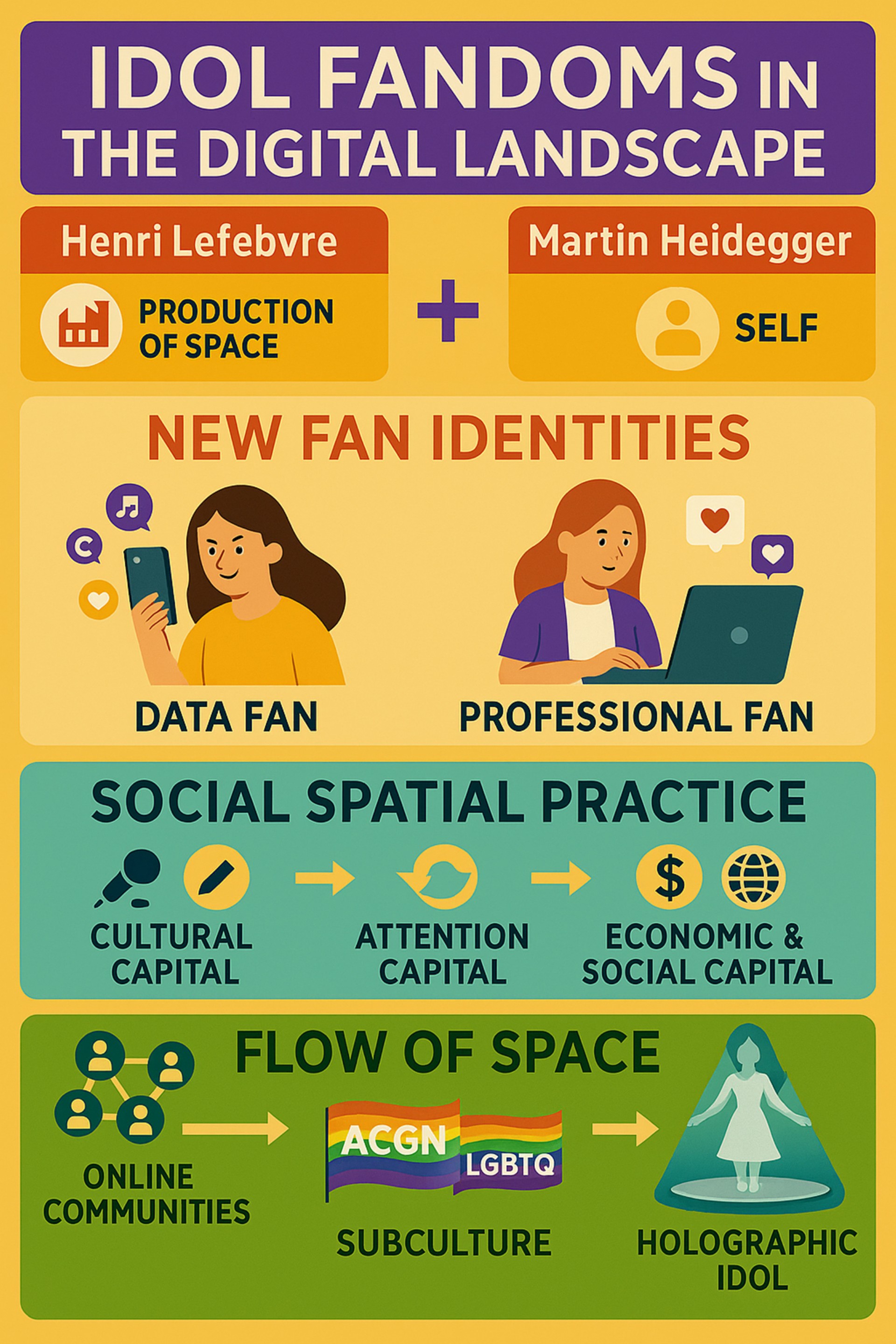
แม้มีงานศึกษาตัวตนและพื้นที่ของแฟนดอมจำนวนหนึ่ง แต่การวิเคราะห์ในมิติโครงสร้างทางสังคมและวัฒนธรรมยังจำกัด บทความนี้จึงนำเสนอปรากฏการณ์แฟนไอดอลผ่านมโนทัศน์กระบวนการผลิตพื้นที่ของ Henri Lefebvre และแนวคิดตัวตนของ Martin Heidegger เพื่ออธิบายว่าภูมิทัศน์ดิจิทัลส่งผลต่อ “ตัวตน” และ “พื้นที่” ของแฟนดอมไอดอลอย่างไร ผู้เขียนพบว่า การใช้ชีวิตในสภาพแวดล้อมดิจิทัลส่งผลให้แฟนคลับไอดอลก่อรูปตัวตนรูปแบบใหม่ ได้แก่ แฟนข้อมูล (data fans) และแฟนมืออาชีพ (professional fans) ตัวตนเหล่านี้เกิดจากปฏิบัติการทางสังคม (spatial practice) ผ่านการสะสมแลกเปลี่ยนทุน โดยแฟนข้อมูลเปลี่ยนทุนวัฒนธรรมให้เป็นทุนความสนใจ และเปลี่ยนทุนความสนใจไปสู่ทุนเศรษฐกิจและทุนทางสังคม ขณะแฟนมืออาชีพใช้ประโยชน์จากการสื่อสารแบบเครือข่ายและพื้นที่ไหลเวียน (space of flow) มาจัดโครงสร้างและรูปแบบการสนับสนุนไอดอลตามทุนที่แฟนครอบครอง ตัวตนของแฟนไอดอลจึงมิได้เป็นเพียงผู้บริโภควัฒนธรรม หากเป็นผู้กำหนดทิศทางการผลิตและจัดระเบียบพื้นที่ภายใต้วัฒนธรรมดิจิทัล เทคโนโลยีดิจิทัลยังทำให้ชุมชนแฟนออนไลน์เป็นพื้นที่ไหลเวียนแบบเครือข่ายซ้อนเครือข่าย เกิดการปะทะสังสรรค์กันระหว่างวัฒนธรรมแฟนกับวัฒนธรรมย่อยอื่น โดยเฉพาะวัฒนธรรม ACGN และ LGBTQ ซึ่งเชื่อมโยงกันทั้งระดับชาติและนานาชาติ เทคโนโลยีดิจิทัลและโฮโลแกรมยังก่อให้เกิดพื้นที่ใหม่ ซึ่งเป็นส่วนผสมระหว่างพื้นที่กายภาพกับพื้นที่เสมือนจริง ส่งผลให้การรับรู้ความหมายที่มีต่อพื้นที่ เวลา และระยะห่างระหว่างไอดอลกับแฟนเปลี่ยนแปลงอย่างสิ้นเชิง โดยสรุปปฏิบัติการเชิงพื้นที่และการใช้ประโยชน์จากพื้นที่ทำให้แฟนดอมไอดอลเป็นภาพแสดงแทนกระบวนการผลิตและผลิตซ้ำการเคลื่อนย้ายข้ามพรมแดนของผู้คน สื่อ เทคโนโลยี และทุน
Although research on identity and space in fandom studies has grown, socio-cultural structural analysis remains limited. This article draws on Henri Lefebvre’s concept of the production of space and Martin Heidegger’s notion of “being” to examine how the digital landscape shapes idol fans’ sense of self and the spatial organization of idol fandoms. The study shows that living in a digital environment enables fans to develop new forms of identity, namely “data fans” and “professional fans.” These identities are derived from spatial practice involving the accumulation and exchange of capital: data fans transform cultural capital—such as digital literacy—into attention capital, which is further converted into economic and social capital, while professional fans use networked communication and spaces of flow to organize support for idols according to the types of capital they hold. In this way, idol fans go beyond cultural consumption to influence production processes and organize space within the digital cultural system. Digital technologies also turn online fan communities into interconnected circulation networks, fostering interaction and negotiation between fan culture and other subcultures, particularly ACGN and LGBTQ, at both national and international levels. Advances in digital and holographic technologies further construct hybrid spaces that blend physical and virtual realms, altering perceptions of space, time, and proximity between idols and fans. In conclusion, fans’ spatial practices and use of space make idol fandom a representational area for the production and reproduction of the cross-border flows of people, media, technology, and capital.
Downloads
Article Details

This work is licensed under a Creative Commons Attribution-NonCommercial-NoDerivatives 4.0 International License.
References
Aisyah, A., & Jin, N. Y. (2017). K-Pop V fansubs, V LIVE and NAVER dictionary: Fansubbers’ synergy in minimising language barriers. 3L: The Southeast Asian Journal of English Language Studies, 23(4), 112–127. http://doi.org/10.17576/3L-2017-2304-09
ALLKPOP. (2025, January 23). Weverse issues global fandom trend report. https://www.allkpop.com/article/2025/01/weverse-issues-global-fandom-trend-report
Bourdieu, P. (1986). The forms of capital. In J. G. Richardson (Ed.), Handbook of theory and research for the sociology of education (pp. 241–258). Greenwood Press.
Castells, M. (2010). The rise of the network society (2nd ed.). Wiley-Blackwell.
Chen, R., & Hu, Y. (2021). Idol economy and consumption of younger generation entertainment: A sociological and motivational approach on Chinese fans. In W. Striełkowski, J. M. Black, S. A. Butterfield, C.-C. Chang, J. Cheng, F. P. Dumanig, R. Al-Mabuk, M. Urban, & S. Webb (Eds.), Proceedings of the 2021 5th International Seminar on Education, Management and Social Sciences (ISEMSS 2021): Advances in social science, education and humanities research, vol. 571 (pp. 834–838). Atlantis Press. https://doi.org/10.2991/assehr.k.210806.158
Chunyan, J. (2019, September 7). How China’s ‘fan circles’ are redefining modern fandom. Caixin Global. https://www.caixinglobal.com/2019-09-07/how-chinas-fan-circles-are-redefining-modern-fandom-101459662.html
Dalugdug, M. (2025, March 27). You’ve heard of superfan app Weverse. Now the parent company of HYBE’s arch-rival has launched a direct competitor. Meet Berriz. Music Business Worldwide. https://www.musicbusinessworldwide.com/youve-heard-of-superfan-app-weverse-now-the-parent-company-of-hybes-arch-rival-has-launched-a-direct-competitor-meet-berriz/
Dear, M. (1988). The postmodern challenge: Reconstructing human geography. Transactions of the Institute of British Geographers, 13(3), 262–274. https://doi.org/10.2307/622990
Giddens, A. (1991). The consequences of modernity. Polity Press.
Heidegger, M. (1996). Being and time (J. Stambaugh, Trans.). State University of New York Press. (Original work published 1927)
Jansson, A., & Falkheimer, J. (2006). Towards a geography of communication. In J. Falkheimer & A. Jansson (Eds.), Geographies of communication: The spatial turn in media studies (pp. 7–23). Nordcom.
Jenkins, H. (2018). Fandom, negotiation, and participatory culture. In P. Booth (Ed.), A companion to media fandom and fan studies (pp. 13–26). Wiley Blackwell.
Jiang, S. (2020, March 10). Xiao Zhan and AO3 fans clash, sparking social media firestorm. Pandaily. https://pandaily.com/xiao-zhan-and-ao3-fans-clash-sparking-social-media-firestorm/
Kaewthep, K., Burarak, P., & Phutket, T. (2012). The right media for anyone who likes it: Cartoon, local television, fan club (สื่อที่ใช่ ของใครที่ชอบ : การ์ตูน โทรทัศน์ท้องถิ่น แฟนคลับ). Parbpim.
Lefebvre, H. (1991). The production of space (D. Nicholson-Smith, Trans.). Basil Blackwell. (Original work published 1974)
Mahaneeranon, T. (2021, November 6). Virtual concert, music innovation connecting the world in the Covid era...Temporary option or forever? (virtual concert นวัตกรรมดนตรีเชื่อมโลกยุคโควิด ...ตัวเลือกชั่วคราว หรือตลอดไป?). Thairath Plus. https://plus.thairath.co.th/topic/subculture/100674
McLuhan, M. (1967). The medium is the massage: An inventory of effects. Bantam Books.
Romano, A. (2020, March 1). China has censored the archive of our own, one of the internet’s largest fanfiction websites. Vox. https://www.vox.com/2020/3/1/21159275/china-ao3-archive-of-our-own-banned-censorship
Rungrojchana, P. (2018, December 17). Holographic idols: When K-pop uses technology to make the fan experience even more fun (ไอดอล hologram : เมื่อ K-pop ใช้เทคโนโลยีสร้างเสริมประสบการณ์ติ่งให้สนุกกว่าเดิม). A Day Magazine. https://adaymagazine.com/hologram-kpop-idol/
Sandvoss, C. (2011). Fan online: Affective media consumption and production in the age of convergence. In M. Christensen, A. Jansson, & C. Christensen (Eds.), Online territories: Globalization, mediated practice and social space (pp. 49–74). Peter Lang.
Specht, D. (2018). Did you find the world or did you make it up? Media, communications and geography in the digital age. Westminster Papers in Communication and Culture, 13(2), 1–13. https://doi.org/10.16997/wpcc.298
Stanhope, H. (2019). This is for your safety and security: The paranoiac post-terror campus branding mythologies, securitization, and enclosure of the late-public realm at King’s College London [Unpublished bachelor’s thesis]. University of London.
Supanan, S. (2011). Space, time, identity and a construction of social meaning (พื้นที่ เวลา อัตลักษณ์ และการสร้างความหมายทางสังคม). Journal of Communication Arts, 29(3), 186–204. https://so02.tci-thaijo.org/index.php/jcomm/article/view/86161
Suwatcharapinun, S., & Danhongmangkorn, W. (2019). The synthesis of theoretical connection of being, space, and everyday life (การสังเคราะห์ความเชื่อมโยงทางทฤษฎีของตัวตน พื้นที่ และชีวิตประจำวัน). Journal of Environmental Design, 6(2), 20–35. https://so02.tci-thaijo.org/index.php/jed/article/view/191030
Tang, D., & Lyons, R. (2016). An ecosystem lens: Putting China’s digital music industry into focus. Global Media and China, 1(4), 350–371. https://doi.org/10.1177/2059436416685101
Tansukanun, P., & Daungthima, W. (2012). The multi-layered districts of Chiang Mai city (Research report) (แนวทางการพัฒนาความเป็นย่านหลากมิติของเมืองเชียงใหม่) (รายงานการวิจัย). Maejo University.
Tantimala, C. (2017). Public spheres and production of space: The meaning of social relationships (พื้นที่สาธารณะและการผลิตพื้นที่ : ความหมายใหม่ของความสัมพันธ์ทางสังคม). Journal of Library and Information Science Srinakharinwirot University, 10(1), 92–103. https://ejournals.swu.ac.th/index.php/jlis/article/view/9947
Thansettakijdigital. (2022, June 28). Lisa’s influence on Celine brand’s success (อิทธิพลของ Lisa กับความสำเร็จของ Celine แบรนด์คู่บุญ). Thansettakij. https://www.thansettakij.com/world/530492
Xinyu, L., Mengyang, C., Manzi, Z., & Zhendong, W. (2021). Fandom culture booming in China, calling for discipline, regulation. Xinhua News. http://www.xinhuanet.com/english/2021-07/25/c_1310084747.htm [in Chinese]
Zhang, Q., & Negus, K. (2020). East Asian pop music idol production and the emergence of data fandom in China. International Journal of Cultural Studies, 23(4), 493–511. https://doi.org/10.1177/1367877920904064
