
กลวิธีภาษาจากเรื่องเล่าของผู้ประกอบการธุรกิจในหาดใหญ่กับการระบาดของเชื้อไวรัสโคโรนา 2019 (COVID-19) (Linguistic strategies in the narratives of Hat Yai entrepreneurs during the COVID-19 pandemic)
Article Sidebar
Main Article Content
Abstract
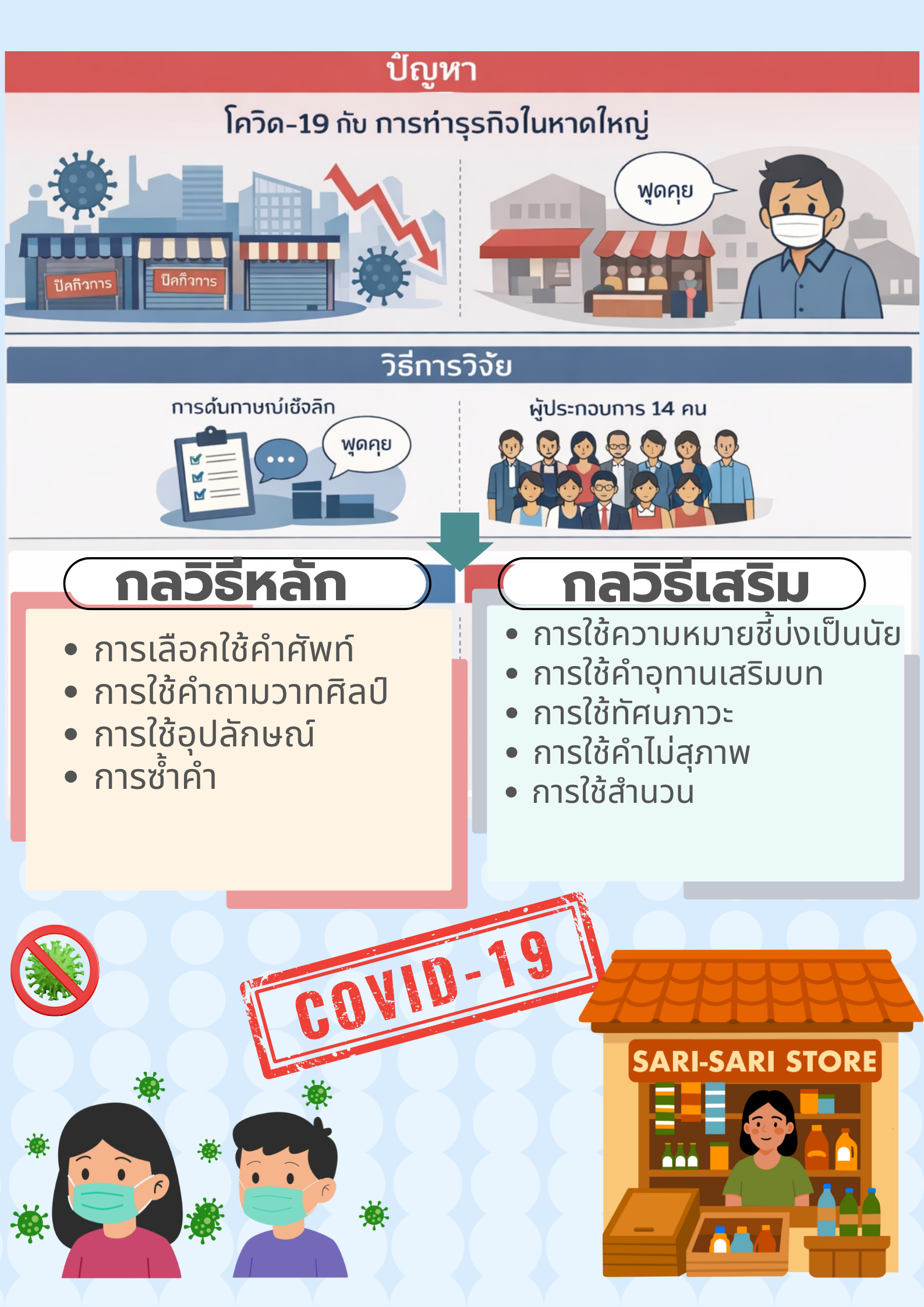
การแพร่ระบาดของโควิด-19 สร้างความท้าทายอย่างยิ่งแก่ผู้ประกอบการในอำเภอหาดใหญ่ ซึ่งเป็นศูนย์กลางการค้าสำคัญในภาคใต้ของไทย ท่ามกลางความเปลี่ยนแปลงอย่างรวดเร็ว เรื่องเล่าของผู้ประกอบการจึงเป็นช่องทางหนึ่งที่สะท้อนถึงการใช้ภาษาในการทำความเข้าใจประสบการณ์ภาวะวิกฤติ งานวิจัยนี้มีวัตถุประสงค์สำคัญ คือ การศึกษากลวิธีภาษาจากเรื่องเล่าการทำธุรกิจของผู้ประกอบการธุรกิจในหาดใหญ่ที่สามารถสะท้อนปริชานทางสังคมของผู้ประกอบการ โดยการสัมภาษณ์ในเชิงลึกถึงเรื่องราวที่เป็นประสบการณ์ตรงในการทำธุรกิจของตัวเอง ในบริบทของสถานการณ์วิกฤตโควิด-19 ผู้วิจัยเก็บข้อมูลจากผู้ประกอบการ จำนวน 14 คน ที่มาจากร้านค้าที่ต่างขนาดกัน ด้วยวิธีคัดเลือกแบบเจาะจง ตามแนวการวิจัยเชิงคุณภาพ ผู้วิจัยใช้แนวคิดทางภาษาศาสตร์ในการวิเคราะห์ข้อมูล ผลการวิจัยพบว่า มีกลวิธีภาษาสำคัญที่สามารถแบ่งได้เป็น 2 กลุ่มใหญ่ คือ 1) กลวิธีหลัก ซึ่งมีกลวิธีย่อย 4 กลวิธี ได้แก่ การเลือกใช้คำศัพท์ การใช้คำถามวาทศิลป์ การใช้อุปลักษณ์ และการซ้ำคำ และ 2) กลวิธีเสริม ซึ่งมีกลวิธีย่อย 5 กลวิธี ได้แก่ การใช้ความหมายชี้บ่งเป็นนัย การใช้คำอุทานเสริมบท การใช้ทัศนภาวะ การใช้คำไม่สุภาพ และการใช้สำนวน ผลการวิจัยที่ได้สะท้อนความคิด ความรู้สึกของผู้ประกอบการหลายประการ โดยเฉพาะประเด็นอารมณ์ความรู้สึกของผู้ประกอบการที่ทำให้เห็นความไม่พึงพอใจ ความผิดหวัง การไม่เห็นทางออกของปัญหา ความคิดที่มีต่อสถานการณ์หรือปัญหาในการทำธุรกิจ รวมถึงรูปแบบหรือวิธีการทำธุรกิจ และยังสื่อสะท้อนวัฒนธรรม ความเป็นไทยผ่านกลวิธีภาษาในแง่มุมผู้ประกอบการในฐานะผู้ขับเคลื่อนเศรษฐกิจในพื้นที่ อันจะนำไปสู่การเรียนรู้ การแก้ปัญหาในการทำธุรกิจผ่านเรื่องเล่าของผู้ประกอบการได้
The COVID-19 pandemic posed unprecedented challenges to entrepreneurs in Hat Yai, a major commercial hub in Southern Thailand. Amid rapid and profound disruptions, entrepreneurs’ narratives provide valuable insight into how language is used to make sense of crisis experiences. This study aims to investigate the linguistic strategies employed in the business narratives of Hat Yai entrepreneurs and to examine how these strategies reflect their social cognition. Using a qualitative research approach, in-depth interviews were conducted with 14 entrepreneurs from businesses of varying sizes, selected through purposive sampling. The participants shared first-hand experiences of managing their businesses during the COVID-19 crisis. The data were analyzed using linguistic analytical frameworks. The findings reveal two major categories of linguistic strategies. The first category, main strategies, comprises four sub-strategies: lexical choice, rhetorical questions, metaphor, and repetition. The second category, supplementary strategies, consists of five sub-strategies: implicature, supplementary exclamations, modality, impolite expressions, and idiomatic expressions. These linguistic strategies reflect various dimensions of the entrepreneurs’ thoughts and emotions, particularly feelings of dissatisfaction, disappointment, and a perceived lack of solutions to business-related problems. The narratives also convey entrepreneurs’ perspectives on business practices, coping strategies, and problem-solving approaches. Furthermore, the findings illustrate how Thai cultural values are embedded in linguistic expression, highlighting entrepreneurs’ roles as key drivers of the local economy. The study demonstrates that entrepreneurs’ narratives serve as an important resource for understanding learning processes and business problem-solving during times of crisis.
Downloads
Article Details

This work is licensed under a Creative Commons Attribution-NonCommercial-NoDerivatives 4.0 International License.
References
Buddawong, N., & Numtong, K. (2022). Political discourse in Chinese headlines on COVID-19 vaccine (วาทกรรมการเมืองในพาดหัวข่าวภาษาจีนเรื่องโควิด-19). Journal of Liberal Arts, Ubon Ratchathani University, 18(1), 90–111.
Culpeper, J. (2012). (Im)politeness: Three issues. Journal of Pragmatics, 44(9), 1128–1133.
Emerging Infectious Diseases Division, Communicable Disease Academic Development Group. (2021, August 18). Situation of Coronavirus disease 2019 (COVID-19), public health measures, and challenges in disease prevention and control among travelers (สถานการณ์โรคติดเชื้อไวรัสโคโรนา 2019 (COVID-19) มาตรการสาธารณสุข และปัญหาอุปสรรคการป้องกันควบคุมโรคในผู้เดินทาง). Department of Disease Control, Ministry of Public Health. https://ddc.moph.go.th/uploads/files/2017420210820025238.pdf
Fairclough, N. (1989). Language and power. Longman.
Fairclough, N. (2003). Analysing discourse: Textual analysis for social research. Routledge.
Grice, H. P. (1975). Logic and conversation. In P. Cole & J. L. Morgan (Eds.), Syntax and semantics, Vol. 3: Speech acts (pp. 41–58). Academic Press.
Halliday, M. A. K. (1994). An introduction to functional grammar (2nd ed.). Edward Arnold.
Hat Yai City Municipality. (n.d.). Basic information (ข้อมูลพื้นฐาน). https://www.hatyaicity.go.th/content/general
Horn, L. R., & Ward, G. (2006). The handbook of pragmatics. Blackwell.
Khamzaev, S. A. (2021). Pragmatic function of linguistic units. International Journal of Social Science and Human Research, 4(12), 3903–3908.
Lakoff, G., & Johnson, M. (1980). Metaphors we live by. The University of Chicago Press.
Locke, T. (2004). Critical discourse analysis. Continuum.
Longdo Dict. (n.d.). Shock (ช็อก). In Longdo Dict. Retrieved July 7, 2023, from https://dict.longdo.com/search/*%E0%B8%8A%E0%B9%87%E0%B8%AD%E0%B8%81*
Luksaneeyanawin, S. (1982). Reduplicative exuberance: Another perspective on the sound and semantic systems of the Thai language (คำซ้ำอุจจารณวิลาส : อีกแง่หนึ่งของระบบเสียง และระบบความหมายในภาษาไทย). Journal of Letters, 14(1), 11–34.
Phaktaranikorn, S. (2022). Discourse of “COVID-19” in Kaihuaror’s KnowCovid issue as propagator of state ideology (วาทกรรม “โควิด 19” ในการ์ตูนขายหัวเราะ ชุด “KnowCovid: รู้ทันโควิด” : สื่อเผยแพร่อุดมการณ์รัฐ). Journal of Liberal Arts, Thammasat University, 22(1), 124–156.
Phingchim, P. (2017). The discourse of press conferences on Thai entertainers’ scandals: A discourse analytical and pragmatic study (ปริจเฉทการแถลงข่าวอื้อฉาวของบุคคลในวงการบันเทิงไทย : การศึกษาเชิงปริจเฉทวิเคราะห์และวัจนปฏิบัติศาสตร์) [Doctoral dissertation, Chulalongkorn University]. Chula Digital Collections. https://digital.car.chula.ac.th/chulaetd/1640
Rattanadilok Na Phuket, W. (2021). “We will get through this crisis together”: Persuasion in the discourse of the news conferences on the situation of the communicable disease Coronavirus 2019 (COVID-19) (“เราจะผ่านวิกฤตไปด้วยกัน” : การโน้มน้าวใจในปริจเฉทการแถลงข่าวสถานการณ์การแพร่ระบาดของโรคติดเชื้อไวรัสโคโรนา 2019 (โควิด-19)). Vannavidas, 21(1), 62–104.
Rattanakul, S. (2012). Introduction to semantics (อรรถศาสตร์เบื้องต้น) (2nd ed.). Mahidol University Press.
Seitel, P. (1981). Proverbs: A social use of metaphor. In W. Mieder & A. Dundes (Eds.), The wisdom of many: Essays on the proverb (pp. 122–139). Garland Pub.
Sereechaikul, T. (2021). Features of language and contents in COVID-19 Hashtags on Twitter (ลักษณะภาษาและเนื้อหาในแฮชแท็กสถานการณ์การแพร่ระบาดของโรคติดเชื้อไวรัสโคโรนา 2019 (โควิด-19) ในสื่อออนไลน์ทวิตเตอร์). Mekong-Salween Civilization Studies Journal, 12(2), 40–60.
The Royal Institute of Thailand. (2013). Royal institute dictionary, B.E. 2554 (พจนานุกรม ฉบับราชบัณฑิตยสถาน พ.ศ. 2554) (2nd ed.). The Royal Institute of Thailand.
Thipdet, B. (2022). Linguistic strategies and the presentation of the Coronavirus 2019 in Variety for Health @Rama (กลวิธีทางภาษาในการนำเสนอความคิดเกี่ยวกับโรคติดเชื้อไวรัสโคโรนา 2019) ในนิตยสารวาไรตี้เพื่อสุขภาพ@Rama). Journal of Thai Studies, 18(2), 137–160.
Upakitsinlapasan, Phraya. (1996). Grammar of the Thai language (หลักภาษาไทย). Thai Watana Panich.
Wagner, I., & Wodak, R. (2006). Performing success: Identifying strategies of self-presentation in women’s biographical narratives. Discourses & Society, 17(3), 385–411.
Wichitmatra, Khun (Sa-nga Kanchanakphan). (2000). Thai idioms (สํานวนไทย) (5th ed.). Technology Promotion Association (Thailand-Japan).
Xie, X., Yuttapongtada, M., & Sengnet, T. (2023). War metaphor: Conceiving of Covid-19 among Thais and Chinese (อุปลักษณ์สงคราม : ความเข้าใจโควิด 19 ในมุมมองของคนไทยและคนจีน). Journal of Social Science and Cultural, 7(6), 188–200.
