
ความกลมกลืนระหว่างหลักฮวงจุ้ยกับหลักสถาปัตยกรรม : การศึกษามิติทางวัฒนธรรมของการออกแบบและจัดวางประตูในบริบทไทย (Harmony between Feng Shui and architectural principles: A cultural study of door design and placement in the Thai context)
Article Sidebar
Main Article Content
บทคัดย่อ
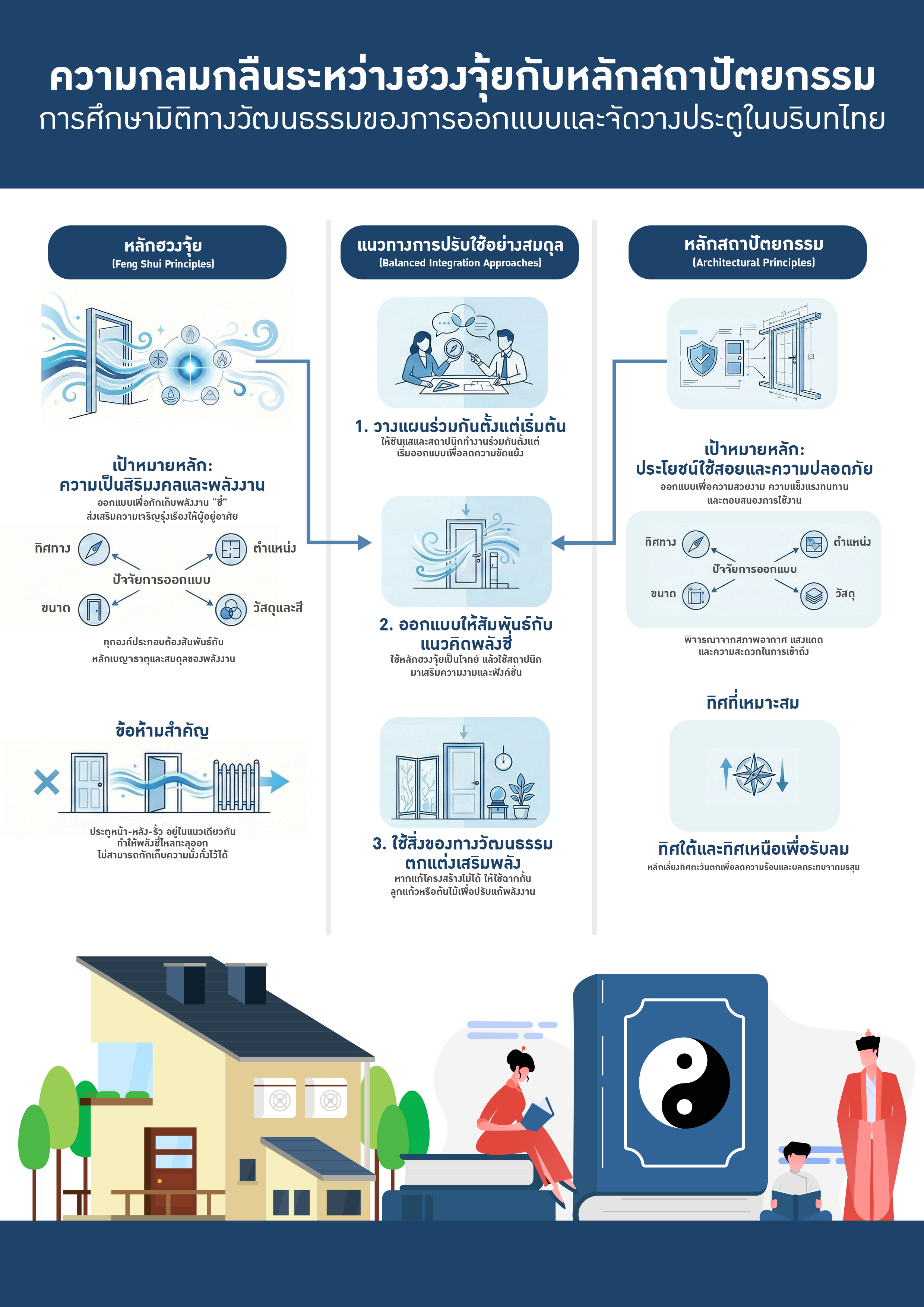
ความเชื่อเรื่องฮวงจุ้ยมีอิทธิพลต่อการออกแบบที่อยู่อาศัยของคนไทยเชื้อสายจีนและได้ผสมผสานเข้ากับแนวคิดสถาปัตยกรรมไทยในปัจจุบันอย่างแพร่หลาย อย่างไรก็ตามยังพบความไม่สอดคล้องกันระหว่างหลักฮวงจุ้ยกับหลักสถาปัตยกรรมในการออกแบบและจัดวางประตูบ้าน งานวิจัยนี้มีวัตถุประสงค์เพื่อศึกษาความแตกต่างระหว่างหลักฮวงจุ้ยและหลักสถาปัตยกรรม รวมถึงหาแนวทางการปรับใช้ร่วมกันอย่างสมดุล การวิจัยใช้วิธีเชิงคุณภาพโดยเก็บข้อมูลผ่านการสัมภาษณ์เชิงลึกจากซินแส สถาปนิก และสถาปนิกซินแส รวมทั้งหมด 8 ราย ผลการศึกษาพบว่า หลักฮวงจุ้ยมุ่งเน้นความเป็นสิริมงคลและการกักเก็บพลังชี่ ขณะที่หลักสถาปัตยกรรมให้ความสำคัญกับประโยชน์ใช้สอย ความงาม ความปลอดภัย และความแข็งแรง แม้แนวคิดทั้งสองจะต่างกันในจุดมุ่งหมาย แต่มีรายละเอียดบางประการในการออกแบบที่สอดคล้องกัน เช่น การคำนึงถึงทิศทางและขนาดของประตู นอกจากนี้ยังพบแนวทางการประสานกันสองแนวทาง ได้แก่ 1) การออกแบบให้สัมพันธ์กับแนวคิดพลังชี่ และ 2) การใช้สิ่งของทางวัฒนธรรมมาตกแต่งเสริมกำลังให้กับผู้อยู่อาศัย ซึ่งผลการศึกษาช่วยเสริมความเข้าใจต่อการประยุกต์ใช้ศาสตร์ฮวงจุ้ยร่วมกับสถาปัตยกรรม เพื่อสร้างสมดุลระหว่างความเชื่อ วัฒนธรรม และประโยชน์ใช้สอยในงานออกแบบร่วมสมัย
Feng Shui beliefs have significantly influenced the residential design practices of Thai Chinese communities and have been widely integrated into contemporary Thai architectural concepts. However, inconsistencies remain between Feng Shui principles and architectural principles, particularly in the design and placement of house entrances. This research aims to examine the differences between these two frameworks and to identify balanced approaches for their combined application. A qualitative research method was employed, drawing on in-depth interviews with eight informants, including Feng Shui masters, architects, and architect–Feng Shui practitioners. The findings reveal that Feng Shui emphasizes auspiciousness and the cultivation and retention of Qi energy, while architectural principles prioritize functionality, aesthetics, safety, and structural integrity. Despite their differing objectives, both systems share certain design considerations, such as door orientation and proportion. Two integrative approaches were identified: 1) designing in alignment with the flow of Qi energy, and 2) incorporating culturally symbolic elements to enhance the occupants’ sense of well-being. The findings contribute to a deeper understanding of how Feng Shui can be harmoniously integrated with architectural practice, helping to establish a balance between belief, culture, and practical utility in contemporary design.
Downloads
Article Details

อนุญาตภายใต้เงื่อนไข Creative Commons Attribution-NonCommercial-NoDerivatives 4.0 International License.
เอกสารอ้างอิง
Bai, H. (2008). Lucky Feng Shui: How to design and customize your own Feng Shui (ฮวงจุ้ยนำโชค ฉบับ วิธีออกแบบและปรับแต่งฮวงจุ้ยด้วยตนเอง) (P. Amphankul, Trans.). Tao Prayuk Books.
Berry, J. W. (1997). Immigration, acculturation, and adaptation. Applied Psychology, 46(1), 5–34. https://doi.org/10.1111/j.1464-0597.1997.tb01087.x
Boonyachut, S. (2014). Building materials and construction (วัสดุและการก่อสร้างอาคาร). Chulalongkorn University Press.
Brookes, E. (2022). Intimate architectures: A cultural geography of doors. Social & Cultural Geography, 23(6), 797–813. https://doi.org/10.1080/14649365.2020.1821389
Chanthanayingyong, N. (2007). How to adjust Feng Shui to make your home ready for living in (วิธีปรับฮวงจุ้ยบ้านให้พร้อมอยู่). Ban Phayakon Books.
Chatjaroonsin, K. (2012). Feng Shui: Its value and influence on the way of life of people in Thai society (ฮวงจุ้ย: คุณค่าและอิทธิพลที่มีต่อวิถีชีวิตของคนในสังคมไทย) [Master’s thesis, Silpakorn University]. Silpakorn University Repository. https://sure.su.ac.th/xmlui/handle/123456789/10485?attempt=2&&locale-attribute=th
Chulasai, B., & Sirithampiti, S. (2004). Door and window materials and construction (วัสดุและการก่อสร้างประตูและหน้าต่าง). Chulalongkorn University Press.
DDproperty Editorial Team. (2019, February 20). Enhancing home Feng Shui through doors and windows (เพิ่มประตู-หน้าต่าง เสริมฮวงจุ้ยบ้าน). DDproperty by PropertyGuru. https://www.ddproperty.com/คู่มือซื้อขาย/เพิ่มประตู-หน้าต่าง-เสริมฮวงจุ้ยบ้าน-12452
Goel, K. (2023). Harmonious home design: A comparison of Vastu Shastra and Feng Shui from a sustainability perspective. Journal of Student Research, 12(4), 1–8.
Hafele Thailand. (n.d.). Fung Shui: Good door position according to Feng Shui principles (Fung Shui ตำแหน่งประตูที่ดี ตามหลักฮวงจุ้ย). https://www.hafelethailand.com/feng-shui/good-door-position-according-to-feng-shui/#:~:text=ประตูหน้ากับประตูหลัง,กั้นไว้ระหว่างประตู
Horayangkura, V. (2015). Architectural programing for the creation of built environment (การจัดทำรายละเอียดโครงการงานสถาปัตยกรรม เพื่อการสร้างสรรค์สภาพแวดล้อมสรรค์สร้าง). G.B.P. Center.
IRONPEN. (2022, July 1). Avoiding Feng Shui design errors: Ensuring accuracy through early consultation with Feng Shui masters (หมดปัญหาออกแบบบ้านผิดฮวงจุ้ย ซินแสเช็กงานตั้งแต่ออกแบบจะได้ไม่ต้องแก้). Bright TV. www.brighttv.co.th/social-news/feng-shui-house-design-savant
Lakas, W. (2005). Feng Shui: Science and art in the dimensions of masters, architects, and engineers (ฮวงจุ้ย : ศาสตร์และศิลป์ในมิติของซินแส สถาปนิก วิศวกร). Matichon Books.
Lawson, B. (2001). The language of space. Architectural Press.
Liuthanamongkhon, N. (1987). A guide to choosing a location based on the zodiac sign of the house (คู่มือเลือกทำเลดูราศีบ้านอาศัย). H.N. GROUP.
On-phueng, A. (2008). Beliefs in Feng Shui affecting choices of the house plans of customers of the Pensland Co., Ltd. (ความเชื่อเรื่องฮวงจุ้ย ที่มีผลต่อการเลือกแบบแปลนบ้าน บริษัท เดอะเพ็นส์แลนด์ จำกัด) [Unpublished master’s thesis]. Phranakhon Rajabhat University.
Patiphatphaophong, A. (2006). Home Feng Shui: You can do it yourself, it’s so easy (ฮวงจุ้ยบ้าน ทำเองก็ได้...ง่ายจัง). Atsachan.
Prabhasanont, M. (2002). Interior decoration tips according to Feng Shui principle (เคล็ดลับตกแต่งภายในตามหลักฮวงจุ้ย) (15th ed.). Matichon Books.
Ruengtam, P. (2013). Design theory (ทฤษฎีการออกแบบ). Inthaninpress.
Sareepol, A. (2002). Feng Shui: Commercial beliefs, case study of Noble Wana village, Pinklao branch (ฮวงจุ้ย : ความเชื่อเชิงพาณิชย์ ศึกษากรณีหมู่บ้าน โนเบิล วานา (Noble Wana) สาขาปิ่นเกล้า) [Undergraduate thesis, Silpakorn University]. Silpakorn University Repository. https://sure.su.ac.th/xmlui/handle/123456789/3007
Shah, S. (2024). Impact of entrances in building. International Journal for Multidisciplinary Research, 6(4), Article IJFMR240424172. https://doi.org/10.36948/ijfmr.2024.v06i04.24172
Sukmanas, N. (1996). The beliefs in Feng-Shui as a way of life of Chinese Thais in Bangkok (ความเชื่อเรื่องฮวงจุ้ยในวิถีชีวิตของชาวไทยเชื้อสายจีน ในกรุงเทพมหานคร) [Master’s thesis, Chulalongkorn University]. Chula DigiVerse. https://doi.org/10.58837/CHULA.THE.1996.1158
The Royal Institute of Thailand. (2011). Royal institute dictionary, B.E. 2554 (พจนานุกรมฉบับราชบัณฑิตยสถาน พ.ศ. 2554). Nanmeebooks.
Viryasiri, T. (2015). Architectural management (การจัดการสถาปัตยกรรม). Faculty of Architecture, Chulalongkorn University.
Wonglaksanaphan, A. (2021). Identity of Chinese architecture in western south of Thailand (อัตลักษณ์สถาปัตยกรรมจีนในพื้นที่ภาคใต้ฝั่งตะวันตกของประเทศไทย) [Doctoral dissertation, Silpakorn University]. Silpakorn University Repository. https://sure.su.ac.th/xmlui/handle/123456789/26416
Wuxing. (2013). Feng Shui for prosperity (ฮวงจุ้ยรับโชคลาภ) (A. Patiphatphaophong, Trans.). Sataporn Books.
Xiaoyun, H., & Kaewbucha, M. (2024). The hybrid culture in Chinese-Thai shophouses based cultural landscape interpreting for tourism. Journal of Modern Learning Development, 9(12), 41–56. https://so06.tci-thaijo.org/index.php/jomld/article/view/279722
Xie, M., & Mao, Y. (2025) Integrating Fengshui and environmental psychology into contemporary architecture design for enhanced occupant well-being. City Diversity, 6(1), Article 3036. https://doi.org/10.54517/cd3036
Xu, P. (2022). Healthy living in the built environment in light of Feng-shui. International Journal of e-Healthcare Information Systems (IJe-HIS), 8(1), 196–202. https://doi.org/10.20533/ijehis.2046.3332.2022.0028
