แนวคิดการออกแบบผลิตภัณฑ์ของที่ระลึกประเภทอาร์ตทอยจากทุนทางวัฒนธรรม จังหวัดเชียงราย (Conceptual design of art toy souvenir products from cultural capital in Chiang Rai)
Article Sidebar
Main Article Content
Abstract
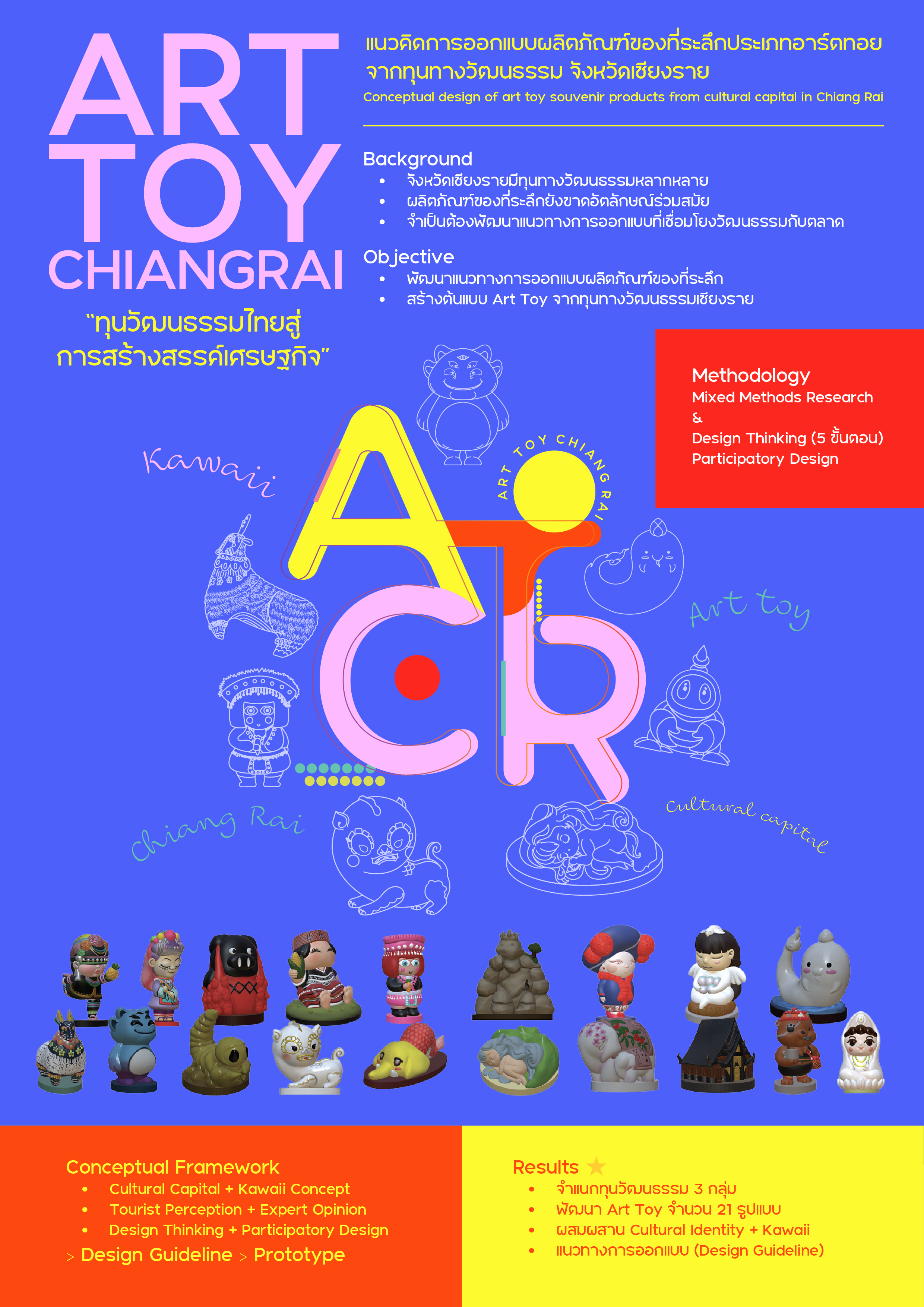
จังหวัดเชียงรายเป็นพื้นที่ที่มีทุนทางวัฒนธรรมหลากหลายและมีศักยภาพในการพัฒนาเป็นผลิตภัณฑ์เชิงสร้างสรรค์ อย่างไรก็ตาม ทุนทางวัฒนธรรมในพื้นที่ยังขาดการพัฒนาเชิงออกแบบเพื่อเพิ่มมูลค่าและสร้างเอกลักษณ์ของผลิตภัณฑ์ของที่ระลึกที่สามารถสะท้อนอัตลักษณ์ของท้องถิ่นได้อย่างชัดเจน การวิจัยนี้มีวัตถุประสงค์เพื่อศึกษาแนวคิดและจำแนกประเภทของทุนทางวัฒนธรรมในจังหวัดเชียงราย และพัฒนาแนวทางการออกแบบผลิตภัณฑ์ของที่ระลึกประเภทอาร์ตทอยจากทุนทางวัฒนธรรม การวิจัยใช้วิธีวิจัยเชิงผสมผสาน (mixed methods) โดยเก็บข้อมูลจากการทบทวนวรรณกรรมการสำรวจความคิดเห็นของนักท่องเที่ยวและการสัมภาษณ์ผู้เชี่ยวชาญ และประยุกต์ใช้แนวคิด Design thinking ในกระบวนการออกแบบเพื่อพัฒนาแนวคิด สร้างต้นแบบ และประเมินรูปแบบผลิตภัณฑ์ ผลการศึกษาพบว่า ทุนทางวัฒนธรรมในจังหวัดเชียงราย สามารถจำแนกออกเป็น 3 กลุ่มหลัก ได้แก่ 1) กลุ่มสถานที่ท่องเที่ยวทางวัฒนธรรมและธรรมชาติ 2) กลุ่มชนเผ่าและชาติพันธุ์ และ 3) กลุ่มวรรณคดีและตำนาน ซึ่งมีศักยภาพในการนำมาใช้เป็นแนวทางในการออกแบบผลิตภัณฑ์ของที่ระลึก จากกระบวนการออกแบบแบบมีส่วนร่วมระหว่างนักวิจัยและศิลปินในจังหวัดเชียงราย ส่งผลให้สามารถออกแบบและพัฒนาผลิตภัณฑ์อาร์ตทอยได้ จำนวน 21 รูปแบบ โดยรูปแบบการออกแบบอ้างอิงจากทุนทางวัฒนธรรมที่สะท้อนอัตลักษณ์ของพื้นที่และสอดคล้องกับความคิดเห็นของนักท่องเที่ยวและผู้เชี่ยวชาญ พร้อมทั้งประยุกต์ใช้แนวคิดวัฒนธรรมคาวาอีของญี่ปุ่น เพื่อเสริมสร้างความน่าสนใจและเพิ่มคุณค่าเชิงสร้างสรรค์ให้กับผลิตภัณฑ์ ผลการวิจัยแสดงให้เห็นว่า การบูรณาการทุนทางวัฒนธรรมร่วมกับกระบวนการออกแบบสามารถพัฒนาเป็นผลิตภัณฑ์ของที่ระลึกที่สะท้อนอัตลักษณ์ของพื้นที่ และมีศักยภาพในการส่งเสริมเศรษฐกิจสร้างสรรค์และการท่องเที่ยวในจังหวัดเชียงรายได้อย่างเป็นรูปธรรม
Chiang Rai province possesses rich cultural capital and strong potential for the development of creative products. However, such cultural capital has not yet been fully utilized through design processes to enhance product value and to create distinctive souvenir products that clearly reflect local identity. This study aimed to examine the concepts and classification of cultural capital in Chiang Rai province and to develop a conceptual design framework for art toy souvenir products based on this cultural capital. A mixed-methods approach was employed, including a literature review, tourist surveys, and expert interviews. The design thinking approach was applied in the processes of concept development, prototyping, and product evaluation. The findings reveal that cultural capital in Chiang Rai can be categorized into three main groups: 1) cultural and natural tourist attractions, 2) ethnic groups and tribes, and 3) literature and legends. These categories provide a foundation for the conceptual design of souvenir products. Through a participatory design process involving researchers and local artists, a total of 21 art toy designs were developed. The designs reflect local identity and align with the perspectives of tourists and experts. Furthermore, elements of Japanese kawaii culture were incorporated to enhance the attractiveness and creative value of the products. The results indicate that the integration of cultural capital with conceptual design processes can lead to the development of distinctive souvenir products that reflect local identity and contribute to the promotion of the creative economy and tourism in Chiang Rai province.
Downloads
Article Details

This work is licensed under a Creative Commons Attribution-NonCommercial-NoDerivatives 4.0 International License.
References
Bourdieu, P. (1986). The forms of capital. In J. G. Richardson (Ed.), Handbook of theory and research for the sociology of education (pp. 241–258). Greenwood Press.
Department of Industrial Promotion. (2016). Thai cultural capital for creative economy development (ทุนวัฒนธรรมไทยสู่การสร้างสรรค์เศรษฐกิจ) . Industrial Journal, 9 Cultural Capital Eras, 58, 5–8. https://e-journal.dip.go.th/dip/images/ejournal/fd2eaa1aedd740f4b4e32346220a000d.pdf
Hetayothin, C. (2021). Guideline for character design: A case study of ‘Character Design Challenge’ (แนวทางการออกแบบตัวละคร กรณีศึกษา ‘เดอะคาแรคเตอร์ ดีไซน์ ชาเลนจ์’). Journal of the Faculty of Architecture, King Mongkut’s Institute of Technology Ladkrabang, 32(1), 1–15.
Inwong, O., Sasom, T., & Srela, T. (2022). Process of upgrading products and art works in commerce of Lanna artists (กระบวนการยกระดับสินค้าและผลงานด้านศิลปะในเชิงพาณิชย์ของศิลปินในกลุ่มจังหวัดล้านนา). Panna Panithan Journal, 7(1), 139–152.
Janpetch, K., & Siriwong, P. (2017). The integration of cultural capital into a creative tourist attraction through participatory process: A case study of Ban Chak Ngaew community, Banglamung district in Chonburi province (การบูรณาการทุนทางวัฒนธรรมสู่การเป็นแหล่งท่องเที่ยวเชิงสร้างสรรค์ด้วยกระบวนการมีส่วนร่วมของชุมชน : กรณีศึกษา ชุมชนบ้านชากแง้ว อำเภอบางละมุง จังหวัดชลบุรี). Journal of Community Development Research (Humanities and Social Sciences), 10(1), 111–121.
Kaewkamon, K., Thaotong, N., Rosruen, S., Pechchan, A., Ratanasupa, A., & Phutiariyawat, J. (2021). Manipulation of cultural capital for sustainable community development (การใช้ทุนทางวัฒนธรรมเพื่อการพัฒนาชุมชนอย่างยั่งยืน). Journal of Humanities and Social Sciences Nakhon Pathom Rajabhat University, 11(1), 75–91. https://so07.tci-thaijo.org/index.php/HUSO-J/article/view/1031
Mankong, A. (2017). The role of cultural capital and the community’s economic development: Case study of community in Ban Toon sub-district, Muang district, Phayao province (บทบาทของทุนทางวัฒนธรรมกับการพัฒนาเศรษฐกิจชุมชน กรณีศึกษาชุมชนในตำบลบ้านตุ่น อำเภอเมือง จังหวัดพะเยา). Research and Development Journal, Loei Rajabhat University, 12(39), 90–100.
Muenjanchoey, R. (2014). Cultural capital for Thai Song Dam’s development in Nakhon Pathom province (ทุนวัฒนธรรมเพื่อการพัฒนากลุ่มชาติพันธุ์ไทยทรงดำในจังหวัดนครปฐม) [Doctoral dissertation, Silpakorn University]. Silpakorn University Repository. https://sure.su.ac.th/xmlui/handle/123456789/13750
Nittono, H. (2016). The two-layer model of ‘kawaii’: A behavioural science framework for understanding kawaii and cuteness. East Asian Journal of Popular Culture, 2(1), 79–95. https://doi.org/10.1386/eapc.2.1.79_1
Oe, H., & Weeks, M. (2025). The “kawaii” connection: A multidimensional model of Z-generation gift-giving behavior influenced by social dynamics and digital platforms. International Journal of Academic Research in Business and Social Sciences, 15(7), 616–635. http://dx.doi.org/10.6007/IJARBSS/v15-i7/25856
Pellitteri, M. (2018). Kawaii aesthetics from Japan to Europe: Theory of the Japanese “cute” and transcultural adoption of its styles in Italian and French comics production and commodified culture goods. Arts, 7(3), Article 24. https://doi.org/10.3390/arts7030024
Poksupphiboon, A. (2019). Mascot design to communicate community identity by using kawaii concept (การออกแบบมาสคอตเพื่อสื่อสารอัตลักษณ์ชุมชนโดยใช้แนวคิดคาวาอี) [Doctoral dissertation, Chulalongkorn University]. Chula Digital Collections. https://digital.car.chula.ac.th/chulaetd/9734
Poksupphiboon, A., & Srikanlayanabuth, A. (2020). The guidelines for designing kawaii local characters and mascots (แนวทางการออกแบบตัวละครและมาสคอตท้องถิ่นที่แสดงออกถึงความคาวาอี). Institute of Culture and Arts Journal, 22(1), 153–165.
Prapattong, P. (2010). Dynamics of being Yunnanese-Chinese in northern Thailand: The integrations into Thai-State (พลวัตของความเป็นชาวจีนยูนนานในภาคเหนือของประเทศไทย : การบูรณาการเข้าสู่รัฐไทย) [Doctoral dissertation, Mae Fah Luang University]. Mae Fah Luang University Intellectual Repository. http://mfuir.mfu.ac.th:80/xmlui/handle/123456789/550
Puanperm, S. (2017). Cultural industry and the diversity of Kawaii culture: Characters : Hello Kitty and Kumamon (อุตสาหกรรมวัฒนธรรมกับความหลากหลายของวัฒนธรรมคาวาอี้ : คาแรกเตอร์เฮลโลคิตตี้ คุมะมง). jsn Journal, 7(3), 103–122. https://doi.org/10.14456/jsnjournal.2017.7
Throsby, D. (2001). Economics and culture. Cambridge University Press.
Yamane, T. (1973). Statistics: An introductory analysis (3rd ed.). Harper & Row.
