
การจัดการการท่องเที่ยวโดยชุมชนผ่านแนวคิดวงจรชีวิตของแหล่งท่องเที่ยว : กรณีศึกษาเขตพื้นที่เศรษฐกิจพิเศษตาก (Community-based tourism management through the tourism area life cycle approach: A case study of the Tak special economic zone)
Article Sidebar
Main Article Content
Abstract
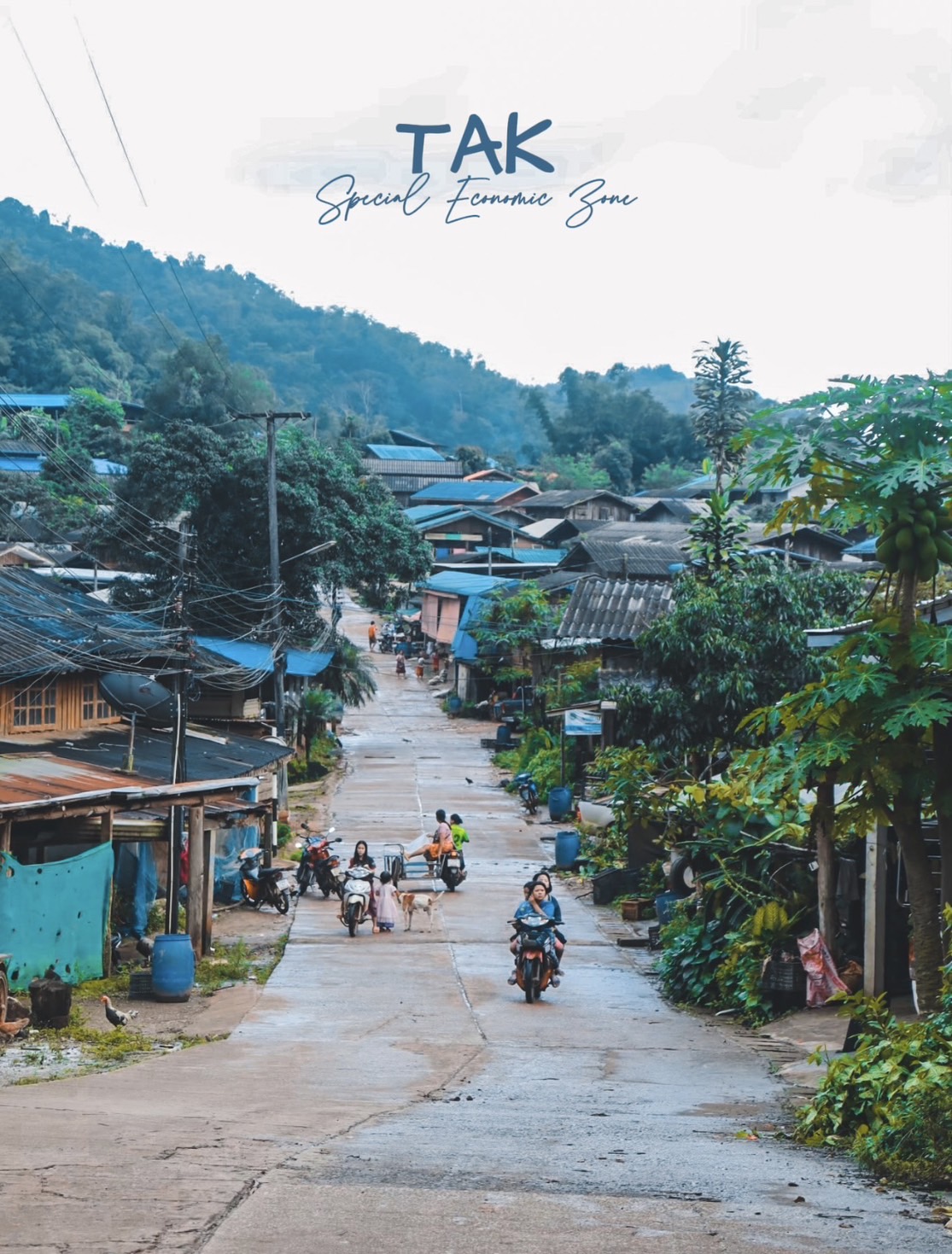
บทความวิจัยนี้มีวัตถุประสงค์เพื่อ 1) วิเคราะห์บริบทของการจัดการการท่องเที่ยวโดยชุมชนในเขตพื้นที่เศรษฐกิจพิเศษตาก และ 2) สังเคราะห์รูปแบบการจัดการการท่องเที่ยวโดยชุมชนผ่านแนวคิดวงจรชีวิตของแหล่งท่องเที่ยว กรณีศึกษาเขตพื้นที่เศรษฐกิจพิเศษตาก โดยใช้วิธีการวิจัยเชิงคุณภาพ จากการศึกษาค้นคว้ารวบรวมข้อมูลแนวคิดและทฤษฎีจากเอกสารตำราเพื่อสร้างเครื่องมือทางการวิจัย และการลงพื้นที่เก็บข้อมูลคนสำคัญโดยการสัมภาษณ์กลุ่มเป้าหมาย จำนวน 3 กลุ่ม ได้แก่ 1) กลุ่มผู้นำและสมาชิกของชุมชนท่องเที่ยว 2) กลุ่มผู้นำทางการท่องเที่ยว คือ ประธานสภาอุตสาหกรรมท่องเที่ยวจังหวัดตาก ประธานผลิตภัณฑ์โอทอปจังหวัดตาก และ 3) กลุ่มหน่วยงานภาครัฐในพื้นที่ คือ พัฒนาการอำเภอแม่สอด พัฒนาการอำเภอแม่ระมาด และพัฒนาการอำเภอพบพระ จากนั้นนำข้อมูลที่ได้มาสังเคราะห์เชิงเนื้อหา ผลการศึกษาพบว่า บริบทของการจัดการการท่องเที่ยวโดยชุมชนในเขตพื้นที่เศรษฐกิจพิเศษตาก มีความโดดเด่นทางด้านทรัพยากรธรรมชาติและความหลากหลายของพหุวัฒนธรรม ทำให้เป็นพื้นที่ท่องเที่ยวที่มีเอกลักษณ์น่าสนใจ ส่วนรูปแบบการจัดการการท่องเที่ยวโดยชุมชนผ่านแนวคิดวงจรชีวิตของแหล่งท่องเที่ยว กรณีศึกษาเขตพื้นที่เศรษฐกิจพิเศษตาก มีองค์ประกอบ 7 ลำดับขั้น คือ 1) ขั้นสำรวจ 2) ขั้นมีส่วนร่วม 3) ขั้นพัฒนา 4) ขั้นเติบโต 5) ขั้นอิ่มตัว 6) ขั้นตกต่ำ และ 7) ขั้นปรับปรุงฟื้นฟู อันนำไปสู่การพัฒนาการจัดการการท่องเที่ยวโดยชุมชนเพื่อรับรู้อดีต เข้าใจปัจจุบันและมองเห็นอนาคต โดยชี้ให้เห็นพลวัตในการปรับตัวของการจัดการ ทั้งนี้ หน่วยงานที่เกี่ยวข้องอาจนำผลการศึกษาไปใช้เป็นประเด็นข้อสังเกตในการกำหนดยุทธศาสตร์เพื่อการขับเคลื่อนนโยบาย การวางแผน และการบริหารการพัฒนาในเขตพื้นที่เศรษฐกิจพิเศษตากให้ชัดเจนและตรงทิศทาง
This research article aims to: 1) analyze the context of community-based tourism management in the Tak special economic zone and 2) synthesize a community-based tourism management model through the tourism area life cycle approach, using the Tak special economic zone as a case study. A qualitative research methodology was employed, incorporating a review of relevant concepts and theories to develop research instruments, documentary analysis, observations, and in-depth interviews with key informants. The study utilized purposive sampling to select three target groups: 1) leaders and members of community-based tourism groups, 2) tourism industry leaders, such as the Chairman of the Tak Provincial Tourism Industry Council and the Chairman of Tak OTOP Products, and 3) local government representatives, including district development officers from Mae Sot, Mae Ramat, and Phop Phra. The collected data were analyzed using content synthesis techniques. The findings indicate that community-based tourism management in the Tak special economic zone is distinguished by its rich natural resources and multicultural diversity, making it a unique and attractive tourism destination. Furthermore, the synthesized community-based tourism management model consists of seven stages: 1) exploration, 2) involvement, 3) development, 4) consolidation, 5) stagnation, 6) decline, and 7) rejuvenation. This model facilitates the strategic development of community-based tourism by acknowledging past trends, understanding present conditions, and anticipating future developments, emphasizing the dynamic nature of tourism management. The study’s findings can serve as a foundation for policymakers and relevant stakeholders in formulating strategies, driving policy implementation, and enhancing planning and development efforts in the Tak special economic zone.
Downloads
Article Details

This work is licensed under a Creative Commons Attribution-NonCommercial-NoDerivatives 4.0 International License.
References
Adhikary, D. K. (2012). Green economy: In pursuance of sustainable development. Administrative and Management Review, 24(2), 77–90.
Bartol, K. M., & Martin, D. C. (1998). Management (3rd ed.). McGraw-Hill.
Beeton, S. (2006). Community development through tourism. Landlinks Press.
Bramwell, B. (1994). Rural tourism and sustainable rural tourism. Journal of Sustainable Tourism, 2(1–2), 1–6.
Butler, R. W. (1980). The concept of a tourist area cycle of evolution: Implications for management of resources. Canadian Geographer, 24(1), 5–12.
Carnall, C. A. (2007). Managing change in organizations (5th ed.). Pearson Education.
Choibamroong, T. (2020, July 8). How to develop sustainable Thai community-based tourism: CBT Redesign (พัฒนาชุมชนท่องเที่ยวไทยอย่างไรให้ยั่งยืน : CBT Redesign) [Video]. DASTA Thailand. https://www.facebook.com/watch/live/?v=319835695691519&ref=watch_permalink
Cohen, J. M., & Uphoff, N. T. (1980). Participation’s place in rural development: Seeking clarity through specificity. World Development, 8(3), 213–235.
Community Development Department, Ministry of Interior. (2018). OTOP Nawatwithi tourism community project management manual (คู่มือบริหารโครงการชุมชนท่องเที่ยว OTOP นวัตวิถี). https://www.oic.go.th/FILEWEB/CABINFOCENTER3/DRAWER051/GENERAL/DATA0000/00000042.PDF
Cooper, H. (2007). Evaluating and interpreting research syntheses in adult learning and literacy. National Center for the Study of Adult Learning and Literacy. https://files.eric.ed.gov/fulltext/ED495441.pdf
Designated Areas for Sustainable Tourism Administration (Public Organization) (DASTA). (2018). Low carbon tourism: Community-based tourism, discover Thainess, Chic & Sustainable (ท่องเที่ยวเกี่ยวเนื่องเรื่องโลกร้อน : การท่องเที่ยวโดยชุมชน วิถีไทย เก๋ไก๋อย่างยั่งยืน)). TAT Review Magazine, 4(3), 54–57.
Dhawan, S. (2020). Online learning: A Panacea in the time of COVID-19 crisis. Journal of Educational Technology Systems, 49(1), 5–22.
Donnan, H., & Wilson, T. M. (1999). Borders: Frontiers of identity, nation and state. Berg Publishers.
Drucker, P. F. (1986). Management: Tasks, responsibilities, practices. Truman Talley Books, E.P. Dutton.
Gilson, L. (2014). Qualitative research synthesis for health policy analysis: What does it entail and what does it offer? Health Policy and Planning, 29(Suppl.3), iii1–iii5.
Goeldner, C. R., & Ritchie, J. R. B. (2012). Tourism: Principles, practices, philosophies (12th ed.). John Wiley & Sons.
Gursoy, D., Uysal, M., Sirakaya-Turk, E., Ekinci, Y., & Baloglu, S. (Eds.). (2014a). Residents’ perceptions and attitudes scales: Tourism impact scale – economic, social, cultural, environmental constructs (Kim, Uysal, & Sirgy, 2013). In Handbook of scales in tourism and hospitality research (pp. 106–108). CABI.
Gursoy, D., Uysal, M., Sirakaya-Turk, E., Ekinci, Y., & Baloglu, S. (Eds.). (2014b). Residents’ perceptions and attitudes scales: Tourism impact attitude scale (TIAS) (Lankford & Howard, 1994). In Handbook of scales in tourism and hospitality research (pp. 90–91). CABI.
Gursoy, D., Uysal, M., Sirakaya-Turk, E., Ekinci, Y., & Baloglu, S. (Eds.). (2014c). Residents’ perceptions and attitudes scales: Sustainable tourism attitude scale (SUSTAS) (Choi & Sirakaya, 2005). In Handbook of scales in tourism and hospitality research (pp. 91–93). CABI.
Haywood, L. (Ed.). (1994). Community leisure and recreation: Theory and practice. Butterworth-Heinemann.
Industrial Promotion Center Region 2. (2018). Mae Sot special economic zone, Tak province (เขตเศรษฐกิจพิเศษแม่สอด จังหวัดตาก). https://ipc2.dip.go.th/th/category/2016-11-09-08-51-32/2018-02-14-04-01-35
Johnson, L. J., & LaMontagne, M. J. (1993). Research methods using content analysis to examine the verbal or written communication of stakeholders within early intervention. Journal of Early Intervention, 17(1), 73–79.
Klawijan, U. (2017). Guidelines for success of community-based tourism management (แนวทางสู่ความสำเร็จของการจัดการการท่องเที่ยวโดยชุมชน). SAU Journal of Social Sciences & Humanities, 1(2), 70–79.
Leiper, N. (1990). Tourist attraction systems. Annals of Tourism Research, 17(3), 367–384.
Lekaota, L. (2015). The importance of rural communities’ participation in the management of tourism management: A case study from Lesotho. Worldwide Hospitality and Tourism Themes, 7(5), 453–462.
Mahtaney, P. (2007). The development paradigm: Its evolution and importance. In India, China and Globalization (pp. 256–276). Palgrave Macmillan.
Manirochana, N. (2017). Community based tourism management (การจัดการการท่องเที่ยวโดยชุมชน). Journal of International and Thai Tourism, 13(2), 25–46.
Muganda, M., Sirima, A., & Ezra, P. M. (2013). The role of local communities in tourism development: Grassroots perspectives from Tanzania. Journal of Human Ecology, 41(1), 53–66.
Onya, P., Praditphonlert, N., Warunsukhasiri, R., & Na Talang, C. (2018). Factors affecting the success of the management of tourist destination that comply with Thailand tourism standard (ปัจจัยที่มีผลต่อความสำเร็จของการบริหารจัดการแหล่งท่องเที่ยวตามมาตรฐานการท่องเที่ยวไทย). Journal of Humanities and Social Sciences, Rajapruk University, 4(3), 75–86.
Permsuphakkul, N., & Sammukkeetham, S. (2020). Achievement characteristics of community-based tourism management: The case studies of Baan Rai Kong Khing and Ban Mae Kampong community in Chiangmai province (ความสำเร็จของการจัดการท่องเที่ยวโดยชุมชน: กรณีศึกษาชุมชนบ้านไร่กองขิงและชุมชนแม่กำปอง จังหวัดเชียงใหม่). Christian University Journal, 26(3), 36–54.
Phohirun, W., & Wiriyasumon, S. (2014). The study of and supporting the community potentiality about agricultural tourism management for self-dependence of MubanRongkha community, Nakhonthai district, Phitsanulok province (Research report) (การศึกษาและส่งเสริมศักยภาพของชุมชนในการจัดการท่องเที่ยวเชิงเกษตรเพื่อการพึ่งตนเองของหมู่บ้านร่องกล้า อำเภอนครไทย จังหวัดพิษณุโลก ระยะที่ 1) (รายงานการวิจัย). Pibulsongkram Rajabhat University.
Robbins, S. P., & DeCenzo, D. A. (2005). Fundamentals of management: Essential concepts and applications (5th ed.). Pearson Education.
Sarobol, S. (Ed.). (2003). Community-based tourism: Concepts and experiences in the northern region (การท่องเที่ยวโดยชุมชน : แนวคิดและประสบการณ์พื้นที่ภาคเหนือ). The Thailand Research Fund.
Singhal, A. (2001). Facilitating community participation through communication. https://www.researchgate.net/publication/228390792_Facilitating_Community_Participation_Through_Communication
Surawattananon, N., Reancharoen, T., Prajongkarn, W., Chunanantatham, S., Simakorn, Y., & Gultawatvichai, P. (2021). Revitalising Thailand’s tourism sector: In search of enablers for future sustainability. Bank of Thailand. https://www.bot.or.th/content/dam/bot/documents/th/research-and-publications/research/discussion-paper-and-policy-paper/250624_WhitepaperVISA.pdf
Suttipisan, S. (2014, October 9–11). Creative community-based tourism: An integrated tourism management approach in Thailand [Paper presentation]. ICADA 2014: Toward ASEAN Development Administration, National Institute Development Administration, Bangkok, Thailand.
Tak Provincial Governor’s Office. (n.d.). Tak province development plan (B.E. 2566–2570) (แผนพัฒนาจังหวัดตาก พ.ศ. 2566–2570). http://web.tak.go.th/upload/files/U-1675315230.pdf
Thangruang, T. (2021). Development guidelines for tourism implies personal values in enhancing the tourism value under the Coronavirus pandemic (แนวทางการพัฒนาการท่องเที่ยวโดยนัยยะค่านิยมส่วนบุคคลในการเพิ่มคุณค่าทางการท่องเที่ยวภายใต้โรคติดเชื้อไวรัสโคโรนา). Journal of Legal Entity Management and Local Innovation, 7(12), 375–392.
Thangruang, T., & Cruz, P. (2023). Tourism community success by tourism management through participation approach (ความสำเร็จชุมชนท่องเที่ยวโดยการจัดการการท่องเที่ยวผ่านแนวคิดการมีส่วนร่วม). Academy Journal of Northern, 10(3), 124–136.
The National Tourism Policy Committee. (2019). Community-based tourism development criteria of Thailand (เกณฑ์การพัฒนาการท่องเที่ยวโดยชุมชนของประเทศไทย). DASTA. https://www.dasta.or.th/uploads/file/202104/1617876403_b5f178f9168db391f996.pdf
