
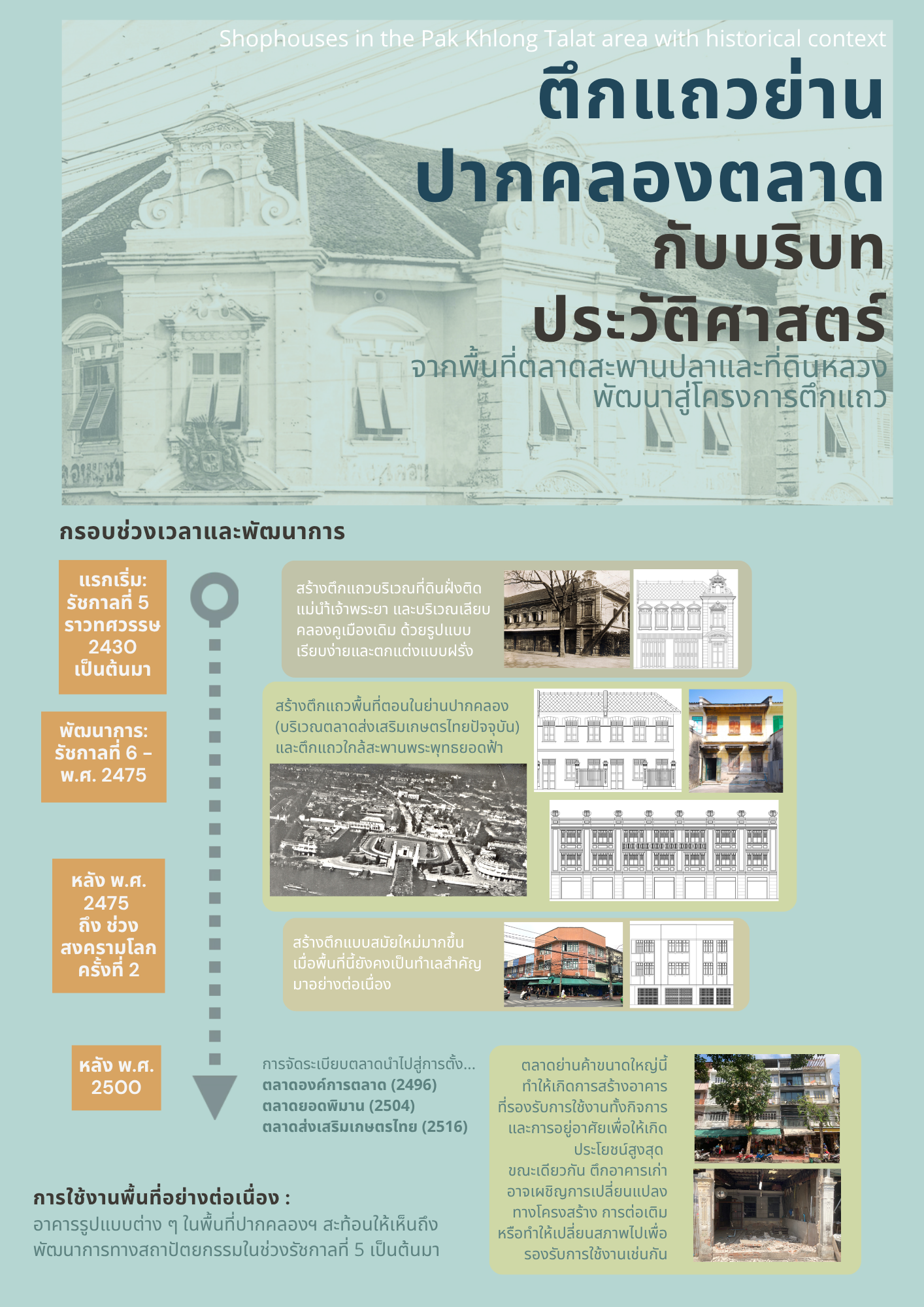
ตึกแถวย่านปากคลองตลาดกับบริบทประวัติศาสตร์ (Shophouses in the Pak Khlong Talat area with historical context)
Article Sidebar
Main Article Content
Abstract
บทความนี้ต้องการนำเสนอการศึกษาตึกแถวและอาคารพาณิชย์ในพื้นที่ปากคลองตลาด โดยมีเหตุสำคัญมาจากที่บริเวณนี้เป็นพื้นที่เก่าแก่ทางประวัติศาสตร์ของกรุงรัตนโกสินทร์ ซึ่งเป็นที่ใช้งานมาอย่างต่อเนื่องตั้งแต่ต้นกรุงรัตนโกสินทร์ พื้นที่แห่งนี้เริ่มจากการเป็นเขตตลาดค้าขาย กลายมาเป็นย่านที่ได้รับการพัฒนาด้านอสังหาริมทรัพย์ด้วยการทำถนนและสร้างตึกแถวและอาคารพาณิชย์ในพื้นที่ตั้งแต่สมัยรัชกาลที่ 5 และมีการปลูกสร้างอาคารเพิ่มเติมเรื่อยมาจนถึงปัจจุบัน การศึกษานี้ใช้กรอบแนวคิดการวิเคราะห์สัณฐานอาคารพาณิชย์ในฐานะผลผลิตเชิงพื้นที่จากการจัดการที่ดินและโครงข่ายคมนาคมโดยกลุ่มชนชั้นนำ จากการศึกษาพบว่าอาคารในพื้นที่อาจแบ่งลักษณะโดยทั่วไปได้ 4 แบบ ได้แก่ 1) รูปแบบตึกแถวระยะแรก ที่มีความเรียบง่ายตกแต่งอาคารเพียงเล็กน้อย 2) รูปแบบการตกแต่งแบบตะวันตก ที่เน้นการประดับองค์ประกอบทางสถาปัตยกรรมภายนอกในแรงบันดาลใจแบบตะวันตก 3) รูปแบบช่วงหัวเลี้ยวหัวต่อ ที่แสดงความเปลี่ยนแปลงในแง่รูปลักษณ์และวัสดุก่อสร้าง และ 4) รูปแบบสมัยใหม่ อาคารรูปทรงกล่องเหลี่ยมที่มีความเรียบเกลี้ยงในแบบทันสมัย นอกจากนี้ผู้ศึกษาได้ยกตัวอย่างอาคารในพื้นที่ 6 กลุ่ม ซึ่งแสดงให้เห็นว่ารูปทรงของอาคารได้เปลี่ยนแปลงไปตามบริบทของสังคมและการเปลี่ยนแปลงพื้นที่ทางกายภาพของกรุงรัตนโกสินทร์จนถึงปัจจุบัน
This article presents a study of shophouses and commercial buildings in Pak Khlong Talat area, an old historical area of Rattanakosin continuously used since its inception. Initially a trading market area, it has undergone real estate development, including road construction and the erection of shophouses and commercial buildings, since the reign of King Rama V, with construction continuing to the present day. This research employs a conceptual framework that analyzes shophouse morphology as a spatial product of land management and transportation networks driven by the land-owning elite. The study identified four general architectural styles in the area: 1) the early shophouse style characterized by simplicity and basic decoration; 2) the Western-style decoration emphasizing Western-inspired exterior architectural elements; 3) the transitional style indicating changes in appearance and construction materials; and 4) the modern style features box-shaped buildings characterized by clean and contemporary design elements. Furthermore, the researcher provided examples of buildings in six groups to demonstrate how the architectural forms of these buildings have evolved in response to social contexts and the physical transformation of Rattanakosin up to the present day.
Downloads
Article Details

This work is licensed under a Creative Commons Attribution-NonCommercial-NoDerivatives 4.0 International License.
References
Announcement from Ministry of the Treasury Regarding the Closure of the Khlong Lod Subdistrict Fish Market. (1892, December 17). Royal Thai Government Gazette. No. 9 Section 38. p. 324.
Bautze, J. K. (2016). Pictures of Siam: Ancient photographs, 1860-1910 (ฉายาลักษณ์สยาม : ภาพถ่ายโบราณ พ.ศ. 2403-2453). River Books.
Chulasai, B., Povatong, P., & Chotipanich, R. (2014). Dusit Palace (วังสวนดุสิต). Matichon Books.
Chungsiriarak, S. (2010). Western architecture in Siam: Rama IV’s reign to 1937 (สถาปัตยกรรมแบบตะวันตกในสยามสมัยรัชกาลที่ 4 - พ.ศ. 2480). Faculty of Architecture, Silpakorn University.
Damrong Rajanubhab, Prince. (1946). Memorandum, written by H.R.H. Prince Damrong Rajanubhab (ความทรงจำ พระนิพนธ์ สมเด็จกรมพระยาดำรงราชานุภาพ). Prachanda Printing Press.
Damrong Rajanubhab, Prince. (2012). Royal chronicles of King Rama 5 (พระราชพงศาวดาร รัชกาลที่ 5) (4th ed.). Matichon Books.
Inchan, D. (2015). Tha Tian: Temples, palaces, houses, shops, markets, and people (ท่าเตียน : วัด วัง บ้าน ร้าน ตลาด และผู้คน). National Discovery Museum Institute.
Jindamaneerojana, S. (2011). Local history of old neighborhoods in Bangkok (ประวัติศาสตร์ท้องถิ่นย่านเก่าในกรุงเทพมหานคร). Faculty of Archaeology, Silpakorn University.
Kanchanakkhaphan, S. (1980). 80 years in my life (80 ปีในชีวิตข้าพเจ้า). Pundit Printing.
Kanchanakkhaphan, S. (1981). Bangkok, 70 years ago (กรุงเทพฯ เมื่อ 70 ปีก่อน) (2nd ed.). Ruangsilp.
Kanchanakkhaphan, S. (1997). A Khlong Bang Luang boy (เด็กคลองบางหลวง). Sarakadee Press.
Office of Archaeology, The Fine Arts Department. (n.d.). Survey report of historical sites in Rattanakosin, Vol. 3: Palaces, shrines, monuments, shophouses (รายงานการสำรวจโบราณสถานในกรุงรัตนโกสินทร์ เล่ม 3 ประเภทวัง ศาลเจ้า อนุสาวรีย์ อาคารร้านค้า). The Fine Arts Department.
Office of His Majesty’s Principal Private Secretary. (1896). The royal archives of King Rama V: Granting land along the eastern riverbank outside the walls of Bangkok, from the front of Wat Ratchaburana to Khlong Talat, as a privilege to Prince Chakrabongse Bhuvanath, Prince Chudadhuj Dharadilok, and Prince Asdang Dejavudh (จดหมายเหตุรัชกาลที่ 5 พระราชทานที่ดินริมแม่น้ำฝั่งตะวันออก นอกกำแพงพระนคร ตั้งแต่หน้าวัดราชบูรณะถึงคลองตลาดให้เป็นสิทธิแก่เจ้าฟ้าจักรพงษ์ภูวนารถ เจ้าฟ้าจุฑาธุชราดิลก เจ้าฟ้าอัษฎางค์เดชาวุธ). (ร.5 รล-พส 14/85). The National Archives of Thailand, Bangkok.
Povatong, P. (2005). Western architects in Siam: Early period of King Rama V (ช่างฝรั่งในกรุงสยาม : ต้นแผ่นดินพระพุทธเจ้าหลวง). Faculty of Architecture, Chulalongkorn University.
Royal Decree of Sanitation District of Bangkok, Rattanakosin Era 116. (1897, November 20). Royal Thai Government Gazette. No. 14 Section 34. pp. 517–525.
Royal Thai Survey Department. (1907). Map of Bangkok, 1907. Royal Thai Survey Department.
Royal Thai Survey Department. (1932). Map of Bangkok, 1932. Royal Thai Survey Department.
Royal Thai Survey Department. (1941). Map of Bangkok, 1941. Royal Thai Survey Department.
Saksri, N., Tiptus, P., Varavarn, C., Sachakul, V., Sthapitanonda, L., & Chulasai, B. (1991). Physical elements of Rattanakosin (องค์ประกอบทางกายภาพกรุงรัตนโกสินทร์). Chulalongkorn University Press.
Singhalampong, E. (2016). All things western: Fashionable identity of the early modern Thai elites (Research report) (เครื่องเคราตะวันตก : อัตลักษณ์นำสมัยของชนชั้นนำไทยช่วงต้นสมัยใหม่) (รายงานการวิจัย). Faculty of Archaeology, Silpakorn University.
Sirithanawat, C., Povatong, P., & Yaimisak, M. (2010). Architecture in the reign of King Chulalongkorn (สถาปัตยกรรมในสมัยพระพุทธเจ้าหลวง). Advanced Info Service.
Siriworrasan, M. (1987). Life like a dream Vol. 1 (ชีวิตเหมือนฝัน เล่ม 1). Bangkok Printing (1984).
Tangtrongjit, K. (2011). The story of post-war times (เล่าความหลังครั้งสงคราม). Pimkham.
The Crown Property Bureau. (2014). Architectural delight: Heritage buildings of The Crown Property Bureau (ทรรศนียาคาร : อาคารอนุรักษ์ของสำนักงานทรัพย์สินส่วนพระมหากษัตริย์) (3rd ed.). Amarin Printing and Publishing.
The National Archives of Thailand. (n.d.-a). Photograph of Tha Rong Ya, Suan Kularb (Document Code NAT-P002984). The Fine Arts Department.
The National Archives of Thailand. (n.d.-b). Photograph of Chak Phet Road and Tri Phet Road (Document Code ภ.002 หวญ 52-22). The Fine Arts Department.
Tiptus, P., & Bongsadadt, M. (1982). Houses in Bangkok: Styles and changes over 200 years, 1782 - 1982 (บ้านในกรุงเทพฯ : รูปแบบและการเปลี่ยนแปลงในรอบ 200 ปี พ.ศ. 2325 - 2525). Chulalongkorn University.
