
การศึกษาการสืบทอดบทเพลงซออู้สำหรับการแสดงหุ่นกระบอก (The study of the transmission of Saw-Ou music for traditional Thai puppetry)
Article Sidebar
Main Article Content
Abstract
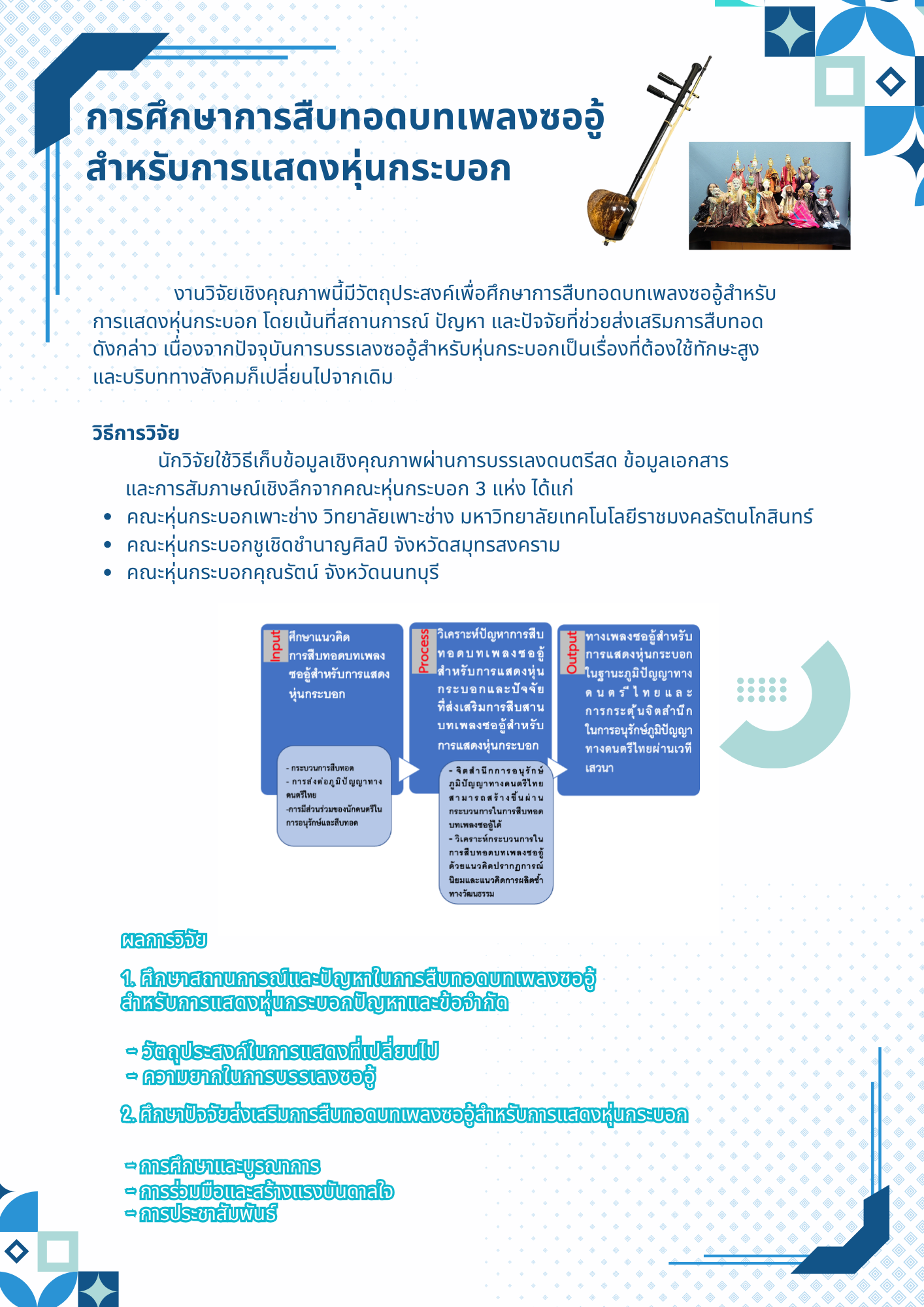
การสืบทอดบทเพลงซออู้สำหรับการแสดงหุ่นกระบอกเป็นการบรรเลงดนตรีที่ต้องใช้ทักษะและความเข้าใจทางดนตรีขั้นสูง ประกอบกับการแสดงหุ่นกระบอกในปัจจุบันมีบริบทการสืบทอดที่ต่างไปจากอดีต งานวิจัยเชิงคุณภาพนี้ จึงมีวัตถุประสงค์เพื่อศึกษาสถานการณ์ ปัญหา และศึกษาปัจจัยส่งเสริมในการสืบทอดบทเพลงซออู้สำหรับการแสดงหุ่นกระบอก โดยการเก็บข้อมูลการบรรเลงดนตรีสด ข้อมูลเอกสาร การสัมภาษณ์เชิงลึกกับคณะหุ่นกระบอกเพาะช่าง วิทยาลัยเพาะช่าง มหาวิทยาลัยเทคโนโลยีราชมงคลรัตนโกสินทร์ คณะหุ่นกระบอกชูเชิดชำนาญศิลป์ จังหวัดสมุทรสงคราม และคณะหุ่นกระบอกคุณรัตน์ จังหวัดนนทบุรี รวมถึงการสนทนากลุ่มแบบเจาะจงระหว่างเสวนาวิชาการดนตรีเพื่อรวบรวมความคิดเห็นของนักวิชาการและผู้รู้ทางดนตรีไทย ผลการวิจัยพบว่า ปัจจุบันการแสดงหุ่นกระบอกทั้ง 3 คณะ มีจุดมุ่งหมายเพื่อการอนุรักษ์หุ่นกระบอกมากกว่าเพื่อการประกอบอาชีพ ทำให้โอกาสในการแสดงลดน้อยลงกว่าในอดีต ประกอบกับผู้บรรเลงซออู้ต้องมีความเข้าใจทางดนตรีและการขับร้องขั้นสูงเพื่อให้เกิดความกลมกลืนในการบรรเลง การเทียบเสียงซออู้ที่แตกต่างกัน 1 เสียง ทำให้การขับร้องและการบรรเลงมีความเฉพาะตัวของแต่ละคณะ การสืบทอดบทเพลงซออู้จึงเกิดขึ้นเฉพาะในคณะของตนเอง อย่างไรก็ตาม ปัจจัยส่งเสริมการสืบทอดด้วยการบูรณาการหุ่นกระบอกกับการเรียนการสอนในโรงเรียน การเชิญนักดนตรีที่มีชื่อเสียงมาร่วมบรรเลง การจัดพิธีไหว้ครูเพื่อการแสดงหุ่นกระบอกและการเผยแพร่การแสดงหุ่นกระบอกผ่านสื่อออนไลน์ที่ทำให้ผู้เรียนเกิดความภาคภูมิใจ รวมถึงการถ่ายทอดบทเพลงด้วยการใช้โน้ตเพลง และการปรับการแสดงให้มีความสนุกสนานมากขึ้นจะทำให้ผู้เรียนและผู้ชมเข้าถึงการแสดงได้ง่ายขึ้น
The transmission of Saw-Ou music, a traditional Thai string instrument, for Hun Krabok performances, a form of traditional Thai puppetry, requires advanced musical skills and a deep understanding of Thai classical music. The contemporary context of Hun Krabok differs significantly from the past. This qualitative study examines the current situation, challenges, and facilitating factors in the transmission of Saw-Ou music. Data were collected through live performance observations, document analysis, in-depth interviews, and focus group discussions during a music seminar with three prominent puppet troupes: the Poh Chang Hun Krabok Troupe of Poh Chang Academy of Arts, Rajamangala University of Technology Rattanakosin; the Chuchoed Chamnansilp Troupe in Samut Songkhram; and the Khun Ratt Troupe in Nonthaburi. The findings indicate that all three troupes primarily aim to preserve the tradition of Hun Krabok rather than pursue it professionally, resulting in fewer performance opportunities than in the past. Saw-Ou performers must possess advanced musical and vocal skills to achieve harmonious accompaniment. Each troupe employs a slightly different tuning system for the Saw-Ou, producing distinctive singing and playing styles unique to each group. Consequently, the transmission of Saw-Ou music tends to occur internally within each troupe. Key factors supporting this transmission include integrating Hun Krabok into school curricula, inviting renowned musicians to perform, organizing Wai Khru ceremonies (paying respects to puppetry teachers), promoting Hun Krabok through social media to instill pride among learners, using musical notation, and adapting performances to make them more entertaining. These measures increase accessibility and engagement for both learners and audiences.
Downloads
Article Details

This work is licensed under a Creative Commons Attribution-NonCommercial-NoDerivatives 4.0 International License.
References
Hongyeesibed, S. (2021). A comparative study of Thai puppet and Burmese puppet performances (การศึกษาเปรียบเทียบรูปแบบการแสดงหุ่นกระบอกไทยและหุ่นกระบอกพม่า). Ganesha Journal, 17(1), 37–50. https://so01.tci-thaijo.org/index.php/pikanasan/article/view/242361
Kaewthep, K., Piyavit, N., Yanako, S., Louiyapong, K., Sirimahawan, S., Siriwattanasakun, W., & Chantharuphan, P. (2006). Firmly adhering to the principles of local media work in communicating health (ยึดหลักปักแน่นกับงานสื่อพื้นบ้านสื่อสารสุขภาวะ). Thammasat University Printing House.
Kamolserirat, Y. (1997). Grandma puppet (คุณยายหุ่นกระบอก). Thai Watana Panich Publishing House.
Kingtakarn, N. (2010). The performing art of Thai puppet for Samut Songkhram arts and Cultural Learning Center’s interior design (นาฎยลีลาหุ่นกระบอกไทยสู่งานออกแบบภายในศูนย์การเรียนรู้ศิลปวัฒนธรรม จังหวัดสมุทรสงคราม) [Master’s thesis, Silpakorn University]. Silpakorn University Repository. https://sure.su.ac.th/xmlui/handle/123456789/394
Kitiarsa, P. (2003). Localism: A review of theory and framework (ท้องถิ่นนิยม : การทบทวนทฤษฎีและกรอบแนวคิด). Chulalongkorn University Press.
Phianchana, P. (2017). Transmission process instrumental and the adjustment Thai music by Dr. Sirichaichan Fachamroon national artist music Thailand (กระบวนการถ่ายทอดการบรรเลงและการปรับวงดนตรีไทยของ ดร.สิริชัยชาญ ฟักจำรูญ ศิลปินแห่งชาติ) [Master’s thesis, Mahasarakham University]. DSpace at Mahasarakham University. http://202.28.34.124/dspace/handle/123456789/274?mode=full
Posayakrit, C. (1986). Thai doll (หุ่นไทย). Amarin Publishing House.
Puttarugsa, S. (2023). Saw-U performance techniquesfor Poh-Chang puppet theater music accompaniment to episode of Nang Wan Thong Haam Thub form Khun Chang Khun Pan (กลวิธีในการบรรเลงซออู้ในการแสดงหุ่นกระบอก เรื่องขุนช้างขุนแผนตอน นางวันทองห้ามทัพของคณะหุ่นกระบอกเพาะช่าง) [Master’s thesis, Chulalongkorn University]. Chulalongkorn University Intellectual Repository. https://cuir.car.chula.ac.th/handle/123456789/83991
Siriwan, N. (2021). Development of learning activities for on local identity through puppet performance: A case of Watpaklsd School Samuthsongkram province (การพัฒนากิจกรรมการแสดงหุ่นกระบอกสำหรับเยาวชน ตามอัตลักษณ์ท้องถิ่น โรงเรียนวัดปากลัด (พลาคารบำรุงวิทย์) จังหวัดสมุทรสงคราม) [Master’s thesis, Srinakharinwirot University]. DSpace at Srinakharinwirot University. http://ir-ithesis.swu.ac.th/dspace/handle/123456789/1941
Uejitmet, W. (1998). The analysis of puppet performing song (การวิเคราะห์เพลงเชิดหุ่นกระบอก) [Master’s thesis, Chulalongkorn University]. Chulalongkorn University Theses and Dissertations (Chula ETD). https://digital.car.chula.ac.th/chulaetd/22172/
