ศิลปะร่วมสมัยเชิงสร้างสรรค์จากต้นทุนทางวัฒนธรรมงานสกุลช่างเมืองเพชร (Creative contemporary art based on the cultural capital of Phetchaburi craftsmanship)
Article Sidebar
Main Article Content
Abstract
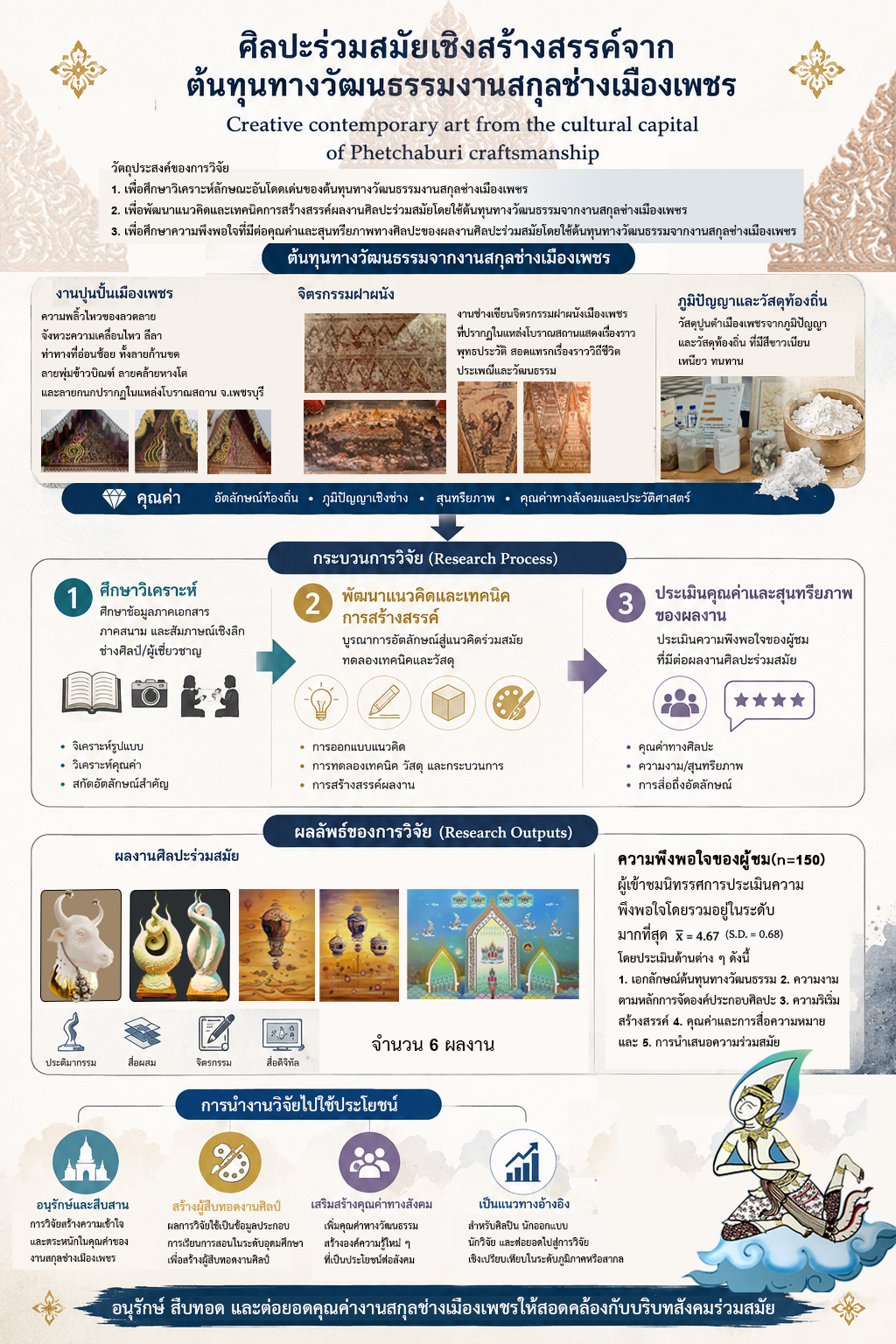
การประยุกต์ใช้ต้นทุนทางวัฒนธรรมผ่านกระบวนการสร้างสรรค์ศิลปะร่วมสมัยเป็นแนวทางสำคัญในการอนุรักษ์ สืบทอด และต่อยอดคุณค่างานสกุลช่างเมืองเพชรให้สอดคล้องกับบริบทสังคมร่วมสมัย งานวิจัยนี้เป็นการวิจัยแบบผสานวิธีร่วมกับการวิจัยเชิงปฏิบัติการสร้างสรรค์ โดยมีวัตถุประสงค์ ดังนี้ 1) เพื่อศึกษาวิเคราะห์ลักษณะอันโดดเด่นของต้นทุนทางวัฒนธรรมงานสกุลช่างเมืองเพชร 2) เพี่อพัฒนาแนวคิดและเทคนิคการสร้างสรรค์ผลงานศิลปะร่วมสมัยโดยใช้ต้นทุนทางวัฒนธรรมจากงานสกุลช่างเมืองเพชร และ 3) เพื่อศึกษาความพึงพอใจที่มีต่อคุณค่าและสุนทรียภาพทางศิลปะของผลงานศิลปะร่วมสมัย ขั้นตอนการวิจัย ประกอบด้วย 1) ศึกษาและวิเคราะห์ข้อมูลงานสกุลช่างเมืองเพชรบุรี 2) ศึกษารูปแบบวิธีการสร้างสรรค์ผลงานศิลปะร่วมสมัย 3) กำหนดแนวคิด วัสดุและเทคนิคการสร้างสรรค์ผลงาน และ 4) จัดแสดงเผยแพร่ผลงาน ผลการวิจัยพบว่า 1) ลักษณะอันโดดเด่นของต้นทุนทางวัฒนธรรมงานสกุลช่างเมืองเพชรปรากฏในแหล่งโบราณสถานและการสืบทอดภูมิปัญญางานสกุลช่างในท้องถิ่น 2) แนวทางการสร้างสรรค์ศิลปะร่วมสมัยสามารถบูรณาการวัสดุ เทคนิค และเทคโนโลยีร่วมสมัยกับอัตลักษณ์งานสกุลช่างเมืองเพชร จนเกิดผลงานสร้างสรรค์ จำนวน 6 ผลงาน ที่สะท้อนคุณค่าทางศิลปะและวัฒนธรรม และ 3) ผลการประเมินความพึงพอใจจากผู้เข้าชมนิทรรศการ จำนวน 150 คน (N = 150) มีค่าเฉลี่ยรวมทุกด้านในระดับมากที่สุด (X̅ = 4.67, S.D. = 0.68) ผลการวิจัยก่อให้เกิดองค์ความรู้ แนวทางการสร้างสรรค์ และผลงานศิลปะร่วมสมัยที่สามารถนำไปประยุกต์ใช้ในการอนุรักษ์และสืบทอดมรดกทางศิลปวัฒนธรรม การจัดการเรียนการสอน การวิจัย การจัดนิทรรศการ และการเผยแพร่อัตลักษณ์ท้องถิ่น อันนำไปสู่การเพิ่มคุณค่าทางวัฒนธรรมและการพัฒนาเศรษฐกิจสร้างสรรค์อย่างยั่งยืน
The application of cultural capital through contemporary art creation is an important approach to preserving, transmitting, and enhancing the value of the Phetchaburi school of traditional craftsmanship in ways that are relevant to contemporary society. This study employed a mixed-methods approach integrated with creative practice-based research. The objectives of this research were to 1) study the unique characteristics of the cultural capital of Phetchaburi craftsmanship, 2) develop concepts and techniques for creating contemporary artworks by applying these unique characteristics, and 3) study the satisfaction with the value, and aesthetics of the contemporary artworks. The research procedures comprised four phases: 1) examining and analyzing the cultural and artistic characteristics of the Phetchaburi school of traditional craftsmanship; 2) exploring contemporary art creation approaches; 3) developing the conceptual framework and determining the materials and techniques for creative production; and 4) exhibiting and disseminating the resulting contemporary artworks. The findings revealed that: 1) the unique characteristics of the cultural capital of Phetchaburi craftmanship are evident in ancient sites and in the transmission of local craftmanship wisdom; 2) the creative approach successfully integrated contemporary materials, techniques, and technologies with the unique identity of Phetchaburi craftsmanship, resulting in six contemporary artworks that effectively conveyed artistic and cultural values; and 3) the satisfaction evaluation conducted among 150 exhibition visitors (N = 150) indicated the highest level of satisfaction (X̅ = 4.67, S.D. = 0.68). The research generated new knowledge, creative approaches, and contemporary artworks that can be applied to the preservation and transmission of cultural heritage, art education, research, exhibition development, and the promotion of local identity. These outcomes contribute to enhancing cultural value and fostering the sustainable development of the creative economy.
Downloads
Article Details

This work is licensed under a Creative Commons Attribution-NonCommercial-NoDerivatives 4.0 International License.
References
Changchaya, B. (2015). Phetchaburi heritage: Local arts and craftsmanship (พื้นภูมิเพชรบุรี : ภูมิศิลปกรรม). Phetchpoom.
Guptabutra, T. (2018). The study of form and content of intangible culture in Thai contemporary art. Humanities, Arts and Social Sciences Studies, 18(1), 29–56. https://doi.org/10.14456/hasss.2018.12
Leksukhum, S. (2017). Art of Ayutthaya: The royal craftsmanship of the king (ศิลปะอยุธยา : งานช่างหลวงแห่งแผ่นดิน) (4th ed.). Muang Boran.
Nimsamer, C. (2014). Composition of art (องค์ประกอบของศิลปะ) (9th ed.). Amarin.
Office of Contemporary Art and Culture. (2017). 108 Contemporary artists to keep an eye on (108 ศิลปินร่วมสมัยที่น่าจับตามอง). Field Style.
Posayanont, A. (2003). The evolution of Thai contemporary art: Traditionalism in reverse (พัฒนาการของศิลปะร่วมสมัยในประเทศไทย : ประเพณีนิยมในด้านที่กลับกัน). The Asia-Pacific of Contemporary Art Triennial Exhibition.
Sangiampaisansuk, C. (Trans.). (2007). The economy of symbolic property (เศรษฐกิจของทรัพย์สินเชิงสัญลักษณ์). Kobfai.
Smith, T. (2009). What is contemporary art? The University of Chicago Press.
Soonpongsri, K. (2016). Aesthetics: Philosophy of art, visual art theory, art criticism (สุนทรียศาสตร์ : หลักปรัชญาศิลปะ ทฤษฎีทัศนศิลป์ ศิลปวิจารณ์) (3rd ed.). Chulalongkorn University Press.
Thaothong, S. (2022). Imagination + creative power, the power of innovative art (กำลังจิตจินตนาการ + พลังคิดสร้างสรรค์ พลานุภาพศิลปะ นวัตกรรมใหม่). Sippatassana.
Tulee, S. (2024). Art research: Synthetic process to artistic innovation (การวิจัยทางศิลปะ : กระบวนการสังเคราะห์สู่นวัตกรรมศิลป์). Faculty of Fine and Applied Arts, Rajamangala University of Technology Thanyaburi.
Uhrmacher, P. B. (2009). Toward a theory of aesthetic learning experiences. Curriculum Inquiry, 39(5), 613–636. https://doi.org/10.1111/j.1467-873X.2009.00462.x
