การพัฒนาทักษะการคิดวิเคราะห์ด้วยการจัดการเรียนรู้แบบสืบเสาะหาความรู้ (5Es) ร่วมกับความรู้ในเนื้อหาผนวกวิธีการสอนและเทคโนโลยีของนักเรียนชั้นมัธยมศึกษาปีที่ 1 (Developing analytical thinking skills through an inquiry-based learning approach (5Es) integrated with technological pedagogical content knowledge among seventh-grade students)
Article Sidebar
Main Article Content
Abstract
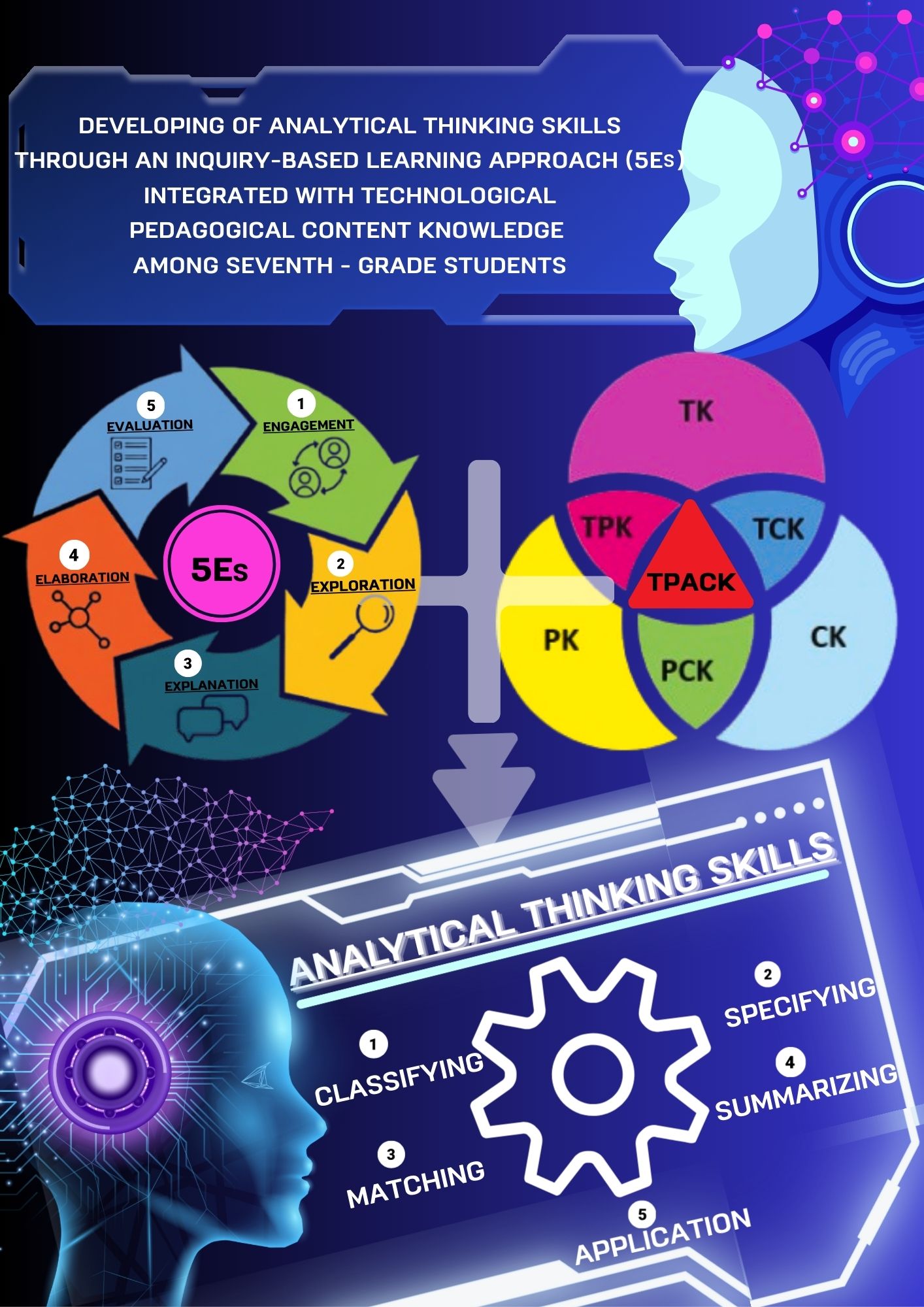
การพัฒนาทักษะการคิดวิเคราะห์เป็นเป้าหมายสำคัญของการเรียนรู้วิทยาศาสตร์ในศตวรรษที่ 21 เนื่องจากเป็นพื้นฐานในการแก้ปัญหาและตัดสินใจอย่างมีเหตุผล งานวิจัยนี้มีวัตถุประสงค์เพื่อพัฒนาการจัดการเรียนรู้แบบสืบเสาะหาความรู้ (5Es) ร่วมกับความรู้ในเนื้อหาผนวกวิธีการสอนและเทคโนโลยี (TPACK) และศึกษาผลของการจัดการเรียนรู้ต่อทักษะการคิดวิเคราะห์ของนักเรียน กลุ่มตัวอย่าง คือ นักเรียนชั้นมัธยมศึกษาปีที่ 1 ปีการศึกษา 2566 จำนวน 100 คน ที่ได้จากการเลือกแบบเจาะจง เครื่องมือวิจัย ประกอบด้วย แผนการจัดการเรียนรู้เรื่อง หน่วยพื้นฐานของสิ่งมีชีวิต ระยะเวลา 6 สัปดาห์ และแบบทดสอบวัดทักษะการคิดวิเคราะห์ ชนิดปรนัย 30 ข้อ ครอบคลุมการจำแนก การจัดหมวดหมู่ การเชื่อมโยง การสรุปความ และการประยุกต์ วิเคราะห์ข้อมูลด้วยสถิติร้อยละ ค่าเฉลี่ย ส่วนเบี่ยงเบนมาตรฐาน และการทดสอบที ผลการวิจัยพบว่า แผนการจัดการเรียนรู้มีประสิทธิภาพสูงกว่าเกณฑ์ที่กำหนด (E1/E2 = 75.36/77.96) และทักษะการคิดวิเคราะห์หลังเรียนสูงกว่าก่อนเรียนอย่างมีนัยสำคัญทางสถิติที่ระดับ 0.05 โดยการจำแนกมีพัฒนาการสูงที่สุด รองลงมา คือ การจัดหมวดหมู่ การเชื่อมโยง การประยุกต์ และการสรุปความ งานวิจัยชี้ว่าการจัดการเรียนรู้แบบสืบเสาะหาความรู้ (5Es) ร่วมกับ TPACK มีประสิทธิผลต่อการพัฒนาทักษะการคิดวิเคราะห์ และสามารถนำไปประยุกต์ใช้ในการจัดการเรียนรู้วิทยาศาสตร์ระดับมัธยมศึกษาตอนต้นได้อย่างมีประสิทธิภาพ
Analytical thinking skills are a crucial goal of 21st-century science education, as they serve as a foundation for effective problem-solving and rational decision-making. This study aimed to develop an inquiry-based learning approach using the 5Es instructional model integrated with Technological Pedagogical Content Knowledge (TPACK) and to examine its effects on seventh-grade students’ analytical thinking skills. The sample consisted of 100 seventh-grade students enrolled in the 2023 academic year, selected through purposive sampling. The research instruments included a six-week instructional plan on the topic Basic Units of Life and a 30-item multiple-choice test designed to assess analytical thinking skills across five dimensions: classifying, specifying, matching, summarizing, and application. Data were analyzed using percentages, means, standard deviations, and t-tests. The findings revealed that the instructional plan achieved an efficiency level exceeding the predetermined criteria (E1/E2 = 75.36/77.96). Students’ post-test scores in analytical thinking skills were significantly higher than their pre-test scores at the 0.05 level. Among the five dimensions, classifying showed the greatest improvement, followed by specifying, matching, application, and summarizing. The findings demonstrate that integrating the 5Es inquiry-based learning approach with TPACK is effective in enhancing analytical thinking skills and can be effectively applied to lower secondary science instruction.
Downloads
Article Details

This work is licensed under a Creative Commons Attribution-NonCommercial-NoDerivatives 4.0 International License.
References
Adebayo, A. O., Olalekan, A. A., & Oladele, O. A. (2016). Effects of computer simulation on academic achievement and retention of students in biology. International Journal of Educational Technology, 3(1), 22–30.
Archambault, L. M., & Barnett, J. H. (2010). Revisiting technological pedagogical content knowledge: Exploring the TPACK framework. Computers & Education, 55(4), 1656–1662. https://doi.org/10.1016/j.compedu.2010.07.009
Bybee, R. W. (2015). The BSCS 5E instructional model: Creating teachable moments. NSTA Press.
Bybee, R. W., Taylor, J. A., Gardner, A., Van Scotter, P., Powell, J. C., Westbrook, A., & Landes, N. (2006). The BSCS 5E instructional model: Origins, effectiveness, and applications. Biological Sciences Curriculum Study (BSCS).
Cetin-Dindar, A., Boz, Y., Sonmez, D. Y., & Celep, N. D. (2018). Development of pre-service chemistry teachers’ technological pedagogical content knowledge. Chemistry Education Research and Practice, 19(1), 167–183. https://doi.org/10.1039/C7RP00175D
Chai, C. S., Koh, J. H. L., & Tsai, C.-C. (2010). Facilitating preservice teachers’ development of technological, pedagogical, and content knowledge (TPACK). Educational Technology & Society, 13(4), 63–73.
Clément, P. (2007). Introducing the cell concept with both animal and plant cells: A historical and didactic approach. Science & Education, 16(3–5), 423–440. https://doi.org/10.1007/s11191-006-9029-7
Elangovan, T., & Ismail, Z. (2014). The effects of 3D computer simulation on biology students’ achievement and memory retention. Asia-Pacific Forum on Science Learning and Teaching, 15(2), Article 10.
Geddis, A. N., & Wood, E. (1997). Transforming subject matter and managing dilemmas: A case study in teacher education. Teaching and Teacher Education, 13(6), 611–626.
Jadeerat, P., Prasitpong, S., & Vanichanon, A. (2021). The development of analytical thinking skill of 10th grade students by using inquiry approach with questioning techniques (การพัฒนาทักษะการคิดวิเคราะห์ของนักเรียนชั้นมัธยมศึกษาปีที่ 4 โดยใช้การจัดการเรียนรู้แบบสืบเสาะหาความรู้ร่วมกับเทคนิคการใช้คำถาม). Journal of Education, Prince of Songkla University, Pattani Campus, 32(1), 61–75.
Koehler, M. J., & Mishra, P. (2009). What is technological pedagogical content knowledge? Contemporary Issues in Technology and Teacher Education, 9(1), 60–70.
Lin, T.-C., Tsai, C.-C., Chai, C. S., & Lee, M.-H. (2013). Identifying science teachers’ perceptions of technological pedagogical and content knowledge (TPACK). Journal of Science Education and Technology, 22(3), 325–336. https://doi.org/10.1007/s10956-012-9396-6
Marzano, R. J. (2001). Designing a new taxonomy of educational objectives. Corwin Press.
Mishra, P., & Koehler, M. J. (2006). Technological pedagogical content knowledge: A framework for teacher knowledge. Teachers College Record, 108(6), 1017–1054.
Olimovna, M. G. (2023). The role of digital educational technologies in teaching physics. International Scientific Journal Science and Innovation, 2(4), 211–216. https://doi.org/10.5281/zenodo.7824362
Pakkullanan, S., & Petsuk, P. (2024). The learning achievement and analytical thinking ability using 5E inquiry-based learning with mind mapping technique activities on science and technology for Prathomsuksa 5 students (ผลสัมฤทธิ์ทางการเรียนและความสามารถในการคิดวิเคราะห์ โดยใช้การจัดการเรียนรู้แบบสืบเสาะหาความรู้ 5 ขั้น ร่วมกับแผนผังความคิดวิชาวิทยาศาสตร์และเทคโนโลยี ของนักเรียนชั้นประถมศึกษาปีที่ 5). Journal for Social Sciences Research, 15(2), 73–89.
Parneesong, U., Naunkaew, J., & Liamtong, S. (2017). Learning management using inquiry method (5E) with concept mapping technique on life and environment towards analytical thinking ability and achievement for grade 10 students (การจัดการเรียนรู้โดยใช้กระบวนการสืบเสาะหาความรู้ (5E) เสริมด้วยเทคนิคการจัดแผนผังมโนทัศน์ เรื่อง ชีวิตกับสิ่งแวดล้อมที่มีผลต่อความสามารถในการคิดวิเคราะห์และผลสัมฤทธิ์ทางการเรียนของนักเรียนชั้นมัธยมศึกษาปีที่ 4). Humanities and Social Sciences Journal of Graduate School, Pibulsongkram Rajabhat University, 11(1), 134–147.
Pellas, N., Dengel, A., & Christopoulos, A. (2020). A scoping review of immersive virtual reality in STEM education. IEEE Transactions on Learning Technologies, 13(4), 748–761.
Phankhat, O. (2018). A study of academic achievement in science and analytical thinking skills of seventh grade students taught by the inquiry instructional method (การศึกษาผลสัมฤทธิ์ทางการเรียนวิทยาศาสตร์และทักษะการคิด วิเคราะห์ของนักเรียนชั้นมัธยมศึกษาปีที่ 1 โดยวิธีสอนแบบสืบเสาะหาความรู้). Journal of Education, Mahasarakham University, 12(3), 232–247.
Phonyiam, P., & Wongkamjan, J. (2023). Development of the 5E of inquiry-based learning combineed with hight level questions technique to promote analytical thinking abilities of grade 7 students (การพัฒนาการจัดการเรียนรู้แบบสืบเสาะหาความรู้ 5 ขั้น (5E) ร่วมกับเทคนิคการใช้คำถามระดับสูงเพื่อส่งเสริมความสามารถในการคิดวิเคราะห์ของนักเรียนชั้นมัธยมศึกษาปีที่ 1). Rajabhat Maha Sarakham University Journal, 17(2), 281–291.
Pierson, M. E. (2001). Technology integration practice as a function of pedagogical expertise. Journal of Research on Computing in Education, 33(4), 413–430. https://doi.org/10.1080/08886504.2001.10782325
Ratniyom, J., Jongpungklang, K., Sudsin, M., Chuchuoy, K., Tientongdee, S., & Lee, A. (2021). The effect of using Kahoot as a formative assessment tool in 4Ex2 learning management on learning achievement and analytical thinking ability (ผลของการใช้ Kahoot เป็นเครื่องมือช่วยวัดประเมินผลระหว่างเรียนในการจัดการเรียนรู้แบบ 4Ex2 ที่มีต่อผลสัมฤทธิ์ทางการเรียนและความสามารถในการคิดวิเคราะห์). Journal of Science and Science Education, 4(2), 264–278.
Sabandar, G. N. C., Supit, N. R., & Suryana, H. T. E. (2018). Kahoot!: Bring the fun into the classroom! Indonesian Journal of Informatics Education, 2(2), 127–134.
Seedaeng, K., Jansawang, N., & Passago, S. (2020). Using the mixed instruction between the 5Es inquiry approach and the modern instructional media for enhancing students’ analytical thinking and their learning achievements on cell and cell function issue (การจัดการเรียนรู้แบบสืบเสาะหาความรู้ 5 ขั้น ร่วมกับสื่อการสอนสมัยใหม่เพื่อพัฒนาการคิดวิเคราะห์และผลสัมฤทธิ์ทางการเรียน เรื่อง เซลล์และการทำงานของเซลล์). Rajabhat Maha Sarakham University Journal, 14(1), 59–68.
Shambare, B., & Jita, T. (2024). TPACK: A descriptive study of science teachers’ integration of the virtual laboratory in rural school teaching. Cogent Education, 11(1), Article 2365110. https://doi.org/10.1080/2331186X.2024.2365110
Shulman, L. S. (1986). Those who understand: Knowledge growth in teaching. Educational Researcher, 15(2), 4–14. https://doi.org/10.3102/0013189X015002004
Shulman, L. S. (1987). Knowledge and teaching: Foundations of the new reform. Harvard Educational Review, 57(1), 1–23.
Taweeboot, C., Pansuppawat, A., & Wongchalee, P. (2018). Development of critical thinking ability using inquiry method and graphic organizers entitled “Photosynthesis” for Mathayom Suksa 5 students (การพัฒนาความสามารถในการคิดวิเคราะห์โดยการจัดการเรียนรู้แบบสืบเสาะหาความรู้ร่วมกับผังกราฟิก เรื่อง การสังเคราะห์ด้วยแสง ของนักเรียนชั้นมัธยมศึกษาปีที่ 5). Journal of Curriculum and Instruction Sakon Nakhon Rajabhat University, 10(27), 99–108.
Thailand PISA National Centre, The Institute for the Promotion of Teaching Science and Technology (IPST). (2021). PISA 2018 Assessment results: Reading, mathematics, and science (ผลการประเมิน PISA 2018 การอ่าน คณิตศาสตร์ และวิทยาศาสตร์). The Institute for the Promotion of Teaching Science and Technology (IPST).
The Institute for the Promotion of Teaching Science and Technology (IPST). (2018). Guidebook for implementing the core science curriculum: Basic science subject group (revised edition 2017) under the basic education core curriculum B.E. 2551 for lower secondary level (คู่มือการใช้หลักสูตรรายวิชาพื้นฐานวิทยาศาสตร์ กลุ่มสาระการเรียนรู้วิทยาศาสตร์ (ฉบับปรับปรุง พ.ศ. 2560) ตามหลักสูตรแกนกลางการศึกษาขั้นพื้นฐาน พุทธศักราช 2551 ระดับมัธยมศึกษาตอนต้น). The Institute for the Promotion of Teaching Science and Technology (IPST), Ministry of Education. https://www.scimath.org/ebook-science/item/8923-2018-10-01-01-59-16
Thiangchanthathip, K., Khumwong, P., Kanyaprasith, K., & Chamrat, S. (2016). High school students’ conceptions in the topic of cell and cell division (มโนทัศน์เรื่องเซลล์และการแบ่งเซลล์ของนักเรียนระดับชั้นมัธยมศึกษาตอนปลาย). Journal of Education, 27(3), 95–110.
Uthaiwat, K., Pansuppawat, A., & Pansuppawat, T. (2017). Development of analytical thinking by using inquiry cycle (5Es) and graphic organizer on the topic of ecosystem for Mathayomsuksa 3 in the learning area of science (การพัฒนาการคิดวิเคราะห์โดยใช้การสอนแบบสืบเสาะหาความรู้ 5Es ร่วมกับผังกราฟิก เรื่องระบบนิเวศ นักเรียนชั้นมัธยมศึกษาปีที่ 3 กลุ่มสาระการเรียนรู้วิทยาศาสตร์). Journal of Curriculum and Instruction, Sakon Nakhon Rajabhat University, 9(25), 53–62.
Voogt, J., Fisser, P., Roblin, N. P., Tondeur, J., & van Braak, J. (2013). Technological pedagogical content knowledge — a review of the literature. Journal of Computer Assisted Learning, 29(2), 109–121. https://doi.org/10.1111/j.1365-2729.2012.00487.x
Wang, A. I., & Tahir, R. (2020). The effect of using Kahoot! for learning — a literature review. Computers & Education, 149, Article 103818. https://doi.org/10.1016/j.compedu.2020.103818
Wongsom, J., & Pankaew, P. (2016). Science learning management through inquiry method with graphic organizers to develop analytical thinking ability of Prathom Suksa 6 students (การจัดการเรียนรู้วิทยาศาสตร์แบบสืบเสาะหาความรู้ที่เสริมด้วยการใช้ผังกราฟิกเพื่อพัฒนาความสามารถในการคิดวิเคราะห์ของนักเรียนชั้นประถมศึกษาปีที่ 6). Journal of Graduate Research, 7(2), 47–59.
