
การผลิตอุปลักษณ์ในภาษาไทยของนักศึกษาชาวจีนต่างชั้นปีที่เรียนภาษาไทยในฐานะภาษาที่สอง (Metaphor production in Thai among Chinese students at different academic year levels learning Thai as a second language)
Article Sidebar
Main Article Content
Abstract
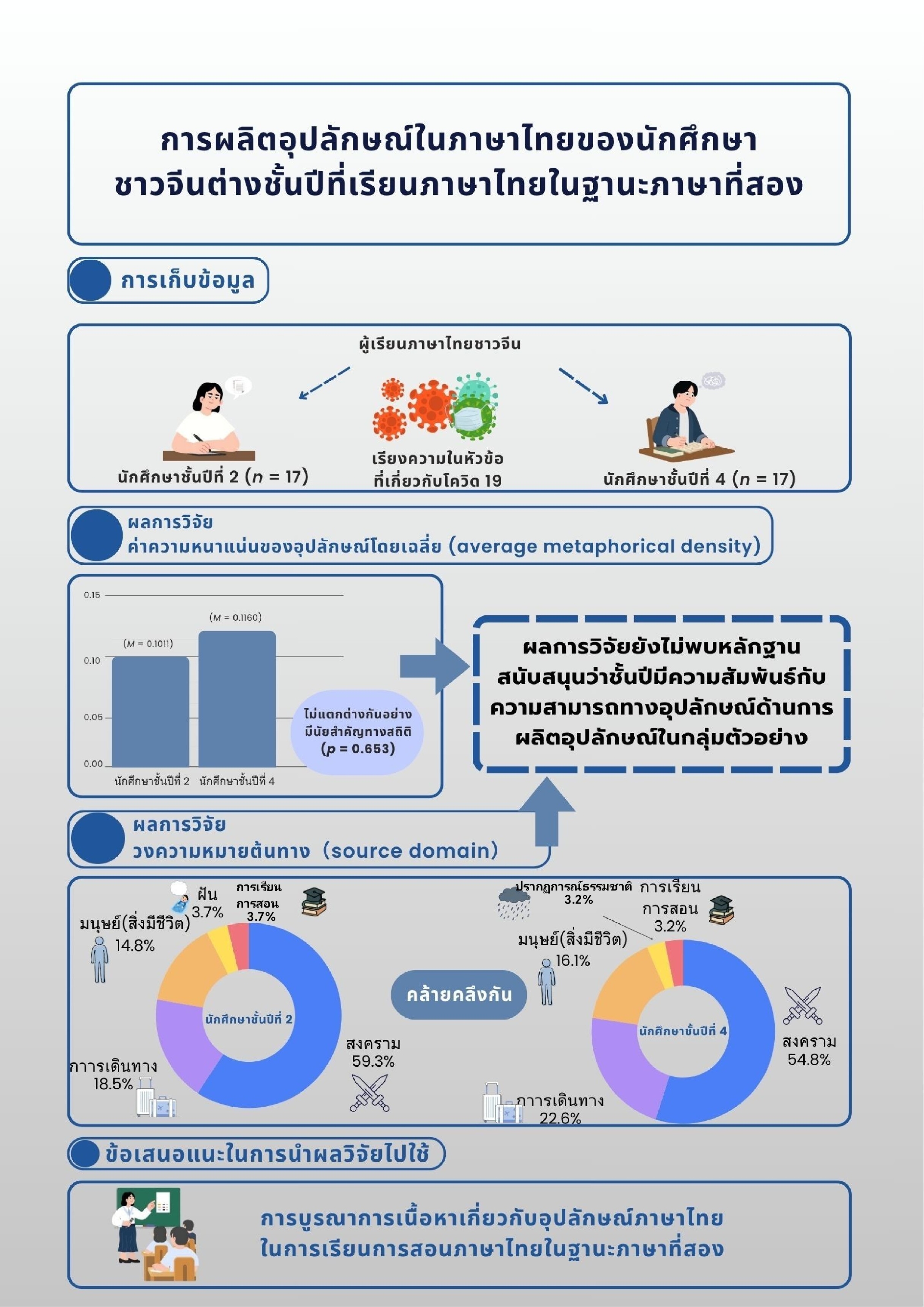
การใช้อุปลักษณ์เป็นปัจจัยสำคัญเกี่ยวกับความเป็นธรรมชาติในการใช้ภาษา และเป็นสิ่งท้าทายในการเรียนภาษาที่สอง งานวิจัยนี้จึงมีวัตถุประสงค์เพื่อศึกษาความสัมพันธ์ระหว่างชั้นปีของนักศึกษาชาวจีนที่เรียนภาษาไทยในฐานะภาษาที่สองกับความสามารถทางอุปลักษณ์ด้านการผลิตอุปลักษณ์ ข้อมูลเก็บจากเรียงความภาษาไทยของนักศึกษาชาวจีนต่างชั้นปีที่เรียนภาษาไทยในฐานะภาษาที่สองทั้งหมด 34 คน โดยแบ่งเป็นสองกลุ่ม คือ กลุ่มที่อยู่ในชั้นปีที่ 4 กับกลุ่มที่อยู่ในชั้นปีที่ 2 โดยศึกษาจากแง่ความหนาแน่นของอุปลักษณ์ ซึ่งสัมพันธ์กับความเป็นธรรมชาติของการใช้ภาษา และแง่วงความหมายต้นทาง ซึ่งสะท้อนความสามารถในการสร้างความสัมพันธ์เชิงอรรถศาสตร์ระหว่างสิ่งที่อยู่ในวงความหมายต่างกัน ผลการวิจัยยังไม่พบหลักฐานสนับสนุนว่าชั้นปีมีความสัมพันธ์กับความสามารถทางอุปลักษณ์ด้านการผลิตอุปลักษณ์ในกลุ่มตัวอย่างดังกล่าว ความหนาแน่นของอุปลักษณ์ของสองกลุ่มไม่แตกต่างกันอย่างมีนัยสำคัญทางสถิติ (p = 0.653) และวงความหมายต้นทางมีลักษณะคล้ายกัน ถ้อยคำอุปลักษณ์ภาษาไทยที่นักศึกษาชาวจีนผลิตอยู่ในวงความหมายสงครามโดยส่วนมาก และอุปลักษณ์ภาษาไทยที่นักศึกษาชาวจีนผลิตมีความคล้ายกันกับอุปลักษณ์ภาษาจีนที่เจ้าของภาษาผลิตซึ่งสะท้อนอิทธิพลจากการถ่ายโอนจากภาษาที่หนึ่ง อย่างไรก็ตาม การบูรณาการเนื้อหาเกี่ยวกับอุปลักษณ์ในการเรียนการสอนภาษาไทย อาจช่วยพัฒนาความตระหนักรู้ด้านมโนทัศน์และความเป็นธรรมชาติในการใช้ภาษาไทยของผู้เรียนชาวจีนได้
Metaphor use is a crucial factor for achieving naturalness in language and poses a major challenge for second language learning. This study aims to investigate the relationship between academic year level and metaphor production as a dimension of metaphorical competence among Chinese learners of Thai as a second language. Data were collected from Thai essays written by 34 Chinese undergraduate students, divided into two groups: second-year and fourth-year students. The analysis focused on metaphorical density, which correlates with language naturalness, and source domains, which reflect the ability to establish semantic connections across different domains. The findings did not provide evidence of a statistically significant relationship between academic year level and metaphor production competence in this sample. Metaphorical density did not differ significantly between the two groups (p = 0.653), and both groups utilized similar source domains. Most Thai metaphorical expressions produced by the learners belonged to the domain of “WAR” and exhibited striking similarities to native Chinese metaphors, suggesting the influence of L1 transfer. Nevertheless, integrating metaphor-oriented content into Thai language teaching may help enhance conceptual awareness and foster greater naturalness in Thai language use among Chinese learners.
Downloads
Article Details

This work is licensed under a Creative Commons Attribution-NonCommercial-NoDerivatives 4.0 International License.
References
Aleshtar, M. T., & Dowlatabadi, H. (2014). Metaphoric competence and language proficiency in the same boat. Procedia - Social and Behavioral Sciences, 98, 1895–1904. https://doi.org/10.1016/j.sbspro.2014.03.620
Chen, L. (2016). A review of overseas studies on metaphorical competence: Retrospect and prospect (国外隐喻能力研究综述—回眸与前瞻). Foreign Languages Research, 33(4), 22–26. [in Chinese]
Danesi, M. (1993). Metaphorical competence in second language acquisition and second language teaching: The neglected dimension. In J. E. Alatis (Ed.), Language, Communication, and Social Meaning (pp. 489–500). Georgetown University Press.
Danesi, M. (1995). Learning and teaching languages: The role of “conceptual fluency”. International Journal of Applied Linguistics, 5(1), 3–20. https://doi.org/10.1111/j.1473-4192.1995.tb00069.x
Danesi, M. (2003). Second language teaching: A view from the right side of the brain. Kluwer Academic.
Danesi, M. (2016). Conceptual fluency in second language teaching: An overview of problems, issues,research findings, and pedagogy. International Journal of Applied Linguistics & English Literature, 5(1), 145–153. https://doi.org/10.7575/aiac.ijalel.v.5n.1p.145
Gardner, H., & Winner, E. (1978). The development of metaphoric competence: Implications for humanistic disciplines. Critical Inquiry, 5(1), 123–141.
Hashemian, M., & Nezhad, M. R. T. (2007). The development of conceptual fluency and metaphorical competence in L2 learners. Linguistik Online, 30(1), 41–56. https://doi.org/10.13092/lo.30.548
Johnson, J., & Rosano, T. (1993). Relation of cognitive style to metaphor interpretation and second language proficiency. Applied Psycholinguistics, 14(2), 159–175. https://doi.org/10.1017/S014271640000953X
Kasper, G. (1992). Pragmatic transfer. Second Language Research, 8(3), 203–231. https://doi.org/10.1177/026765839200800303
Lakoff, G., & Johnson, M. (2003). Metaphors we live by. The University of Chicago Press.
Lin, C. (2022). A study of Chinese metaphor
comprehension competence and affecting factors of Thai university students (การวิจัยด้านความสามารถในการเข้าใจอุปลักษณ์ภาษาจีนและปัจจัยที่มีอิทธิพลของนักศึกษาไทย). Journal of Liberal Arts, Thammasat University, 22(3), 294–323. https://doi.org/10.14456/lartstu.2022.42
Littlemore, J. (2001). Metaphoric competence: A language learning strength of students with a holistic cognitive style? TESOL Quarterly, 35(3), 459–491. https://doi.org/10.2307/3588031
Littlemore, J., Krennmayr, T., Turner, J., & Turner, S. (2014). An investigation into metaphor use at different levels of second language writing. Applied Linguistics, 35(2), 117–144. https://doi.org/10.1093/applin/amt004
Littlemore, J., & Low, G. (2006). Metaphoric competence, second language learning, and communicative language ability. Applied Linguistics, 27(2), 268–294. https://doi.org/10.1093/applin/aml004
Low, G. D. (1988). On teaching metaphor. Applied Linguistics, 9(2), 125–147. https://doi.org/10.1093/applin/9.2.125
Lu, Q., & Deignan, A. (2024). Unconventional metaphor use in the writing of Chinese learners of English. Sage Open, 14(2). https://doi.org/10.1177/21582440241252293
MacArthur, F. (2010). Metaphorical competence in EFL: Where are we and where should we be going? A view from the language classroom. AILA Review, 23(1), 155–173. https://doi.org/10.1075/aila.23.09mac
Nacey, S. (2017). Metaphor comprehension and production in a second language. In E. Semino & Z. Demjén (Eds.), The Routledge handbook of metaphor and language (pp. 503–515). Routledge.
Office of the Permanent Secretary, Ministry of Higher Education, Science, Research and Innovation. (2025). Total number of students in the second semester of academic year 2025, classified by institution / institution group / sex / level of education / faculty / (for international (students degree program and academic year level)) (นักศึกษารวม ปีการศึกษา 2568 ภาคเรียนที่ 2 ในสถาบันอุดมศึกษาทั้งหมด จำแนกตาม สถาบัน / กลุ่มสถาบัน / เพศ / ระดับการศึกษา / คณะ / (เฉพาะนักศึกษาต่างชาติ (ชื่อปริญญา / ชั้นปี))). https://info.mhesi.go.th/stat_std_all.php?search_year=2568
Pollio, H. R., Barlow, J. M., Fine, H. J., & Pollio, M. R. (1977). Psychology and the poetics of growth: Figurative language in psychology, psychotherapy, and education. Lawrence Erlbaum Associates.
Pollio, H. R., & Burns, B. C. (1977). The anomaly of anomaly. Journal of Psycholinguistic Research, 6(3), 247–260.
Pollio, H. R., & Smith, M. K. (1979). Sense and nonsense in thinking about anomaly and metaphor. Bulletin of the Psychonomic Society, 13(5), 323–326. https://doi.org/10.3758/BF03336884
Sabet, M. K., & Tavakoli, M. (2016). Metaphorical competence: A neglected component of communicative competence. International Journal of Education & Literacy Studies, 4(1), 32–39. https://doi.org/10.7575/aiac.ijels.v.4n.1p.32
Thu, N. T. H. (2019). Using metaphor in EFL classroom to enhance writing skills: A case study. International Journal of Humanity Studies, 3(1), 1–13. https://doi.org/10.24071/ijhs.2019.030101
Wan, W. (2014). Constructing and developing ESL students’ beliefs about writing through metaphor: An exploratory study. Journal of Second Language Writing, 23, 53–73. https://doi.org/10.1016/j.jslw.2014.01.002
Wang, J., & Sun, Y. (2020). How is Chinese English learners’ L2 metaphoric competence related to that at of L1? An E-prime-based multi-dimensional study. International Journal of English Linguistics, 10(4), 115–123. https://doi.org/10.5539/ijel.v10n4p115
Xie, X. (2023). Metaphors related to COVID-19 in Thai and Chinese (อุปลักษณ์เกี่ยวกับโควิด 19 ในภาษาไทยและภาษาจีน) [Master’s thesis, Kasetsart University]. Kasetsart University Library Network. https://www.lib.ku.ac.th/KUthesis/2565/xin-xie-all.pdf
Xu, B., Yu, Q., & Yuan, F. (2014). A rationale analysis of the relationship between metaphorical competence and language competence (隐喻能力与语言能力关系的理据分析). Foreign Languages Research, 31(1), 47–50. [in Chinese]
Xu, B., & Yuan, F. (2012). A review of metaphorical competence studies in the last 30 years. Journal of PLA University of Foreign Languages, 35(6), 34–39.
Xu, B., Yuan, F., & Wang, L. (2012). An empirical study of the relationship between cognitive style and metaphor comprehension. Shandong Foreign Language Teaching, 33(4), 56–61.
Yang, C. (2023) Problems and improvement strategies in non-major Thai language teaching in Chinese universities under the “Belt and Road” initiative (“一带一路”背景下高校非专业泰语教学中存在的问题及改进策略). New Curriculum Research, 20(30), 108–110. [in Chinese]
Yuan, F. (2016). A comparative study of metaphor production competence between different groups of subjects of various English levels. Foreign Language Academic, 4, 17–26.
Yuan, F. (2020). A review of the research on metaphoric competence. Modern Linguistics, 8(2), 162–171.
Yuan, F., & Guo, T. (2014). A comparative study of metaphor interpretation competence between different groups of subjects of various English levels. Foreign Language Research, 37(5), 101–106.
Yuan, F., & Xu, B. (2019). A comparative study of metaphorical output through writing by university students of various English levels. Foreign Language Education in China, 2(2), 63–72.
Yuan, F., Xu, B., & Wang, L. (2012). On the definition of metaphorical competence. Foreign Language Education, 33(5), 1–7.
Yuan, F., & Zhang, X. (2015). A comparative study of conceptual metaphor induction competence between different groups of subjects of various language proficiency levels. Foreign Language Learning Theory and Practice, 37(2), 7–12.
Zhou, X., Younas, M., Omar, A., & Guan, L. (2022). Can second language metaphorical competence be taught through instructional intervention? A meta-analysis. Frontiers in Psychology, 13, Article 1065803. https://doi.org/10.3389/fpsyg.2022.1065803
