
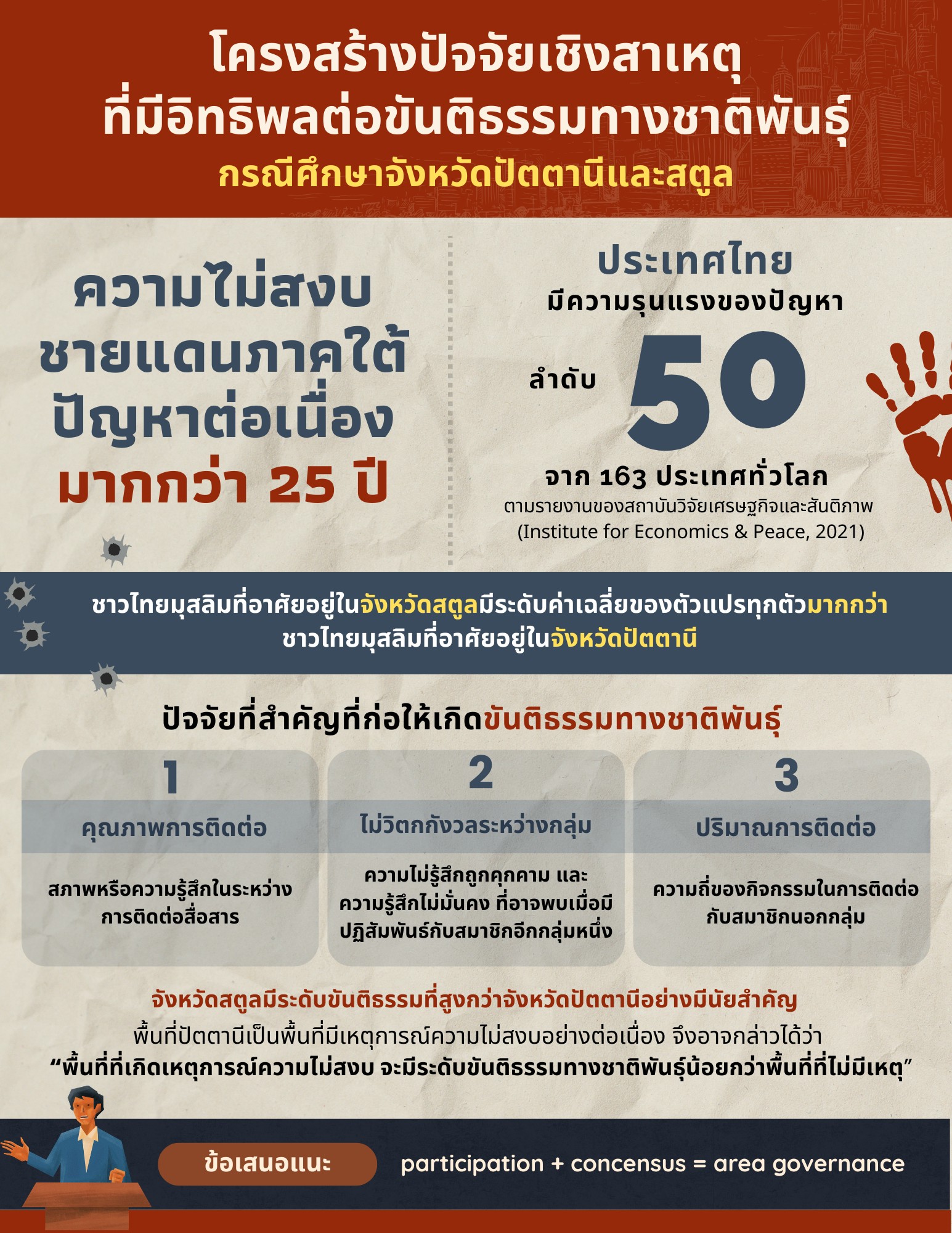
โครงสร้างปัจจัยเชิงสาเหตุที่มีอิทธิพลต่อขันติธรรมทางชาติพันธุ์ : กรณีศึกษาจังหวัดปัตตานีและสตูล (The structure of causal factors influencing ethnic tolerance in the case studies of Pattani and Satun provinces)
Article Sidebar
Main Article Content
Abstract
สถานการณ์ความไม่สงบในจังหวัดชายแดนภาคใต้ของประเทศไทยยังคงมีความรุนแรงต่อเนื่อง ซึ่งจำเป็นต้องใช้แนวทางการแก้ไขปัญหาที่หลากหลายและอาศัยผลวิจัยเชิงประจักษ์เพื่อสร้างข้อเสนอทางนโยบาย การวิจัยครั้งนี้มีวัตถุประสงค์เพื่อ 1) ศึกษาและเปรียบเทียบระดับของขันติธรรมทางชาติพันธุ์ ความวิตกกังวลระหว่างกลุ่ม ปริมาณการติดต่อ ทุนทางสังคม ประสบการณ์ในอดีต และคุณภาพการติดต่อ ในพื้นที่จังหวัดปัตตานีและสตูล และ 2) ศึกษารูปแบบความสัมพันธ์เชิงโครงสร้างของปัจจัยเชิงสาเหตุที่มีอิทธิพลต่อขันติธรรมทางชาติพันธุ์ กลุ่มตัวอย่าง 1,987 คน ประกอบด้วย ชาวไทยมุสลิมที่อยู่อาศัยในจังหวัดปัตตานี (984 คน) และสตูล (1,003 คน) เก็บรวบรวมข้อมูลโดยใช้แบบสอบถาม และวิเคราะห์ข้อมูลโดย t-test และการวิเคราะห์สมการโครงสร้าง เพื่อตอบสมมติฐาน 13 ข้อ ผลการวิเคราะห์ความแตกต่างของค่าเฉลี่ย พบว่า ชาวไทยมุสลิมในจังหวัดสตูลมีค่าเฉลี่ยมากกว่าจังหวัดปัตตานีทุกตัวแปรอย่างมีนัยสำคัญทางสถิติที่ระดับน้อยกว่า 0.001 ผลการวิเคราะห์แบบจำลองโครงสร้างความสัมพันธ์เชิงสาเหตุมีความสอดคล้องกับข้อมูลเชิงประจักษ์โดยมีค่า CMIN/DF = 3.247, IFI = .920, TLI = .911, CFI = .919, RMSEA = 0.48 และพบผลสำคัญว่า คุณภาพการติดต่อส่งผลต่อขันติธรรมทางชาติพันธุ์มากที่สุด (β = .685) และยังมีผลอิทธิพลทางตรงและทางอ้อมโดยรวมสูงสุดอีกด้วย รองลงมา คือ ความวิตกกังวลระหว่างกลุ่ม (β = .268) และปริมาณการติดต่อเป็นลำดับถัดมา (β = .179) โดยมีข้อเสนอเชิงนโยบาย คือ การตระหนักถึงบทบาทหน้าที่ตามหลักการจัดการปกครองสาธารณะ และสิทธิความเป็นพลเมืองของประชาชนในพื้นที่ของภาครัฐ และข้อเสนอแนะเชิงพื้นที่ คือ สร้างเป้าหมายที่มีร่วมกันในระดับชุมชน ด้วยกิจกรรมที่ใช้ชุมชนเป็นตัวฐานและการกำหนดการใช้พื้นที่ส่วนกลางร่วมกัน
The persistent violence and complex instability in Thailand’s Southern Border Provinces necessitate a multifaceted and evidence-based policy approach for effective resolution. This research aimed to: 1) compare the levels of ethnic tolerance, intergroup anxiety, quantity of contact, social capital, past experience, and quality of contact among Thai Muslims residing in Pattani and Satun provinces; and 2) examine the structural relationships among causal factors influencing ethnic tolerance. A total of 1,987 Thai Muslim residents participated in the study, comprising 984 respondents from Pattani and 1,003 from Satun. Data were collected using structured questionnaires and analyzed using independent samples t-tests and Structural Equation Modeling (SEM) to test thirteen hypotheses. The analysis of mean differences revealed that Thai Muslims in Satun province scored significantly higher than those in Pattani across all variables (p < 0.001). The proposed structural model demonstrated a good fit with the empirical data (CMIN/DF = 3.247, IFI = .920, TLI = .911, CFI = .919, RMSEA = 0.48). The findings indicated that quality of contact was the strongest predictor of ethnic tolerance (β = .685), followed by intergroup anxiety (β = .268) and quantity of contact (β = .179). This study offers two key recommendations: first, government agencies should adhere to the principles of public governance and recognize the civic rights and participatory roles of local citizens; second, shared community goals should be promoted through community-based activities and the designated use of shared public spaces.
Downloads
Article Details

This work is licensed under a Creative Commons Attribution-NonCommercial-NoDerivatives 4.0 International License.
References
Alesina, A., & La Ferrara, E. (2000). Participation in heterogeneous communities. The Quarterly Journal of Economics, 115(3), 847–904.
Allport, G. W. (1954). The nature of prejudice. Addison-Wesley.
Barnes, A., & Ephross, P. H. (1994). The impact of hate violence on victims: Emotional and behavioral responses to attacks. Social Work, 39(3), 247–251.
Bettelheim, B., & Janowitz, M. (1949). Ethnic tolerance: A function of social and personal control. American Journal of Sociology, 55(2), 137–145.
Brown, R., & Hewstone, M. (2005). An integrative theory of intergroup contact. Advances in Experimental Social Psychology, 37, 255–343. https://doi.org/10.1016/S0065-2601(05)37005-5
Butler, G., & Mathews, A. (1983). Cognitive processes in anxiety. Advances in Behaviour Research and Therapy, 5(1), 51–62. https://doi.org/10.1016/0146-6402(83)90015-2
Committee on National Security, The House of Representatives. (2010). Report on the study of the unrest situation in the southern border provinces and proactive solutions (รายงานผลการพิจารณาศึกษาเรื่อง สถานการณ์ความไม่สงบในจังหวัดชายแดนภาคใต้และแนวทางแก้ไขเชิงรุก). The Secretariat of the House of Representatives.
Crowley, F., & Walsh, E. (2024). Tolerance, social capital, and life satisfaction: A multilevel model from transition countries in the European Union. Review of Social Economy, 82(1), 23–50. https://doi.org/10.1080/00346764.2021.1957994
Eller, A., Abrams, D., Viki, G. T., Imara, D. A., & Peerbux, S. (2007). Stay cool, hang loose, admit nothing: Race, intergroup contact, and public-police relations. Basic and Applied Social Psychology, 29(3), 213–224.
Essed, P. (1991). Understanding everyday racism: An interdisciplinary theory. Sage.
Eysenck, M. W. (1992). Anxiety: The cognitive perspective. Lawrence Erlbaum Associates.
Feagin, J. R. (1991). The continuing significance of race: Antiblack discrimination in public places. American Sociological Review, 56(1), 101–116.
Fiala, A. (2002). Terrorism and the philosophy of history: Liberalism, realism, and the supreme emergency exemption. Essays in Philosophy, 3(3), 329–341. https://doi.org/10.5840/eip20023s2
Hair, J. F., Jr., Black, W. C., Babin B. J., Anderson, R. E., & Tatham, R. L. (2006). Multivariate data analysis (6th ed.). Pearson Prentice Hall.
Hamberger, J., & Hewstone, M. (1997). Inter-ethnic contact as a predictor of blatant and subtle prejudice: Tests of a model in four West European nations. British Journal of Social Psychology, 36(2), 173–190. https://doi.org/10.1111/j.2044-8309.1997.tb01126.x
Hewstone, M., & Brown, R. (1986). Contact is not enough: An intergroup perspective on the contact hypothesis. In M. Hewstone & R. Brown (Eds.), Contact and conflict in intergroup encounters (pp. 1–44). Basil Blackwell.
Institute for Economics & Peace. (2021, June 17). Global peace index 2021: Measuring peace in a complex world. ReliefWeb. https://reliefweb.int/report/world/global-peace-index-2021
Islam, M. R., & Hewstone, M. (1993). Dimensions of contact as predictors of intergroup anxiety, perceived out-group variability, and out-group attitude: An integrative model. Personality and Social Psychology Bulletin, 19(6), 700–710. https://doi.org/10.1177/0146167293196005
Jackson, J. S., Brown, K. T., & Kirby, D. C. (1998). International perspectives on prejudice and racism. In J. L. Eberhardt & S. T. Fiske (Eds.), Confronting racism: The problem and the response (pp. 101–135). Sage.
Krejcie, R. V., & Morgan, D. W. (1970). Determining sample size for research activities. Educational and Psychological Measurement, 30(3), 607–610. https://doi.org/10.1177/001316447003000308
Lerner, J. S., & Keltner, D. (2000). Beyond valence: Toward a model of emotion-specific influences on judgement and choice. Cognition and Emotion, 14(4), 473–493. https://doi.org/10.1080/026999300402763
Lerner, J. S., & Keltner, D. (2001). Fear, anger, and risk. Journal of Personality and Social Psychology, 81(1), 146–159.
Levin, S., van Laar, C., & Sidanius, J. (2003). The effects of ingroup and outgroup friendships on ethnic attitudes in college: A longitudinal study. Group Processes & Intergroup Relations, 6(1), 76–92. https://doi.org/10.1177/1368430203006001013
Mesch, G. S. (2002). Between spatial and social segregation among immigrants: The case of immigrants from the FSU in Israel. International Migration Review, 36(3), 912–934. https://doi.org/10.1111/j.1747-7379.2002.tb00109.x
Mogg, K., Mathews, A., Bird, C., & Macgregor-Morris, R. (1990). Effects of stress and anxiety on the processing of threat stimuli. Journal of Personality and Social Psychology, 59(6), 1230–1237. https://doi.org/10.1037/0022-3514.59.6.1230
Organisation for Economic Co-operation and Development (OECD). (2022). The OECD measurement of social capital project and question databank. https://www.oecd.org/sdd/social-capital-project-and-question-databank.htm
Pernice, R., & Brook, J. (1996). Refugees’ and immigrants’ mental health: Association of demographic and post-immigration factors. The Journal of Social Psychology, 136(4), 511–519. https://doi.org/10.1080/00224545.1996.9714033
Pettigrew, T. F. (1997). Generalized intergroup contact effects on prejudice. Personality and Social Psychology Bulletin, 23(2), 173–185. https://doi.org/10.1177/0146167297232006
Pettigrew, T. F. (1998). Intergroup contact theory. Annual Review of Psychology, 49, 65–85. https://doi.org/10.1146/annurev.psych.49.1.65
Pettigrew, T. F., & Tropp, L. R. (2006). A meta-analytic test of intergroup contact theory. Journal of Personality and Social Psychology, 90(5), 751–783. https://doi.org/10.1037/0022-3514.90.5.751
Pickett, C. L., & Brewer, M. B. (2001). Assimilation and differentiation needs as motivational determinants of perceived in-group and out-group homogeneity. Journal of Experimental Social Psychology, 37(4), 341–348. https://doi.org/10.1006/jesp.2000.1469
Pongsapich, A. (1998). Culture, religion and ethnicity: An anthropological analysis of Thai society (วัฒนธรรม ศาสนา และชาติพันธุ์ : วิเคราะห์สังคมไทยแนวมานุษยวิทยา) (5th ed.). Chulalongkorn University Press.
Putnam, R. (1993). The prosperous community: Social capital and public life. The American Prospect, 4(13), 35–42.
Putnam, R. D. (2007). E Pluribus Unum: Diversity and community in the twenty-first century. The 2006 Johan Skytte prize lecture. Scandinavian Political Studies, 30(2), 137–174. https://doi.org/10.1111/j.1467-9477.2007.00176.x
Raghunathan, R., & Pham, M. T. (1999). All negative moods are not equal: Motivational influences of anxiety and sadness on decision making. Organizational Behavior and Human Decision Processes, 79(1), 56–77. https://doi.org/10.1006/obhd.1999.2838
Schuster, M. A., Stein, B. D., Jaycox, L. H., Collins, R. L., Marshall, G. N., Elliott, M. N., Zhou, A. J., Kanouse, D. E., Morrison, J. L., & Berry, S. H. (2001). A national survey of stress reactions after the September 11, 2001, terrorist attacks. The New England Journal of Medicine, 345(20), 1507–1512. https://doi.org/10.1056/NEJM200111153452024
Seesombat, S. (2009). A community learning center and the revitalization of the Chong ethnic (แหล่งการเรียนรู้ชุมชนกับการฟื้นฟูอัตลักษณ์ทางชาติพันธุ์ของชาวชอง) [Unpublished master’s thesis]. Mahidol University.
Senate Extraordinary Committee on Monitoring, Accelerating, and Evaluating the Solution and Development of Southern Border Provinces. (2011). Report on the study of the senate extraordinary committee on monitoring, accelerating, and evaluating the solution and development of southern border provinces (รายงานการพิจารณาศึกษาของ คณะกรรมาธิการวิสามัญติดตาม เร่งรัด ประเมินผลการแก้ไขปัญหา และการพัฒนาจังหวัดชายแดนภาคใต้ วุฒิสภา). The Secretariat of the Senate.
Senate Extraordinary Committee on Studying Security Problems in the Southern Provinces. (2011). Report of the senate extraordinary committee on studying security problems in the southern provinces (รายงานของคณะกรรมาธิการวิสามัญศึกษาปัญหาความมั่นคงในจังหวัดภาคใต้ วุฒิสภา). The Secretariat of the Senate.
Senate Standing Committee on the Military. (2012). Report on the study results of the administrative and development policy of the southern border provinces, 2012-2014 (รายงานผลการพิจารณาศึกษานโยบายการบริหารและการพัฒนาจังหวัดชายแดนภาคใต้ พ.ศ. 2555-2557). Cabinet and Royal Gazette Publishing Office.
Southern Border Provinces Administrative Centre. (2022). Southern Border Provinces Administrative Centre (ศูนย์อำนวยการบริหารจังหวัดชายแดนภาคใต้). https://www.sbpac.go.th/home/
Stephan, W. G. (1987). The contact hypothesis in intergroup relations. In C. Hendrick (Ed.), Group processes and intergroup relations (pp. 13–40). Sage.
Stephan, W. G., & Stephan, C. W. (1985). Intergroup anxiety. Journal of Social Issues, 41(3), 157–175. https://doi.org/10.1111/j.1540-4560.1985.tb01134.x
Tausch, N., Hewstone, M., & Roy, R. (2009). The relationships between contact, status and prejudice: An integrated threat theory analysis of Hindu-Muslim relations in India. Journal of Community & Applied Social Psychology, 19(2), 83–94. https://doi.org/10.1002/casp.984
Turner, R. N., Hewstone, M., Voci, A., & Vonofakou, C. (2008). A test of the extended intergroup contact hypothesis: The mediating role of intergroup anxiety, perceived ingroup and outgroup norms, and inclusion of the outgroup in the self. Journal of Personality and Social Psychology, 95(4), 843–860. https://doi.org/10.1037/a0011434
Voci, A., & Hewstone, M. (2003). Intergroup contact and prejudice toward immigrants in Italy: The mediational role of anxiety and the moderational role of group salience. Group Processes & Intergroup Relations, 6(1), 37–54. https://doi.org/10.1177/1368430203006001011
Vogt, W. P. (1997). Tolerance & education: Learning to live with diversity and difference. Sage.
Wagner, U., Christ, O., Pettigrew, T. F., Stellmacher, J., & Wolf, C. (2006). Prejudice and minority proportion: Contact instead of threat effects. Social Psychology Quarterly, 69(4), 380–390.
Wise, J., & Driskell, R. (2017). Tolerance within community: Does social capital affect tolerance? Social Indicators Research, 134(2), 607–629. https://doi.org/10.1007/s11205-016-1449-4
Yiend, J., & Mathews, A. (2001). Anxiety and attention to threatening pictures. The Quarterly Journal of Experimental Psychology Section A, 54(3), 665–681. https://doi.org/10.1080/713755991
