
การวิเคราะห์คุณลักษณะที่เหมาะสมของผลิตภัณฑ์น้ำพริกกะปิเมืองเพ็ชร์กึ่งสำเร็จรูปด้วยแบบจำลองคาโน (Analysis of optimal product attributes of instant Nam Prik Kapi Mueang Phet using the Kano Model)
Article Sidebar
Main Article Content
Abstract
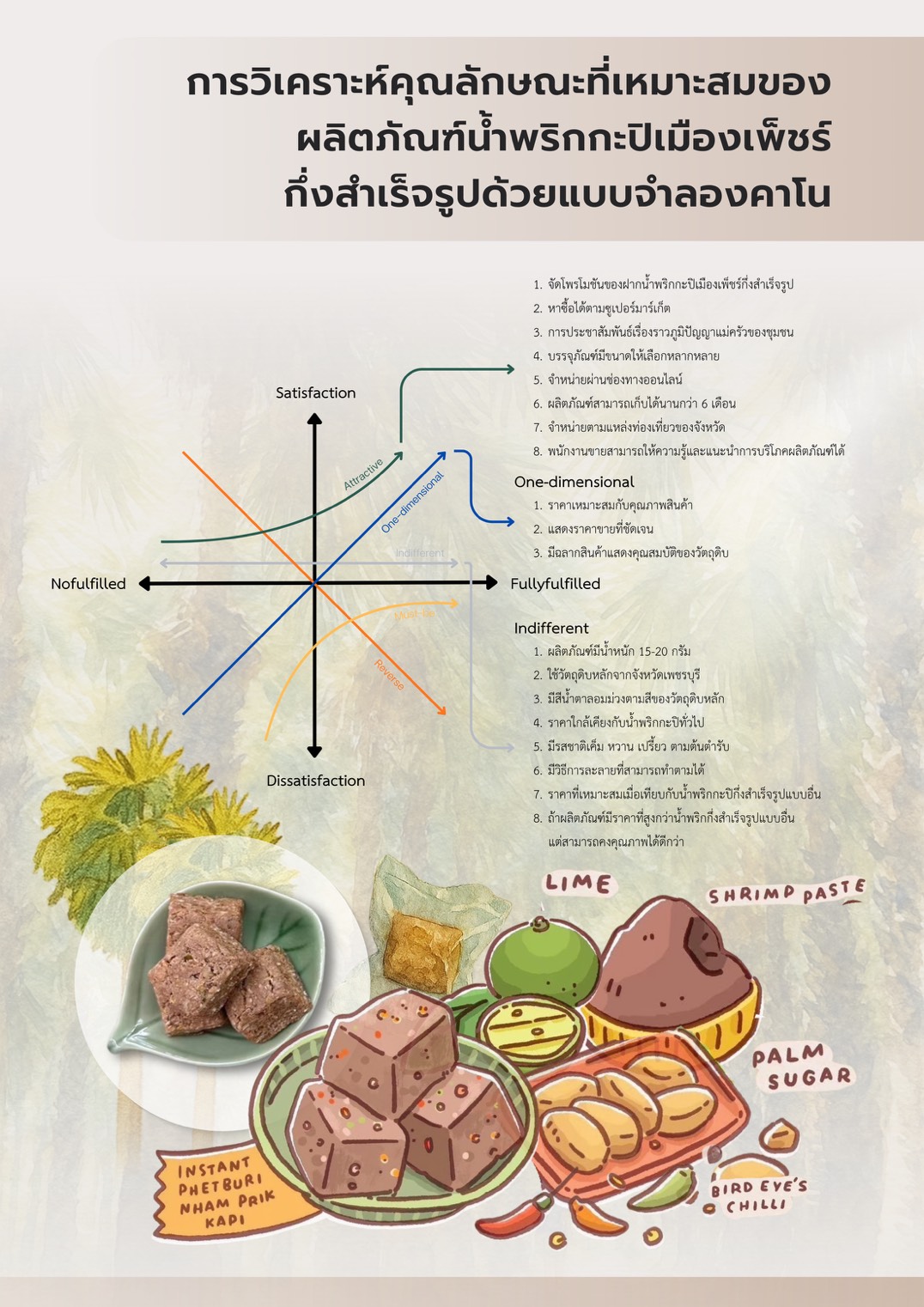
น้ำพริกกะปิเมืองเพ็ชร์เป็นอาหารที่มีกรดฟีนอลิกและความสามารถในการต้านอนุมูลอิสระ ทั้งนี้การพัฒนาเพื่อจำหน่ายในเชิงพาณิชย์จำเป็นต้องมีการประยุกต์ใช้แบบจำลองคาโน การศึกษานี้มีวัตถุประสงค์เพื่อศึกษาพฤติกรรมผู้บริโภคน้ำพริก และศึกษาคุณลักษณะที่เหมาะสมของผลิตภัณฑ์น้ำพริกกะปิเมืองเพ็ชร์กึ่งสำเร็จรูปด้วยแบบจำลองคาโน กลุ่มตัวอย่าง คือ ผู้บริโภคทั่วไปที่มีความคุ้นเคยในน้ำพริกกะปิ จำนวน 402 คน เครื่องมือที่ใช้ คือ แบบสอบถามออนไลน์ สถิติที่ใช้ในการวิเคราะห์ข้อมูล ได้แก่ ค่าความถี่ ร้อยละ ค่าเฉลี่ย ส่วนเบี่ยงเบนมาตรฐาน และค่าสัมประสิทธิ์ความพึงพอใจของผู้บริโภค ผลการศึกษาพบว่า ในระยะเวลา 1 เดือน ผู้บริโภคมีพฤติกรรมรับประทานน้ำพริก 1-3 ครั้ง มีการรับประทานน้ำพริกกะปิร่วมกับอาหารหมวดโปรตีนแบบทอด และผู้บริโภคส่วนมากไม่เคยซื้อผลิตภัณฑ์น้ำพริกกะปิกึ่งสำเร็จรูป ผลการวิเคราะห์คุณลักษณะที่เหมาะสมของผลิตภัณฑ์น้ำพริกกะปิเมืองเพ็ชร์กึ่งสำเร็จรูปด้วยแบบจำลองคาโน พบคุณลักษณะ 3 ด้าน ดังนี้ 1) ด้านคุณลักษณะพิเศษที่ดึงดูด (A) ได้แก่ การส่งเสริมการขาย มีการวางจำหน่ายในซูเปอร์มาร์เก็ต และมีการประชาสัมพันธ์เรื่องราวภูมิปัญญาแม่ครัวของชุมชน 2) ด้านคุณลักษณะที่ไม่แตกต่าง (I) น้ำพริกกะปิเมืองเพ็ชร์กึ่งสำเร็จรูปมีน้ำหนัก 15-20 กรัม มีการใช้วัตถุดิบหลักจากจังหวัดเพชรบุรี และมีสีน้ำตาลอมม่วง และ 3) ด้านคุณลักษณะที่ทำให้ผู้บริโภคพึงพอใจ (O) ประกอบด้วย ราคาเหมาะสมกับคุณภาพสินค้า แสดงราคาขายที่ชัดเจน และน้ำพริกกะปิเมืองเพ็ชร์กึ่งสำเร็จรูปมีฉลากสินค้าแสดงคุณสมบัติของวัตถุดิบ ผลการศึกษานี้สามารถใช้เป็นแนวทางในการวางแผนพัฒนาผลิตภัณฑ์ของฝากทางการท่องเที่ยวของจังหวัดเพชรบุรีต่อไปได้
Nam Prik Kapi Mueang Phet is a traditional chili paste rich in phenolic acids and antioxidants. However, its commercial development requires the application of the Kano Model to identify attributes that meet consumer expectations. This research aimed to investigate consumer behavior regarding chili paste consumption and to determine the optimal product attributes of instant Nam Prik Kapi Mueang Phet using the Kano Model. The sample consisted of 402 consumers familiar with shrimp paste. An online questionnaire was used as the research instrument, and data were analyzed using frequency, percentage, mean, standard deviation, and the consumer satisfaction coefficient. The results showed that within a one-month period, consumers typically consumed chili paste one to three times, often pairing shrimp paste with fried protein-based foods. Most respondents had never purchased instant shrimp paste chili products. The Kano Model analysis identifies three key categories of product attributes: 1) Attractive attributes (A), which include sales promotion activities, product availability in supermarkets, and publicity highlighting the culinary wisdom and local heritage of community cooks; 2) Indifferent attributes (I), including a product weight of 15–20 grams, use of main ingredients sourced from Phetchaburi province, and a brownish-purple color; and 3) One-dimensional attributes (O), which include reasonable pricing consistent with product quality, clearly displayed pricing, and labeling that indicates ingredient properties. The findings provide practical guidelines for developing souvenir food products to promote tourism in Phetchaburi province.
Downloads
Article Details

This work is licensed under a Creative Commons Attribution-NonCommercial-NoDerivatives 4.0 International License.
References
Berger, C., Blauth, R., Boger, D., Bolster, C., Burchill, G., DuMouchel, W., Pouliot, F., Richter, R., Rubinoff, A., Shen, D., Timko, M., & Walden, D. (1993). Kano’s methods for understanding customer-defined quality. Center for Quality of Management Journal, 2(4), 3–28. https://walden-family.com/public/cqm-journal/2-4-Whole-Issue.pdf
Charoen, R., Soison, B., & Dhamvithee, P. (2009). Survey of consumer satisfaction on sport drink product by Kano Model (การสำรวจความพึงพอใจของผู้บริโภคที่มีต่อผลิตภัณฑ์เครื่องดื่มเกลือแร่โดยใช้เทคนิคคาโน). In Proceedings of 47th Kasetsart University Annual Conference: Agro-Industry (การประชุมทางวิชาการของมหาวิทยาลัยเกษตรศาสตร์ ครั้งที่ 47: สาขาอุตสาหกรรมเกษตร) (pp. 490–498). Kasetsart University. https://kukr.lib.ku.ac.th/kukr_es/index.php/bkn/search_detail/result/11608
Dangsungwal, N., Chamnanwad, N., Muangburee, W., Masavang, S., Hiran-Akkharawong, I., Kankaew, S., & Thimthong, S. (2025). Exploring the product attributes of butterscotch sauce made from palm syrup by Kano Model. Multidisciplinary Science Journal, 7(3), Article e2025128. https://malque.pub/ojs/index.php/msj/article/view/5221
Department of Cultural Promotion. (2016). Knowledge and practices related to nature and the universe: National intangible culture heritage (ความรู้และแนวปฏิบัติเกี่ยวกับธรรมชาติและจักรวาล : มรดกภูมิปัญญาทางวัฒนธรรมของชาติ). The War Veterans Organization of Thailand under Royal Patronage of His Majestry the King (WVO) Office of Printing Mill. http://book.culture.go.th/newbook/ich/dcp2/files/mobile/index.html#1
Heamsrisawad, P., Duangporm, K., Peamsrikan, N., & Prapluettrakul, B. (2020). The study on the local wisdom of food: Nam Prik Kapi Cha-Karm (Suaeda maritima) in Samut SongKharm province (การศึกษาภูมิปัญญาอาหารท้องถิ่น : กรณีศึกษา น้ำพริกกะปิชะคราม จังหวัดสมุทรสงคราม). Journal of Thai Food Culture, 2(1), 25–32. https://so04.tci-thaijo.org/index.php/jfood/article/view/255595
Jaipan, T., & Potchanasin, C. (2016). An analysis of optimal tomato juice product attributes for the consumer in Bangkok metropolis (การวิเคราะห์คุณลักษณะที่เหมาะสมของผลิตภัณฑ์น้ำมะเขือเทศ สำหรับผู้บริโภคในเขตกรุงเทพมหานคร). Journal of Economics Ramkhamhaeng University, 2(1), 53–76. http://www.ecojournal.ru.ac.th/journals/16_1500189495.pdf
Jankingthong, W., Jankingthong, K., & Na Phayap, N. (2023). Tourists satisfaction toward southern catfish chili paste products from waste catfish of the Ban Ngok Nam community, Phatthalung province (ความพึงพอใจของนักท่องเที่ยวที่มีต่อผลิตภัณฑ์น้ำพริกปลาดุกปักษ์ใต้จากเศษปลาดุกเหลือใช้ของชุมชนบ้านโงกน้ำ จังหวัดพัทลุง). In The 14th Hatyai National and International Conference Proceeding (การประชุมหาดใหญ่วิชาการระดับชาติและนานาชาติ ครั้งที่ 14) (pp. 1796–1806). Hatyai University. https://www.hu.ac.th/conference/proceedings/
Jantest, S., Suwonsichon, T., & Suwonsichon, S. (2013). Application of Kano Model for customer need in mongo tablets (การประยุกต์แบบจำลองคาโนค้นหาความต้องการของผู้บริโภคในผลิตภัณฑ์มะม่วงอัดเม็ด). In Proceedings of 51st Kasetsart University Annual Conference: Agricultural Extension and Home Economics, Agro-Industry (การประชุมทางวิชาการของมหาวิทยาลัยเกษตรศาสตร์ ครั้งที่ 51: สาขาส่งเสริมการเกษตรและคหกรรมศาสตร์, สาขาอุตสาหกรรมเกษตร) (pp. 346–353). Kasetsart University. https://kukr.lib.ku.ac.th/kukr_es/index.php?/BKN_AGRO/search_detail/result/13371
Kano, N., Seraku, N., Takahashi, F., & Tsuji, S. (1984). Attractive quality and must-be quality. Journal of the Japanese Society for Quality Control, 14(2), 147–156. https://doi.org/10.20684/quality.14.2_147
Kotler, P., & Keller, K. L. (2016). Marketing management (15th ed.). Pearson Education.
Laoulan, N., & Masavang, W. (2018). Semi ready-made Namprik Kapi supplement Platoo powder (shrimp paste mackerel chilli paste) (น้ำพริกกะปิอบแห้งเสริมปลาทูกึ่งสำเร็จรูปแบบผง) [Special project for Bachelor’s degree, Rajamangala University of Technology Phra Nakhon]. RMUTP Academic Resource and Information Technology. https://lib.rmutp.ac.th/bibitem?bibid=b00102982
Leerattanakorn, N., & Yooyen, A. (2011). Consumer behavior and marketing mix influence on organic vegetable purchase: Temperate vegetables in Chiang Mai province (Research report) (พฤติกรรมผู้บริโภคและส่วนประสมทางการตลาดที่มีอิทธิพลต่อการตัดสินใจซื้อผลิตภัณฑ์ผักอินทรีย์ : ผักเมืองหนาวในจังหวัดเชียงใหม่) (รายงานการวิจัย). Maejo University. http://webpac.library.mju.ac.th:8080/mm/fulltext/research/2556/nisachon_leerattanakorn_2554_1/fulltext.pdf
Manochai, P., Manowan, K., & Chomsri, N. (2020). Development of traditional chili paste for health food (การพัฒนาน้ำพริกพื้นบ้านเพื่อเป็นอาหารสุขภาพ). Journal of Innovation Technology Research, 4(2), 50–59. https://so04.tci-thaijo.org/index.php/JIT/article/view/243505
Materla, T., Cudney, E. A., & Antony, J. (2019). The application of Kano Model in the healthcare industry: A systematic literature review. Total Quality Management & Business Excellence, 30(5–6), 660–681. https://doi.org/10.1080/14783363.2017.1328980
Matzler, K., & Hinterhuber, H. H. (1998). How to make product development projects more successful by integrating Kano’s model of customer satisfaction into quality function deployment. Technovation, 18(1), 25–38. https://doi.org/10.1016/S0166-4972(97)00072-2
McClements, D. J., Newman, E., & McClements, I. F. (2019). Plant‐based milks: A review of the science underpinning their design, fabrication, and performance. Comprehensive Reviews in Food Science and Food Safety, 18(6), 2047–2067. https://doi.org/10.1111/1541-4337.12505
Pasunon, P., Chantuk, T., Boonmeesrisa-nga, M., Roonpho, P., Thongmar, T., Bhichaipat, S., & Netchu, K. (2024). The development of tourism routes in the old town community along the Phetchaburi river focusing on historical and cultural tourism in order to enhance Phetchaburi province into a creative city (การพัฒนาเส้นทางการท่องเที่ยวย่านชุมชนเมืองเก่าริมแม่น้ำเพชรบุรีที่มุ่งเน้นการท่องเที่ยวเชิงประวัติศาสตร์และศิลปวัฒนธรรมเพื่อยกระดับจังหวัดเพชรบุรีสู่เมืองสร้างสรรค์). Journal of Politics, Administration and Law, 16(1), 182–199. https://so03.tci-thaijo.org/index.php/polscilaw_journal/article/view/277556
Pasunon, P., Dangsungwal, N., & Raksasiri, V. B. (2021). Participatory action research on the development of local cuisine as an innovative culinary tourism product in accordance with the new normal: A case study of Khlong Krachaeng community, Phetchaburi province (Research report) (การวิจัยเชิงปฏิบัติการแบบมีส่วนร่วมในการพัฒนาอาหารพื้นถิ่นเพื่อเป็นนวัตกรรมผลิตภัณฑ์การท่องเที่ยวเชิงอาหารตามบรรทัดฐานใหม่ กรณีศึกษาชุมชนคลองกระแชง จังหวัดเพชรบุรี) (รายงานการวิจัย). Faculty of Management Science, Silpakorn University.
Patnukao, A., Kaunsiri, S., & Thanapatsirichot, K. (2023). Factors affecting consumers’ dining manner during the COVID-19 situation in Bangkok and its vicinity (ปัจจัยที่มีผลต่อลักษณะของผู้บริโภคอาหารในสถานการณ์โควิด 19 ในพื้นที่กรุงเทพมหานครและปริมณฑล). Journal of Liberal Arts, Thammasat University, 23(3), 481–511. https://so03.tci-thaijo.org/index.php/liberalarts/article/view/267947
Pongwiritton, R., Pakvipas, P., Nithisathian, K., Thopanich, J., & Srichum, S. (2018). The guidelines for the design and development of cereal grain product according to the needs of the customer by applying the Kano Model (แนวทางการออกแบบและพัฒนาผลิตภัณฑ์ธัญชาติตามความต้องการของลูกค้าโดยประยุกต์ใช้คาโนโมเดล). Panyapiwat Journal, 10(1), 15–28. https://so05.tci-thaijo.org/index.php/pimjournal/article/view/120642
Shahidi, F., & Ambigaipalan, P. (2015). Phenolics and polyphenolics in foods, beverages and spices: Antioxidant activity and health effects - A review. Journal of Functional Foods, 18(Part B), 820–897. https://doi.org/10.1016/j.jff.2015.06.018
Shahidi, F., & Naczk, M. (2004). Phenolics in food and nutraceuticals (2nd ed.). CRC Press.
Silpcharu, T. (2024). Research and statistical data analysis using SPSS and AMOS (การวิจัยและการวิเคราะห์ข้อมูลทางสถิติด้วย SPSS และ AMOS) (18th ed.). S. R. Printing Mass Products.
Sinha, S. K., & Verma, P. (2020). Impact of sales promotion’s benefits on perceived value: Does product category moderate the results? Journal of Retailing and Consumer Services, 52, Article 101887. https://doi.org/10.1016/j.jretconser.2019.101887
Tan, K. C., & Shen, X. X. (2000). Integrating Kano’s model in the planning matrix of quality function deployment. Total Quality Management, 11(8), 1141–1151. https://doi.org/10.1080/095441200440395
TAT News. (2021, November 22). Phetchaburi honored with UNESCO creative city of gastronomy status. https://www.tatnews.org/2021/11/phetchaburi-honoured-with-unesco-creative-city-of-gastronomy-status/?utm_source=chatgpt.com
Thai Industrial Standards Institute (TISI). (2004). Thai community product standard: Spicy mixed dried shrimp and chili (มาตรฐานผลิตภัณฑ์ชุมชนน้ำพริกกุ้งเสียบ). https://tcps.tisi.go.th/pub/tcps322_47.pdf
Thongoiam, M. (2021). Applying conjoint analysis and Kano Model to identify target customer needs for master degree in industrial engineering (การประยุกต์ใช้การวิเคราะห์องค์ประกอบร่วมและแบบจำลองคาโนเพื่อหาความต้องการของกลุ่มลูกค้าเป้าหมาย สำหรับหลักสูตรมหาบัณฑิต สาขาวิศวกรรมอุตสาหการ) [Master’s thesis, Chulalongkorn University]. Chula Digital Collections. https://digital.car.chula.ac.th/chulaetd/5544/
Vanichbuncha, K. (2013). Statistical analysis: Statistics for administration and research (การวิเคราะห์สถิติ : สถิติสำหรับการบริหารและวิจัย) (14th ed.). Chulalongkorn University Press.
Yuwanaboon, N., Chaitup, W., Thuntre, N., Krisnachuta, S., Pandum, P., & Satavee, S. (2007). Nam Prik: Food resource base and community lifestyles under the wave of globalization (น้ำพริก : ฐานทรัพยากรอาหาร วิถีชุมชน ภายใต้กระแสโลกาภิวัตน์). Pimdee Karnpim.
Zhao, H., Yao, X., Liu, Z., & Yang, Q. (2021). Impact of pricing and product information on consumer buying behavior with customer satisfaction in a mediating role. Frontiers in Psychology, 12, Article 720151. https://doi.org/10.3389/fpsyg.2021.720151
