เพลงร้องทำนองไทยร่วมสมัยสำหรับเด็ก : การสร้างสรรค์ชุดบทเพลงไทยร่วมสมัย สำหรับเด็กปฐมวัยในประเทศไทย (Contemporary Thai songs for children: Creation of songs for children in Thailand)
Article Sidebar
Main Article Content
Abstract
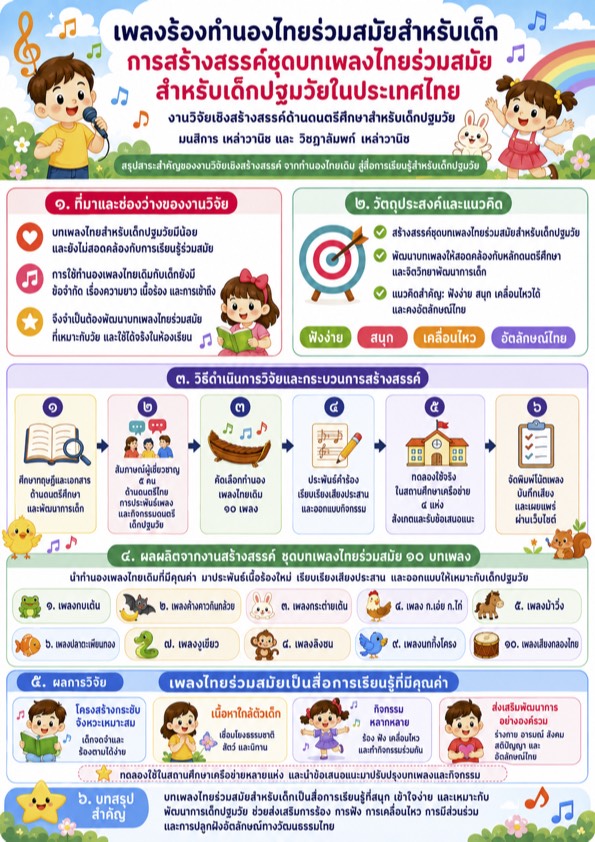
ปัจจุบันบทเพลงไทยสำหรับเด็กปฐมวัยที่เชื่อมโยงมรดกดนตรีไทยกับบริบทการเรียนรู้ร่วมสมัยยังมีอยู่อย่างจำกัด งานวิจัยสร้างสรรค์ชิ้นนี้จึงมีวัตถุประสงค์เพื่อพัฒนาชุดบทเพลงไทยร่วมสมัยสำหรับเด็กปฐมวัยในฐานะสื่อการเรียนรู้ที่เหมาะสมกับพัฒนาการของเด็ก โดยประยุกต์ทำนองเพลงไทยเดิมร่วมกับหลักการดนตรีศึกษาและจิตวิทยาพัฒนาการเด็ก เพื่อส่งเสริมทักษะทางดนตรีอย่างเป็นระบบ ดำเนินการตามแนวทางการวิจัยเชิงคุณภาพ ผ่านการศึกษาเอกสาร การสัมภาษณ์ผู้ให้ข้อมูลหลักซึ่งเป็นผู้เชี่ยวชาญด้านดนตรีไทย ด้านการประพันธ์เพลง และด้านการจัดกิจกรรมดนตรีสำหรับเด็กปฐมวัย รวมทั้งการออกแบบบทเพลงและกิจกรรมประกอบเพลง ก่อนนำไปทดลองใช้ในสถานศึกษาเครือข่ายหลายแห่ง ได้แก่ โรงเรียนจิตตเมตต์ โรงเรียนสาธิตจุฬาลงกรณ์มหาวิทยาลัย ฝ่ายประถม สถาบันแห่งชาติเพื่อการพัฒนาเด็กและครอบครัว มหาวิทยาลัยมหิดล และโรงเรียนดนตรีเดอเมโลดี ผลการวิจัยพบว่า บทเพลงที่สร้างสรรค์ขึ้นมีโครงสร้างกระชับ จังหวะเหมาะสม และเนื้อหาสอดคล้องกับประสบการณ์ใกล้ตัวของเด็ก อีกทั้งสามารถบูรณาการเข้ากับกิจกรรมการเรียนรู้ได้อย่างหลากหลาย จากการนำไปทดลองใช้พบว่า บทเพลงดังกล่าวช่วยส่งเสริมพัฒนาการของเด็กปฐมวัยทั้งด้านร่างกาย อารมณ์ สังคม และสติปัญญา ผ่านการเคลื่อนไหวตามจังหวะ ความเพลิดเพลินในการเรียนรู้ การทำกิจกรรมร่วมกับผู้อื่น ตลอดจนการเรียนรู้คำศัพท์ การฝึกฟัง และการจดจำคำร้องและทำนอง ข้อค้นพบนี้สะท้อนให้เห็นว่า บทเพลงไทยร่วมสมัยสามารถเป็นสื่อการเรียนรู้ที่มีคุณค่าในการส่งเสริมพัฒนาการเด็กปฐมวัย พร้อมทั้งมีส่วนสำคัญในการปลูกฝังอัตลักษณ์ทางวัฒนธรรมไทยได้อย่างเหมาะสม
At present, Thai songs for early childhood that connect Thai musical heritage with contemporary learning contexts remain limited. This creative research aimed to develop a collection of contemporary Thai songs for young children as learning media appropriate to child development by adapting traditional Thai melodies in accordance with principles of music education and developmental psychology in order to systematically promote musical skills. The study employed a qualitative approach through document review, interviews with key informants who were experts in Thai music, music composition, and music activities for early childhood, as well as the design of songs and accompanying activities. The songs were then piloted in several partner institutions, including Jittamet School, Chulalongkorn University Demonstration School (Elementary Division), the National Institute for Child and Family Development at Mahidol University, and De Melody Music School. The findings revealed that the songs created in this study were concise in structure, developmentally appropriate in rhythm, and closely related to children’s everyday experiences. Moreover, they could be integrated into a wide range of learning activities. The pilot implementation further showed that these songs supported young children’s physical, emotional, social, and intellectual development through rhythmic movement, joyful engagement, collaborative participation, vocabulary learning, listening practice, and the memorization of lyrics and melodies. These findings suggest that contemporary Thai songs can serve as valuable learning media for promoting early childhood development while also fostering Thai cultural identity in an appropriate and meaningful way.
Downloads
Article Details

This work is licensed under a Creative Commons Attribution-NonCommercial-NoDerivatives 4.0 International License.
References
Bureau of Academic Affairs and Educational Standards. (2018a). Manual for the early childhood curriculum B.E. 2560 (2017) for children aged 3-6 years (คู่มือหลักสูตรการศึกษาปฐมวัย พุทธศักราช 2560 สำหรับเด็กอายุ 3-6 ปี). Agricultural Co-operative Federation of Thailand Printing House. https://academic.obec.go.th/images/document/1572317514_d_1.pdf
Bureau of Academic Affairs and Educational Standards. (2018b). Manual for the early childhood curriculum B.E. 2560 (2017) for children under 3 years old (คู่มือหลักสูตรการศึกษาปฐมวัย พุทธศักราช 2560 สำหรับเด็กอายุต่ำกว่า 3 ปี). Agricultural Co-operative Federation of Thailand Printing House. https://academic.obec.go.th/web/images/document/1572317544_d_1.pdf
Chuppunnarat, Y., Laovanich, V., & Srisuttiyakorn, S. (2018). The development of assessment tools and quality judgment system for Mahori ensemble competition (การพัฒนาเครื่องมือประเมินและระบบคุณภาพการตัดสินผลการประกวดบรรเลงรวมวงมโหรี). Journal of Education Studies, Chulalongkorn University, 46(4), 300–317. https://so02.tci-thaijo.org/index.php/EDUCU/article/view/163462
Damrong Rajanubhab, Prince. (1929). The children’s home of H.M. Queen Sudhasininat (ตำนานโรงเลี้ยงเด็กของพระอัครชายาเธอฯ). Sophon Phiphat Thanakon Printing House.
Diamond, A. (2012). Activities and programs that improve children’s executive functions. Current Directions in Psychological Science, 21(5), 335–341. https://doi.org/10.1177/0963721412453722
Gavee, J. (2018). Thai popular songs for children from 1939 to 1957 (เพลงไทยสากลสำหรับเด็กช่วงปี พ.ศ. 2482-2500). Journal of Cultural Approach, 19(35), 16–25. https://so02.tci-thaijo.org/index.php/cultural_approach/article/view/123932
Juntunen, M.-L. (2002). Practical applications of Dalcroze Eurhythmics. Nordic Research in Music Education Yearbook, 6, 75–92.
Komolphan, K. (2020). Development of body percussion learning activities using Thai children songs to promote percussion basic skills for elementary teachers (การพัฒนาชุดกิจกรรมร่างกายสร้างจังหวะโดยใช้เพลงไทยสำหรับเด็กเพื่อเสริมสร้างทักษะเครื่องกระทบขั้นพื้นฐานสำหรับครูประถมศึกษา) [Master’s thesis, Chulalongkorn University]. Chula Digital Collections. https://digital.car.chula.ac.th/chulaetd/4233/
Laovanich, M. (2018). Raising children with music (เลี้ยงลูกด้วยเสียงดนตรี). Amarin Printing and Publishing.
Moreno, S., Bialystok, E., Barac, R., Schellenberg, E. G., Cepeda, N. J., & Chau, T. (2011). Short-term music training enhances verbal intelligence and executive function. Psychological Science, 22(11), 1425–1433. https://doi.org/10.1177/0956797611416999
Narkwong, T. (1999). Orff-Schulwerk - Music for children (การสอนดนตรีสำหรับเด็กตามแนวของคาร์ล ออร์ฟ). Kasetsart University Press.
Narkwong, T. (2001). Kodaly method to practice (โคไดสู่การปฏิบัติ). Kasetsart University Press.
Schellenberg, E. G. (2005). Music and cognitive abilities. Current Directions in Psychological Science, 14(6), 317–320. https://doi.org/10.1111/j.0963-7214.2005.00389.x
Schellenberg, E. G. (2016). Music training and nonmusical abilities. In S. Hallam, I. Cross, & M. Thaut (Eds.), The Oxford handbook of music psychology (2nd ed., pp. 415–430). Oxford University Press.
Sportsman, E. L. (2011). Development of musicianship and executive functioning among children participating in a music program [Doctoral dissertation, University of Michigan]. University of Michigan Library. https://search.lib.umich.edu/catalog/record/990123799210106381
Suttachitt, N. (2001). Musical behaviors (พฤติกรรมการสอนดนตรี) (3rd ed.). Chulalongkorn University Press.
Suttachitt, N. (2017). Music teaching methodology (วิธีวิทยาการสอนดนตรี). Chulalongkorn University Press.
