
ปัจจัยที่ส่งผลต่อความตั้งใจซื้อสินค้าจากไต้หวันของผู้บริโภคไทยเจเนอเรชัน Z (Factors affecting the purchase intention of Taiwanese (ROC) products among Thai Generation Z consumers)
Article Sidebar
Main Article Content
Abstract
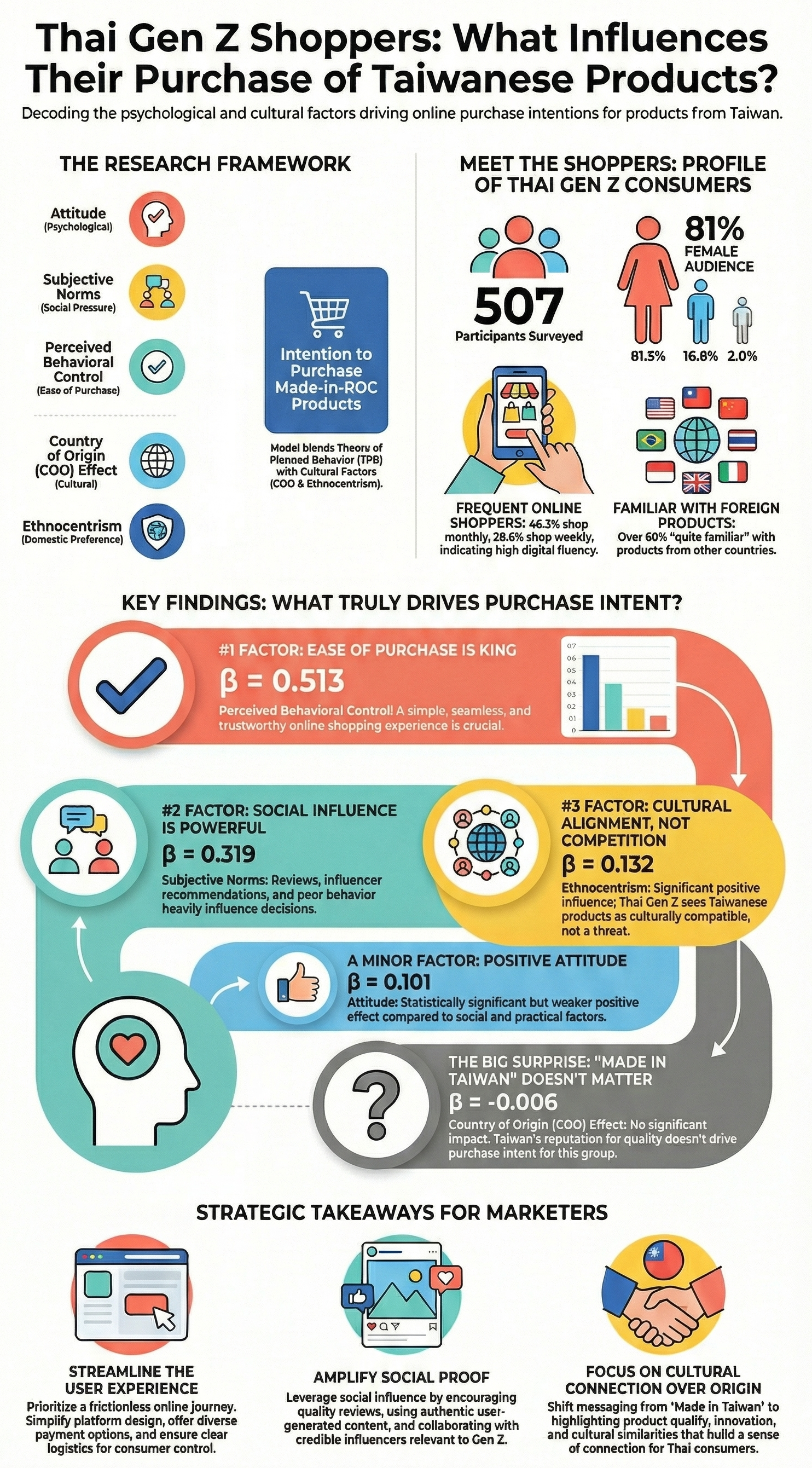
การขยายตัวของ E-commerce และนโยบายการค้าระหว่างประเทศส่งผลให้สินค้าจากไต้หวันได้รับความสนใจมากขึ้นในตลาดไทย งานวิจัยนี้จึงมีวัตถุประสงค์เพื่อศึกษาปัจจัยทางจิตวิทยาและวัฒนธรรมที่มีอิทธิพลต่อความตั้งใจซื้อผลิตภัณฑ์จากไต้หวันของผู้บริโภคเจเนอเรชัน Z ในประเทศไทย โดยประยุกต์ใช้ทฤษฎีพฤติกรรมตามแผน (Theory of Planned Behavior: TPB) ร่วมกับแนวคิดแหล่งกำเนิดสินค้า (Country of Origin: COO) และอัตนิยมทางวัฒนธรรม (ethnocentrism) ดำเนินการวิจัยเชิงปริมาณด้วยการเก็บรวบรวมข้อมูลผ่านแบบสอบถามออนไลน์จากกลุ่มตัวอย่างนักศึกษาระดับปริญญาตรี จำนวน 507 คน และวิเคราะห์ข้อมูลด้วยสถิติการถดถอยเชิงพหุคูณ ผลการวิจัยพบว่า ปัจจัยที่มีอิทธิพลเชิงบวกต่อความตั้งใจซื้ออย่างมีนัยสำคัญทางสถิติ ได้แก่ การรับรู้ความสามารถในการควบคุมพฤติกรรมซึ่งมีอิทธิพลสูงสุด รองลงมา คือ บรรทัดฐานทางสังคม อัตนิยมทางวัฒนธรรม และทัศนคติ ตามลำดับ โดยความสัมพันธ์เชิงบวกของอัตนิยมทางวัฒนธรรมสะท้อนว่าผู้บริโภคมองสินค้าไต้หวันว่ามีความสอดคล้องกับวิถีชีวิตไทยมากกว่าเป็นคู่แข่ง ในขณะที่ปัจจัยแหล่งกำเนิดสินค้าไม่มีผลต่อการตัดสินใจซื้ออย่างมีนัยสำคัญ งานวิจัยนี้สรุปได้ว่าผู้ประกอบการควรให้ความสำคัญกับการพัฒนาระบบการซื้อที่ใช้งานง่าย ไร้รอยต่อ และใช้กลยุทธ์การตลาดผ่านกลุ่มอิทธิพลทางสังคมเพื่อกระตุ้นการตัดสินใจซื้อของกลุ่มคนรุ่นใหม่ อาทิ การสร้างอิทธิพลทางความคิดผ่านสื่อออนไลน์โดยใช้ผู้นำทางความคิดที่มีอิทธิพลต่อกลุ่มของผู้บริโภคเพื่อเพิ่มการโน้มน้าว และสุดท้ายควรใช้การสื่อสารแบรนด์ในเชิงวัฒนธรรมในลักษณะสร้างความกลมกลืนเชิงวัฒนธรรม เพื่อสร้างความรู้สึกเป็นหนึ่งเดียวกับแบรนด์มากขึ้น
The expansion of e-commerce and international trade policies has increased interest in Taiwanese products in the Thai market. This research aims to investigate the psychological and cultural factors influencing the purchase intention of Taiwanese (ROC) products among Generation Z consumers in Thailand by integrating the Theory of Planned Behavior (TPB) with the concept of Country of Origin (COO) and ethnocentrism. A quantitative approach was employed, with data collected through an online survey from 507 undergraduate students and analyzed using multiple regression analysis. The findings indicate that perceived behavioral control exerted the strongest positive influence on purchase intention, followed by subjective norms, ethnocentrism, and attitude, respectively. The positive association between ethnocentrism and purchase intention suggests that consumers perceive Taiwanese products as culturally compatible with Thai lifestyle rather than as competing alternatives. In contrast, the Country of Origin factor did not have a statistically significant effect on purchase intention. This study concludes that entrepreneurs should prioritize the development of seamless and user-friendly purchasing platforms and employ social influence strategies to stimulate purchase intentions among this digital-native generation. Such strategies include leveraging online influence through Key Opinion Leaders (KOLs) who are relevant to the target consumer group in order to enhance persuasive effectiveness. Finally, brands should adopt culturally oriented communication strategies that emphasize cultural harmony, thereby fostering a stronger sense of identification and connection with the brand.
Downloads
Article Details

This work is licensed under a Creative Commons Attribution-NonCommercial-NoDerivatives 4.0 International License.
References
Ajzen, I. (1991). The theory of planned behavior. Organizational Behavior and Human Decision Processes, 50(2), 179–211. https://doi.org/10.1016/0749-5978(91)90020-T
Arvola, A., Vassallo, M., Dean, M., Lampila, P., Saba, A., Lähteenmäki, L., & Shepherd, R. (2008). Predicting intentions to purchase organic food: The role of affective and moral attitudes in the theory of planned behaviour. Appetite, 50(2–3), 443–454. https://doi.org/10.1016/j.appet.2007.09.010
Bai, Y., Yao, Z., & Dou, Y.-F. (2015). Effect of social commerce factors on user purchase behavior: An empirical investigation from renren.com. International Journal of Information Management, 35(5), 538–550. https://doi.org/10.1016/j.ijinfomgt.2015.04.011
Balabanis, G., & Diamantopoulos, A. (2016). Consumer xenocentrism as determinant of foreign product preference: A system justification perspective. Journal of International Marketing, 24(3), 58–77. https://doi.org/10.1509/jim.15.0138
Balabanis, G., Stathopoulou, A., & Qiao, J. (2019). Favoritism toward foreign and domestic brands: A comparison of different theoretical explanations. Journal of International Marketing, 27(2), 38–55. https://doi.org/10.1177/1069031x19837945
Bassiouni, D. H., & Hackley, C. (2014). ‘Generation Z’ children’s adaptation to digital consumer culture: A critical literature review. Journal of Customer Behaviour, 13(2), 113–133. https://doi.org/10.1362/147539214X14024779483591
Cao, V. Q. (2024). Some factors influence the willingness to buy Thai products - A case study in Vietnam. Thailand and The World Economy, 42(2), 78–103. https://so05.tci-thaijo.org/index.php/TER/article/view/263592
D’Souza, C., Ibanez, V. A., & Hartmann, P. (2025). Interplay of multiple labels and willingness to pay. International Journal of Retail & Distribution Management, 53(1), 1–15. https://doi.org/10.1108/ijrdm-02-2024-0056
Dzever, S., & Quester, P. (1999). Country-of-origin effects on purchasing agents’ product perceptions: An Australian perspective. Industrial Marketing Management, 28(2), 165–175. https://doi.org/10.1016/S0019-8501(98)00014-5
George, J. F. (2004). The theory of planned behavior and internet purchasing. Internet Research, 14(3), 198–212. https://doi.org/10.1108/10662240410542634
Hair, J. F., Jr., Black, W. C., Babin, B. J., & Anderson, R. E. (2010). Multivariate data analysis: A global perspective. Pearson Education.
Hansen, T., Jensen, J. M., & Solgaard, H. S. (2004). Predicting online grocery buying intention: A comparison of the theory of reasoned action and the theory of planned behavior. International Journal of Information Management, 24(6), 539–550. https://doi.org/10.1016/j.ijinfomgt.2004.08.004
Hsu, C.-L., Chang, C.-Y., & Yansritakul, C. (2017). Exploring purchase intention of green skincare products using the theory of planned behavior: Testing the moderating effects of country of origin and price sensitivity. Journal of Retailing and Consumer Services, 34, 145–152. https://doi.org/10.1016/j.jretconser.2016.10.006
Huang, X., & Wu, F. (2025). What drives Chinese Generation Z’s purchase intentions for new Chinese style apparel? A study from a stimulus-organism-response perspective. Journal of Fashion Marketing and Management, 29(2), 304–326. https://doi.org/10.1108/jfmm-03-2024-0111
Islam, T., & Hussain, M. (2023). How consumer uncertainty intervene country of origin image and consumer purchase intention? The moderating role of brand image. International Journal of Emerging Markets, 18(11), 5049–5067. https://doi.org/10.1108/ijoem-08-2021-1194
Kline, R. B. (2016). Principles and practice of structural equation modeling (4th ed.). The Guilford Press.
Kuncharin, W., & Mohamed, B. (2014). The impacts of consumer ethnocentrism on foreign product judgment and local helping purchase: A case of Malaysian cross-border shoppers in Hatyai, Thailand. International Journal of Business and Management, 9(9), 135–146. https://doi.org/10.5539/ijbm.v9n9p135
Lee, J. K., Lee, B.-K., & Lee, W.-N. (2013). Country-of-origin fit’s effect on consumer product evaluation in cross-border strategic brand alliance. Journal of Business Research, 66(3), 354–363. https://doi.org/10.1016/j.jbusres.2011.08.016
Mahmoud, M. A., Mallen-Ntiador, T. N. E., Andoh, D., Iddrisu, M., & Kastner, A. N. A. (2023). Consumer xenocentrism and foreign goods purchase intention in an emerging economy. International Journal of Emerging Markets, 18(3), 567–587. https://doi.org/10.1108/ijoem-08-2020-0911
Mueller, R. D., Wang, G. X., Liu, G., & Cui, C. C. (2016). Consumer xenocentrism in China: An exploratory study. Asia Pacific Journal of Marketing and Logistics, 28(1), 73–91. https://doi.org/10.1108/apjml-11-2014-0158
Ngo, Q.-H., Nguyen, T.-D., & Phan, N.-B. (2025). Exploring green purchasing intentions and behaviours among Vietnamese Generation Z: A perspective from the theory of planned behaviour. PLoS ONE, 20(5), Article e0323879. https://doi.org/10.1371/journal.pone.0323879
Office of the Permanent Secretary, Ministry of Higher Education, Science, Research and Innovation. (2024, October 1). Student information (ข้อมูลนักศึกษา). https://info.mhesi.go.th/homestat_std.php
Paul, J., Modi, A., & Patel, J. (2016). Predicting green product consumption using theory of planned behavior and reasoned action. Journal of Retailing and Consumer Services, 29, 123–134. https://doi.org/10.1016/j.jretconser.2015.11.006
Pavlou, P. A. (2003). Consumer acceptance of electronic commerce: Integrating trust and risk with the technology acceptance model. International Journal of Electronic Commerce, 7(3), 101–134. https://doi.org/10.1080/10864415.2003.11044275
Pham, T.-N., & Nguyen, N.-T. (2020). Consumer sentiments: A missing link between personality traits and purchase intention toward foreign products - An empirical study on young Vietnamese consumers. Journal of Southwest Jiaotong University, 55(4), Article 39. https://doi.org/10.35741/issn.0258-2724.55.4.39
Priporas, C.-V., Stylos, N., & Fotiadis, A. K. (2017). Generation Z consumers’ expectations of interactions in smart retailing: A future agenda. Computers in Human Behavior, 77, 374–381. https://doi.org/10.1016/j.chb.2017.01.058
Sangpanya, P. (2018). New southbound policy: Soft power of Taiwan (นโยบายมุ่งใต้ใหม่: Soft power ของไต้หวัน). Bodhi Research Journal, 2(1), 74–96.
Shanbhag, P. R., Pai, Y. P., Kidiyoor, G., & Prabhu, N. (2023). Development and initial validation of a theory of planned behavior questionnaire: Assessment of purchase intentions towards products associated with CRM campaigns. Cogent Business & Management, 10(2), Article 2229528. https://doi.org/10.1080/23311975.2023.2229528
Shankarmahesh, M. N. (2006). Consumer ethnocentrism: An integrative review of its antecedents and consequences. International Marketing Review, 23(2), 146–172. https://doi.org/10.1108/02651330610660065
Shimp, T. A., & Sharma, S. (1987). Consumer ethnocentrism: Construction and validation of the CETSCALE. Journal of Marketing Research, 24(3), 280–289. https://doi.org/10.2307/3151638
Sungkaho, N. (2021). Taiwan’s new southbound policy implementation as a tool to maintain diplomatic ties (การดำเนินนโยบายมุ่งใต้ใหม่ของไต้หวันในฐานะเครื่องมือในการสร้างมิตรประเทศ) [Master’s thesis, Chulalongkorn University]. Chula Digital Collections. https://digital.car.chula.ac.th/chulaetd/7904/
Taylor, S., & Todd, P. (1995). Decomposition and crossover effects in the theory of planned behavior: A study of consumer adoption intentions. International Journal of Research in Marketing, 12(2), 137–155. https://doi.org/10.1016/0167-8116(94)00019-K
Thailand Business Information Center in Taiwan. (2025). Newsletter, January–December 2025. Thailand Trade and Economic Office. https://online.pubhtml5.com/rjvvs/nkwo/
Tomić Maksan, M., Kovačić, D., & Cerjak, M. (2019). The influence of consumer ethnocentrism on purchase of domestic wine: Application of the extended theory of planned behaviour. Appetite, 142, Article 104393. https://doi.org/10.1016/j.appet.2019.104393
Veale, R., & Quester, P. (2009). Do consumer expectations match experience? Predicting the influence of price and country of origin on perceptions of product quality. International Business Review, 18(2), 134–144. https://doi.org/10.1016/j.ibusrev.2009.01.004
Verlegh, P. W. J. (2001). Country-of-origin effects on consumer product evaluations [Doctoral dissertation, Wageningen University]. Wageningen University Research Portal. https://research.vu.nl/en/publications/country-of-origin-effects-on-consumer-product-evaluations
Verlegh, P. W. J., & Steenkamp, J.-B. E. M. (1999). A review and meta-analysis of country-of-origin research. Journal of Economic Psychology, 20(5), 521–546. https://doi.org/10.1016/S0167-4870(99)00023-9
