นวัตกรรมการจัดการเรียนรู้เพื่อเสริมสร้างสมรรถนะการเรียนรู้ภาษาไทยอย่างยั่งยืนสำหรับนักศึกษาวิชาชีพครู (Learning management innovation to enhance sustainable Thai language learning competencies for pre-service teachers)
Article Sidebar
Main Article Content
Abstract
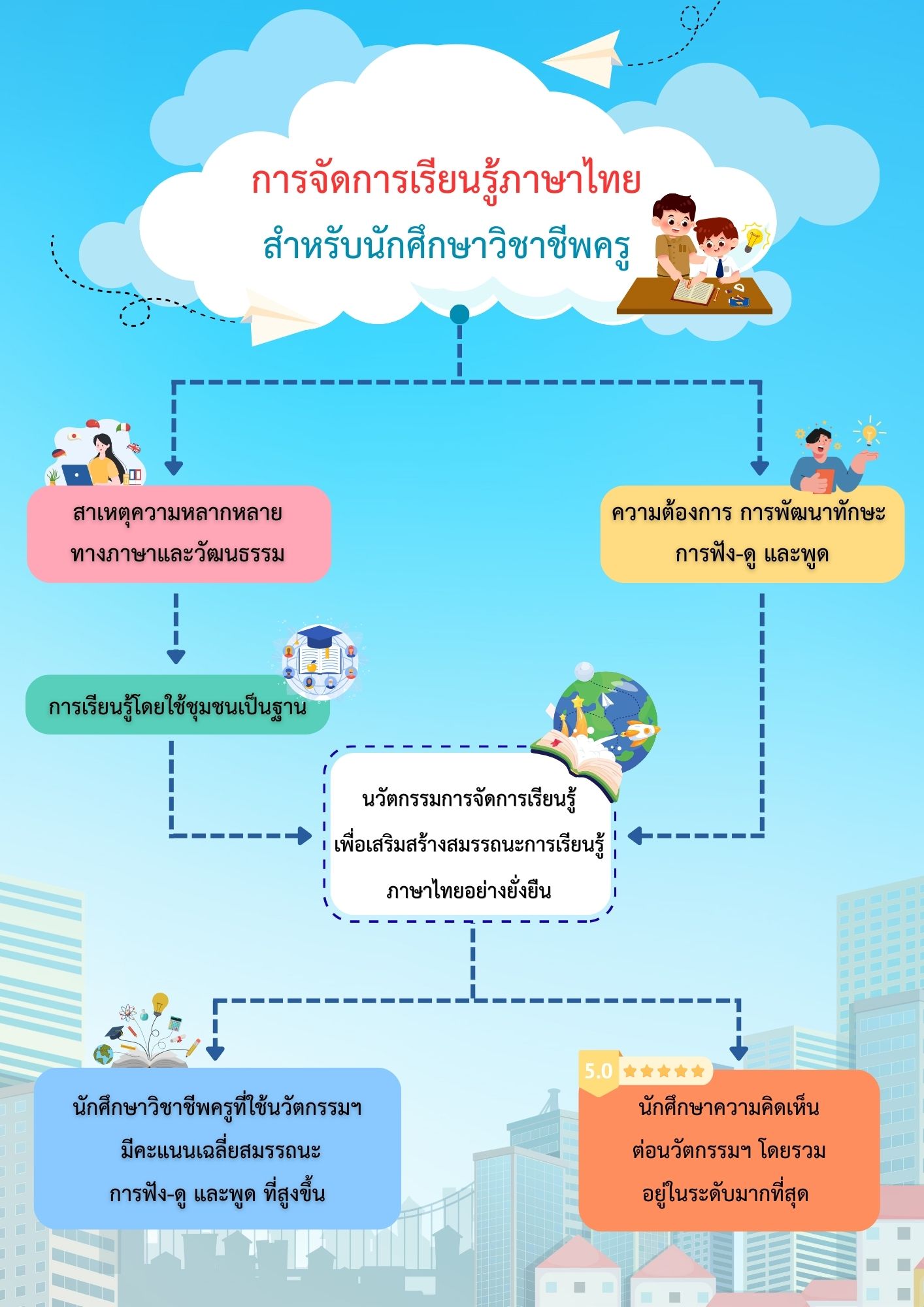
ความหลากหลายทางชาติพันธุ์และวัฒนธรรม สร้างความท้าทายใหม่ให้กับระบบการศึกษา โดยเฉพาะการพัฒนาสมรรถนะภาษาไทยสำหรับนักศึกษาวิชาชีพครูที่มีภูมิหลังทางภาษาและวัฒนธรรมที่แตกต่างกัน การวิจัยนี้มีวัตถุประสงค์ คือ 1) เพื่อประเมินความต้องการจำเป็นในการเสริมสร้างสมรรถนะการเรียนรู้ภาษาไทยสำหรับนักศึกษาวิชาชีพครู 2) เพื่อพัฒนานวัตกรรมการจัดการเรียนรู้โดยใช้ชุมชนเป็นฐานร่วมกับการสร้างความรู้ด้วยตนเอง 3) เพื่อวิเคราะห์ผลการใช้นวัตกรรมฯ และ 4) เพื่อสำรวจความคิดเห็นของนักศึกษาที่มีต่อนวัตกรรมฯ กลุ่มตัวอย่างในการวิจัย คือ นักศึกษาวิชาชีพครูโครงการปกติและโครงการครูรัก(ษ์)ถิ่น คณะศึกษาศาสตร์ มหาวิทยาลัยเชียงใหม่ ในรายวิชา 067311 หลักภาษาไทยในหลักสูตรการศึกษาขั้นพื้นฐาน จำนวน 61 คน โดยใช้นวัตกรรมการจัดการเรียนรู้ฯ จำนวน 5 หน่วย (40 ชั่วโมง) แบบประเมินสมรรถนะการพูด แบบทดสอบสมรรถนะการฟัง-ดู สถิติที่ใช้วิเคราะห์ข้อมูล คือ สถิติเชิงบรรยาย ค่าร้อยละ ค่าเฉลี่ยและส่วนเบี่ยงเบนมาตรฐาน ผลการวิจัยพบว่า นักศึกษาวิชาชีพครูมีความต้องการเสริมสร้างสมรรถนะการเรียนรู้ภาษาไทยด้านการพูดมากที่สุด รองลงมา คือ สมรรถนะการฟัง-ดู นวัตกรรมฯ ที่พัฒนาขึ้นมีความเหมาะสมระดับมากที่สุด ประกอบด้วย ขั้นตอนการจัดกิจกรรมการเรียนรู้ 5 ขั้น ได้แก่ ขั้นทบทวนหลักภาษา ขั้นค้นคว้าจากชุมชน ขั้นประมวลผลความรู้ ขั้นฟัง ดู พูดนำเสนองานตน และขั้นสะท้อนผลการเรียนรู้สู่ยั่งยืน นักศึกษาวิชาชีพครูที่ใช้นวัตกรรมฯ มีคะแนนเฉลี่ยสมรรถนะการฟัง-ดู และพูด หลังเรียนสูงกว่าก่อนเรียนอย่างมีนัยสำคัญทางสถิติที่ระดับ 0.05 และมีความคิดเห็นต่อนวัตกรรมฯ โดยรวมอยู่ในระดับมากที่สุด สามารถใช้เป็นต้นแบบในการเสริมสร้างสมรรถนะการเรียนรู้ภาษาไทยอย่างยั่งยืนให้กับนักศึกษาวิชาชีพครูในสถาบันการศึกษาอื่น ๆ ได้ต่อไป
The ethnic and cultural diversity of contemporary Thai society poses new challenges to the education system, particularly in developing Thai language competencies among pre-service teachers from varied linguistic and cultural backgrounds. This research aimed to: 1) assess the needs for strengthening Thai language learning competencies among pre-service teachers, 2) develop a learning management innovation integrating community-based learning with self-directed learning to promote sustainable Thai language competence, 3) evaluate the effectiveness of the innovation, and 4) examine students’ opinions regarding its implementation. The sample included 61 pre-service teachers enrolled in both the regular program and the Kru Rak (Raksa) Thin Program at the Faculty of Education, Chiang Mai University, in the course 067311 Thai Language Fundamentals in the Basic Education Curriculum. The innovation consisted of five learning units (40 hours total), incorporating speaking competency assessments and listening-viewing competency tests. Data were analyzed using descriptive statistics, including percentages, means, and standard deviations. The findings revealed that pre-service teachers reported the highest need to enhance speaking competence, followed by listening-viewing competence. The developed innovation was rated as highly appropriate and was structured into five stages: 1) reviewing Thai language fundamentals, 2) conducting community-based inquiry, 3) synthesizing knowledge, 4) listening, viewing, and presenting individual work, and 5) reflecting on developmental outcomes for sustainability. Post-instruction mean scores for both listening-viewing and speaking competencies were significantly higher at the 0.05 level. Overall, participants rated the innovation at the highest level, indicating its potential as an effective tool for enhancing sustainable Thai language learning competencies among pre-service teachers in other educational institutions.
Downloads
Article Details

This work is licensed under a Creative Commons Attribution-NonCommercial-NoDerivatives 4.0 International License.
References
Aprilianti, B. D. A. (2024). Teaching English writing for primary students: Constructivism views. Journal of English Teaching, 10(3), 255–265. https://doi.org/10.33541/jet.v10i3.6067
Çibukçiu, B. (2025). The impact of constructivist methods on students’ mathematical problem-solving. Discover Education, 4(1), Article 83. https://doi.org/10.1007/s44217-025-00475-w
Chamnancha, B., & Kongudomsup, S. (2020). The study of community based learning: Bang Numphueng community, case-study of Southeast Bangkok College (การศึกษารูปแบบการเรียนการสอนแบบชุมชนเป็นฐาน : ชุมชนบางน้ำผึ้ง กรณีศึกษาของวิทยาลัยเซาธ์อีสท์ บางกอก). Southeast Bangkok Journal (Humanities and Social Sciences), 6(1), 37–49. https://so05.tci-thaijo.org/index.php/SB_Journal/article/view/186809/163620
Equitable Education Fund. (2025, March 14). The “Kru Rak (sa) Thin” project and the Equitable Education Fund (EEF) have been recognized by UNESCO as initiatives that promote linguistic equity (โครงการครูรัก(ษ์)ถิ่นและ กสศ. ได้รับการยอมรับจาก UNESCO ว่าเป็นโครงการที่ส่งเสริมความเสมอภาคด้านภาษา). https://www.eef.or.th/news-140325-2/
Insan, P. (2023). Rhetoric for education: The art of using language as a key to communication (วาทวิทยาเพื่อการศึกษา ศิลปะการใช้ภาษาคือทักษะสำคัญของการสื่อสาร). In A. Sipitakiat, T. Arinta, J. Sithi, & K. Thungkaew (Eds.), CMU 21st century learning report : Humanities and social sciences (รายงานฉบับสมบูรณ์ผลโครงการส่งเสริมการจัดการเรียนรู้ที่สอดคล้องกับศตวรรษที่ 21 ประจำปีการศึกษา 2565 กลุ่มสาขาวิชามนุษยศาสตร์และสังคมศาสตร์) (pp. 187–193). Teaching and Learning Innovation Center, Chiang Mai University. https://www.info.tlic.cmu.ac.th/_files/ugd/feedef_a18a3f0ab0ae4b5899db958914a03a63.pdf
Janrasamichot, R. (2015). Developing a self-directed learning instructional model of Mathayomsuksa 3 students by applied Constructivism theory to learning with research process (การพัฒนารูปแบบการสอนการเรียนรู้ด้วยตนเองของนักเรียนชั้นมัธยมศึกษาปีที่ 3 โดยการประยุกต์ทฤษฎีคอนสตรัตติวิซึม สู่การเรียนรู้ด้วยกระบวนการวิจัย) [Doctoral dissertation, Burapha University]. Burapha University Research Information. https://buuir.buu.ac.th/handle/1234567890/10612
Kamnuan, S. (2022). Community-based literature criticism learning management: A case study of Lilit Talaeng Phai and Suwannadararam temple, Phra Nakhon Si Ayutthaya province (การจัดการเรียนรู้วรรณคดีวิจักษ์ โดยใช้ชุมชนเป็นฐาน : กรณีศึกษา เรื่องลิลิตตะเลงพ่ายกับวัดสุวรรณดาราราม จังหวัดพระนครศรีอยุธยา). Prasarnmit Demonstration School (Secondary), Srinakharinwirot University. https://shorturl.asia/P9tJe
Lincharoen, A. (2011). A development of the learning process model on studying community for finding the knowledge and local wisdom (Research report) (การพัฒนารูปแบบการจัดกระบวนการเรียนรู้ เรื่องการศึกษาชุมชนเพื่อสืบค้นองค์ความรู้และภูมิปัญญาท้องถิ่น) (รายงานการวิจัย). Faculty of Education, Pibulsongkram Rajabhat University.
Phonkun, C. (2011). Teaching the theory of thinking process and its application (การสอนกระบวนการคิด : ทฤษฎีและการนำไปใช้). Chulalongkorn University Press.
Rittikoop, W. (2018). Community-based learning: Effective pedagogy strategies for teachers in the 21st century (การจัดการเรียนรู้โดยใช้ชุมชนเป็นฐาน : กลยุทธ์การจัดการเรียนรู้ที่มีประสิทธิภาพของครูในศตวรรษที่ 21). Graduate School Journal Chiang Rai Rajabhat University, 11(3), 179–191. https://so01.tci-thaijo.org/index.php/crrugds_ejournal/article/view/169135
Thipdet, U. (2018). Speaking (ตำราเรื่อง การพูด). Chotana Print.
