
การวิเคราะห์บทเพลงและสเปกตรัมของเสียงมโหระทึกสำหรับโครงการวิจัยดนตรีสุวรรณภูมิระยะที่ 2 มรดกดนตรีสุวรรณภูมิ (Music and spectrum analysis of bronze drums in the Suvarnabhumi Music Research Project, Phase 2: Heritage of Suvarnabhumi Music)
Article Sidebar
Main Article Content
Abstract
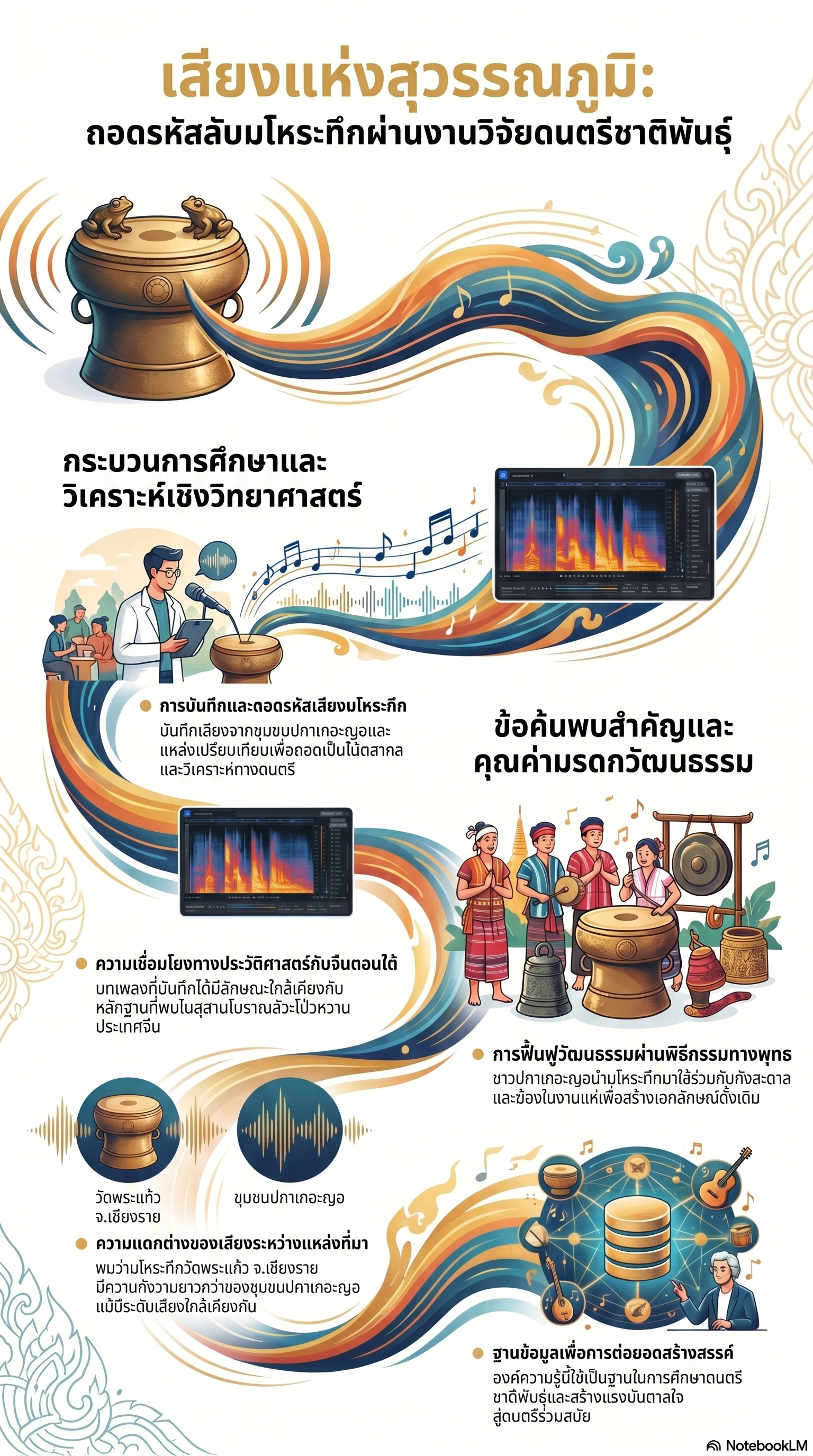
มโหระทึกเป็นเครื่องดนตรีโลหะที่มีบทบาทสำคัญในการประกอบพิธีกรรมมาแต่โบราณ พบมากในวัฒนธรรมพื้นที่เอเชียตะวันออกเฉียงใต้มาอย่างยาวนาน บทความนี้เป็นส่วนหนึ่งของโครงการวิจัยดนตรีสุวรรณภูมิระยะที่ 2 มรดกดนตรีสุวรรณภูมิ มีวัตถุประสงค์เพื่อ 1) เก็บบันทึกบทเพลงและเสียงมโหระทึกของชุมชนชาวปกาเกอะญอที่ยังใช้งานในปัจจุบัน 2) เก็บบันทึกเสียงมโหระทึกจากแหล่งอื่นเพื่อเป็นตัวอย่างสำหรับการเปรียบเทียบ และ 3) วิเคราะห์เปรียบเทียบบทเพลงและสเปกตรัมของเสียงมโหระทึกเพื่อสร้างความเข้าใจถึงคุณลักษณะเสียงของมโหระทึกแบบเฮเกอร์ III การวิจัยใช้ระเบียบวิธีวิจัยเชิงคุณภาพ และกระบวนการแบบดนตรีชาติพันธุ์วิทยา คัดเลือกกลุ่มตัวอย่างแบบลูกโซ่ มีการถอดเสียงเป็นโน้ตสากล และการวิเคราะห์สเปกตรัมหลายจุดเวลาด้วยโปรแกรม iZotope RX 9 ผลการวิจัยพบว่า วงดนตรีมโหระทึกชุมชนชาวปกาเกอะญอมีแนวคิดฟื้นฟูวัฒนธรรมดั้งเดิมของบรรพบุรุษที่นับถือพระพุทธศาสนา โดยนำมโหระทึกมาใช้ในขบวนแห่และพิธีกรรมสำคัญร่วมกับกังสดาล ฉาบ และฆ้อง ส่งผลให้กิจกรรมทางพระพุทธศาสนามีความโดดเด่น และได้รับความร่วมมือจากคนในชุมชนมากขึ้น นอกจากนี้บทเพลงที่บันทึกได้ พบว่ามีลักษณะใกล้เคียงกับหลักฐานบทเพลงจากหลุมฝังศพ เอ็ม 1 ที่สุสานลัวะโป่วหวาน ทางตอนใต้ของจีน ผลการวิเคราะห์สเปกตรัมเสียง พบว่า มโหระทึกจากวัดพระแก้ว จังหวัดเชียงราย มีความกังวานยาวมากกว่าของชุมชนชาวปกาเกอะญอ แต่ทั้งสองใบมีลักษณะระดับเสียงในสเปกตรัมที่ใกล้เคียงกัน องค์ความรู้จากการศึกษาครั้งนี้สามารถใช้เป็นฐานข้อมูลเพื่อการอนุรักษ์มรดกดนตรี การศึกษาดนตรีชาติพันธุ์วิทยา การวิเคราะห์เสียงเครื่องดนตรีโบราณ และการต่อยอดสู่การสร้างสรรค์ดนตรีร่วมสมัย
Bronze drums are important metal percussion instruments that have long played significant roles in the ritual and cultural life of Southeast Asia. This article is part of the Suvarnabhumi Music Research Project, Phase 2: Heritage of Suvarnabhumi Music. It aims to: 1) document the musical repertory and sounds of bronze drums currently used by the Karen community, 2) collect bronze drum sound samples from other sources for comparative purposes, and 3) analyze and compare the musical materials and sound spectra of bronze drums in order to better understand the acoustic characteristics of Heger III bronze drums. The study employed a qualitative research design grounded in ethnomusicological fieldwork. Data were collected through snowball sampling method. Data analysis included musical transcription into Western notation and multi-spots of time spectrum analysis using iZotope RX 9 software. The findings indicate that the Karen community’s bronze drum ensemble is driven by a commitment to reviving the traditional culture of their Buddhist ancestors. The bronze drum is now used alongside the moon shaped bell, cymbals, and gongs, in ritual processions and important ceremonial events. This has resulted in more prominent local Buddhist activities and increased community participation. In addition, the recorded musical pattern shows notable similarities to musical evidence from Tomb M1 at Luopowan Cemetery in southern China. Acoustic analysis further reveals that the bronze drum from Wat Phra Kaew in Chiang Rai province, has a longer resonance than that of the Karen community, although both instruments exhibit similar spectral pitch characteristics. This study contributes to the documentation and preservation of musical heritage, ethnomusicological research, ancient instrument acoustics, and contemporary music.
Downloads
Article Details

This work is licensed under a Creative Commons Attribution-NonCommercial-NoDerivatives 4.0 International License.
References
Amin, O. S. M. (2018). Chinese bronze Bo bell. In World history encyclopedia. https://www.worldhistory.org/image/9491/chinese-bronzebo-bell/
Boonsripornchai, S. (2025). Improvisation in electronic music (การด้นสดในดนตรีอิเล็กทรอนิกส์). Silpakorn University e-Journal (Social Sciences, Humanities, and Arts), 45(2), 110–119. https://doi.org/10.69598/sujthai.45.2.271770
Calò, A. (2009). The distribution of bronze drums in early Southeast Asia: Trade routes and cultural spheres. Bar Publishing.
Churchman, C. (2016). The people between the rivers: The rise and fall of a bronze drum culture, 200-750 CE. Rowman & Littlefield.
Jiang, T., & Liao, M. (2015). Bronze drums in China (H. Wu, Trans.). Homa & Sekey Books.
Jirawattana, M. (2003). The bronze kettle drums in Thailand (กลองมโหระทึกในประเทศไทย). Office of National Museums, The Fine Arts Department.
Rattichot, J., Wongsiri, W., & Sopalang, S. (2024). Identities of intangible cultural heritage: Stories and myths of Lansaka district, Nakhon Si Thammarat province (อัตลักษณ์ มรดกภูมิปัญญาทางวัฒนธรรม: เรื่องเล่า ตำนาน อำเภอลานสกา จังหวัดนครศรีธรรมราช). Silpakorn University e-Journal (Social Sciences, Humanities, and Arts), 44(2), 47–58. https://doi.org/10.14456/sujthai.2024.13
Rees, F. J., & Michelis, R. M. (1991). Identifying musical performance behavior in instrumentalists using computer-based sound spectrum analysis. Bulletin of the Council for Research in Music Education, 1991(110), 53–66.
Rossing, T. D. (2000). Science of percussion instruments. World Scientific.
Tenzer, M. (1991). Balinese music. Periplus Editions.
Wu, Z. (1993). Ritual and music of the Luobowan M1 tomb’s occupant. In Second International Conference on Ancient Bronze Drums and Bronze Cultures in Southern China and Southeast Asia (pp. 237–239). Guangxi Nationalities Publishing House.
