การวิเคราะห์ประเภทและหน้าที่ของคำต้องห้ามในเพลงฮิปฮอปของวง N.W.A (An analysis of types and functions of taboo words in N.W.A’s hip-hop songs)
Article Sidebar
Main Article Content
Abstract
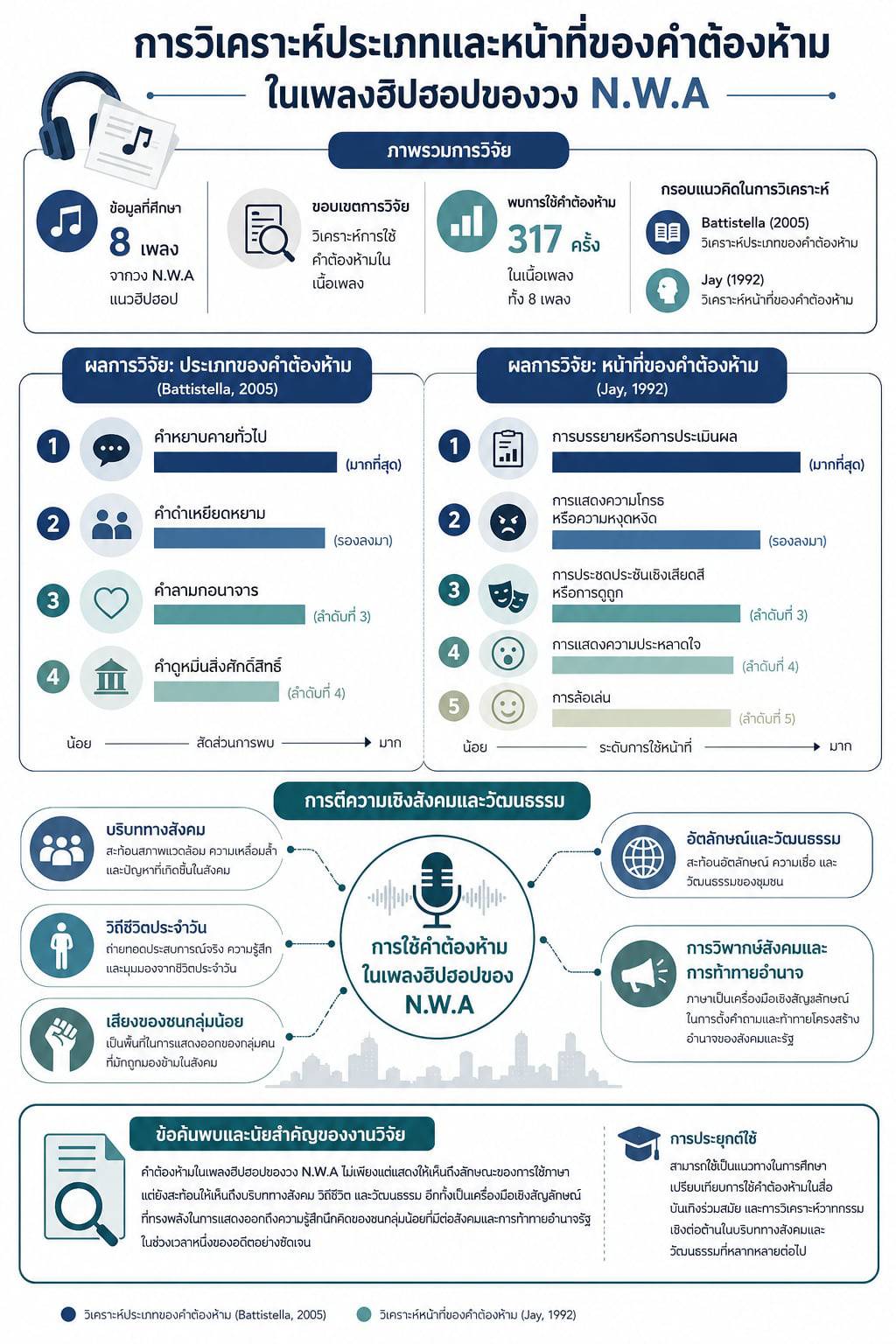
คำต้องห้ามเป็นลักษณะคำรูปแบบหนึ่งที่พบได้ในชีวิตประจำวันและมักถูกนำมาใช้สื่อสารในสถานการณ์ที่ไม่เป็นทางการ รวมทั้งในสื่อบันเทิงประเภทต่าง ๆ อย่างแพร่หลายตั้งแต่อดีตจนถึงปัจจุบัน งานวิจัยนี้มีวัตถุประสงค์เพื่อวิเคราะห์ประเภทและหน้าที่ของคำต้องห้ามที่ปรากฏในเพลงฮิปฮอปของวง N.W.A จำนวนทั้งสิ้น 8 เพลง โดยใช้กรอบแนวคิดของ Battistella (2005) ในการวิเคราะห์ประเภทของคำต้องห้าม และกรอบแนวคิดของ Jay (1992) ในการวิเคราะห์หน้าที่ของคำต้องห้ามที่ปรากฏในเพลง ผลการวิจัยพบคำต้องห้าม จำนวนทั้งสิ้น 317 ครั้ง โดยประเภทของคำต้องห้ามที่พบมากที่สุด คือ คำหยาบคายทั่วไป รองลงมา คือ คำด่าเหยียดหยาม คำลามกอนาจาร และคำดูหมิ่นสิ่งศักดิ์สิทธิ์ ส่วนหน้าที่ของคำต้องห้าม พบการบรรยายหรือการประเมินผลมากที่สุด รองลงมา คือ การแสดงความโกรธหรือความหงุดหงิด การประชดประชันเชิงเสียดสีหรือการดูถูก การแสดงความประหลาดใจและการล้อเล่น ตามลำดับ ผลการศึกษาแสดงให้เห็นว่าคำต้องห้ามที่ปรากฏในเพลงฮิปฮอปของวง N.W.A ไม่เพียงแต่แสดงให้เห็นถึงลักษณะของการใช้ภาษา แต่ยังสะท้อนให้เห็นถึงบริบททางสังคม วิถีชีวิต และวัฒนธรรม อีกทั้งการใช้คำต้องห้ามในเพลงฮิปฮอปยังเป็นเครื่องมือเชิงสัญลักษณ์ที่ทรงพลังในการแสดงออกถึงความรู้สึกนึกคิดของชนกลุ่มน้อยที่มีต่อสังคมและการท้าทายอำนาจรัฐในช่วงเวลาหนึ่งในอดีตอย่างชัดเจน ข้อค้นพบจากงานวิจัยนี้ยังสามารถใช้เป็นแนวทางในการศึกษาเปรียบเทียบการใช้คำต้องห้ามในสื่อบันเทิงร่วมสมัย ตลอดจนการวิเคราะห์วาทกรรมเชิงต่อต้านในบริบททางสังคมและวัฒนธรรมที่หลากหลายต่อไป
Taboo words are a type of lexical form commonly found in everyday life and have long widely been used for communication in informal situations, as well as in various forms of entertainment media, from the past to the present. This study aimed to analyze the types and functions of taboo words found in eight hip-hop songs of N.W.A. Battistella’s (2005) framework was applied to identify the types of taboo words, while Jay’s (1992) theory was employed to investigate their functions. From 317 occurrences of taboo words, all types and functions of them were found. Based on the data analysis, vulgarity was the most frequently occurring type of all the words, followed by epithet, obscenity, and profanity, respectively. The most dominant function was description-evaluation, followed by anger-frustration, sarcastic irony or insult, surprise, and joke. Additionally, the study highlighted that the taboo words in N.W.A’s songs not only reflected linguistic characteristics but also mirrored the social context, lifestyle, and culture of a particular historical period. Furthermore, the use of taboo words in hip-hop songs has functioned as a powerful symbolic tool for minority groups to clearly express their thoughts and feelings toward society and also resistance against state power during a particular period in the past. The findings of this study serve as a reference for conducting comparative studies on taboo words in contemporary media, as well as analyzing resistance discourse across diverse socio-cultural contexts.
Downloads
Article Details

This work is licensed under a Creative Commons Attribution-NonCommercial-NoDerivatives 4.0 International License.
References
Allan, K., & Burridge, K. (2006). Forbidden words: Taboo and the censoring of language. Cambridge University Press.
Battistella, E. L. (2005). Bad language: Are some words better than other? Oxford University Press.
Bussmann, H. (1996). Routledge dictionary of language and linguistics (G. P. Trauth & K. Kazzazi, Trans. & Eds.). Routledge.
Garcarz, M. (2013). African American hip hop slang: A sociolinguistic study of street speech. Oficyna Wydawnicza ATUT.
Hanafi, H., Pakaya, U., & Ahmad, I. J. (2023). An analysis of taboo words in Megan Thee Stallion songs. TRANS-KATA: Journal of Language, Literature, Culture, and Education, 3(2), 104–117. https://doi.org/10.54923/jllce.v3i2.2
Hornby, A. S. (2000). Oxford advance learner’s dictionary of current English (6th ed.). Oxford University Press.
Jay, T. (1992). Cursing in America: A psycholinguistics study of dirty language in the courts, in the movies, in the schoolyards and on the streets. John Benjamins Publishing Company.
Jay, T. (2009). The utility and ubiquity of taboo words. Perspectives on Psychological Science, 4(2), 153–161. https://doi.org/10.1111/j.1745-6924.2009.01115.x
Kennedy, G. D. (2017, December 9). Exclusive: The moment N.W.A changed the music world. Los Angeles Times. https://www.latimes.com/entertainment/music/la-et-ms-nwa-parental-discretion-20171205-htmlstory.html
Laurence, R. (2015, August 14). NWA: ‘The world’s most dangerous group’? BBC. https://www.bbc.com/culture/article/20150813-nwa-the-worlds-most-dangerous-group
Mariyanto, I. K., Sulatra, I. K., & Ayomi, P. N. (2023). Types and functions of taboo words found in Lil Dicky’s song on Album Professional Rapper. Apollo Project: Jurnal Ilmiah Program Studi Sastra Inggris, 12(1), 9–18. https://doi.org/10.34010/apollo.v12i1.7684
McKevitt, G. (2024, August 5). ‘It’s time to retaliate in song’ – Why NWA’s provocative 80s rap became an anthem. BBC. https://www.bbc.com/culture/article/20240802-the-nwa-protest-anthem-that-foreshadowed-riots-in-the-us
Nitisari, D., Lestari, I., & Ramadhan, M. R. (2023). The types and the functional categories of taboo words in Euphoria Season 2 TV series scripts. Jurnal Sosial Humaniora dan Pendidikan, 2(2), 56–62. https://doi.org/10.56127/jushpen.v2i2.835
Nurcholish, M., Taufik, M., & Syurganda, A. (2023). Analysis of taboo language used in The Wolf of Wall Street movie. ASHLITION: Ash-Shahabah English Literature, Linguistics, & Education,1(2), 24–33. https://doi.org/10.59638/ashlition.v1i2.631
Puri, A. D., Yudanti, T. P., & Yogaswari, O. Z. (2024). The function of taboo expressions in Nicki Minaj’s song lyrics. Journal of Language and Literature, 24(1), 144–152. https://doi.org/10.24071/joll.v24i1.5955
Putri, D. E., Sembiring, B., & Imranuddin. (2019). An analysis of taboo words in Rich Brian’s song lyrics. Journal of English Education and Teaching, 3(2), 143–155. https://doi.org/10.33369/jeet.3.2.143-155
Tungkagi, S. A., & Djohan, R. S. (2024). An analysis of types and functions of taboo words in Hot Fuzz movie. Journal of English Language and Literature, 9(2), 461–472. https://doi.org/10.37110/jell.v9i02.265
Wardhaugh, R. (2006). An introduction to sociolinguistics (5th ed.). Blackwell.
