
ปัจจัยที่มีอิทธิพลต่อการเข้าร่วมกิจกรรมของศิษย์เก่าโรงเรียนมัธยมศึกษา ตามกรอบแนวคิด UTAUT (Factors influencing alumni participation in school activities: A study based on the UTAUT framework)
Article Sidebar
Main Article Content
Abstract
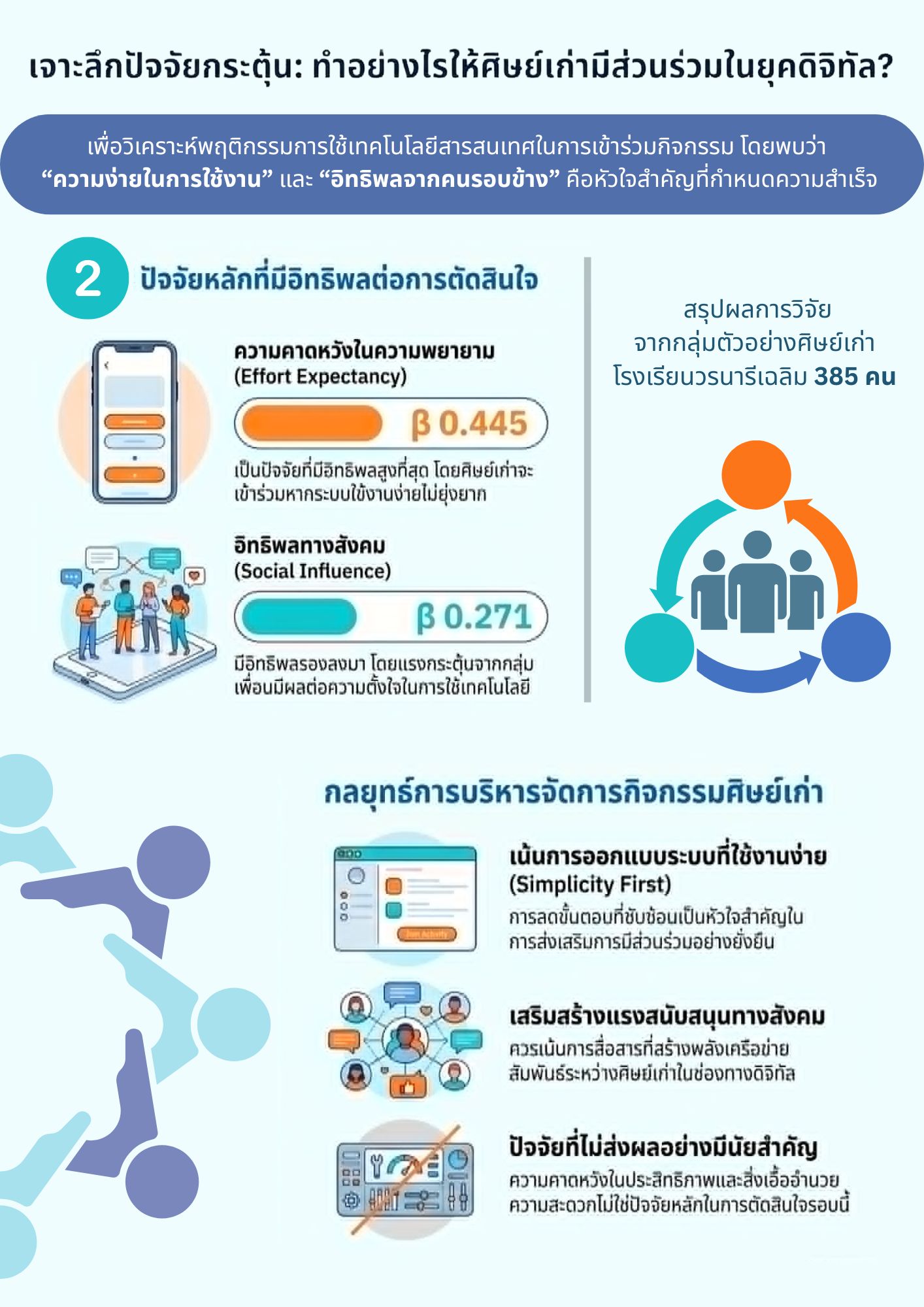
การเข้าร่วมกิจกรรมของศิษย์เก่าในยุคดิจิทัลมีความสัมพันธ์กับการใช้เทคโนโลยีสารสนเทศอย่างใกล้ชิด งานวิจัยนี้มีวัตถุประสงค์เพื่อศึกษาความคิดเห็นของศิษย์เก่าโรงเรียนวรนารีเฉลิมเกี่ยวกับการรับรู้กิจกรรมผ่านเทคโนโลยีสารสนเทศ รวมถึงวิเคราะห์ปัจจัยที่มีอิทธิพลต่อพฤติกรรมการเข้าร่วมกิจกรรมตามกรอบแนวคิด Unified Theory of Acceptance and Use of Technology (UTAUT) โดยดำเนินการเก็บรวบรวมข้อมูลจากกลุ่มตัวอย่างศิษย์เก่า จำนวน 385 คน ด้วยวิธีการสุ่มตัวอย่างแบบสะดวก ผ่านการตอบแบบสอบถามออนไลน์ ที่ผ่านการตรวจสอบความเที่ยงตรงและความเชื่อมั่นแล้ว ข้อมูลที่ได้ถูกนำมาวิเคราะห์ด้วยเทคนิค Partial Least Squares Structural Equation Modeling (PLS-SEM) และ Bootstrapping ผ่านโปรแกรม SmartPLS เพื่อตรวจสอบคุณภาพโมเดลและความสัมพันธ์ระหว่างตัวแปร ผลการศึกษาพบว่า ปัจจัยด้านความคาดหวังในความพยายาม มีอิทธิพลเชิงบวกต่อความตั้งใจเชิงพฤติกรรมมากที่สุด (β = 0.445, p < 0.001) รองลงมา คือ ปัจจัยด้านอิทธิพลทางสังคม (β = 0.271, p < 0.05) มีนัยสำคัญทางสถิติต่อพฤติกรรมความตั้งใจใช้เทคโนโลยีสารสนเทศเพื่อการเข้าร่วมกิจกรรม ในขณะที่ปัจจัยด้านความคาดหวังในประสิทธิภาพ (β = 0.013) และปัจจัยสิ่งเอื้ออำนวยความสะดวกในการใช้งาน (β = 0.200) ไม่พบอิทธิพลอย่างมีนัยสำคัญทางสถิติ นอกจากนี้ แบบจำลองที่ทดสอบมีค่าความตรงเชิงประกอบและความตรงเชิงโครงสร้างในเกณฑ์ที่น่าเชื่อถือ ผลการวิจัยชี้ให้เห็นว่า การออกแบบระบบที่ใช้งานง่ายและการเสริมสร้างแรงสนับสนุนทางสังคมเป็นปัจจัยสำคัญในการส่งเสริมการมีส่วนร่วมของศิษย์เก่าในกิจกรรมผ่านช่องทางดิจิทัลอย่างยั่งยืน โดยสามารถนำไปประยุกต์ใช้ในการกำหนดกลยุทธ์การสื่อสารและการบริหารจัดการกิจกรรมศิษย์เก่าให้สอดคล้องกับบริบทเทคโนโลยีในปัจจุบันได้อย่างมีประสิทธิภาพ
Alumni participation in institutional activities in the digital era is closely associated with the use of information technology. This study aimed to examine the perceptions of alumni of Woranari Chalerm School regarding activity information via information technology and to analyze the factors influencing behavioral intention to participate based on the Unified Theory of Acceptance and Use of Technology (UTAUT) framework. Data were collected from 385 alumni using convenience sampling via a validated online questionnaire. The data were analyzed using Partial Least Squares Structural Equation Modeling (PLS-SEM) with a bootstrapping procedure in SmartPLS to assess both the measurement and structural models. The results indicated that effort expectancy had the strongest positive effect on behavioral intention (β = 0.445, p < 0.001), followed by social influence (β = 0.271, p < 0.05). In contrast, performance expectancy (β = 0.013) and facilitating conditions (β = 0.200) did not demonstrate statistically significant effects. The measurement model exhibited satisfactory composite reliability as well as convergent and discriminant validity, confirming the adequacy of the proposed model. These findings highlight that user-friendly system design and the enhancement of social support are critical determinants of sustainable alumni participation in digital activities. The findings also provide practical implications for developing communication strategies and managing alumni activities in alignment with contemporary technological contexts.
Downloads
Article Details

This work is licensed under a Creative Commons Attribution-NonCommercial-NoDerivatives 4.0 International License.
References
Abubakar, F. M., & Ahmad, H. B. (2013). The moderating effect of technology awareness on the relationship between UTAUT constructs and behavioural intention to use technology: A conceptual paper. Australian Journal of Business and Management Research, 3(2), 14–23.
Alkhalifah, T. (2022). A structural equation modelling of governing factors influencing patient acceptance of mobile health in Saudi Arabia: A modified UTAUT model. International Journal of E-Services and Mobile Applications, 14(1), 1–17. https://doi.org/10.4018/IJESMA.295963
Azizah, S. N., Suwartono, T., Nurhayati, S., Sungkawati, E., & Nur’aeni, N. (2024). Examining Indonesian college students’ behavioral intention of using Moodle app for e-learning platform. Qubahan Academic Journal, 4(3), 226–241. https://doi.org/10.48161/qaj.v4n3a668
Bandoh, S. O., Akweittey, E., Lotey, E. K., Gordon, J. F., & Appiagyei, E. (2024). Using UTAUT model to assess the factors influencing the use of ICT in Ghanaian pre-tertiary mathematics education. Journal of Digital Educational Technology, 4(1), Article ep2407. https://doi.org/10.30935/jdet/14297
Bayaga, A., & du Plessis, A. (2024). Ramifications of the Unified Theory of Acceptance and Use of Technology (UTAUT) among developing countries’ higher education staffs. Education and Information Technologies, 29(8), 9689–9714. https://doi.org/10.1007/s10639-023-12194-6
Budhathoki, T., Zirar, A., Njoya, E. T., & Timsina, A. (2024). ChatGPT adoption and anxiety: A cross-country analysis utilising the Unified Theory of Acceptance and Use of Technology (UTAUT) [Special issue]. Studies in Higher Education, 49(5), 831–846. https://doi.org/10.1080/03075079.2024.2333937
Candra, S., Frederica, E., Putri, H. A., & Loang, O. K. (2025). The UTAUT approach to Indonesia’s behavioral intention to use mobile health apps. Journal of Science and Technology Policy Management, 16(5), 892–911. https://doi.org/10.1108/JSTPM-10-2022-0175
Cao, J., Feng, H., Lim, Y., Kodama, K., & Zhang, S. (2024). How social influence promotes the adoption of mobile health among young adults in China: A systematic analysis of trust, health consciousness, and user experience. Behavioral Sciences, 14(6), Article 498. https://doi.org/10.3390/bs14060498
Chen, L., Rashidin, M. S., Song, F., Wang, Y., Javed, S., & Wang, J. (2021). Determinants of consumer’s purchase intention on fresh e-commerce platform: Perspective of UTAUT model. SAGE Open, 11(2). https://doi.org/10.1177/21582440211027875
Chen, S., Huang, L., Shadiev, R., & Hu, P. (2025). An extension of UTAUT model to understand elementary school students’ behavioral intention to use an online homework platform. Education and Information Technologies, 30(1), 229–255. https://doi.org/10.1007/s10639-024-12852-3
Chin, W. W. (1998). The partial least squares approach to structural equation modeling. In G. A. Marcoulides (Ed.), Modern methods for business research (pp. 295–336). Lawrence Erlbaum Associates.
Fishbein, M., & Ajzen, I. (1977). Belief, attitude, intention, and behavior: An introduction to theory and research. Addison-Wesley.
Garba, S. B., Inuwa, U., & Ibrahim, A. (2024). Performance, effort expectancy and business education students’ behavioral intention towards online learning in Bauchi State, Nigeria. Kashere Journal of Management Sciences, 7(1), 66–72.
Hair, J. F., Sarstedt, M., Ringle, C. M., & Mena, J. A. (2012). An assessment of the use of partial least squares structural equation modeling in marketing research. Journal of the Academy of Marketing Science, 40(3), 414–433. https://doi.org/10.1007/s11747-011-0261-6
Hair, J. F., Jr., Sarstedt, M., Hopkins, L., & Kuppelwieser, V. G. (2014). Partial least squares structural equation modeling (PLS-SEM): An emerging tool in business research. European Business Review, 26(2), 106–121. https://doi.org/10.1108/EBR-10-2013-0128
Hanif, Y., & Lallie, H. S. (2021). Security factors on the intention to use mobile banking applications in the UK older generation (55+). A mixed-method study using modified UTAUT and MTAM - with perceived cyber security, risk, and trust. Technology in Society, 67, Article 101693. https://doi.org/10.1016/j.techsoc.2021.101693
Henseler, J., Ringle, C. M., & Sarstedt, M. (2012). Using partial least squares path modeling in advertising research: Basic concepts and recent issues. In S. Okazaki (Ed.), Handbook of research on international advertising (pp. 252–276). Edward Elgar Publishing.
Huang, Q., Li, Y., Wu, X., Ge, S., Qu, Z., Wang, A., & Tang, X. (2022). The willingness and influencing factors to choose smart senior care among old adults in China. BMC Geriatrics, 22(1), Article 967. https://doi.org/10.1186/s12877-022-03691-3
Idayani, R. W., & Darmaningrat, E. W. T. (2024). Evaluation of factors affecting student acceptance of Zedemy using the Unified Theory of Acceptance and Use of Technology (UTAUT). Procedia Computer Science, 234, 1276–1287. https://doi.org/10.1016/j.procs.2024.03.125
Im, I., Hong, S., & Kang, M. S. (2011). An international comparison of technology adoption: Testing the UTAUT model. Information & Management, 48(1), 1–8. https://doi.org/10.1016/j.im.2010.09.001
Ivanova, A., & Kim, J. Y. (2022). Acceptance and use of mobile banking in Central Asia: Evidence from modified UTAUT model. The Journal of Asian Finance, Economics and Business, 9(2), 217–227. https://doi.org/10.13106/jafeb.2022.vol9.no2.0217
Jadil, Y., Rana, N. P., & Dwivedi, Y. K. (2021). A meta-analysis of the UTAUT model in the mobile banking literature: The moderating role of sample size and culture. Journal of Business Research, 132, 354–372. https://doi.org/10.1016/j.jbusres.2021.04.052
Jiang, B., & North-Samardzic, A. (2015). Acceptance and use of Moodle by students and academics. In Proceedings of the Americas Conference on Information Systems 2015 (pp. 1–13). Association for Information Systems. https://aisel.aisnet.org/amcis2015/ISEdu/GeneralPresentations/9/
Krejcie, R. V., & Morgan, D. W. (1970). Determining sample size for research activities. Educational and Psychological Measurement, 30(3), 607–610. https://doi.org/10.1177/001316447003000308
La Barbera, F., & Ajzen, I. (2020). Control interactions in the theory of planned behavior: Rethinking the role of subjective norm. Europe’s Journal of Psychology, 16(3), 401–417. https://doi.org/10.5964/ejop.v16i3.2056
Li, W. (2025). A study on factors influencing designers’ behavioral intention in using AI-generated content for assisted design: Perceived anxiety, perceived risk, and UTAUT. International Journal of Human–Computer Interaction, 41(2), 1064–1077. https://doi.org/10.1080/10447318.2024.2310354
Li, Y., & Zhao, M. (2021). A study on the influencing factors of continued intention to use MOOCs: UTAUT model and CCC moderating effect. Frontiers in Psychology, 12, Article 528259. https://doi.org/10.3389/fpsyg.2021.528259
Lu, C.-C., & Tsai-Lin, T.-F. (2024). Are older adults special in adopting public eHealth service initiatives? The modified model of UTAUT. SAGE Open, 14(1). https://doi.org/10.1177/21582440241228639
Luangsoontorn, K., & Prayoonsak, J. (2024). A study of attitude towards using online social network of Dhonburi Rajabhat University’s students (การพัฒนาระบบฐานข้อมูลศิษย์เก่า คณะวิทยาการจัดการ มหาวิทยาลัยราชภัฏธนบุรี). Journal of Management Science, Dhonburi Rajabhat University, 6(1), 1–18.
Mina, F. L. P., Batara, E. B., Hussien, E. P., & Lavilles, R. Q. (2022). Citizens’ adoption of an e-health system during the pandemic. Jurnal Studi Pemerintahan, 13(1), 86–111. https://doi.org/10.18196/jgp.v13i1.13541
Misra, R., Mahajan, R., Singh, N., Khorana, S., & Rana, N. P. (2022). Factors impacting behavioural intentions to adopt the electronic marketplace: Findings from small businesses in India. Electronic Markets, 32(3), 1639–1660. https://doi.org/10.1007/s12525-022-00578-4
Mohamed, M. J., & Hassan, S. A. (2023). Studying the factors that influence the adoption of educational technology in Mogadishu secondary schools using UTAUT model. International Journal of Information and Education Technology, 13(7), 1070–1077. https://doi.org/10.18178/ijiet.2023.13.7.1906
Namwong, M., & Wongthanavasu, S. (2017). Relationship management with alumni, Khon Kaen University Alumni Relations Office (การบริหารความสัมพันธ์กับศิษย์เก่าของสำนักงานศิษย์เก่าสัมพันธ์ มหาวิทยาลัยขอนแก่น). Journal of Social Sciences and Humanities Research in Asia, 23(3), 159–178.
Rehman, A. U., Bashir, S., Mahmood, A., Karim, H., & Nawaz, Z. (2022). Does e-shopping service quality enhance customers’e-shopping adoption? An extended perspective of unified theory of acceptance and use of technology. PLoS ONE, 17(2), Article e0263652. https://doi.org/10.1371/journal.pone.0263652
Savić, J., & Pešterac, A. (2019). Antecedents of mobile banking: UTAUT model. The European Journal of Applied Economics, 16(1), 20–29. https://doi.org/10.5937/EJAE15-19381
Silva, J., Hernández-Fernández, L., Torres Cuadrado, E., Mercado-Caruso, N., Rengifo Espinosa, C., Acosta Ortega, F., Hernández P, H., & Jiménez Delgado, G. (2019). Factors affecting the big data adoption as a marketing tool in SMEs. In Y. Tan & Y. Shi (Eds.), Data mining and big data. DMBD 2019. Communications in computer and information science, vol. 1071 (pp. 34–43). Springer. https://doi.org/10.1007/978-981-32-9563-6_4
Strzelecki, A. (2024). Students’ acceptance of ChatGPT in higher education: An extended unified theory of acceptance and use of technology. Innovative Higher Education, 49(2), 223–245. https://doi.org/10.1007/s10755-023-09686-1
Sukha, P., Lapho, T., & Suwan, S. (2024). The acceptance of information technology utilization in academic operations of Pathumwilai School Teachers (การยอมรับการใช้เทคโนโลยีสารสนเทศในการดำเนินงานทางวิชาการของครูโรงเรียนปทุมวิไล). In Proceedings of the 21st KU KPS National Conference (การประชุมวิชาการระดับชาติ ครั้งที่ 21 มหาวิทยาลัยเกษตรศาสตร์ วิทยาเขตกำแพงแสน) (pp. 2857–2871). Kasetsart University, Kamphaeng Saen Campus. https://esd.kps.ku.ac.th/kuk-gallery/article_21/full_21_30June25.pdf
Taamneh, A., Alsaad, A., Elrehail, H., Al-Okaily, M., Lutfi, A., & Sergio, R. P. (2023). University lecturers acceptance of Moodle platform in the context of the COVID-19 pandemic. Global Knowledge, Memory and Communication, 72(6–7), 666–684. https://doi.org/10.1108/GKMC-05-2021-0087
Tian, W., Ge, J., Zhao, Y., & Zheng, X. (2024). AI Chatbots in Chinese higher education: Adoption, perception, and influence among graduate students—an integrated analysis utilizing UTAUT and ECM models. Frontiers in Psychology, 15, Article 1268549. https://doi.org/10.3389/fpsyg.2024.1268549
Venkatesh, V., & Davis, F. D. (2000). A theoretical extension of the technology acceptance model: Four longitudinal field studies. Management Science, 46(2), 186–204.
Venkatesh, V., Morris, M. G., Davis, G. B., & Davis, F. D. (2003). User acceptance of information technology: Toward a unified view. MIS Quarterly, 27(3), 425–478. https://doi.org/10.2307/30036540
Venkatesh, V., Thong, J. Y. L., & Xu, X. (2012). Consumer acceptance and use of information technology: Extending the unified theory of acceptance and use of technology. MIS Quarterly, 36(1), 157–178. https://doi.org/10.2307/41410412
Wei, M.-F., Luh, Y.-H., Huang, Y.-H., & Chang, Y.-C. (2021). Young generation’s mobile payment adoption behavior: Analysis based on an extended UTAUT model. Journal of Theoretical and Applied Electronic Commerce Research, 16(4), 618–637. https://doi.org/10.3390/jtaer16040037
Weiser, M., & Brown, J. S. (1997). The coming age of calm technology. In P. J. Denning & R. M. Metcalfe (Eds.), Beyond calculation: The next fifty years of computing (pp. 75–85). Copernicus.
Widyanto, H. A., Kusumawardani, K. A., & Yohanes, H. (2022). Safety first: Extending UTAUT to better predict mobile payment adoption by incorporating perceived security, perceived risk and trust. Journal of Science and Technology Policy Management, 13(4), 952–973. https://doi.org/10.1108/JSTPM-03-2020-0058
Xue, L., Rashid, A. M., & Ouyang, S. (2024). The Unified Theory of Acceptance and Use of Technology (UTAUT) in higher education: A systematic review. SAGE Open, 14(1). https://doi.org/10.1177/21582440241229570
