
ความเข้มแข็งของพรรคการเมืองไทยหลังรัฐประหาร 2549 (The strength of Thai political parties after the 2006 coup)
Article Sidebar
Main Article Content
Abstract
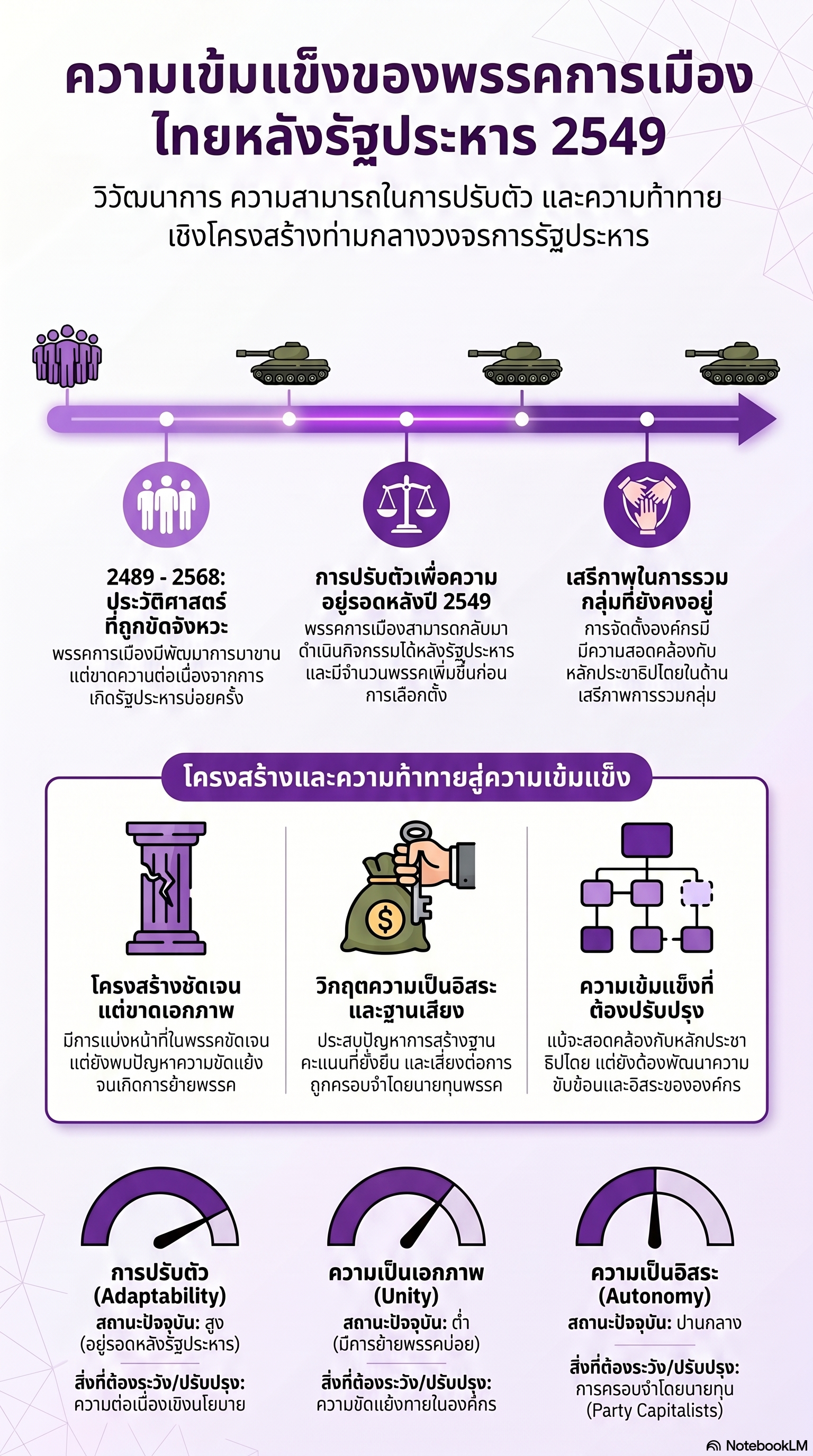
The strength of Thai political parties is crucial to democratic development. However, scholarly attention to this issue remains limited, particularly in the aftermath of the two most recent military coups. This study therefore aims to examine: 1) the development of Thai political parties from 1946 to 2025; 2) the strengthening of political parties from 2006 to 2025; and 3) the alignment between efforts to strengthen political parties and democratic principles from 2006 to 2025. This research employs a qualitative approach through content analysis of primary and secondary documents. The findings reveal that: 1) Thai political parties have developed continuously since 1946; however, they have lacked continuity in their political activities due to frequent military coups. 2) Thai political parties have shown improved adaptability, as most were able to survive and resume political activities after coups, and the number of active parties prior to elections increased during 2006–2025. Organizational structures have become more clearly defined; however, internal unity remaines problematic due to internal conflicts, which have led to party switching before elections. In terms of autonomy, political parties still require monitoring to prevent domination by financial elites. Moreover, most parties face difficulties in building and maintaining voter bases, resulting in only a small number achieving electoral success. 3) The analysis of alignment between party strengthening and democratic principles indicates that these aspects are generally consistent. Freedom of association and organization corresponds with adaptability, organizational complexity, internal unity, centralization, and autonomy. However, these aspects still require improvement to further strengthen political parties.
Downloads
Article Details

This work is licensed under a Creative Commons Attribution-NonCommercial-NoDerivatives 4.0 International License.
References
Announcement of the Registrar of Political Parties on Changes to the Party Regulations and the Executive Committee of the Pheu Thai Party. (2019, March 7). Royal Thai Government Gazette. No. 136 Section 18 D. pp. 306–372.
Announcement of the Registrar of Political Parties on the Changes to the Regulations of the Democrat Party. (2023, August 24). Royal Thai Government Gazette. No. 140 Section 64 D. pp. 92–142.
Bizzarro, F., Gerring, J., Hicken, A., Knutsen, C. H., Bernhard, M., Skaaning, S.-E., Coppedge, M., & Lindberg, S. I. (2015). Party strength and economic growth. V-Dem Institute, Department of Political science, University of Gothenburg. https://www.v-dem.net/media/publications/v-dem_working_paper_2015_10_edited.pdf
Bryce, J. (1921). Modern democracies, vol. 2. Macmillan.
Charnvirakul, A. (n.d.). Private sector funding for political parties (การให้ทุนสนับสนุนพรรคการเมืองของภาคธุรกิจเอกชน). Office of the Election Commission of Thailand. https://newweb.ect.go.th/web-upload/1xff0d34e409a13ef56eea54c52a291126/m_document/2167/26696/file_download/acf0bc98880f1c1675447197212b0818.pdf
Chartthaipattana Party. (2024). Party regulations (ข้อบังคับพรรค). https://www.chartthaipattana.or.th/media/user/files/What_we_stand_for.pdf
Chingduang, S. (2007). Political parties from 1933 - present (พรรคการเมือง ตั้งแต่ปี พ.ศ. 2476 - ปัจจุบัน). King Prajadhipok’s Institute. https://www.kpi-lib.com/elib/cgi-bin/opacexe.exe?op=mmvw&db=Main&skin=&mmid=3982&bid=11316
Comsook, S. (1995). Thai political party system 1969-1991 (ระบบพรรคการเมืองไทย พ.ศ. 2512-2534) [Doctoral dissertation, Chulalongkorn University]. Chula DigiVerse. https://doi.org/10.58837/CHULA.THE.1995.530
Comsook, S. (2015). Democratic dimensions in the July 3, 2011 general election: The competitive dimension from the candidate nominations of 41 political parties (มิติประชาธิปไตยในการเลือกตั้งทั่วไป 3 กรกฎาคม 2554 : มิติการแข่งขันจากการจัดส่งผู้สมัครของพรรคการเมือง 41 พรรค). Sukhothai Thammathirat Open University Press.
Democrat Party. (2024). Party executive committee (คณะกรรมการบริหารพรรค). https://www.democrat.or.th/party-personnel/committee
Domjun, J. (2019). Democracy without consolidation (ประชาธิปไตยที่ไม่ตั้งมั่น). Matichon.
Duverger, M. (1999). Political party. In Encyclopedia Britannica. Retrieved May 8, 2025, from https://www.britannica.com/topic/political-party
Goodman, W. (1960). The two-party system in the United States. D. Van Nostrand.
Huntington, S. P. (1969). Political order in changing societies (3rd ed.). Yale University Press.
LaPalombara, J., & Weiner, M. (1966). Political parties and political development. Princeton University Press.
Mekhasophon, R. (2010). Blood-stained democracy, seems to have come a long way but has not reached anywhere (ประชาธิปไตยเปื้อนเลือดเหมือนมาไกล แต่ไปไม่ถึงไหน). Ban Phra Athit.
Office of the Election Commission of Thailand. (2008). Statistics and results of the 2007 House of Representatives elections (ข้อมูลสถิติ และผลการเลือกตั้งสมาชิกสภาผู้แทนราษฎร พ.ศ. 2550). Rung Silp Printing. https://www.ect.go.th/web-upload/migrate/download/article/article_20170509150020.pdf
Office of the Election Commission of Thailand. (2012). Statistical data on the 2011 House of Representatives elections (ข้อมูลสถิติการเลือกตั้งสมาชิกสภาผู้แทนราษฎร พ.ศ. 2554). Rung Silp Printing. https://www.ect.go.th/web-upload/migrate/download/article/article_20170405163102.pdf
Office of the Election Commission of Thailand. (2014). Information on political parties still in operation as of 2 January 2014 (ข้อมูลพรรคการเมืองที่ยังดำเนินการอยู่ ณ วันที่ 2 มกราคม 2557). https://www.ect.go.th/web-upload/migrate/download/article/article_20160713133222.pdf
Office of the Election Commission of Thailand. (2015). Information on political parties still in operation as of 4 December 2015 (ข้อมูลพรรคการเมืองที่ยังดำเนินการอยู่ ณ วันที่ 4 ธันวาคม 2558). https://www.ect.go.th/web-upload/migrate/download/article/article_20160713133355.pdf
Office of the Election Commission of Thailand. (2019). Information on political parties still in operation as of 13 March 2019 (ข้อมูลพรรคการเมืองที่ยังดำเนินการอยู่ ณ วันที่ 13 มีนาคม 2562). https://www.ect.go.th/web-upload/migrate/download/article/article_20190318074234.pdf
Office of the Election Commission of Thailand. (2020). Statistical data on the 2019 House of Representatives elections (ข้อมูลสถิติการเลือกตั้งสมาชิกสภาผู้แทนราษฎร พ.ศ. 2562). Sahy Block & Karnpim. https://www.ect.go.th/web-upload/migrate/download/article/article_20201002121233.pdf
Office of the Election Commission of Thailand. (2023). Information on political parties still in operation as of 29 May 2023 (ข้อมูลพรรคการเมืองที่ยังดำเนินการอยู่ ณ วันที่ 29 พฤษภาคม 2566). https://www.ect.go.th/web-upload/migrate/download/article/article_20230529153859.pdf
Office of the Election Commission of Thailand. (2024). Information on political parties still in operation as of 4 November 2024 (ข้อมูลพรรคการเมืองที่ยังดำเนินการอยู่ ณ วันที่ 4 พฤศจิกายน 2567). https://www.ect.go.th/web-upload/1xff0d34e409a13ef56eea54c52a291126/m_document/2034/25522/file_download/38688125b63b730b3e3da715c9337df7.pdf
Pheu Thai Party. (2024). Executive committee of the Pheu Thai Party (กรรมการบริหารพรรคเพื่อไทย). https://ptp.or.th/กรรมการบรหารพรรค
Rathamarit, N. (2010). Democracy in international countries (การปกครองระบอบประชาธิปไตยในนานาประเทศ). Thammasat University Press.
Rocket Media Lab. (2023, May 10). Revealing information on party transfers of constituency MPs in 2019: Which party did they transfer to and how many in the 2023 election (เปิดข้อมูลการย้ายพรรค ส.ส. แบ่งเขต ปี ’62 ย้ายไปพรรคไหน เท่าไร ในการเลือกตั้งปี ’66). https://rocketmedialab.co/election-66-15/
Roskin, M. G., Cord, R. L., Medeiros, J. A., & Jones, W. S. (2017). Political science: An introductio (14th ed.). Pearson Education.
Schattschneider, E. E. (1942). Party government. Holt, Rinehart, and Winston.
Thai Junior Encyclopedia Foundation by His Majesty King Bhumibol Adulyadej The Great. (n.d.). Volume 31: Thai political parties (เล่ม 31 พรรคการเมืองไทย). https://saranukromthai.or.th/oldchild/2832
Thananithichot, S. (2013). Strengthening political party in Thailand (พรรคการเมืองยังไม่ “เข้มแข็ง”). Journal of Politics, Administration and Law, 5(3), 117–146. https://so03.tci-thaijo.org/index.php/polscilaw_journal/issue/view/15236
Tocqueville, A. D. (2010). De la démocratie en Amérique (Democracy in America) (J. T. Schleifer, Trans.). Liberty Fund.
Wongtrangan, K. (1993). Thai political party (พรรคการเมืองไทย). Chulalongkorn University Press.
