บุคลาธิษฐานและอุปลักษณ์ : การแปล “Il Penseroso” ของ จอห์น มิลตัน เป็นกวีนิพนธ์ไทย (Personification and metaphor: A Thai poetic translation of John Milton’s “Il Penseroso”)
Article Sidebar
Main Article Content
Abstract
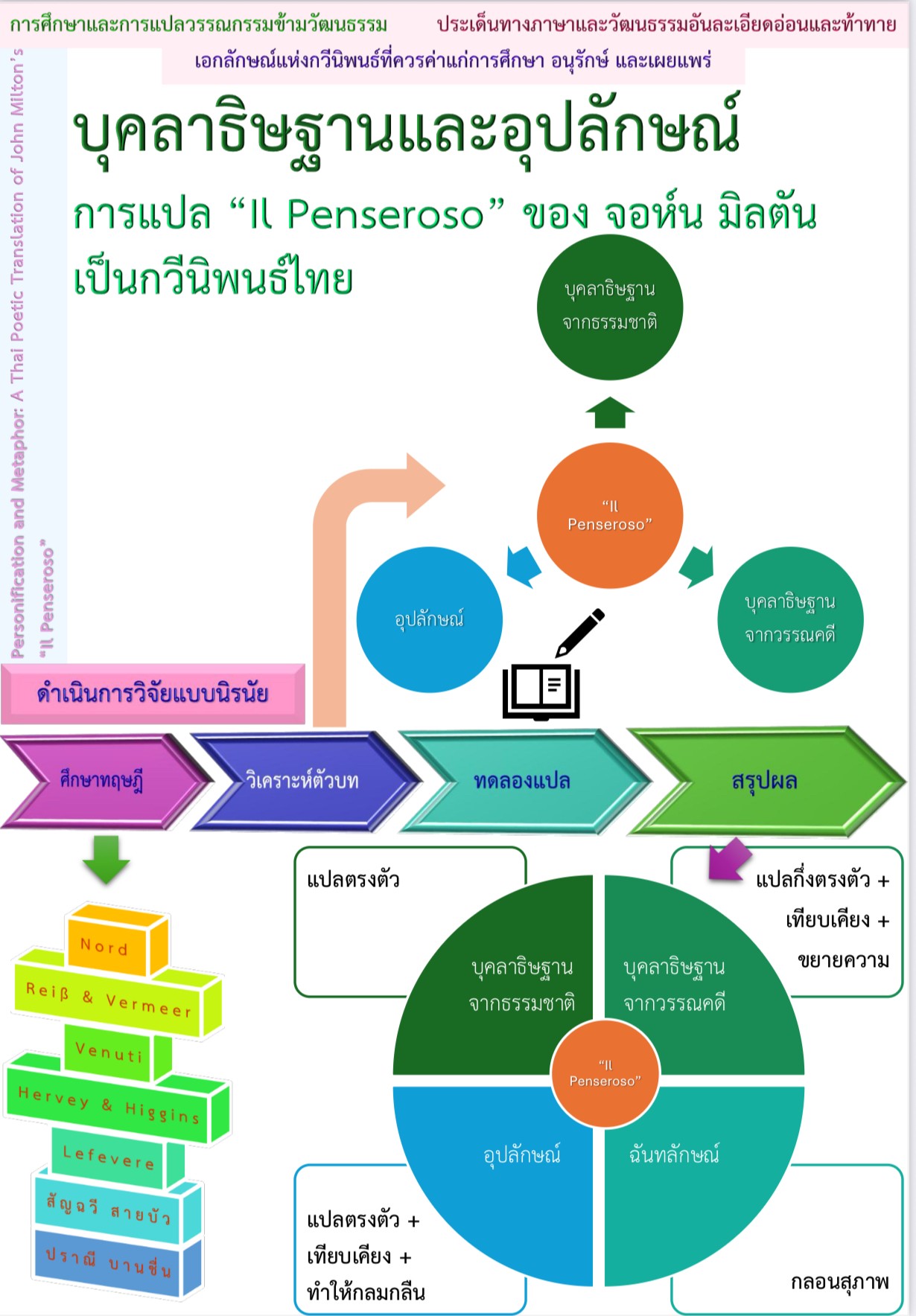
การแปลภาพพจน์เป็นประเด็นทางภาษาและวัฒนธรรมที่ละเอียดอ่อนและท้าทาย ส่วนกวีนิพนธ์เป็นตัวบทที่มีเอกลักษณ์ ควรศึกษาเพื่ออนุรักษ์และเผยแพร่วรรณกรรมข้ามวัฒนธรรม บทความฉบับนี้เป็นงานวิจัยเชิงคุณภาพ มีวัตถุประสงค์เพื่อศึกษาแนวทางการแปลภาพพจน์ประเภทบุคลาธิษฐาน (จากธรรมชาติกับจากวรรณคดี) และอุปลักษณ์ที่ปรากฏในกวีนิพนธ์ เรื่อง “Il Penseroso” ของ จอห์น มิลตัน โดยรักษาความหมาย รูปแบบ และสุนทรียลักษณ์ของตัวบทต้นฉบับ ดำเนินการวิจัยแบบนิรนัยโดยนำทฤษฎีที่เกี่ยวข้องมาทดลองแปลภาพพจน์สองประเภทนี้ เพื่อสรุปว่ากลวิธีและฉันทลักษณ์ใดเหมาะที่สุด ผลการวิจัยพบว่า การแปลต้องวิเคราะห์และแปลตัวบทโดยอาศัยทฤษฎีการกระทำการแปลของ Christiane Nord ทฤษฎีสโคพอสของ Katharina Reiß และ Hans Vermeer ทฤษฎีการแปลแบบทำให้กลมกลืนของ Lawrence Venuti กลวิธีการแปลชดเชยของ Sándor Hervey และ Ian Higgins กลวิธีการแปลกวีนิพนธ์ของ André Lefevere หลักการแปลของสัญฉวี สายบัว และหลักการแปลของ ปราณี บานชื่น โดยสรุปได้ว่า บุคลาธิษฐานจากธรรมชาติสามารถแปลแบบตรงตัว บุคลาธิษฐานจากวรรณคดีต้องแปลแบบกึ่งตรงตัวร่วมกับการแปลเทียบเคียงและการขยายความเพื่อให้ผู้อ่านเห็นภาพชัดเจน อุปลักษณ์ใช้การแปลแบบตรงตัวร่วมกับการแปลเทียบเคียงและการแปลแบบทำให้กลมกลืน ส่วนฉันทลักษณ์ที่ถ่ายทอดบุคลาธิษฐานและอุปลักษณ์ใน “Il Penseroso” โดยรักษาความหมาย รูปแบบ และสุนทรียลักษณ์ได้เหมาะที่สุด คือ กลอนสุภาพ โดยบทแปลที่ได้เป็นส่วนหนึ่งขององค์ความรู้ที่สามารถใช้เป็นแนวทางสำหรับผู้สนใจและใช้ในการเรียนการสอนการแปลกวีนิพนธ์ ทั้งนี้ การศึกษาการแปลการอ้างถึง (ปฏิรูปพจน์) น่าจะช่วยขยายองค์ความรู้การแปลภาพพจน์ในกวีนิพนธ์ให้กว้างขวางขึ้น
The translation of figurative language represents a complex and challenging area in the study of language and culture. Similarly, poetry as a genre is distinguished by its unique formal and aesthetic characteristics. Both are therefore worthy of scholarly attention for the preservation and dissemination of cross-cultural literary heritage. This qualitative research aims to examine approaches to translating figures of speech, particularly personification (of nature and abstract concepts in literature) and metaphor, in John Milton’s “Il Penseroso” into Thai, while preserving its meaning, poetic form and aesthetic qualities. Using a deductive approach, the research applies relevant translation theories to the analysis and translation of these figures of speech in order to identify appropriate strategies and poetic forms. The findings indicate that translation analysis and practice are informed by Nord’s Translatorisches Handeln, Reiß and Vermeer’s Skopostheorie, Venuti’s domestication and foreignization strategies, Hervey and Higgins’s compensation techniques, Lefevere’s theories on poetry translation, as well as Saibua’s and Bancheun’s principles of poetry translation. The study finds that personification of nature can be effectively rendered through literal translation. For personification of abstract concepts, a near-literal translation approach combined with amplification is required to enhance reader comprehension. For metaphors, literal translation, formal equivalence, and domestication are appropriate strategies. The most suitable Thai poetic form for preserving the meaning, structure, and aesthetics of “Il Penseroso” is Klon Supab, an octosyllabic quatrain with four lines of eight syllables each. The resulting translation contributes to existing knowledge and may be useful for teaching, learning, and translating figurative language in English poetry into Thai verse. Further research on the translation of allusion as a prominent figure of speech would further expand the field of poetry translation studies.
Downloads
Article Details

This work is licensed under a Creative Commons Attribution-NonCommercial-NoDerivatives 4.0 International License.
References
Abrams, M. H., & Harpham, G. G. (2009). A glossary of literary terms (9th ed.). Wadsworth Cengage Learning.
Banchuen, P. (1980). Advanced translation (การแปลขั้นสูง). Chulalongkorn University Press.
Boonrawdpanich, N. (2006). Translation of Paradise Lost: An epic by John Milton (การแปลมหากาพย์พาราไดซ์ ลอสท์ ของ จอห์น มิลตัน) [Master’s thesis, Chulalongkorn University]. Chulalongkorn University Intellectual Repository. https://cuir.car.chula.ac.th/handle/123456789/12279
Brown, C. C. (2016). The legacy of the late Jacobean period. In T. N. Corns (Ed.), A new companion to Milton (pp. 107–123). John Wiley & Sons.
Buck, P. M., Jr. (Ed.). (1911). Milton’s L’Allegro, Il Penseroso, Comus, and Lycidas. American Book Company.
Caldarone, J. (2010). The cypress trees in “The Starry Night”: A symbolic self-portrait of Vincent Van Gogh [Undergraduate thesis, Providence College]. Providence College Digital Commons. https://digitalcommons.providence.edu/art_students/3
Chatraporn, S. (1996). Poetry: An introductory study (2nd ed.). Faculty of Arts, Chulalongkorn University.
Childs, P., & Fowler, R. (2006). The Routledge dictionary of literary terms. Routledge.
Chongsathitwatthana, S. (2015). Sweet scents of sandalwood and songs of silvery sounds: Literary language in Thai literature (เจิมจันทน์กังสดาล : ภาษาวรรณศิลป์ในวรรณคดีไทย) (3rd ed.). Academic Project of the Faculty of Arts, Chulalongkorn University.
Connell, F. M. (1913). A text-book for the study of poetry. Allyn and Bacon.
Drabble, M. (Ed.). (2000). The Oxford companion to English literature (6th ed.). Oxford University Press.
Eco, U. (1994). The limits of interpretation. Indiana University Press.
Embry, T. J. (1978). Sensuality and chastity in “L’Allegro” and “Il Penseroso”. The Journal of English and Germanic Philology, 77(4), 504–529. https://www.jstor.org/stable/pdf/27708401
Gildenhard, I., & Zissos, A. (2007). Barbarian variations: Tereus, Procne and Philomela in Ovid (Met. 6.412-674) and beyond. Dictynna: Revue de poétique latine, 4, 1–22. https://doi.org/10.4000/dictynna.150
Harris, C. (2019). “For rage”: Rape survival, women’s anger, and sisterhood in Chaucer’s Legend of Philomela. The Chaucer Review, 54(3), 253–269. https://doi.org/10.5325/chaucerrev.54.3.0253
Hervey, S., & Higgins, I. (1992). Thinking translation. A course in translation method: French to English. Routledge.
Israël, F. (1991). Traduction littéraire: L’appropriation du texte. In M. Lederer & F. Israël (Eds.), La liberté en traduction (pp. 17–41). Didier Erudition.
Kayunrawat, W. (2007). The translation of Shakespeare’s love sonnets (การแปลบทกวีรักซอนเนต ของวิลเลี่ยม เชกสเปียร์) [Unpublished master’s thesis, Chulalongkorn University]. Chulalongkorn University Library and Information Network.
Knight, S. (2016). Exact Latinity and excellent English: Milton’s early poetry. In T. N. Corns (Ed.), A new companion to Milton (pp. 282–290). John Wiley & Sons.
Lefevere, A. (1975). The translation of poetry: Some observations and a model. Comparative Literature Studies, 12(4), 384–392. https://www.jstor.org/stable/40246103
Luepromchai (Watcharawit), P. (2016). Mastering translation: A handbook for professional translators (การแปลให้เก่ง : คู่มือนักแปลมืออาชีพ). The Publishers and Booksellers Association of Thailand.
Lynch, K., & Luxon, T. H. (n.d.). Scepter’d Pall. The John Milton Reading Room: Il Penseroso. https://milton.host.dartmouth.edu/reading_room/penseroso/text.shtml
Madaminovna, K. D. (2018). Reflection the archaisms in translations of “Baburname”. International Journal of English Literature and Social Sciences, 3(5), 913–915. https://dx.doi.org/10.22161/ijels.3.5.35
Makjaeng, S. (1993). Thai poetry (กวีนิพนธ์ไทย). Odeon Store.
Manisai, C. (2003). “Gems of Siam” Chandas by No.Mo.So.: An experimental poetic invention (ฉันท์ชุดแก้วสยามของ น.ม.ส.: ประดิษฐการเชิงทดลอง). Vannavidas, 3, 94–106. https://so06.tci-thaijo.org/index.php/VANNAVIDAS/article/view/62310/51291
Merriam-Webster. (n.d.). Cypress. In Merriam-Webster.com dictionary. Retrieved May 27, 2021, from https://www.merriam-webster.com/dictionary/cypress
Milton, J. (1645). Il penseroso. In Poems of Mr. John Milton, both English and Latin, compos’d at several times (pp. 37–44). Ruth Raworth. https://ia601307.us.archive.org/15/items/poemsofmrjohnmil00milt/poemsofmrjohnmil00milt.pdf
Newmark, P. (1988). A textbook of translation. Prentice Hall International.
Pengsrithong, C. (1998). English and American poetry (บทประพันธ์ร้อยกรองของอังกฤษและอเมริกา). Ramkhamhaeng University Press.
Pinitpuwadol, S. (1994). Literary translation (การแปลวรรณกรรม). In Proceedings of the translator training workshop (pp. 13–31). n.p.
Quinn, E. (2006). A dictionary of literary and thematic terms (2nd ed.). Facts On File.
Revard, S. P. (2013). The design of the 1645 poems. In E. Jones (Ed.), Young Milton: The emerging author, 1620-1642 (pp. 206–220). Oxford University Press.
Rojanawit, P., & Panlay, S. (2022). The translation of personification and allusion in the two Thai translated versions of The Alchemist (การแปลบุคลาธิษฐานและปฏิรูปพจน์ในฉบับแปลภาษาไทยของ The Alchemist : เปรียบเทียบบทแปลสองสำนวน). Journal of Multidisciplinary Academic Research and Development, 4(1), 45–62. https://he02.tci-thaijo.org/index.php/JMARD/article/view/253281
Saengaramruang, W. (2009). Theories of translation (ทฤษฎีและหลักการแปล) (3rd ed.). Academic Project of the Faculty of Arts, Chulalongkorn University.
Saibua, S. (2017). Principles of translation (หลักการแปล) (9th ed.). Thammasat University Press.
Sansuksomboon, C. (2007). A study of metaphor translation in the two translated versions of The Crescent Moon by Tagore (การศึกษาแนวทางการแปลอุปลักษณ์โดยเปรียบเทียบสำนวนแปลสองสำนวน จากต้นฉบับ “The Crescent Moon” ของ รพินทรนาถ ฐากูร) [Master’s thesis, Chulalongkorn University]. Chulalongkorn University Intellectual Repository. https://cuir.car.chula.ac.th/handle/123456789/80465
Sato, E. (2015). Metaphors and translation prisms. Theory and Practice in Language Studies, 5(11), 2183–2193. http://dx.doi.org/10.17507/tpls.0511.01
Shakespeare, W. (1916). The merchant of Venice (เวนิสวานิช : เรื่องลครเริงรมย์) (His Majesty King Vajiravudh, Trans.). (Original work published 1600) Chula DigiVerse. https://digiverse.chula.ac.th/Info/item/dc:2836
Shakespeare, W., & Rolfe, W. J. (Ed.). (1911). Shakespeare’s comedy of the merchant of Venice. American Book Company. https://dn790007.ca.archive.org/0/items/merchantofvenrol00shakuoft/merchantofvenrol00shakuoft.pdf
Shaw, R. B. (2007). Blank verse: A guide to its historyand use. Ohio University Press.
Stevenson, K. G. (2016). Reading Milton, 1674-1800. In T. N. Corns (Ed.), A new companion to Milton (pp. 529–546). John Wiley & Sons.
Tuvung, K. (2012). Language change. From Ælfric to New American Standard Bible: A morphological analysis of five translations of Genesis 3:1-15 and Matthew 3:1-15 [Undergraduate thesis, University of Gothenburg]. Gothenburg University Library. https://gupea.ub.gu.se/handle/2077/29151
Umavijani, M. (Trans.). (1977). The four greatest American poets (สี่กวีเอกอเมริกัน). Praepittaya.
Upakit Sinlapasan, Phraya. (2005). Principles of the Thai language (หลักภาษาไทย) (13th ed.). Thai Watana Panich.
Venuti, L. (1995). The translator’s invisibility: A history of translation. Routledge.
