
ความต้องการจำเป็นในการจัดการความรู้ทุนทางเศรษฐกิจชุมชน ตำบลทุ่งหวัง อำเภอเมือง จังหวัดสงขลา (The needs for community economic capital knowledge management Thung Wang subdistrict, Mueang district, Songkhla province)
Article Sidebar
Main Article Content
Abstract
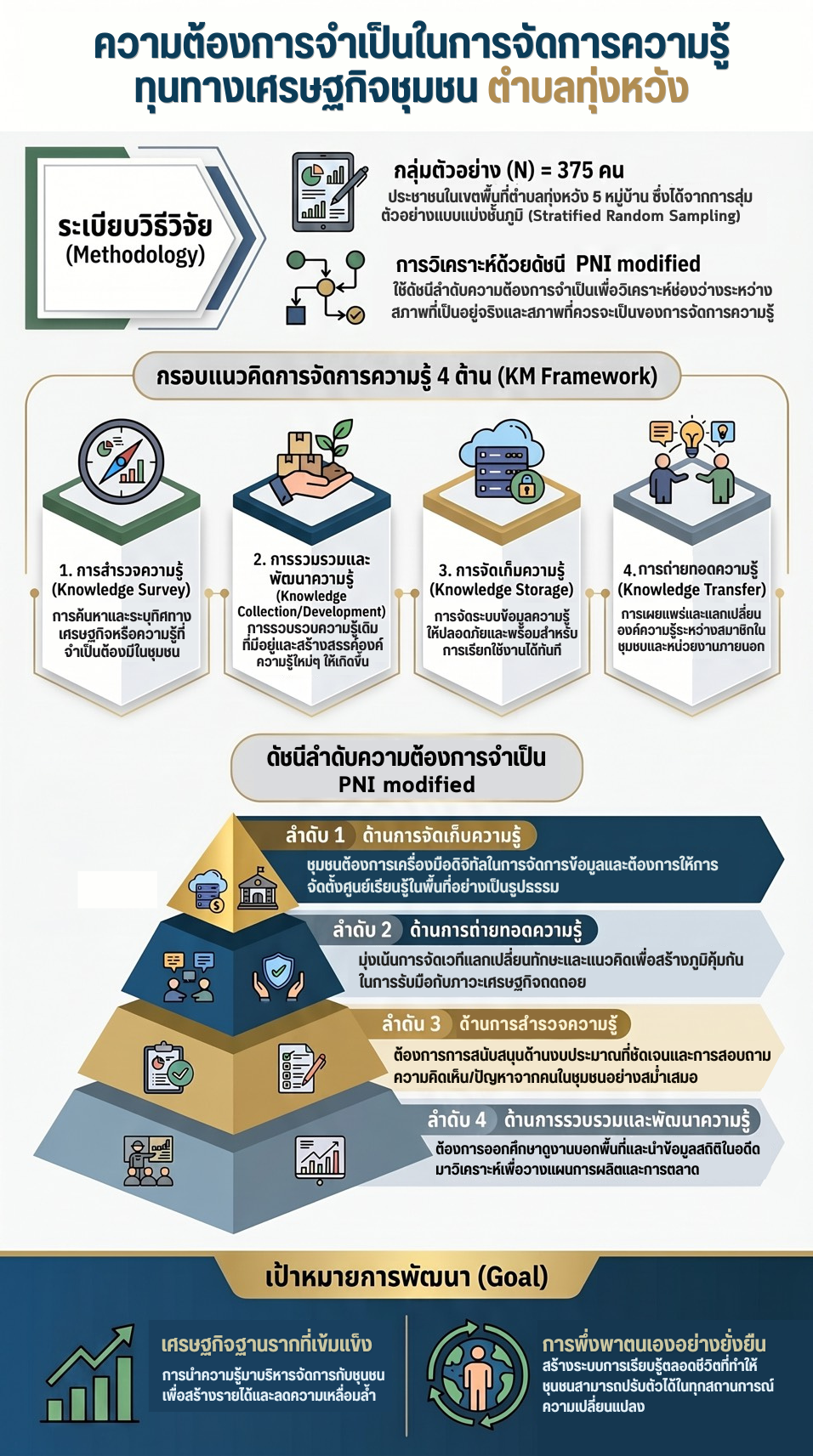
การจัดการความรู้ทุนทางเศรษฐกิจของชุมชนเป็นกลไกสำคัญในการยกระดับศักยภาพและเสริมสร้างเศรษฐกิจฐานรากของชุมชน แต่ยังขาดระบบการจัดการที่สอดคล้องกับบริบทพื้นที่ การวิจัยนี้มีวัตถุประสงค์เพื่อศึกษาความต้องการจำเป็นในการจัดการความรู้ทุนทางเศรษฐกิจของชุมชนตำบลทุ่งหวัง อำเภอเมือง จังหวัดสงขลา โดยใช้ระเบียบวิธีวิจัยเชิงปริมาณ กลุ่มตัวอย่าง จำนวน 375 คน ได้จากการสุ่มแบบแบ่งชั้นภูมิ เครื่องมือที่ใช้ คือ แบบสอบถามประเมินความต้องการจำเป็น มีค่าความเที่ยง 0.91 วิเคราะห์ข้อมูลด้วยค่าเฉลี่ย ค่าส่วนเบี่ยงเบนมาตรฐาน และดัชนีลำดับความต้องการจำเป็น ผลการวิจัยพบว่า การจัดการความรู้ทุนทางเศรษฐกิจของชุมชนมีช่องว่างที่ต้องได้รับการพัฒนาในทุกด้าน ผลการประเมินความต้องการจำเป็นชี้ให้เห็นว่า ด้านการจัดเก็บความรู้ มีความต้องการจำเป็นสูงสุดเนื่องจากยังขาดระบบที่ชัดเจน ประชาชนต้องการพัฒนาทักษะการใช้เครื่องมือดิจิทัลและจัดตั้งศูนย์เรียนรู้ในพื้นที่ รองลงมา คือ ด้านการถ่ายทอดความรู้ ซึ่งชุมชนต้องการเวทีแลกเปลี่ยนแนวคิดและทักษะเพื่อสร้างภูมิคุ้มกันต่อสภาวะเศรษฐกิจถดถอย ขณะที่ด้านการสำรวจความรู้ และด้านการรวบรวมและพัฒนาความรู้ สะท้อนให้เห็นถึงข้อจำกัดด้านงบประมาณสนับสนุนจากภาครัฐ ตลอดจนความต้องการเปิดมุมมองใหม่ ๆ ผ่านการศึกษาดูงานนอกพื้นที่และการนำข้อมูลในอดีตมาวางแผนขับเคลื่อนด้านการผลิตและการตลาด แม้ชุมชนตระหนักถึงคุณค่าของทุนทางเศรษฐกิจที่มีอยู่ แต่ยังขาดกลไกการจัดการที่เป็นระบบ หน่วยงานที่เกี่ยวข้องจึงจำเป็นต้องเร่งสนับสนุนงบประมาณเพื่อพัฒนาระบบจัดเก็บข้อมูลด้วยเทคโนโลยีดิจิทัล ควบคู่กับการส่งเสริมการถ่ายทอดองค์ความรู้อย่างมีส่วนร่วม เพื่อเป็นแนวทางในการยกระดับเศรษฐกิจฐานรากให้พึ่งพาตนเองได้อย่างเป็นรูปธรรม
The management of community economic capital knowledge is a vital mechanism for enhancing potential and strengthening the grassroots economy of communities. However, there remains a lack of management systems that are aligned with local contexts. The objective of this research was to study the needs for community economic capital knowledge management in Thung Wang subdistrict, Mueang district, Songkhla province, A quantitative research method was employed, with a sample of 375 participants selected through stratified random sampling. The research instrument was a needs assessment questionnaire with a reliability coefficient of 0.91. Data were analyzed using mean, standard deviation, and the Modified Priority Needs Index. The results revealed that the community expressed needs for the development of knowledge management because it lacks systematic approaches. The highest priority need was knowledge acquisition, with community members emphasizing the promotion of vocational and technical skills development, as well as the preservation and transmission of local wisdom. The second highest priority was knowledge transfer, where community members highlighted the importance of establishing platforms and opportunities for exchanging ideas, experiences, and skills to strengthen local economy. Regarding knowledge exploration and knowledge collection and development, the findings revealed limitations in government support and funding. Community members also expressed a need to broaden their perspectives through external study visits and to use historical data for planning and improving production and marketing activities. Although the community recognizes the value of its economic capital, it still lacks systematic mechanisms for managing and leveraging these resources. Ultimately, relevant agencies should therefore prioritize funding for the development of digital data management systems while promoting participatory knowledge sharing and transfer. These measures will strengthen the community economy and foster sustainable, self-reliant grassroots economic development.
Downloads
Article Details

This work is licensed under a Creative Commons Attribution-NonCommercial-NoDerivatives 4.0 International License.
References
Arnstein, S. R. (1969). A ladder of citizen participation. Journal of the American Institute of Planners, 35(4), 216–224. https://doi.org/10.1080/01944366908977225
Cortés, J. D., Guix, M., & Carbonell, K. B. (2021). Innovation for sustainability in the Global South: Bibliometric findings from management & business and STEM (science, technology, engineering and mathematics) fields in developing countries. Heliyon, 7(8), Article e07809. https://doi.org/10.1016/j.heliyon.2021.e07809
Emery, M., & Flora, C. (2006). Spiraling-up: Mapping community transformation with community capitals framework. Community Development, 37(1), 19–35. https://doi.org/10.1080/15575330609490152
Erceg, V., & Zoranović, T. (2022). Knowledge management and digital business transformation. Strategic Management, 27(2), 57–63. https://doi.org/10.5937/StraMan2200007E
Kaewla, W. (2020). Process of the community economy development based on social and cultural capitals of Northeastern regions’ communities (กระบวนการพัฒนาเศรษฐกิจของชุมชนบนฐานทุนทางสังคมและวัฒนธรรมของชุมชนในภาคตะวันออกเฉียงเหนือตอนล่าง) [Doctoral dissertation, Mahachulalongkornrajavidyalaya University]. e-Thesis Central Library Mahachulalongkornrajavidyalaya University. https://e-thesis.mcu.ac.th/thesis/603
Kaufman, R., & English, F. W. (1979). Needs assessment: Concept and application. Educational Technology Publications.
Khatasombun, H. (2020). Community potential development to create sustainable economic foundations: Case study of Noen Sala subdistrict, Krok Phra district, Nakhon Sawan province (การพัฒนาศักยภาพของชุมชนเพื่อสร้างเศรษฐกิจฐานรากอย่างยั่งยืน : กรณีศึกษาตำบลเนินศาลา อำเภอโกรกพระ จังหวัดนครสวรรค์). Journal of MCU Peace Studies, 8(2), 473–488.
Mueller, D., Hoard, S., Roemer, K., Sanders, C., & Rijkhoff, S. A. M. (2020). Quantifying the community capitals framework: Strategic application of the community assets and attributes model. Community Development, 51(5), 535–555. https://doi.org/10.1080/15575330.2020.1801785
Ngamcharoen, P. (2024). Social capital and strengthening the community’s foundation economy (ทุนทางสังคมกับการเสริมสร้างความเข้มแข็งของเศรษฐกิจฐานรากของชุมชน). Journal of MCU Peace Studies, 12(2), 473–484.
Office of the National Economic and Social Development Council (NESDC). (2022). The thirteenth national economic and social development plan (2023-2027) (แผนพัฒนาเศรษฐกิจและสังคมแห่งชาติ ฉบับที่ 13 พ.ศ. 2566-2570). Office of the National Economic and Social Development Council, Office of the Prime Minister.
Panich, V. (2012). The way to create learning for students in the 21st century (วิถีสร้างการเรียนรู้เพื่อศิษย์ ในศตวรรษที่ 21). Tathata Publication.
Prasunin, J. (2020). Knowledge management of community capital to support sustainable management of communities in Mae Pao sub-district, Phaya Mengrai district, Chiang Rai province (การจัดการความรู้ทุนชุมชนเพื่อการส่งเสริมการจัดการที่ยั่งยืนของตำบลแม่เปา อำเภอพญาเม็งราย จังหวัดเชียงราย). Humanities & Social Sciences, 37(1), 61–79.
Smith, G., Chowenga, M., & Karsters, J. (2024). Local knowledge matters: Understanding the decision-making processes of communities under climate change in Suriname. Frontiers in Climate, 5, Article 1294271. https://doi.org/10.3389/fclim.2023.1294271
Sripoona, S., Pruksa, S., Rahannok, P., Gubtapol, K., Boonvarichananan, B., & Laobusnanant, P. (2024). Utilizing community capital to promote sustainable development with the BCG model. Educational Administration: Theory and Practice, 30(6), 2294–2301. https://kuey.net/index.php/kuey/article/view/5647/3987
The Bureau of Registration Administration. (2024). Population registration statistics: Population data of Thung Wang subdistrict, Mueang district, Songkhla province, June 2024 (สถิติประชากรทางการทะเบียนราษฎร(รายเดือน) ข้อมูลเดือนมิถุนายน 2567 พื้นที่ตำบลทุ่งหวัง อำเภอเมือง จังหวัดสงขลา). https://stat.bora.dopa.go.th/stat/statnew/statMONTH/statmonth/#/displayData
Wicharn, B. (2007). Knowledge management in action (การจัดการความรู้ สู่ปัญญาปฏิบัติ). Expernet Publishing.
Witinok-Huber, R., Knapp, C. N., Lund, J., Eaton, W., Ewers, B. E., de Figueiredo, A. R., Geerts, B., Gunshenan, C. I., Inouye, M. C., Keller, M. L., Lumadue, N. M., Ryan, C. M., Shuman, B. N., Spoonhunter, T., & Williams, D. G. (2025). Does knowledge co-production influence adaptive capacity?: A framework for evaluation. Environmental Science & Policy, 164, Article 104008. https://doi.org/10.1016/j.envsci.2025.104008
Witkin, B. R., & Altschuld, J. W. (1995). Planning and conducting needs assessments: A practical guide. Sage.
Wongwanich, S. (2015). Needs assessment research (การวิจัยประเมินความต้องการจำเป็น) (3rd ed.). Chulalongkorn University Press.
Yamane, T. (1973). Statistics: An introductory analysis (3rd ed.). Harper & Row.
