
การสื่อสารภาพลักษณ์ของรถไฟนำเที่ยวของการรถไฟแห่งประเทศไทย (รฟท.) ผ่านสื่อออนไลน์ : KIHA183 และ Royal Blossom (Communicating the image of the State Railway of Thailand’s tourist trains through online media: KIHA183 and Royal Blossom)
Article Sidebar
Main Article Content
Abstract
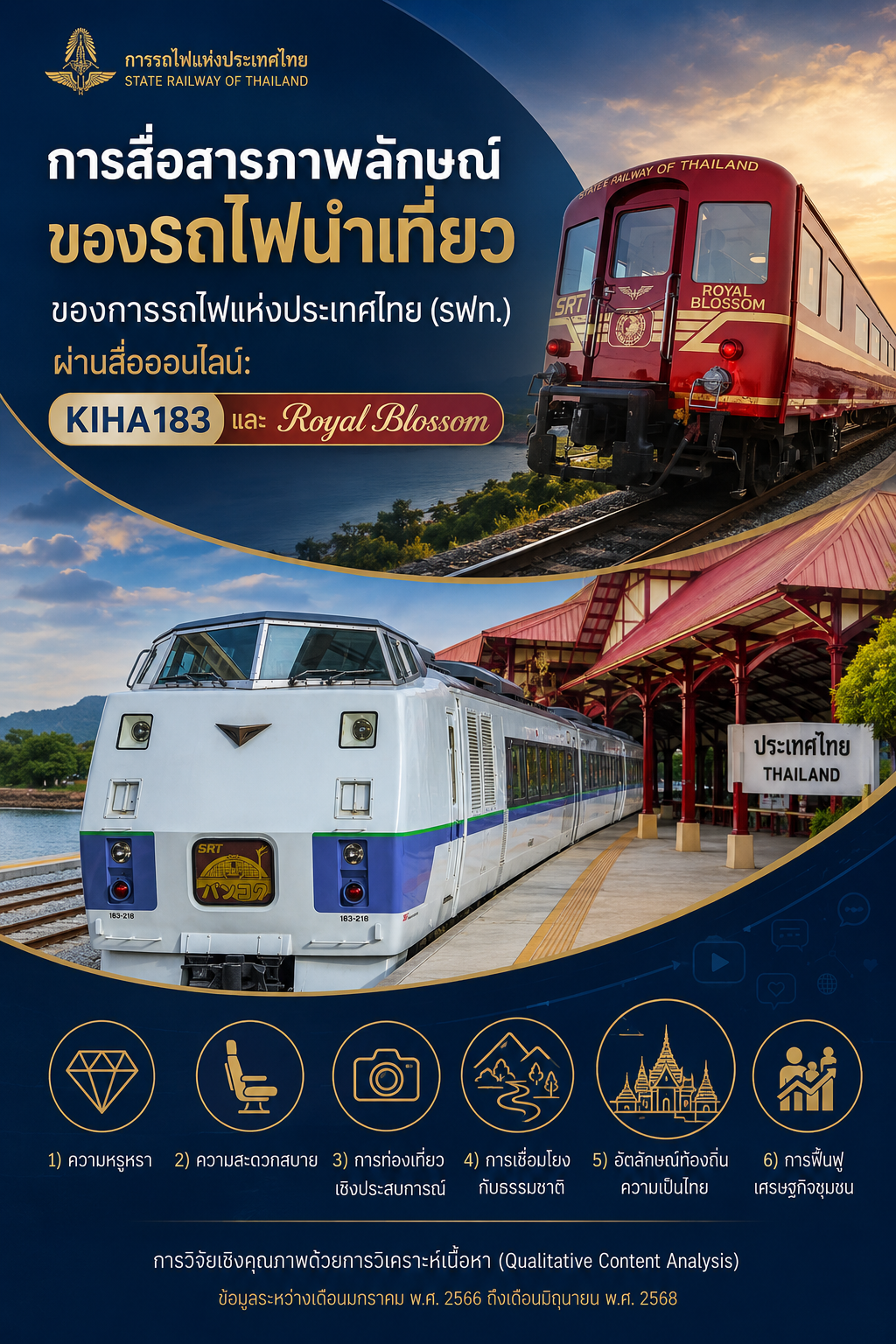
ในบริบทที่การท่องเที่ยวเชิงประสบการณ์และสื่อออนไลน์มีบทบาทสำคัญต่อการรับรู้ของผู้บริโภค งานวิจัยด้านการสื่อสารภาพลักษณ์ของบริการรถไฟนำเที่ยวยังมีอยู่อย่างจำกัด งานวิจัยนี้จึงมุ่งเติมเต็มช่องว่างดังกล่าวในบริบทของการรถไฟแห่งประเทศไทย (รฟท.) การวิจัยมีวัตถุประสงค์เพื่อศึกษาการสื่อสารภาพลักษณ์ของรถไฟนำเที่ยวขบวน KIHA183 และ Royal Blossom ของ รฟท. ผ่านสื่อออนไลน์ โดยมุ่งเน้นวิเคราะห์การนำเสนอภาพลักษณ์ที่ปรากฏในช่องทางต่าง ๆ ทั้งสื่อของหน่วยงานรัฐและสื่ออิสระ อาทิ เพจประชาสัมพันธ์ของ รฟท. เว็บไซต์รีวิวการท่องเที่ยว สื่อข่าวออนไลน์ และช่อง YouTube ที่มีผู้ติดตามจำนวนมาก การวิจัยใช้ระเบียบวิธีวิจัยเชิงคุณภาพ โดยอาศัยการวิเคราะห์เนื้อหา (qualitative content analysis) จากข้อมูลที่รวบรวมในช่วงระหว่างเดือนมกราคม พ.ศ. 2566 ถึงเดือนมิถุนายน พ.ศ. 2568 และวิเคราะห์แบบผสมผสานทั้งเชิงอุปนัยและนิรนัย ผลการศึกษาพบว่า ภาพลักษณ์ของรถไฟนำเที่ยวทั้งสองขบวนถูกถ่ายทอดผ่าน 6 ประเด็นหลัก ได้แก่ 1) ความหรูหรา 2) ความสะดวกสบาย 3) การส่งเสริมการท่องเที่ยวเชิงประสบการณ์ 4) การเชื่อมโยงกับธรรมชาติ 5) อัตลักษณ์ท้องถิ่น/ความเป็นไทย และ 6) การฟื้นฟูเศรษฐกิจชุมชน ข้อค้นพบสามารถนำไปใช้เป็นแนวทางในการพัฒนากลยุทธ์การสื่อสารของ รฟท. และหน่วยงานที่เกี่ยวข้อง เพื่อสร้างภาพลักษณ์ที่ชัดเจน มีเอกลักษณ์และสอดคล้องกับยุทธศาสตร์การท่องเที่ยวของประเทศอย่างมีประสิทธิภาพ
In the context where experiential tourism and online media play an increasingly significant role in shaping consumer perceptions, research on the image communication of tourist train services remains limited. This study therefore seeks to address this research gap within the context of the State Railway of Thailand (SRT). The objective of this research is to examine the image communication of SRT’s KIHA183 and Royal Blossom tourist trains through online media. The study focuses on analyzing how the images of these two train services are presented across various online channels, including official public relations platforms of the SRT, travel review websites, online news media, and YouTube channels with large numbers of followers. This study employs a qualitative research methodology, using qualitative content analysis of data collected between January 2023 and June 2025. The analysis integrates both inductive and deductive approaches. The findings reveal that the images of the two tourist train services are communicated through six key themes: 1) luxury, 2) convenience, 3) promotion of experiential tourism, 4) connection with nature, 5) cultural identity/Thainess, and 6) community revitalization. The findings provide practical implications for the development of communication strategies by the SRT and relevant agencies. These strategies can help strengthen a clear and distinctive image of tourist train services while ensuring alignment with Thailand’s national tourism development strategies.
Downloads
Article Details

This work is licensed under a Creative Commons Attribution-NonCommercial-NoDerivatives 4.0 International License.
References
Entman, R. M. (1993). Framing: Toward clarification of a fractured paradigm. Journal of Communication, 43(4), 51–58. https://doi.org/10.1111/j.1460-2466.1993.tb01304.x
Fan, Y. (2006). Branding the nation: What is being branded? Journal of Vacation Marketing, 12(1), 5–14. https://doi.org/10.1177/1356766706056633
Goffman, E. (1974). Frame analysis: An essay on the organization of experience. Harper & Row.
Kaplanidou, K., & Vogt, C. (2003). Destination branding: Concept and measurement. Michigan State University.
Kiryakova-Dineva, T. (2025). Communicating national identity markers in official tourism commercials: The challenge of overrepresentation. Online Journal of Communication and Media Technologies, 15(3), Article e202527. https://doi.org/10.30935/ojcmt/16805
Konecnik, M., & Gartner, W. C. (2007). Customer-based brand equity for a destination. Annals of Tourism Research, 34(2), 400–421. https://doi.org/10.1016/j.annals.2006.10.005
Lifen, R., Rashid, S. M., & Ahmad, N. (2025). Digital media and tourism destination branding: Promoting Jingxing’s traditional villages. Journal of Information Systems Engineering and Management, 10(36s), 728–738. https://doi.org/10.52783/jisem.v10i36s.6559
Matheus, R., Janssen, M., & Maheshwari, D. (2020). Data science empowering the public: Data-driven dashboards for transparent and accountable decision-making in smart cities. Government Information Quarterly, 37(3), Article 101284. https://doi.org/10.1016/j.giq.2018.01.006
Mutanga, C. N., Masunga, G. S., Kolawole, O. D., Gondo, R., & Mbaiwa, J. E. (2025). Media framing of stakeholders’ perceptions on the sustainability of tourism development at Chobe National Park Riverfront in Botswana: Insights for sustainable tourism planning. Scientific African, 29, Article e02876. https://doi.org/10.1016/j.sciaf.2025.e02876
O’Connor, C., & Joffe, H. (2020). Intercoder reliability in qualitative research: Debates and practical guidelines. International Journal of Qualitative Methods, 19, 1–13. https://doi.org/10.1177/1609406919899220
Pike, S. (2005). Tourism destination branding complexity. Journal of Product & Brand Management, 14(4), 258–259. https://doi.org/10.1108/10610420510609267
Sangpikul, A. (2013). An analysis of tourism and hotel studies in Thailand during the past decade (2000 - 2010) (การวิเคราะห์งานวิจัยด้านการท่องเที่ยวและการโรงแรมของประเทศไทยในรอบทศวรรษ (พ.ศ. 2543 - 2553)). BU Academic Review, 12(1), 113–126. https://so01.tci-thaijo.org/index.php/BUacademicreview/article/view/81039
