การจัดการทรัพยากรกายภาพชุมชนโดยการมีส่วนร่วมในการพัฒนากายภาพพื้นที่สร้างสรรค์ ชุมชนย่านเมืองเก่า จังหวัดเพชรบุรี (Community facility management by participating in the physical development of creative spaces in the old town community, Phetchaburi province)
Article Sidebar
Main Article Content
Abstract
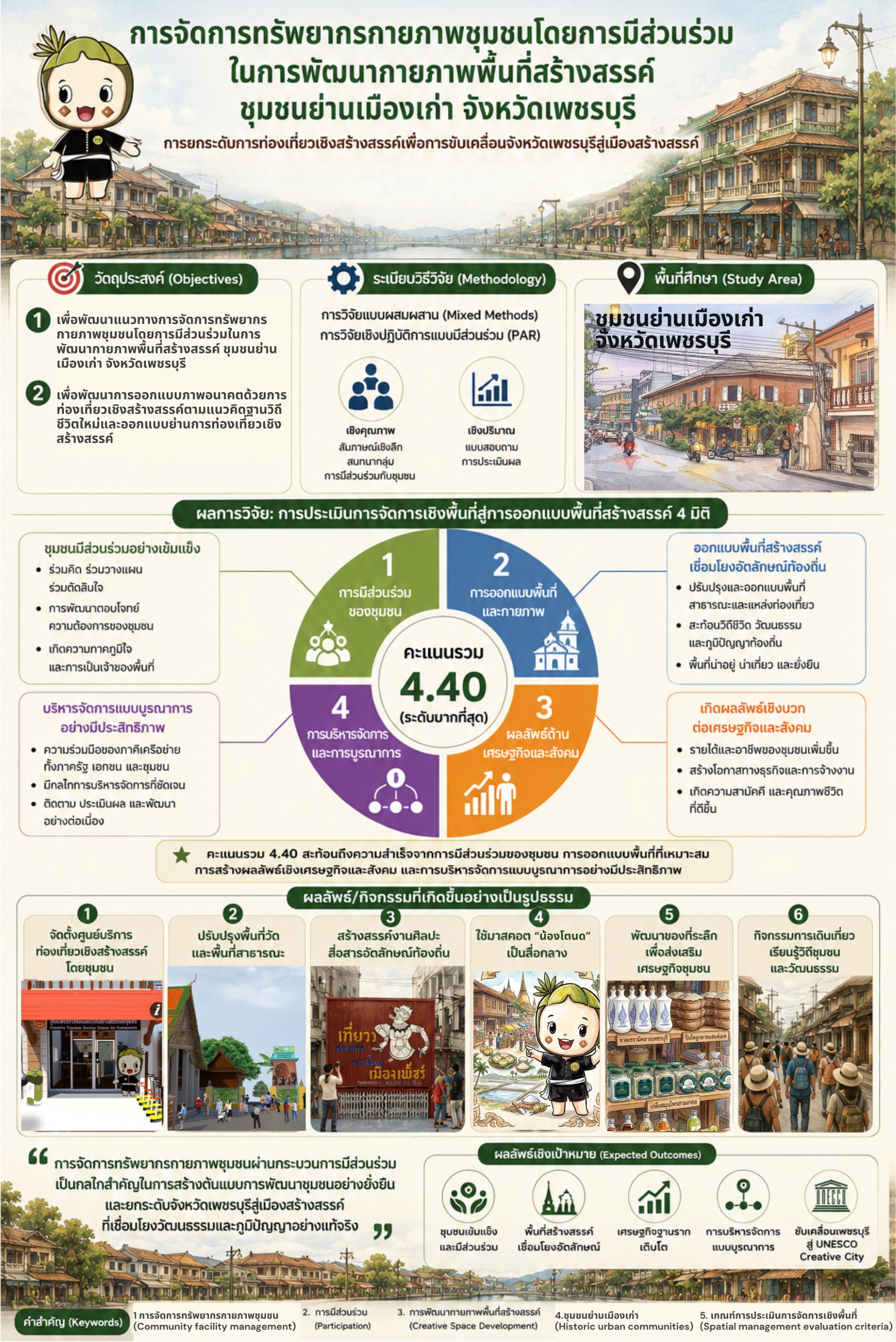
การยกระดับการท่องเที่ยวเชิงสร้างสรรค์เพื่อการขับเคลื่อนจังหวัดเพชรบุรีสู่เมืองสร้างสรรค์ การวิจัยนี้มีวัตถุประสงค์เพื่อพัฒนาแนวทางการจัดการทรัพยากรกายภาพชุมชนโดยการมีส่วนร่วมในย่านเมืองเก่าและออกแบบภาพอนาคตการท่องเที่ยวเชิงสร้างสรรค์ตามแนวคิดฐานวิถีชีวิตใหม่และออกแบบย่านการท่องเที่ยวเชิงสร้างสรรค์ ใช้ระเบียบวิธีวิจัยแบบผสมผสานในลักษณะการวิจัยเชิงปฏิบัติการแบบมีส่วนร่วมทั้งเชิงคุณภาพและเชิงปริมาณ งานวิจัยนี้มีความสำคัญต่อการพัฒนาต้นแบบเพื่อสร้างพื้นที่สร้างสรรค์ที่สะท้อนอัตลักษณ์ท้องถิ่นเชื่อมโยงเศรษฐกิจฐานราก ทั้งยังสนับสนุนการขับเคลื่อนจังหวัดสู่การเป็น UNESCO Creative City ผลการวิจัยพบว่า การมีส่วนร่วมของประชาชนสามารถขับเคลื่อนการพัฒนาพื้นที่เชิงกายภาพที่ตอบสนองต่อความต้องการของชุมชนได้อย่างเป็นรูปธรรม โดยผลการประเมินการจัดการเชิงพื้นที่สู่การออกแบบพื้นที่สร้างสรรค์ใน 4 มิติ ได้แก่ 1) การมีส่วนร่วมของชุมชน 2) การออกแบบพื้นที่และกายภาพ 3) ผลลัพธ์ด้านเศรษฐกิจและสังคม และ 4) การบริหารจัดการและการบูรณาการ โดยได้คะแนนรวม 4.40 สะท้อนถึงความสำเร็จที่เกิดจากความร่วมมือของชุมชน การออกแบบพื้นที่ส่งเสริมผลลัพธ์เชิงเศรษฐกิจ สังคมภายใต้การบริหารจัดการแบบบูรณาการ นอกจากนี้ ชุมชนสามารถพัฒนากิจกรรม พื้นที่ท่องเที่ยวเชิงสร้างสรรค์ได้อย่างเป็นรูปธรรม ได้แก่ การจัดตั้งศูนย์บริการท่องเที่ยวเชิงสร้างสรรค์โดยชุมชน การปรับปรุงพื้นที่วัด การสร้างสรรค์งานศิลปะสื่อสารอัตลักษณ์ท้องถิ่น การใช้มาสคอต “น้องโตนด” เป็นสื่อกลางและการพัฒนาของที่ระลึกเพื่อส่งเสริมเศรษฐกิจชุมชน การจัดการทรัพยากรกายภาพชุมชนผ่านกระบวนการมีส่วนร่วมนี้จึงเป็นกลไกสำคัญในการสร้างต้นแบบการพัฒนาชุมชนอย่างยั่งยืนและยกระดับจังหวัดสู่เมืองสร้างสรรค์ที่เชื่อมโยงวัฒนธรรมภูมิปัญญาอย่างแท้จริง
Elevating creative tourism serves as an initiative to drive Phetchaburi province toward becoming a Creative City. This research aims to develop participatory guidelines for community facility management in the old town area, to design future scenarios for creative tourism based on the New Normal concept, and to design a creative tourism district. Utilizing a mixed-methods design, the study conducts Participatory Action Research (PAR) integrating qualitative and quantitative methodologies. This research contributes to establishing a development model for creative spaces that reflect local identity, thereby linking creative tourism with grassroots economic growth and supporting Phetchaburi’s advancement toward becoming a UNESCO Creative City. The findings reveal that public participation effectively drives physical space development to meet community needs. The evaluation of spatial management for creative space design across four dimensions—1) community participation, 2) spatial and physical design, 3) economic and social outcomes, and 4) management and integration—yielded an overall average score of 4.40. This reflects the project's success stemming from community collaboration and integrated management. Furthermore, the community could successfully implement tangible creative tourism initiatives including establishing a community-based creative tourism service center, revitalizing local temple landscape, creating artworks that communicate local identity, utilizing the “Nong Tanod” mascot as a communication medium, and developing local souvenirs to stimulate the community economy. Ultimately, community facility management through participatory processes serves as a crucial mechanism for building sustainable community development models and elevating the province into a true creative city that bridges tourism with cultural heritage.
Downloads
Article Details

This work is licensed under a Creative Commons Attribution-NonCommercial-NoDerivatives 4.0 International License.
References
Abreu, L. A. D., Walkowski, M. D. C., Perinotto, A. R. C., & Fonseca, J. F. D. (2024). Community-based tourism and best practices with the sustainable development goals. Administrative Sciences, 14(2), Article 36. https://doi.org/10.3390/admsci14020036
Adewunmi, Y. A., Nelson, M., Chigbu, U. E., Makashini-Masiba, L., Mwando, S., Mompati, L., & Kahireke, U. (2023). A scoping review of community-based facilities management for public services through social enterprises in developing communities. Facilities, 41(13–14), 868–889. https://doi.org/10.1108/F-07-2022-0100
Barney, J. (1991). Firm resources and sustained competitive advantage. Journal of Management, 17(1), 99–120. https://doi.org/10.1177/014920639101700108
Boone, H. N., Jr., & Boone, D. A. (2012). Analyzing Likert data. Journal of Extension, 50(2), Article 48. https://doi.org/10.34068/joe.50.02.48
Cloke, P., & Jones, O. (2001). Dwelling, place, and landscape: An orchard in Somerset. Environment and Planning A: Economy and Space, 33(4), 649–666. https://doi.org/10.1068/a3383
Dees, J. G. (1998). The meaning of “social entrepreneurship”. The Kauffman Center for Entrepreneurial Leadership and the Stanford’s Graduate School of Business.
Denzin, N. K. (2017). The research act: A theoretical introduction to sociological methods. Routledge.
Dorosh, O., Dorosh, A., & Tarnopolskyi, A. (2023). Effective resources management in the territorial communities as the key to their development. Land Management, Cadastre and Land Monitoring, 2023(1), 12–21. https://doi.org/10.31548/zemleustriy2023.01.01
Duman, Ü., & Asilsoy, B. (2022). Developing an evidence-based framework of universal design in the context of sustainable urban planning in Northern Nicosia. Sustainability, 14(20), Article 13377. https://doi.org/10.3390/su142013377
Evans, G. (2001). Cultural planning: An urban renaissance? Routledge.
Falah, P. A., Sofianto fian, Saputra, A., Ramadhan, B. S., & Likuwatan, P. (2024). Peran masyarakat lokal dalam pengelolaan sumber daya alam: Studi kasus pertanian berbasis komunitas. Paradigma Mandiri: Jurnal Pengabdian Kepada Masyarakat, 2(02), 94–107. https://doi.org/10.37949/pm22173 [in Indonesian]
Freeman, R. E. (1984). Strategic management: A stakeholder approach. Pitman.
Gulbovaitė, E., Liorančaitė-Šukienė, A., Dabravalskytė-Radzevičė, J., & Radzevičius, M. (2026). Creative tourism in a peripheral rural destination: Latent experiential portfolios and early-stage development. Tourism and Hospitality, 7(4), Article 101. https://doi.org/10.3390/tourhosp7040101
Jensen, P.A. (2021). Facilities management models, methods and tools. Buildings, 11(10), Article 490. https://doi.org/10.3390/buildings11100490
Kelkar, N. P., & Spinelli, G. (2016). Building social capital through creative placemaking. Strategic Design Research Journal, 9(2), 54–66. https://doi.org/10.4013/sdrj.2016.92.01
Kidjawan, N. (2018). Design thinking process: New perspective Thai healthcare system (กระบวนการคิดเชิงออกแบบ : มุมมองใหม่ของระบบสุขภาพไทย). Thai Journal of Nursing Council, 33(1), 5–14.
Kim, M. J., Cho, M. E., & Chae, H. H. (2014). A smart community for placemaking in housing complexes. Journal of Asian Architecture and Building Engineering, 13(3), 539–546. https://doi.org/10.3130/jaabe.13.539
Llewelyn-Davies. (2000). Urban design compendium. English Partnerships and The Housing Corporation.
Macmillan, T. T. (1971, May 3–5). The Delphi technique [Paper presentation]. Annual Meeting of the California Junior Colleges Associations Committee on Research and Development, Monterey, California, United States.
National Strategy B.E. 2561-2580. (2018, October 13). Royal Thai Government Gazette. No. 135 Section 82 A. pp. 1–74.
Normoyle, C., & Christian, C. (2016). A catalyst for change: Understanding characteristics of citizen-driven placemaking endeavors across diverse communities. Design Principles and Practices: An International Journal, 10(1), 41–58. https://doi.org/10.18848/1833-1874/CGP/v10i01/41-58
Office of the National Economic and Social Development Council. (2017). The twelfth national economic and social development plan B.E. 2560-2564 (2017-2021) (แผนพัฒนาเศรษฐกิจและสังคมแห่งชาติ ฉบับที่ 12 พ.ศ. 2560-2564). Office of the National Economic and Social Development Council, Office of the Prime Minister.
Oksanen, K., & Ståhle, P. (2013). Physical environment as a source for innovation: Investigating the attributes of innovative space. Journal of Knowledge Management, 17(6), 815–827. https://doi.org/10.1108/JKM-04-2013-0136
Phetchaburi Provincial Office. (2018). Phetchaburi provincial development plan B.E. 2561-2565 (2018-2022) (revised edition) (แผนพัฒนาจังหวัดเพชรบุรี พ.ศ. 2561-2565 (ฉบับทบทวน)). Strategy and Information for Provincial Development Division, Phetchaburi Provincial Office.
Project for Public Spaces. (2007). What is placemaking. https://www.pps.org/article/what-is-placemaking
Rapoport, A. (1990). The meaning of the built environment: A nonverbal communication approach. The University of Arizona Press.
Richards, G. (2014). Creativity and tourism in the city. Current Issues in Tourism, 17(2), 119–144. https://doi.org/10.1080/13683500.2013.783794
Rosenqvist, T., Goddard, G., Nugent, J., Brown, N., Lemos, E., Ximenes, E., & Santos, A. (2022). Community-based water resource management: Pathway to rural water security in Timor-Leste? In M. J. Currell & B. G. Katz (Eds.), Threats to springs in a changing world: Science and policies for protection (pp. 155–170). John Wiley & Sons.
Sawangchaeng, S., & Chaowarat, P. (2019). Placemaking for development of the bike and walk friendly community (การพัฒนาชุมชนให้เป็นมิตรต่อการเดินและใช้จักรยานโดยการสร้างถิ่นที่). Built Environment Inquiry Journal, 18(3), 37–49. https://doi.org/10.14456/bei.2019.14
Song, S., Yang, Q., & Zou, T. (2026). Sustainable evaluation framework for urban creative space: Exploring a better way for urban development. Sustainability, 18(6), Article 3083. https://doi.org/10.3390/su18063083
Srisa-ard, B. (2011). Introduction to research (การวิจัยเบื้องต้น) (9th ed.). Suweeriyasan.
Steinfeld, E., & Maisel, J. L. (2012). Universal design: Creating inclusive environments. John Wiley & Sons.
Tantoh, H. B., & Simatele, D. (2017). Community-based water resource management in North-west Cameroon: The role of potable water supply in community development. South African Geographical Journal, 99(2), 166–183. https://doi.org/10.1080/03736245.2016.1208589
UNESCO. (2021). Cities, culture, creativity: Leveraging culture and creativity for sustainable urban development and inclusive growth. https://doi.org/10.58337/IIRA3223
Yee, J., Akama, Y., Teerapong, K., & Petrella, V. (2020). Creative and cultural districts in Thailand. British Council.
Yiu, C. Y., & Yau, Y. (2006). An ecological framework for the strategic positioning of a shopping mall. Journal of Retail & Leisure Property, 5(4), 270–280. https://doi.org/10.1057/palgrave.rlp.5100037
