
วงจรชีวิตพื้นที่ท่องเที่ยวและพัฒนาการของการพัฒนาการท่องเที่ยวโดยชุมชน : กรณีศึกษา ชุมชนในพื้นที่ภาคเหนือตอนล่าง ประเทศไทย (The tourist area life cycle and the development of community-based tourism: A case study of local communities in the lower northern region of Thailand)
Article Sidebar
Main Article Content
บทคัดย่อ
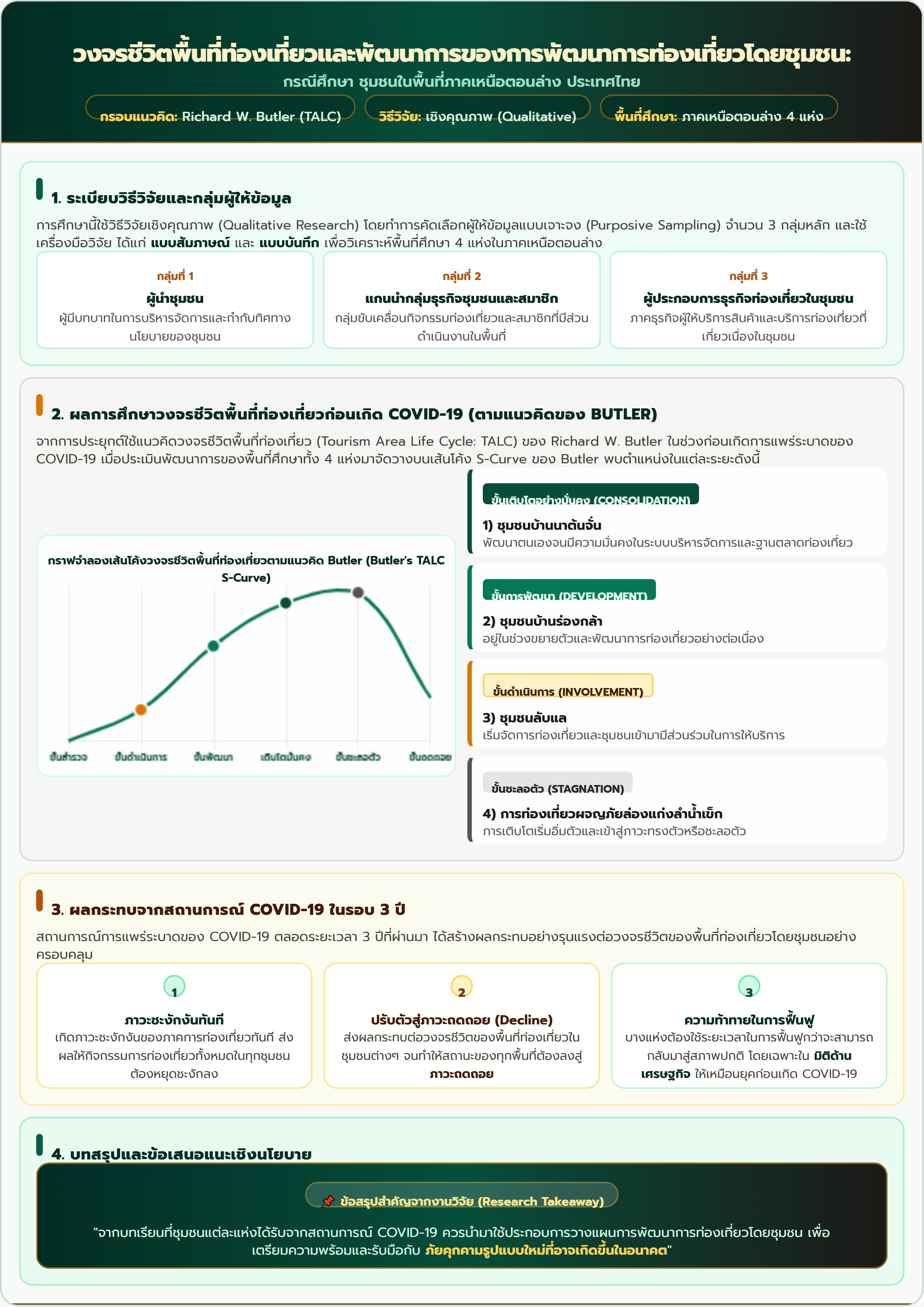
การท่องเที่ยวโดยชุมชน (Community-Based Tourism: CBT) มีบทบาทสำคัญในการพัฒนาเศรษฐกิจฐานรากการสร้างงาน และกระจายรายได้สู่ครัวเรือน อย่างไรก็ตาม การยกระดับสู่การเป็นพื้นที่ CBT ที่ประสบความสำเร็จนั้น ชุมชนต้องเผชิญกับความท้าทายหลายประการ ส่งผลให้บางแห่งสามารถเติบโตได้อย่างมั่นคง ในขณะที่บางแห่งไม่อาจพัฒนาขีดความสามารถของตนเองได้ บทความนี้จึงมีวัตถุประสงค์เพื่อวิเคราะห์พัฒนาการและวงจรชีวิตของพื้นที่ท่องเที่ยวชุมชน โดยใช้แนวคิดวงจรชีวิตแหล่งท่องเที่ยวของ Richard W. Butler เป็นกรอบการศึกษา พื้นที่เป้าหมาย คือ CBT ในภาคเหนือตอนล่าง จำนวน 4 แห่ง ได้แก่ ชุมชนบ้านนาต้นจั่น ชุมชนบ้านใหม่ร่องกล้า ชุมชนลับแล และชุมชนลำน้ำเข็ก การศึกษาครั้งนี้ใช้วิธีวิจัยเชิงคุณภาพโดยทำการคัดเลือกผู้ให้ข้อมูลแบบเจาะจง จำนวน 3 กลุ่ม คือ 1) ผู้นำชุมชน 2) แกนนำกลุ่มธุรกิจชุมชนและสมาชิก 3) ผู้ประกอบการธุรกิจท่องเที่ยวในชุมชน เครื่องมือที่ใช้ คือ แบบสัมภาษณ์กึ่งโครงสร้างและแบบบันทึก ผลการศึกษาวงจรชีวิตพื้นที่ท่องเที่ยวก่อนเกิดการแพร่ระบาดของ COVID-19 พบว่า 1) การท่องเที่ยวโดยชุมชนบ้านนาต้นจั่นสามารถพัฒนาตนเองจนอยู่ในขั้นเติบโตอย่างมั่นคง (consolidation) 2) การท่องเที่ยวโดยชุมชนบ้านใหม่ร่องกล้าอยู่ในขั้นการพัฒนา (development) 3) การท่องเที่ยวโดยชุมชนลับแลอยู่ในขั้นดำเนินการ (involvement) และ 4) การท่องเที่ยวเชิงผจญภัยล่องแก่งลำน้ำเข็กมีการเติบโตอยู่ในขั้นชะลอตัว (stagnation) นอกจากนี้ วิกฤตการณ์ COVID-19 ในช่วง 3 ปีที่ผ่านมาได้สร้างภาวะชะงักงันและส่งผลให้วงจรชีวิตพื้นที่ท่องเที่ยวของชุมชนเกิดภาวะถดถอย หลายแห่งต้องอาศัยระยะเวลาในการฟื้นฟูระบบเศรษฐกิจให้กลับสู่สภาวะปกติ ดังนั้น บทเรียนจากสถานการณ์ดังกล่าวจึงควรนำมาประยุกต์ใช้เป็นแนวทางในการวางแผนพัฒนาการท่องเที่ยวโดยชุมชน เพื่อสร้างความพร้อมในการรับมือกับภัยคุกคามรูปแบบใหม่ที่อาจเกิดขึ้นในอนาคต
Community-Based Tourism (CBT) plays a crucial role in grassroots economic development, job creation, and household income distribution. However, elevating a community to a successful CBT destination involves various challenges. Consequently, some communities achieve sustainable growth, while others struggle to develop their full potential. Therefore, this article aims to analyze the development and tourist area life cycle of community-based tourism destinations, utilizing Richard W. Butler’s concept as the analytical framework. The target areas comprise four CBT destinations in the lower northern region of Thailand: Baan Na Ton Chan, Baan Mai Rong Kla, Lablae, and Nam Khek communities. This qualitative research employed a purposive sampling technique to select three groups of key informants: 1) community leaders, 2) leaders and members of community enterprise groups, and 3) community tourism business operators. The research instruments consisted of interview forms and recording forms. The results regarding the tourist area life cycle before the COVID-19 pandemic revealed that: 1) Baan Na Ton Chan community tourism had reached the consolidation stage; 2) Baan Mai Rong Kla community tourism was in the development stage; 3) Lablae community tourism was in the involvement stage; and 4) Nam Khek whitewater rafting adventure tourism had reached the stagnation stage. Furthermore, the COVID-19 crisis over the past three years caused stagnation and led to a decline in the communities’ tourist area life cycle. Many destinations require considerable time to recover economically and return to normal conditions. Therefore, the lessons learned from this study should be applied as guidelines for community-based tourism development planning to ensure
preparedness for potential new threats in the future.
Downloads
Article Details

อนุญาตภายใต้เงื่อนไข Creative Commons Attribution-NonCommercial-NoDerivatives 4.0 International License.
เอกสารอ้างอิง
Butler, R. W. (1980). The concept of a tourist area cycle of evolution: Implications for management of resources. Canadian Geographer, 24(1), 5–12. https://doi.org/10.1111/j.1541- 0064.1980.tb00970.x
Ginanjar, R., & Runingsawitri, H. S. (2023). Community empowerment in tourism development: Concepts and implications. The Eastasouth Management and Business, 1(3), 111–119. https://doi.org/10.58812/esmb.v1i03.82
Habiba, M., & Lina, F. Y. (2023). Community-Based Tourism (CBT): A community development tool. European Journal of Business and Management, 15(17), 1–9. https://doi.org/10.7176/ejbm/15-17-01
Kaosa-ard, M., Phaokhrueang, A., Unthong, A., Phasabut, R., Fongthong, S., Suriyanrattakorn, S., & Pampasit, R. (2019). Tourist behaviors and economic/social benefits for tourism - related communities (Research report) (พฤติกรรมนักท่องเที่ยวและผลประโยชน์ทางเศรษฐกิจและสังคมของการท่องเที่ยวเพื่อชุมชน) (รายงานการวิจัย). Thailand Science Research and Innovation.
Ministry of Public Health. (2022). Plan and measures for managing the COVID-19 situation towards an endemic disease (แผนและมาตรการการบริหารจัดการสถานการณ์โรคโควิด 19 สู่โรคประจำถิ่น). Strategy and Planning Division, Office of the Permanent Secretary, Ministry of Public Health. https://dmsic.moph.go.th/index/detail/8962
Ministry of Tourism and Sports. (2017a). Tourism economic report No. 7 January-March 2017 (รายงานสภาวะเศรษฐกิจการท่องเที่ยว ฉบับที่ 7 มกราคม-มีนาคม 2560). Office of the Permanent Secretary, Ministry of Tourism and Sports.
Ministry of Tourism and Sports. (2017b). Tourism statistics 2017 (สถิติด้านการท่องเที่ยว ปี 2560). https://www.mots.go.th/news/category/414
Ministry of Tourism and Sports. (2019). Tourism economic report Q3/2019 (รายงานภาวะเศรษฐกิจการท่องเที่ยว ไตรมาส 3/2562). http://www.mots.go.th/download/TourismEconomicReport/3PresentationTourismEconomic.pdf
Murphy, P. E. (1988). Community driven tourism planning. Tourism Management, 9(2), 96–104. https://doi.org/10.1016/0261-5177(88)90019-2
Murphy, P. E. (2013). Tourism: A community approach (RLE Tourism). Routledge. https://doi.org/10.4324/9780203068533
Namwong, S. (2015). The development of community based tourism plan Bannatonchan, Si Satchanalai district, Sukhothai province (การพัฒนาแผนการท่องเที่ยวโดยชุมชน บ้านนาต้นจั่น อำเภอศรีสัชนาลัย จังหวัดสุโขทัย) [Master’s thesis, Naresuan University]. NU Intellectual Repository. https://shorturl.asia/ULI4w
Office of the National Economic and Social Development Council. (2026, May 29). National Income of Thailand 2024 (รายได้ประชาชาติของประเทศไทย พ.ศ. 2567). https://www.nesdc.go.th/info/thailands-national-income/
Pampasit, R. (2009). Sustainability and the social carrying capacity of adventure tourism: The case study of rafting tourism at Keg River, Phitsanulok (ความยั่งยืนและความสามารถในการรองรับทางสังคมของการท่องเที่ยวเชิงผจญภัย : กรณีศึกษา การท่องเที่ยวล่องแก่งลำน้ำเข็ก จังหวัดพิษณุโลก) [Doctoral dissertation, Naresuan University]. NU Intellectual Repository. https://shorturl.asia/yAqQK
Pampasit, R. (2019). Tourist behaviors and economic/social benefits for tourism - related communities: Case study lower north (Research report) (พฤติกรรมนักท่องเที่ยวและผลประโยชน์ทางเศรษฐกิจและสังคมของการท่องเที่ยวชุมชน : กรณีศึกษา ภาคเหนือตอนล่าง) (รายงานการวิจัย). Thailand Science Research and Innovation.
Pampasit, R. (2022). Community-based tourism and community economic development: The case of the lower northern region, Thailand. Journal of Community Development Research (Humanities and Social Sciences), 15(4), 110–124. https://doi.org/10.14456/jcdr-hs.2022.39
Pampasit, R. (2026). Community-based tourism development: A case study of Ban Na Ton Chan, Ban Tuek subdistrict, Si Satchanalai district, Sukhothai province (การพัฒนาการท่องเที่ยวโดยชุมชน: กรณีศึกษาบ้านนาต้นจั่น ตำบลบ้านตึก อำเภอศรีสัชนาลัย จังหวัดสุโขทัย). In C. Samnieng (Ed.), Dawn of happiness: History, economy, society, and politics of northern towns (อรุณรุ่งแห่งความสุขประวัติศาสตร์ เศรษฐกิจ สังคม และการเมืองหัวเมืองฝ่ายเหนือ) (pp. 213–246). Naresuan University Press.
Phromkham, T. (2022). Community-based tourism management based on the collaborative management concept: A case study of Phu Hin Rong Kla national park and Ban Rong Kla community, Nakhon Thai district, Phitsanulok province (การจัดการการท่องเที่ยวโดยชุมชนภายใต้แนวคิดการจัดการแบบร่วมมือกัน กรณีศึกษา อุทยานแห่งชาติภูหินร่องกล้าและชุมชนบ้านร่องกล้า อำเภอนครไทย จังหวัดพิษณุโลก) [Doctoral dissertation, Naresuan University]. NU Intellectual Repository. http://nuir.lib.nu.ac.th/dspace/handle/123456789/5376
Phromkham, T., Pampasit, R., Boonwanno, T., & Rattanaprathum, N. (2022). Development of community-based tourism under the tourism area life cycle concept of Richard W. Butler on national park area: A case study of Ban Rong Kla community, Nakhon Thai district, Phitsanulok province (พัฒนาการท่องเที่ยวโดยชุมชนภายใต้แนวคิดวงจรชีวิตพื้นที่ท่องเที่ยวของ Richard W. Butler ในพื้นที่อุทยานแห่งชาติ กรณีศึกษา: ชุมชนบ้านร่องกล้า อำเภอนครไทย จังหวัดพิษณุโลก). Nakhon Ratchasima Rajabhat University Community Research Journal, 16(4), 123–136. https://doi.org/10.14456/nrru-rdi.2022.70
Promprasit, W. (2022). The key success factors of community-based tourism development: A case study of Baan Na Ton Chan, Bantuek Sub-district, Srichatchanalai district, Sukhothai province (ปัจจัยความสำเร็จของการพัฒนาการท่องเที่ยวโดยชุมชน: กรณีศึกษาบ้านนาต้นจั่น ตำบลบ้านตึก อำเภอศรีสัชนาลัย จังหวัดสุโขทัย) [Master’s thesis, Naresuan University]. NU Intellectual Repository. http://nuir.lib.nu.ac.th/dspace/handle/123456789/5883
Rojrungsat, P. (2010). Community-based tourism (การท่องเที่ยวชุมชน). Odeon Store.
Sriwilai, S., & Thongsri, R. (2021). The effects of the spread of Covid-19 pandemic on Thai tourism (การแพร่ระบาดของโควิด-19 ส่งผลต่อการท่องเที่ยวของประเทศไทย). Journal of Legal Entity Management and Local Innovation, 7(8), 405–416.
Sutresna, I. B., Suyana, U. I. M., Saskara, I. A. N., & Wiwin, S. N. P. (2019). Community based tourism as sustainable tourism support. Russian Journal of Agricultural and Socio-Economic Sciences, 94(10), 70–78. https://doi.org/10.18551/rjoas.2019-10.09
United Nations World Tourism Organization (UNWTO). (2014). UNWTO tourism highlights, 2014 edition. https://www.e-unwto.org/doi/book/10.18111/9789284416226
United Nations World Tourism Organization (UNWTO). (2018). UNWTO tourism highlights, 2018 edition. https://www.e-unwto.org/doi/pdf/10.18111/9789284419876
United Nations World Tourism Organization (UNWTO). (2020). UNWTO world tourism barometer. https://www.unwto.org/unwto-world-tourism-barometer-data
