
ความหลากหลายทางเพศและความเป็นอิสระของคณะกรรมการบริษัทกับผลการดำเนินงานของบริษัทจดทะเบียนในตลาดหลักทรัพย์แห่งประเทศไทย (Board gender diversity and firm performance of listed companies)
Article Sidebar
Main Article Content
บทคัดย่อ
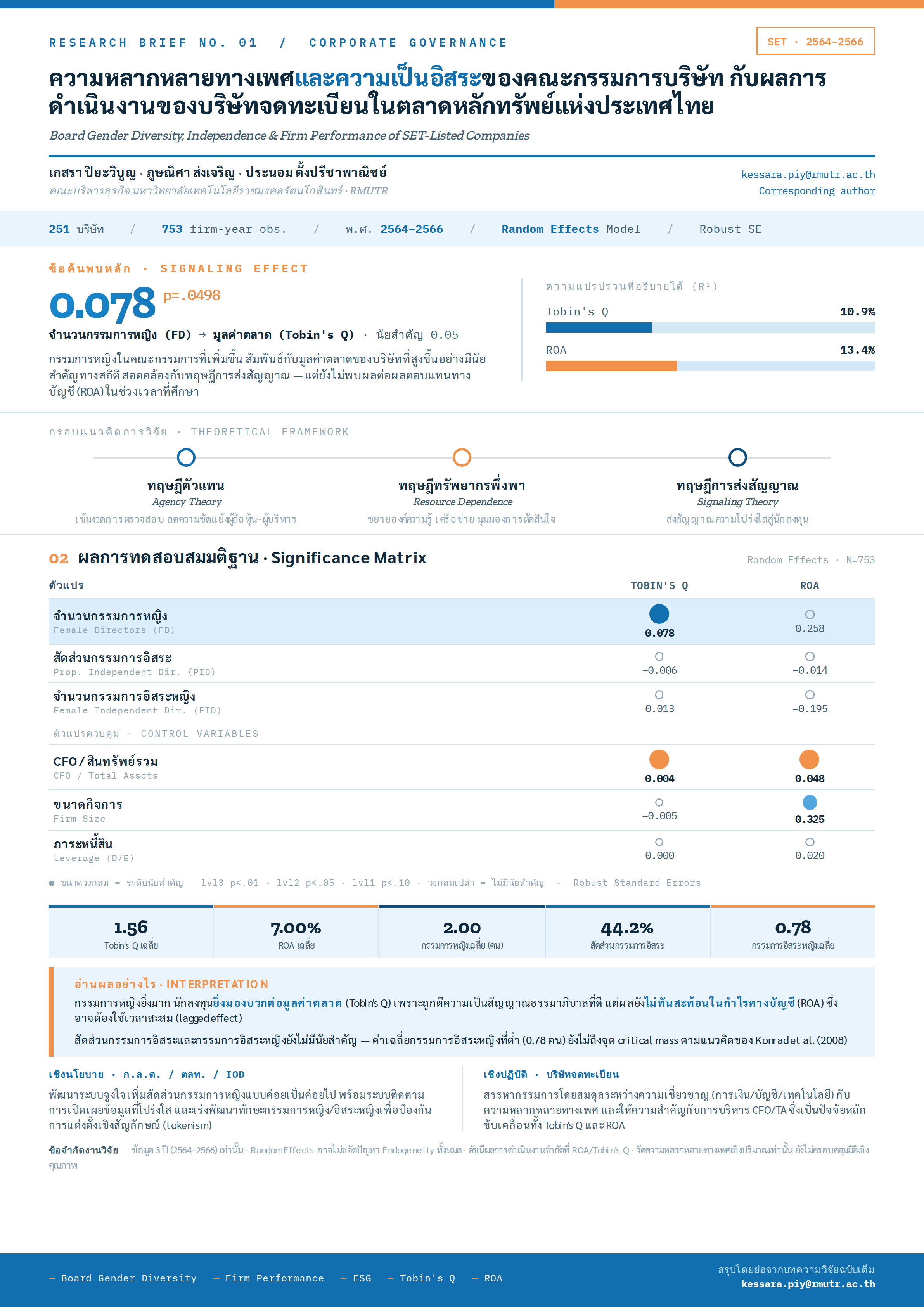
การขับเคลื่อนนโยบายด้านสิ่งแวดล้อม สังคม และการกำกับดูแลกิจการ (ESG) ทำให้ความหลากหลายทางเพศและความเป็นอิสระของคณะกรรมการเป็นกลไกสำคัญในการยกระดับธรรมาภิบาลและความยั่งยืน งานวิจัยนี้จึงมุ่งศึกษาอิทธิพลของความหลากหลายทางเพศและความเป็นอิสระของคณะกรรมการต่อผลการดำเนินงานของบริษัทจดทะเบียนในตลาดหลักทรัพย์แห่งประเทศไทย โดยใช้ข้อมูลทุติยภูมิจากบริษัทจดทะเบียน จำนวน 251 แห่ง (รวม 753 กรณีสังเกต) ระหว่างปี พ.ศ. 2564-2566 และวิเคราะห์ด้วยแบบจำลองผลกระทบแบบสุ่ม โดยทดสอบอิทธิพลขององค์ประกอบคณะกรรมการ 3 ด้าน ได้แก่ จำนวนกรรมการหญิง สัดส่วนกรรมการอิสระ และจำนวนกรรมการอิสระหญิง ต่อผลการดำเนินงานที่วัดด้วยมูลค่าตลาด (Tobin’s Q) และผลการดำเนินงานทางบัญชี (ROA) ผลการศึกษาพบว่า จำนวนกรรมการหญิงมีอิทธิพลเชิงบวกต่อ Tobin’s Q อย่างมีนัยสำคัญทางสถิติที่ระดับ 0.05 (b = 0.078, p = 0.0498) แต่ไม่พบอิทธิพลอย่างมีนัยสำคัญต่อ ROA สำหรับองค์ประกอบด้านการกำกับดูแลอื่น ๆ ไม่พบอิทธิพลที่มีนัยสำคัญทางสถิติเช่นกัน อย่างไรก็ตาม ตัวแปรควบคุมสำคัญ คือ อัตราส่วนกระแสเงินสดจากการดำเนินงานต่อสินทรัพย์รวม (CFO/TA) มีอิทธิพลเชิงบวกต่อทั้ง Tobin’s Q และ ROA อย่างมีนัยสำคัญทางสถิติในระดับสูง นอกจากนี้ ขนาดกิจการยังมีอิทธิพลเชิงบวกต่อ ROA อย่างมีนัยสำคัญทางสถิติที่ระดับ 0.10 ทั้งนี้ แบบจำลองสามารถอธิบายความผันผวนของ Tobin’s Q และ ROA ได้ร้อยละ 10.90 และ 13.42 ตามลำดับผลการศึกษานี้สอดคล้องกับทฤษฎีการส่งสัญญาณที่ชี้ว่า ความหลากหลายทางเพศของคณะกรรมการทำหน้าที่ส่งสัญญาณเชิงบวก เพื่อยกระดับความโปร่งใสและความน่าเชื่อถือในสายตาของนักลงทุน อันนำไปสู่การสร้างมูลค่าตลาดของกิจการ งานวิจัยนี้จึงสนับสนุนแนวนโยบายของสำนักงานคณะกรรมการกำกับหลักทรัพย์และตลาดหลักทรัพย์ ที่มุ่งส่งเสริมธรรมาภิบาลและความยั่งยืนในตลาดทุนไทย
The implementation of Environmental, Social, and Governance (ESG) policies has made board gender diversity and independence essential for enhancing corporate governance and sustainability. This research examines their influence on the performance of companies listed on the Stock Exchange of Thailand. Using secondary data from 251 firms (753 observations) collected from 2021 to 2023 and a random effects model, this study analyzes how the number of female directors, the proportion of independent directors, and the number of female independent directors impact market performance (Tobin’s Q) and accounting performance (ROA). The results reveal that the number of female directors has a significant positive influence on Tobin’s Q at the 0.05 level (b = 0.078,
p = 0.0498), whereas no significant influence is observed on ROA. Furthermore, other corporate governance attributes do not demonstrate statistically significant effects. Notably, the control variable, cash flow from operations to total assets (CFO/TA), exerts a strong positive influence on both Tobin’s Q and ROA. Additionally, firm size has a significant positive impact on ROA at the 0.10 level. The models explain 10.90% and 13.42% of the variance in Tobin’s Q and ROA, respectively. These findings are consistent with signaling theory, suggesting that board gender diversity serves as a positive signal that enhances transparency and credibility in the eyes of investors, thereby contributing to the creation of market value for firms. Consequently, this study supports the policy initiatives of the Securities and Exchange Commission (SEC) of Thailand, which aim to foster robust corporate governance and sustainable development within the Thai capital market.
Downloads
Article Details

อนุญาตภายใต้เงื่อนไข Creative Commons Attribution-NonCommercial-NoDerivatives 4.0 International License.
เอกสารอ้างอิง
Adams, R. B., & Ferreira, D. (2009). Women in the boardroom and their impact on governance and performance. Journal of Financial Economics, 94(2), 291–309. https://doi.org/10.1016/j.jfineco.2008.10.007
Bernile, G., Bhagwat, V., & Yonker, S. (2018). Board diversity, firm risk, and corporate policies. Journal of Financial Economics, 127(3), 588–612. https://doi.org/10.1016/j.jfineco.2017.12.009
Breusch, T. S., & Pagan, A. R. (1980). The Lagrange multiplier test and its applications to model specification in econometrics. The Review of Economic Studies, 47(1), 239–253. https://doi.org/10.2307/2297111
Brigham, E. F., & Houston, J. F. (2019). Fundamentals of financial management (15th ed.). Cengage Learning.
Carter, D. A., D’Souza, F., Simkins, B. J., & Simpson, W. G. (2010). The gender and ethnic diversity of US boards and board committees and firm financial performance. Corporate Governance: An International Review, 18(5), 396–414. https://doi.org/10.1111/j.1467-8683.2010.00809.x
Chung, K. H., & Pruitt, S. W. (1994). A simple approximation of Tobin’s q. Financial Management, 23(3), 70–74.
Connelly, B. L., Certo, S. T., Ireland, R. D., & Reutzel, C. R. (2011). Signaling theory: A review and assessment. Journal of Management, 37(1), 39–67. https://doi.org/10.1177/0149206310388419
Fama, E. F., & Jensen, M. C. (1983). Separation of ownership and control. Journal of Law and Economics, 26(2), 301–325. https://doi.org/10.1086/467037
Greene, W. H. (2020). Econometric analysis (8th ed.). Pearson.
Hair, J. F., Jr., Black, W. C., Babin, B. J., & Anderson, R. E. (2019). Multivariate data analysis (8th ed.). Cengage Learning.
Hausman, J. A. (1978). Specification tests in econometrics. Econometrica, 46(6), 1251–1271. https://doi.org/10.2307/1913827
Jensen, M. C., & Meckling, W. H. (1976). Theory of the firm: Managerial behavior, agency costs and ownership structure. Journal of Financial Economics, 3(4), 305–360. https://doi.org/10.1016/0304-405X(76)90026-X
Kline, R. B. (2011). Principles and practice of structural equation modeling (3rd ed.). Guilford Press.
Konrad, A. M., Kramer, V., & Erkut, S. (2008). Critical mass: The impact of three or more women on corporate boards. Organizational Dynamics, 37(2), 145–164. https://doi.org/10.1016/j.orgdyn.2008.02.005
Rungdetthanalai, T., & Phakdee, A. (2019). Board composition firm characteristics and earnings management of Thai listed companies (องค์ประกอบคณะกรรมการ ลักษณะกิจการ และการจัดการกำไร ของบริษัทจดทะเบียนในตลาดหลักทรัพย์แห่งประเทศไทย). VRU Research and Development Journal Humanities and Social Science, 14(1), 63–72.
Spence, M. (1973). Job market signaling. The Quarterly Journal of Economics, 87(3), 355–374. https://doi.org/10.2307/1882010
Terjesen, S., Couto, E. B., & Francisco, P. M. (2016). Does the presence of independent and female directors impact firm performance? A multi-country study of board diversity. Journal of Management & Governance, 20(3), 447–483. https://doi.org/10.1007/s10997-014-9307-8
The Securities and Exchange Commission, Thailand. (n.d.). Recommendations on gender diversity in the board of directors under principle 3: Strengthening board effectiveness of the corporate governance code for listed companies 2017 (คำแนะนำประเด็นความหลากหลายทางเพศ (gender diversity) ของคณะกรรมการ สำหรับหลักปฏิบัติ 3 เสริมสร้างคณะกรรมการที่มีประสิทธิผล ของหลักการกำกับดูแลกิจการที่ดี สำหรับบริษัทจดทะเบียน ปี 2560). https://www.sec.or.th/TH/Documents/GenderCorner/Guidance%20on%20Gender%20Diversity%20on%20Boards.pdf
The Securities and Exchange Commission, Thailand. (2017). Corporate governance code for listed companies 2017 (หลักการกำกับดูแลกิจการที่ดี สำหรับบริษัทจดทะเบียน ปี 2560). https://www.sec.or.th/cgthailand/TH/Documents/Regulation/CGCode.pdf
Tukey, J. W. (1977). Exploratory data analysis. Addison-Wesley.
Wooldridge, J. M. (2010). Econometric analysis of cross section and panel data (2nd ed.). MIT Press.
