
แบบจำลองความชอบและคุณลักษณะของลูกชิ้นเต้าหู้ไก่ที่พึงประสงค์ของผู้บริโภค ในจังหวัดชลบุรี : การประยุกต์ใช้การวิเคราะห์องค์ประกอบร่วม (A consumer preference model and desirable attributes of chicken tofu meatballs in Chonburi province: An application of conjoint analysis)
Article Sidebar
Main Article Content
บทคัดย่อ
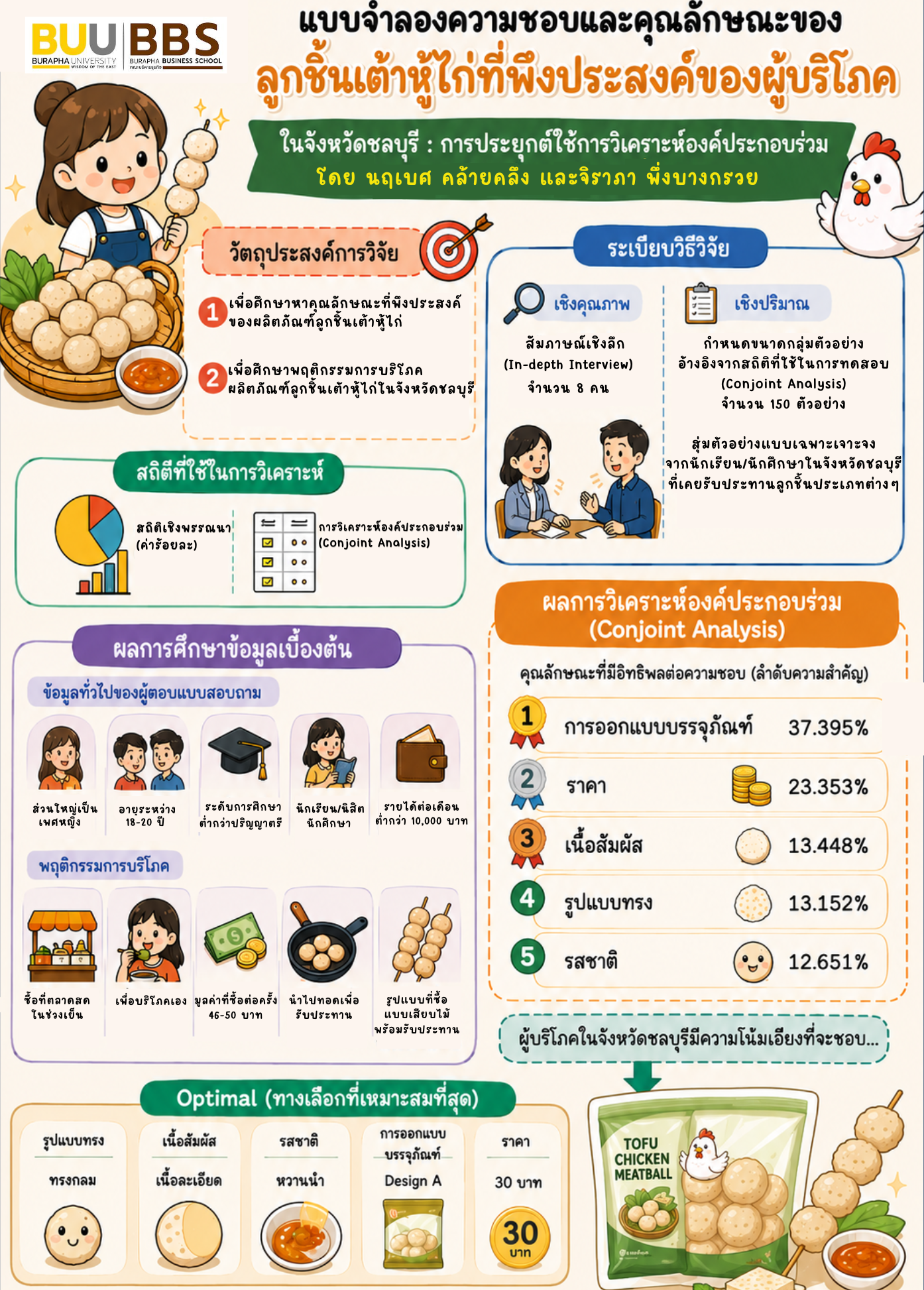
การเข้าใจคุณลักษณะเชิงอรรถประโยชน์และพฤติกรรมการบริโภคในเชิงลึกมีความสำคัญอย่างยิ่งต่อการพัฒนาผลิตภัณฑ์และการวางกลยุทธ์การตลาดเชิงพาณิชย์ การวิจัยนี้มีวัตถุประสงค์เพื่อศึกษาหาคุณลักษณะที่พึงประสงค์ของผลิตภัณฑ์ลูกชิ้นเต้าหู้ไก่ และศึกษาพฤติกรรมการบริโภคผลิตภัณฑ์ลูกชิ้นเต้าหู้ไก่ในจังหวัดชลบุรี เป็นงานวิจัยแบบผสม 2 ขั้นตอน ได้แก่ ขั้นตอนการวิจัยเชิงคุณภาพ ใช้เทคนิคการสัมภาษณ์เชิงลึก จำนวน 8 คน และขั้นตอนการวิจัยเชิงปริมาณ ทำการกำหนดขนาดของกลุ่มตัวอย่างโดยอ้างอิงจากสถิติที่ใช้ในการทดสอบ ได้แก่ การวิเคราะห์องค์ประกอบร่วม จำนวน 150 ตัวอย่าง สุ่มตัวอย่างแบบเฉพาะเจาะจงจากนักเรียน/นักศึกษาที่เคยรับประทานผลิตภัณฑ์ลูกชิ้นประเภทต่าง ๆในจังหวัดชลบุรี วิเคราะห์ข้อมูลด้วยสถิติเชิงพรรณนา ได้แก่ ค่าร้อยละ ทำการวิเคราะห์แบบจำลองความชอบในคุณลักษณะที่พึงประสงค์ด้วยการวิเคราะห์องค์ประกอบร่วม ผลการศึกษาข้อมูลทั่วไป พบว่า ผู้ตอบแบบสอบถามส่วนใหญ่เป็นเพศหญิง มีอายุระหว่าง 18-20 ปี การศึกษาระดับต่ำกว่าปริญญาตรี เป็นนักเรียน/นิสิต/นักศึกษา รายได้ต่ำกว่า 10,000 บาท นอกจากนี้ มีพฤติกรรมการซื้อที่ตลาดสดในช่วงเย็นเพื่อบริโภคเอง โดยมูลค่าที่ซื้อต่อครั้ง 46-50 บาท โดยจะนำไปทอดเพื่อรับประทาน รูปแบบของลูกชิ้นที่ซื้อจะเป็นแบบเสียบไม้พร้อมรับประทาน ผลการวิเคราะห์คุณลักษณะที่พึงประสงค์ พบว่า คุณลักษณะที่ผู้บริโภคให้ความสำคัญมากที่สุด ได้แก่ การออกแบบบรรจุภัณฑ์ นอกจากนี้ ผู้บริโภคในจังหวัดชลบุรี มีความโน้มเอียงที่จะชอบรูปแบบทรงกลม เนื้อละเอียด มีรสชาติหวานนำ มีการออกแบบบรรจุภัณฑ์แบบ Design A และจำหน่ายในราคา 30 บาท ข้อค้นพบที่ได้จากการวิจัยนี้สามารถนำไปใช้เป็นแนวทางสำหรับผู้ประกอบการในการวางกลยุทธ์การพัฒนาผลิตภัณฑ์ลูกชิ้นเต้าหู้ไก่ที่สามารถตอบสนองความต้องการและพฤติกรรมการบริโภคของกลุ่มผู้บริโภคเป้าหมายได้อย่างมีประสิทธิภาพ
The understanding of product utilitarian attributes and consumer behavior is crucial for product development and commercial marketing strategies. This research aims to examine the desirable characteristics and consumption behavior of chicken tofu meatballs in Chonburi province. This study employed a two-phase mixed-methods design. The qualitative phase involved in-depth interviews with eight participants. In the qualitative phase, conjoint analysis was used to determine the sample size, resulting a sample of 150 participants. Purposive sampling was used to select students in Chonburi province who had prior experience consuming various types of meatballs. Data were analyzed using descriptive statistics, including percentages, while conjoint analysis was employed to develop a preference model for the desirable attributes. The demographic analysis revealed that the majority of respondents were female, aged between 18 and 20 years, had an education level below a bachelor’s degree, were currently students, and earned a monthly income of less than THB 10,000. Regarding consumption behavior, most respondents purchased meatballs from fresh markets in the evening for personal consumption, spending an average of THB 46-50 per purchase. The respondents typically fried the meatballs before consumption and purchased them in a ready-to-eat skewers. The analysis of desirable attributes revealed that packaging design was the most important attribute influencing consumer choice. Specifically, consumers in Chonburi province exhibited a preference for chicken tofu meatballs that were round in shape, had a fine texture with predominantly sweet flavor, featured packaging Design A, and were priced at THB 30. The findings of this study can serve as a guideline for entrepreneurs in developing chicken tofu meatballs that effectively meet the needs and consumption behavior of their target consumers.
Downloads
Article Details

อนุญาตภายใต้เงื่อนไข Creative Commons Attribution-NonCommercial-NoDerivatives 4.0 International License.
เอกสารอ้างอิง
Asioli, D., Aschemann-Witzel, J., Caputo, V., Vecchio, R., Annunziata, A., Næs, T., & Varela, P. (2017). Making sense of the ‘‘clean label’’ trends: A review of consumer food choice behavior and discussion of industry implications. Food Research International, 99(Part 1), 58–71. https://doi.org/10.1016/j.foodres.2017.07.022
Choksakunsap, Y. (2021). Business plan for the production and distribution of processed food in the category of Happy Meat pork balls (แผนธุรกิจผลิตและจำหน่ายอาหารแปรรูปประเภทลูกชิ้นหมูแฮปปี้ มีท (Happy Meat)) [Master’s thesis, Bangkok University]. DSpace at Bangkok University. http://dspace.bu.ac.th/jspui/handle/123456789/4992
Demirtas, E. A., Anagun, A. S., & Koksal, G. (2009). Determination of optimal product styles by ordinal logistic regression versus conjoint analysis for kitchen faucets. International Journal of Industrial Ergonomics, 39(5), 866–875. https://doi.org/10.1016/j.ergon.2009.06.007
Ekpong, A. (2015). The application of conjoint analysis for developing new food product concepts (การประยุกต์ใช้เทคนิคการวิเคราะห์องค์ประกอบร่วมในการพัฒนาแนวคิดผลิตภัณฑ์อาหารชนิดใหม่). Journal of Science & Technology, Ubon Ratchathani University, 17(3), 71–78.
Hair, J. F., Jr., Black, W. C., Babin, B. J., & Anderson, R. E. (2019). Multivariate data analysis (8th ed.). Cengage Learning.
Hasdeepong, P. (2022). Business plan for flourless pork meatballs filled with dipping sauce under the brand “Sauce Ball” (แผนธุรกิจผลิตภัณฑ์ลูกชิ้นหมูไร้แป้งสอดไส้น้ำจิ้ม ภายใต้แบรนด์ “Sauce Ball”) [Unpublished master’s thesis]. Mahidol University.
Kavinteraphap, C. (2015). Increasing sales in the fish ball business, Teeraparp Company, Samutprakarn province (การเพิ่มยอดขายของธุรกิจลูกชิ้นปลา บริษัทธีรภาพ จังหวัดสมุทรปราการ) [Master’s thesis, Burapha University]. Burapha University Research Information. https://buuir.buu.ac.th/bitstream/1234567890/12729/1/55710290.pdf
Keawploy, S. (2014). The optimization of developed formula for chicken ball mixed with domestic vegetables by design of experiment method (การพัฒนาสูตรที่เหมาะสมสำหรับลูกชิ้นเอ็นไก่ผสมผักพื้นบ้านโดยวิธีการออกแบบการทดลอง). In Proceedings of the 4th Annual Conference on Sustainable Rural Development (การประชุมวิชาการ การพัฒนาชนบทที่ยั่งยืน ครั้งที่ 4) (pp. 357–363). Khon Kaen University. https://cscd.kku.ac.th/database/index/40
Kornboontritos, S. (2023, February 15). Business/Industry trends 2023-2025: Chilled, frozen, and processed chicken industry (แนวโน้มธุรกิจ/อุตสาหกรรม ปี 2566-2568: อุตสาหกรรมไก่แช่เย็นแช่แข็ง และแปรรูป). Krungsri Research. https://www.krungsri.com/th/research/industry/industry-outlook/food-beverage/frozen-processed-chicken/io/io-chilled-frozen-processed-chicken
Lapmak, R. (2025, November 10). Business/Industry trends 2026-2028: Ready-to-eat food industry (แนวโน้มธุรกิจ/อุตสาหกรรมปี 2569-2571: อุตสาหกรรมอาหารพร้อมทาน). Krungsri Research. https://www.krungsri.com/th/research/industry/industry-outlook/food-beverage/ready-to-eat-food/io/ready-to-eat-food-2026-2028
Malhotra, N. K. (2019). Marketing research: An applied orientation (7th ed.). Pearson.
Oppewal, H., & Vriens, M. (2000). Measuring perceived service quality using integrated conjoint experiments. International Journal of Bank Marketing, 18(4), 154–169. https://doi.org/10.1108/02652320010349049
Orme, B. K. (2010). Getting started with conjoint analysis: Strategies for product design and pricing research (2nd ed.). Research Publishers LLC.
Piriyakul, M. (2012). Conjoint analysis [Special issue]. Ramkhamhaeng Journal, 29(2), 252–272. https://share.google/XrBiESG3o0sIeLJIQ
Silayoi, P., & Speece, M. (2007). The importance of packaging attributes: A conjoint analysis approach. European Journal of Marketing, 41(11–12), 1495–1517. https://doi.org/10.1108/03090560710821279
Sirilert, T. (2007). Evaluating the texture of food (การประเมินลักษณะเนื้อสัมผัสในอาหาร). Journal of Food Technology, Siam University, 3(1), 6–13. https://li01.tci-thaijo.org/index.php/JFTSU/article/view/38437
Tongjerm, S. (2008). Pork balls development by using experimental design technique (การพัฒนาผลิตภัณฑ์ลูกชิ้นหมูโดยใช้เทคนิคการออกแบบการทดลอง) [Master’s thesis, Chiang Mai University]. Chiang Mai University Digital Collections. https://cmudc.library.cmu.ac.th/frontend/Info/item/dc:48782
Wangplaicharoensuk, W., Wanchavee, A., Sattabut, T., Phanaworakul, D., Bhoyen, K., Thungphanthong, N., & Thongrit, K. (2023). The consumption behavior of consumers interested in buying mushroom balls mixed with chicken breast (a healthy product) in Bangkok (พฤติกรรมการบริโภคของผู้ที่สนใจซื้อลูกชิ้นเห็ดอกไก่ (ผลิตภัณฑ์เพื่อสุขภาพ) ในกรุงเทพมหานคร). Journal of BSRU-Research and Development Institute, 8(1), 35–49. https://so06.tci-thaijo.org/index.php/rdibsru/article/view/261337
